· reAPI Team
DeepSeek V4.1 Flash vs Claude Opus 5.5: Cost, Benchmarks, and Routing
Compare DeepSeek V4.1 Flash vs Claude Opus 5.5 on pricing, 384K vs 128K output limits, coding benchmarks, MIT open weights, and multi-model API routing.
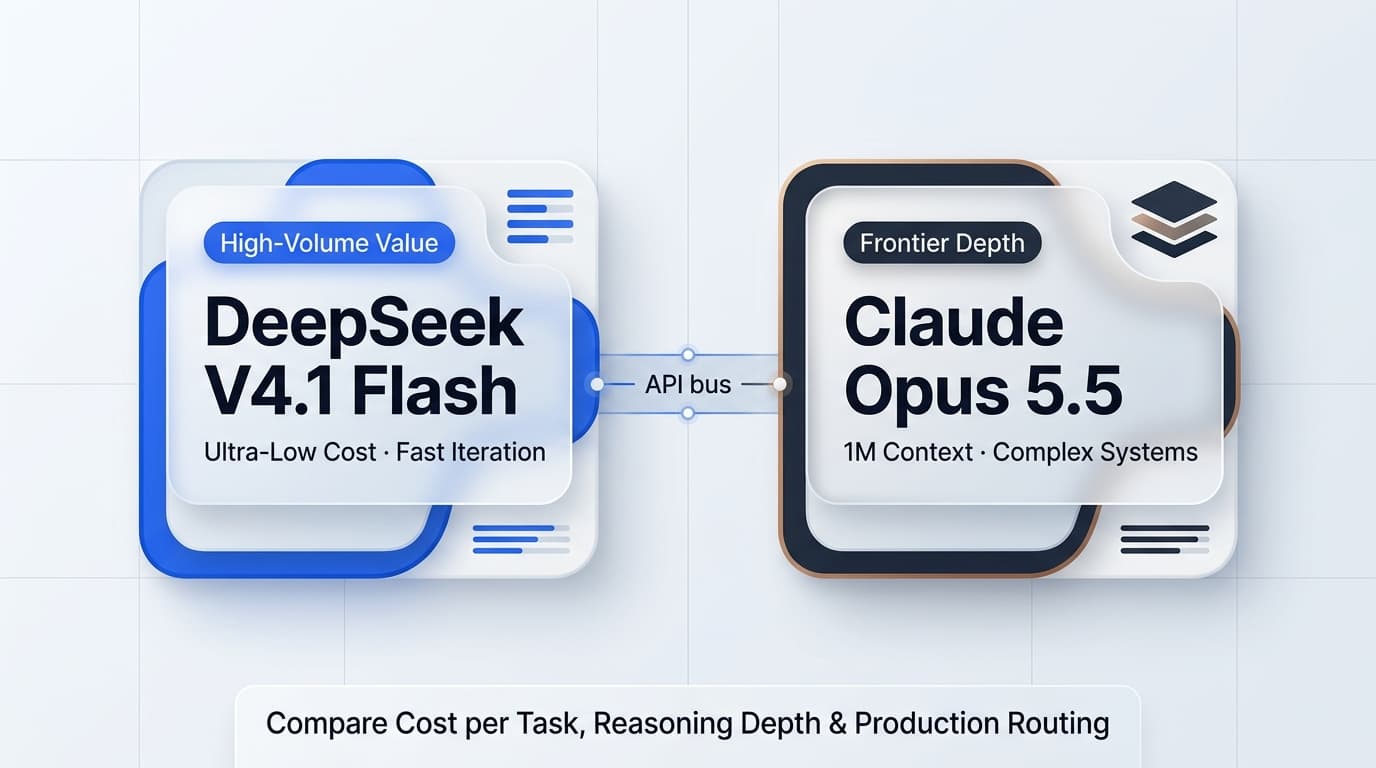
Comparing DeepSeek V4.1 Flash against Claude Opus 5.5 is deliberately an asymmetric tier matchup—an open-weight, MIT-licensed Flash-class MoE against Anthropic's proprietary flagship—and that asymmetry is exactly why so many engineering teams evaluate both together. On Artificial Analysis evaluations, Claude Opus 5.5 leads the Intelligence Index 58 to 39, while DeepSeek V4.1 Flash costs roughly 22x less per benchmark task ($0.27 vs $5.98), streams nearly twice as fast (176 vs 97 tok/s), and offers a 384,000-token output ceiling—three times Opus 5.5's 128K limit.[1][2]
On reAPI's live unified gateway, that translates into a 7x input gap ($0.40 vs $2.80 per 1M tokens) and a 10.8x output gap ($1.30 vs $14.00 per 1M tokens).[2][3] The practical takeaway is straightforward: choose DeepSeek V4.1 Flash when throughput, bulk token economics, ultra-long single-pass output, or self-hosting control drive the architecture. Choose Claude Opus 5.5 when first-pass correctness on ambiguous, multi-file systems engineering matters far more than token spend.
Specifications and Pricing at a Glance
DeepSeek V4.1 Flash launched on September 10, 2026 (with an updated 1017 checkpoint on October 17 and official NVIDIA NVFP4 weights on November 1), while Claude Opus 5.5 launched on September 22, 2026.[1][4] Both give you a full 1-million-token context window with flat pricing across the entire context length—no sudden long-context price jump at 128K or 200K tokens.
| Specification | DeepSeek V4.1 Flash (deepseek-v4.1-flash) | Claude Opus 5.5 (claude-opus-5-5) |
|---|---|---|
| Release date | September 10, 2026 (1017 checkpoint Oct 17) | September 22, 2026 |
| Architecture & license | 552B MoE (Causal Encoder-Decoder), MIT open weights | Proprietary flagship, API-only |
| Context window | 1,000,000 tokens (flat rate) | 1,000,000 tokens (flat rate) |
| Max output tokens | 384,000 tokens | 128,000 tokens (including thinking) |
| Modalities | Text + Vision (JPEG, PNG, GIF, WebP) -> Text | Text + Vision -> Text |
| Vendor direct input / output | Vendor deepseek-flash rate card (check live sheet) | $4.00 / $20.00 per MTok |
| reAPI displayed input / output | $0.40 / $1.30 per MTok | $2.80 / $14.00 per MTok |
| reAPI displayed cache read | $0.015 per MTok | $0.14 per MTok |
| Thinking / reasoning mode | On by default (reasoning_effort: low, high, max) | Adaptive thinking always on (low to max) |
| Measured throughput (AA) | ~176 tok/s | ~97 tok/s |
| Self-hosting / local deployment | Yes (MIT weights, NVFP4 / sub-64GB quant profiles) | No |
Check the live DeepSeek V4.1 Flash and Claude Opus 5.5 pages for current gateway quotes, and our Claude API pricing guide for Anthropic's direct cache-write and Batch modifiers.[2][3]
Two structural advantages often get buried behind the raw price headline:
- 384K output ceiling on DeepSeek V4.1 Flash. If your pipeline generates huge structured transformations—full-module migrations, synthetic training datasets, multi-chapter documentation builds, or exhaustive log-extraction JSON payloads—DeepSeek V4.1 Flash can emit up to 384,000 tokens in a single response without chunking stitches.
- MIT-licensed open weights. DeepSeek V4.1 Flash lets regulated or air-gapped teams start on a hosted API today and migrate to self-hosted GPU clusters later (including community setups using NVFP4 and sub-64GB quantization profiles). Claude Opus 5.5 is strictly API-hosted.
Benchmarks: Where DeepSeek V4.1 Flash Punches Above Its Weight—and Where Opus 5.5 Pulls Away
Public evaluations across Artificial Analysis, BenchLM, and vendor-reported coding suites confirm that this is not a photo finish on peak capability, yet the gap varies dramatically by task type.[1][5]
| Evaluation | DeepSeek V4.1 Flash | Claude Opus 5.5 | What It Signals for Production |
|---|---|---|---|
| Artificial Analysis Intelligence Index | 39.0 – 39.5 | 58.0 | Broad reasoning & multi-step synthesis strongly favor Opus 5.5 |
| BenchLM Composite | 70.0 | 82.8 | Consistent 12+ point frontier advantage for Opus 5.5 |
| Terminal-Bench 4.0 | 31.2% | 66.4% | Multi-step terminal debugging & patch verification heavily favor Opus 5.5 |
| Humanity's Last Exam (with tools) | 63.9% | 67.7% | Narrower gap (under 4 pts) when external search/tools ground the reasoning |
| Chartography (with tools) | 78.9% | 89.0% | Opus 5.5 is noticeably stronger on visual-analytical precision |
| OSWorld 2.0 (partial) | N/A | 81.8% | Opus 5.5 is purpose-built for GUI / computer-use automation |
| Cybergym | 88.1% | N/A | DeepSeek V4.1 Flash excels on security & vulnerability-style tasks |
| Cost per AA Intelligence Index task | $0.27 | $5.98 | ~22x lower task spend for DeepSeek V4.1 Flash |
Read those numbers together rather than cherry-picking a single row:
- Where Claude Opus 5.5 dominates: Autonomous, multi-step terminal and repository engineering. A 35-point spread on Terminal-Bench 4.0 (66.4% vs 31.2%) shows up immediately in real developer workflows: when an agent must inspect ten files, deduce a subtle state invariant, edit four modules, and make integration tests pass without hand-holding, Opus 5.5 gets there in one or two passes where DeepSeek V4.1 Flash frequently loops or misses edge cases.
- Where DeepSeek V4.1 Flash surprises teams: Tool-grounded search, security analysis, and well-defined code generation. On Humanity's Last Exam with tools, DeepSeek V4.1 Flash lands within four points of Opus 5.5 (63.9% vs 67.7%) at a fraction of the spend, and its 88.1% Cybergym score confirms that strong domain-specific coding and security reasoning does not always require flagship token prices.[5]
- Latency at maximum reasoning effort: Artificial Analysis measurements highlight a stark time-to-first-token (TTFT) contrast at
maxeffort—roughly 1.23 seconds for DeepSeek V4.1 Flash versus over 700 seconds for Opus 5.5 atmaxduring extended reasoning phases (though Opus 5.5 atlow/mediumeffort responds much faster).[1] For interactive user-facing features or CI checks with tight timeouts, DeepSeek's speed advantage is hard to ignore.
Architecture and Long-Context Efficiency
Both models advertise 1,000,000-token context windows, but they arrive there differently. DeepSeek V4.1 Flash uses a 552B-parameter Mixture-of-Experts Causal Encoder-Decoder (CED) architecture with compressed KV-cache footprints (reported at ~890 bytes per token), DSpark speculative decoding, and Engram conditional memory.[1] That engineering focus explains why DeepSeek can serve 1M-token prompts with $0.015 / MTok cache reads on reAPI—nearly 10x lower than Opus 5.5's $0.14 / MTok cache reads.
If your application repeatedly feeds a 200K-token codebase index, legal corpus, or log bundle into hundreds of parallel worker calls, KV-cache economics dominate the invoice. On 500 million cached input tokens per month, reAPI cache-read spend is $7.50 on DeepSeek V4.1 Flash versus $70.00 on Claude Opus 5.5.
Monthly Budget Math: What 50M and 200M Tokens Actually Cost
Token unit prices feel abstract until you multiply them across a real production workload. Assume a typical coding-assistant or extraction pipeline with a 4:1 ratio of fresh input to output tokens plus 60% additional prompt volume served from cache (priced at reAPI's published rates):
| Monthly Workload | DeepSeek V4.1 Flash (reAPI) | Claude Opus 5.5 (reAPI) | Monthly Difference |
|---|---|---|---|
| Mid-size team — 40M fresh input, 10M output, 60M cache read | $16.00 + $13.00 + $0.90 = $29.90 | $112.00 + $140.00 + $8.40 = $260.40 | Save $230.50 / mo (88.5%) |
| High-volume SaaS / CI — 160M fresh input, 40M output, 240M cache read | $64.00 + $52.00 + $3.60 = $119.60 | $448.00 + $560.00 + $33.60 = $1,041.60 | Save $922.00 / mo (88.5%) |
| Hybrid 85 / 15 split (High-volume tier: 85% Flash, 15% Opus 5.5) | $101.66 (Flash) + $156.24 (Opus) = $257.90 | $1,041.60 (100% Opus) | Save $783.70 / mo (75.2%) |
Look closely at the third row. Moving 100% of a high-volume SaaS workload to DeepSeek V4.1 Flash saves $922/month, but if 15% of your tickets are ambiguous multi-file refactors where Flash fails twice and burns engineer debugging time, the "cheapest" setup loses money on human salary. Running an 85% DeepSeek V4.1 Flash / 15% Claude Opus 5.5 hybrid pipeline captures 75% of the maximum possible cost reduction while preserving Opus 5.5's frontier accuracy on every high-stakes turn.
API Integration Gotchas When Running Both Through One Gateway
Because both models live behind your single reAPI account and API key, combining them in one backend is straightforward—provided you account for four wire-level quirks documented in reAPI's model contracts:[2][4]
- Exact model IDs: On reAPI, send
"model": "deepseek-v4.1-flash"(with the dot) to/v1/chat/completions, and"model": "claude-opus-5-5"to/v1/messages(or the unified/v1/chat/completionsendpoint if you want a single OpenAI-compatible SDK client). reasoning_effortcollapse on DeepSeek V4.1 Flash: DeepSeek V4.1 Flash has thinking on by default athigh, and only implements three real effort rungs:low,high, andmax. If your code passesminimal,medium,xhigh, orultra, DeepSeek silently maps them (minimal -> low,medium/xhigh -> high,ultra -> max).[2]- Ignored sampling parameters in thinking mode: While DeepSeek V4.1 Flash is in thinking mode,
temperature,presence_penalty, andfrequency_penaltyare silently ignored, and anytop_pbelow0.95is raised to0.95. Do not rely ontemperature: 0for determinism—useresponse_formatJSON schemas and downstream validation instead. - Echoing
reasoning_contentduring tool loops: DeepSeek V4.1 Flash returnsreasoning_contentalongsidecontent. You must echoreasoning_contentback on subsequent assistant turns only when the request includestools; withouttools, it is ignored. On Claude Opus 5.5's native/v1/messages, preserve full signed thinking blocks inside the same model's multi-turn conversation, and never pass one vendor's reasoning blocks to the other model during escalation.
Production Pattern: Two-Lane Routing Over One reAPI Key
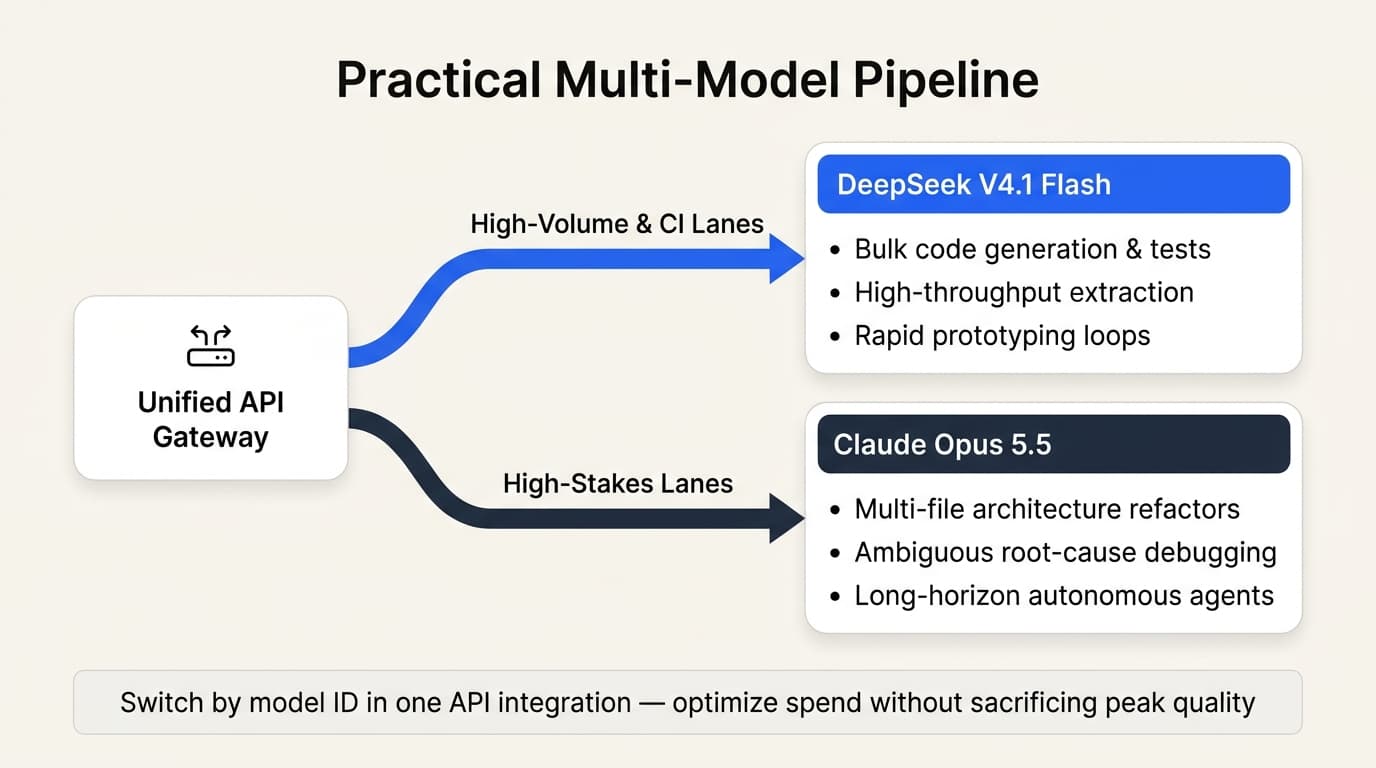
Here is a clean Python router using the standard openai SDK against reAPI's unified /v1/chat/completions endpoint so one client handles both lanes without maintaining two separate provider billing accounts:
import os
from openai import OpenAI

client = OpenAI(
    api_key=os.environ["REAPI_API_KEY"],
    base_url="https://api.reapi.ai/v1",
)

HIGH_STAKES_TASKS = {"architecture_rfc", "multi_file_refactor", "root_cause_debug"}

def run_task(task_type: str, prompt: string, prior_failures: int = 0) -> str:
    use_opus = task_type in HIGH_STAKES_TASKS or prior_failures >= 1

    if use_opus:
        model = "claude-opus-5-5"
        extra = {"max_tokens": 8192}
    else:
        model = "deepseek-v4.1-flash"
        extra = {
            "max_tokens": 16384,
            "reasoning_effort": "high",  # valid rungs: low, high, max
        }

    resp = client.chat.completions.create(
        model=model,
        messages=[
            {"role": "system", "content": "Be concise, accurate, and cite exact file paths."},
            {"role": "user", "content": prompt},
        ],
        **extra,
    )
    return resp.choices[0].message.content or ""
If you need a middle tier between these two extremes—something stronger than DeepSeek V4.1 Flash on Terminal-Bench 4.0 without paying Opus 5.5's full rate—evaluate Claude Sonnet 5.5 vs Claude Opus 5.5 ($1.40 / $7.00 on reAPI) as your middle lane.
Frequently Asked Questions
Is DeepSeek V4.1 Flash better than Claude Opus 5.5?
Not on raw peak intelligence. Claude Opus 5.5 outscores DeepSeek V4.1 Flash by roughly 19 points on the Artificial Analysis Intelligence Index (58 vs 39) and leads heavily on Terminal-Bench 4.0 (66.4% vs 31.2%). DeepSeek V4.1 Flash is better on unit economics (7x–11x lower token rates on reAPI, ~22x cheaper per benchmark task), token speed, 384K max output length, and open-weight self-hosting flexibility.
Is DeepSeek V4.1 Flash cheaper than Claude Opus 5.5?
Yes, by roughly an order of magnitude. On reAPI, DeepSeek V4.1 Flash is listed at $0.40 input / $1.30 output / $0.015 cache read per 1M tokens, compared to $2.80 input / $14.00 output / $0.14 cache read for Claude Opus 5.5. Even after accounting for occasional extra retries on medium-difficulty prompts, DeepSeek V4.1 Flash stays substantially cheaper on high-volume pipelines.
Which is better for coding—DeepSeek V4.1 Flash or Claude Opus 5.5?
Split by scope. Use DeepSeek V4.1 Flash for rapid boilerplate generation, unit-test scaffolding, log parsing, security scanning, and high-throughput CI review tasks where fast iteration and low cost matter most. Use Claude Opus 5.5 for multi-file refactors, architectural planning, and ambiguous production bugs where a single flawed patch costs far more in engineering time than the extra API tokens.
Do DeepSeek V4.1 Flash and Claude Opus 5.5 have the same context window?
Both support a 1,000,000-token input context window at flat standard rates. Their output ceilings differ significantly: DeepSeek V4.1 Flash supports up to 384,000 output tokens per request, whereas Claude Opus 5.5 caps output (including thinking tokens) at 128,000 tokens.
Can I run Claude Opus 5.5 locally like DeepSeek V4.1 Flash?
No. Claude Opus 5.5 is a proprietary, API-only model. DeepSeek V4.1 Flash publishes MIT-licensed open weights (552B MoE with NVFP4 and community sub-64GB quantization profiles), so teams can deploy it on private hardware or switch freely between hosted APIs and self-managed clusters.
Is DeepSeek V4.1 Flash faster than Claude Opus 5.5?
Yes in most configurations. Artificial Analysis measures DeepSeek V4.1 Flash at roughly 176 tokens/second versus 97 tokens/second for Claude Opus 5.5, with much shorter time-to-first-token at maximum reasoning effort.
Ready to test both lanes on your own repository? Compare live quotes on the DeepSeek V4.1 Flash and Claude Opus 5.5 model pages, or grab a single unified key in API Keys to route both models from one codebase.
References
- Kie.ai. DeepSeek V4.1 Flash vs Claude Opus 5.5: Price & Benchmarks (Artificial Analysis scores, throughput, CED KV cache, and 1017/NVFP4 updates). Checked November 23, 2026. kie.ai/blog/deepseek-v4-1-flash-vs-claude-opus-5-5
- reAPI. DeepSeek V4.1 Flash model page, live pricing, and request surface (
deepseek-v4.1-flash, 384K output, reasoning_effort mapping). reapi.ai/models/deepseek-v4-1-flash - reAPI. Claude API pricing (official direct and reAPI displayed schedules for Claude Opus 5.5). reapi.ai/blog/claude-api-pricing
- Anthropic. Claude Opus 5.5 overview. Checked November 23, 2026. platform.claude.com/docs/en/models/opus-5-5/overview
- SynthorAI. Claude Opus 5.5 vs DeepSeek V4.1 Flash benchmark comparison (Terminal-Bench 4.0, OSWorld 2.0, Cybergym, HLE with tools, Chartography). Checked November 23, 2026. synthorai.io/es/compare/models/claude-opus-5-5-vs-deepseek-v4-1-flash
- DeepSeek. Models & Pricing (
deepseek-flashservingDeepSeek-V4.1-Flash). Checked November 23, 2026. api-docs.deepseek.com/quick_start/pricing