OpenAI
GPT-5.4
From $1.00 per 1M tokens
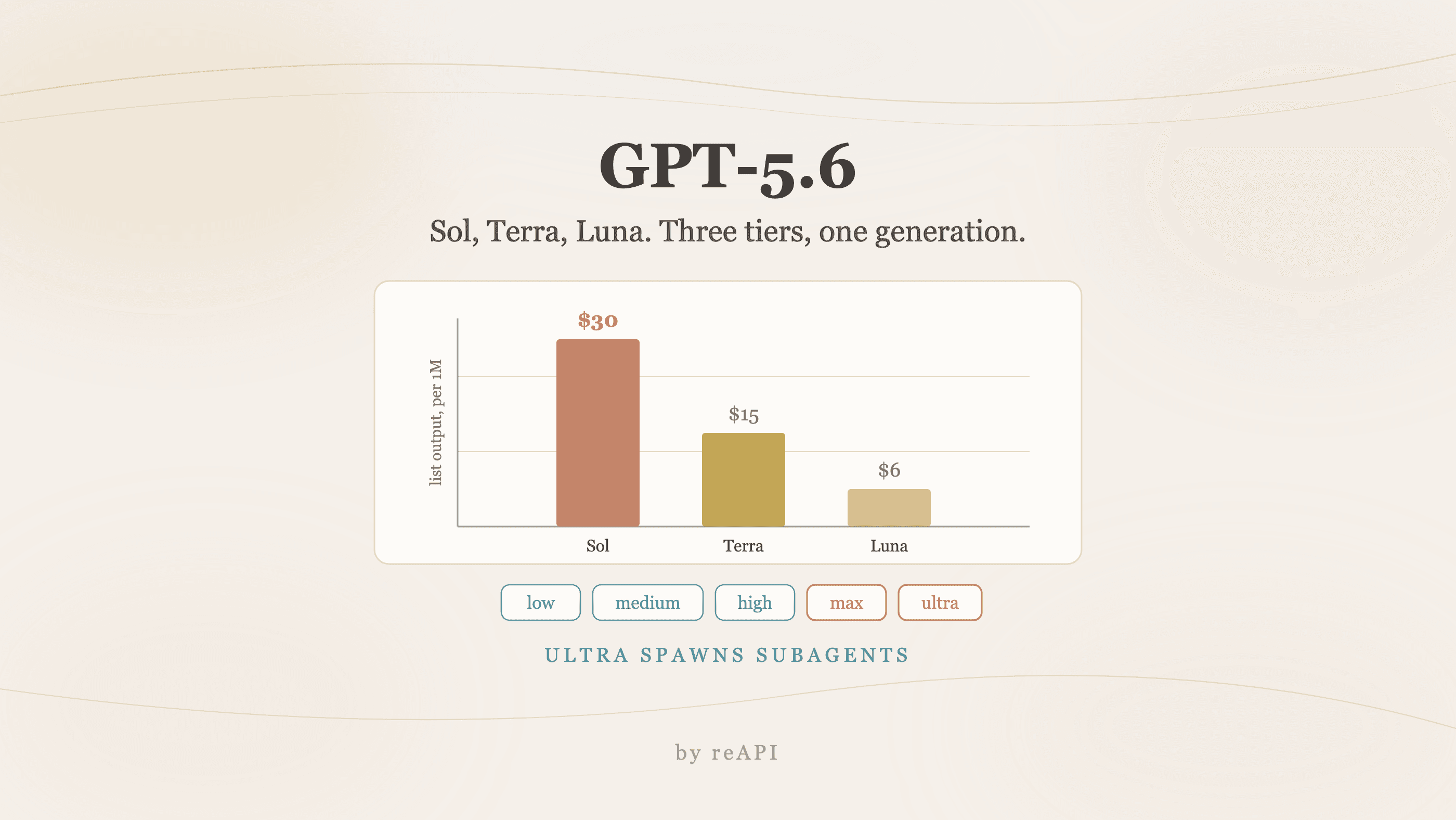
GPT-5.6 Terra is the tier OpenAI positions between intelligence and cost, and it lands exactly where the family's default reasoning effort sits. GPT-5.6 Terra reads a 1,050,000-token context window, returns up to 128,000 tokens, and takes all six effort rungs from off to max. OpenAI rates its reasoning Higher and its speed Fast. On reAPI, GPT-5.6 Terra bills below OpenAI's published rate on both input and output.
Start with the prompt in the composer or choose an example.
GPT-5.6 Terra is the tier of OpenAI's GPT-5.6 family that balances intelligence against cost, served on reAPI through an OpenAI-compatible /api/v1/chat/completions endpoint. It reads a 1,050,000-token context window, returns up to 128,000 tokens, takes all six reasoning-effort rungs from none to max, and sits exactly at medium — the family's default — with OpenAI rating its reasoning Higher and its speed Fast. Billing is per 1M tokens, with input and output priced separately; reasoning tokens count as output.
Real-world workflows and production use cases you can build and ship with this model.

Read OpenAI's own description of medium effort and it names agentic coding first, then research, spreadsheets and slides, and delegating long-horizon work. That list is the job description of a workhorse, and GPT-5.6 Terra is the tier priced for running it all day rather than for the occasional hard call. The family's limits do not change here: GPT-5.6 Terra still reads 1,050,000 tokens and still returns up to 128,000, so an agent working from a whole repository does not need a different tier just to see its inputs.
Read the API docs


Spreadsheets with working formulas, slide decks that follow a convention, runbooks with owners and rollback points: OpenAI puts this class of work under the same default effort setting, and it is where a 128,000-token output ceiling stops being a specification and starts being the reason the deliverable arrives whole. Pair GPT-5.6 Terra with a JSON schema when the artefact is consumed by another system, and with plain prose when a person will read it — the model is the same either way, only the contract changes.

Because GPT-5.6 Terra starts at the family default, it is the natural place to run the experiment that actually saves money: take a real route, try low, try high, and keep whichever your evals prefer. OpenAI's guidance for low is planning and multi-step decisions at speed, and for high it is complex debugging and deep planning — both reachable on this tier without changing models. When a route turns out to want max effort every time, that is the signal to move it up to the frontier sibling rather than pay for depth this tier was not priced for.
Credit-based — 1 credit = $0.001 USD. Pay only for completed generations.
One 1K-token prompt with a 1K-token answer at the cheapest tier.
| Model | Category | Price |
|---|---|---|
| Token pricing | Input | $1.6 1M tokens |
| Output | $9.6 1M tokens | |
| Long context · prompts over 272K tokens | Input | $3.2 1M tokens |
| Output | $14.5 1M tokens |
OpenAI publishes a per-million-token rate for GPT-5.6 Terra input and output. On reAPI, GPT-5.6 Terra bills below both, and the rates on this page are updated live. No subscription underneath it, no minimum commitment, pay-as-you-go from your reAPI balance. The exact numbers are in the pricing table on this page.
GPT-5.6 Terra is served from a standard `/api/v1/chat/completions` endpoint. If your code already speaks that shape, adopting GPT-5.6 Terra is a base URL, a key and a model string — the same SDKs work once the base URL points at reapi.ai. No SDK swap, no bespoke client.
The same reAPI key that calls GPT-5.6 Terra calls the tier below it, the frontier tier above it, the Claude and Gemini families, and the open-weight models. Tiering a workload up or down is a model string rather than a second integration, a second invoice and a second set of credentials.
Same family, adjacent tiers, and an unusually honest comparison because nearly every specification is shared: identical context window, identical output ceiling, identical effort ladder, identical tools, identical knowledge cutoff, identical endpoint. What differs is the reasoning rating OpenAI gives each, the earlier-generation tier they descend from, and the rate. The question the rows below answer is whether your route needs the top of the ladder often enough to pay for it.
Comparison reflects behavior documented on OpenAI's own model pages at the time of writing. Rates are described as relationships rather than amounts; the live numbers for GPT-5.6 Terra are in the pricing table above.
Sign in to reAPI and create a key under API keys. That one key reaches GPT-5.6 Terra and every other model on the platform, billed from a single balance.
OpenSet your base URL to reapi.ai's API and your key to the one you just created. Any client that already speaks OpenAI Chat Completions works unchanged — no SDK swap is needed to reach GPT-5.6 Terra.
OpenSet the model field to `gpt-5.6-terra` — with the dots — and post your messages. You can leave reasoning effort alone to start with, since the family default is medium and that is this tier's intended setting; turn on streaming for anything a person is watching.
Opencurl https://reapi.ai/api/v1/chat/completions \
-H "Authorization: Bearer YOUR_API_KEY" \
-H "Content-Type: application/json" \
-d '{
"model": "gpt-5.6-terra",
"messages": [
{ "role": "user", "content": "Hello" }
],
"reasoning_effort": "medium",
"stream": true
}'Rejected synchronously with the failing field named. Check enum values, ranges, and URL fields — nothing is charged.
401 means a missing or invalid Bearer key; 402 means the reserve exceeds your balance. Manage keys and credits in the console.
Reference material and outputs pass automated moderation. Rejected tasks fail with a clear error and a full refund.
A task that reaches a failed state is never charged — the reserve refunds automatically. Keep the task id and retry when ready.
Common questions about this model.
Try it in the playground or grab an API key to integrate now.