Seedance 2.5 is live — 30-second cinematic video with native audio & real-person references

Claude Opus 4.8 API — Anthropic's Most Capable Model

Claude Opus 4.8 is Anthropic's most capable model for complex reasoning and long-horizon agentic coding — 1M context, 128K max output, vision input, prompt caching, and standard /v1/chat/completions in one call. Pay-as-you-go pricing in USD.

Highlights
Refined Opus 4 line · streaming chat
Best for
Code review, refactoring, research
Input
Chat messages (OpenAI-compatible)
Output
Text, streaming optional
Claude Opus 4.8modelclaude-opus-4-8

Claude Opus 4.8 playground

Chat models run on the api.reapi.ai gateway, which has its own console and its own key. Open the console to run Claude Opus 4.8 through the OpenAI-compatible Chat Completions surface.

What is the Claude Opus 4.8 API?

Claude Opus 4.8 is Anthropic's model for complex reasoning and long-horizon agentic coding, served on an OpenAI-compatible /v1/chat/completions endpoint (the native /v1/messages surface is available too). It carries a 1M-token context window, up to 128K output tokens per call, vision input, prompt caching, tool use, and the temperature and top_p controls. Billing is per million tokens with input and output priced separately, cached reads charged at a lower rate, and web search billed per request.

What you can build with this model

Real-world workflows and production use cases you can build and ship with this model.

Claude Opus 4.8 driving a long-horizon agentic coding session

Long-horizon agentic coding

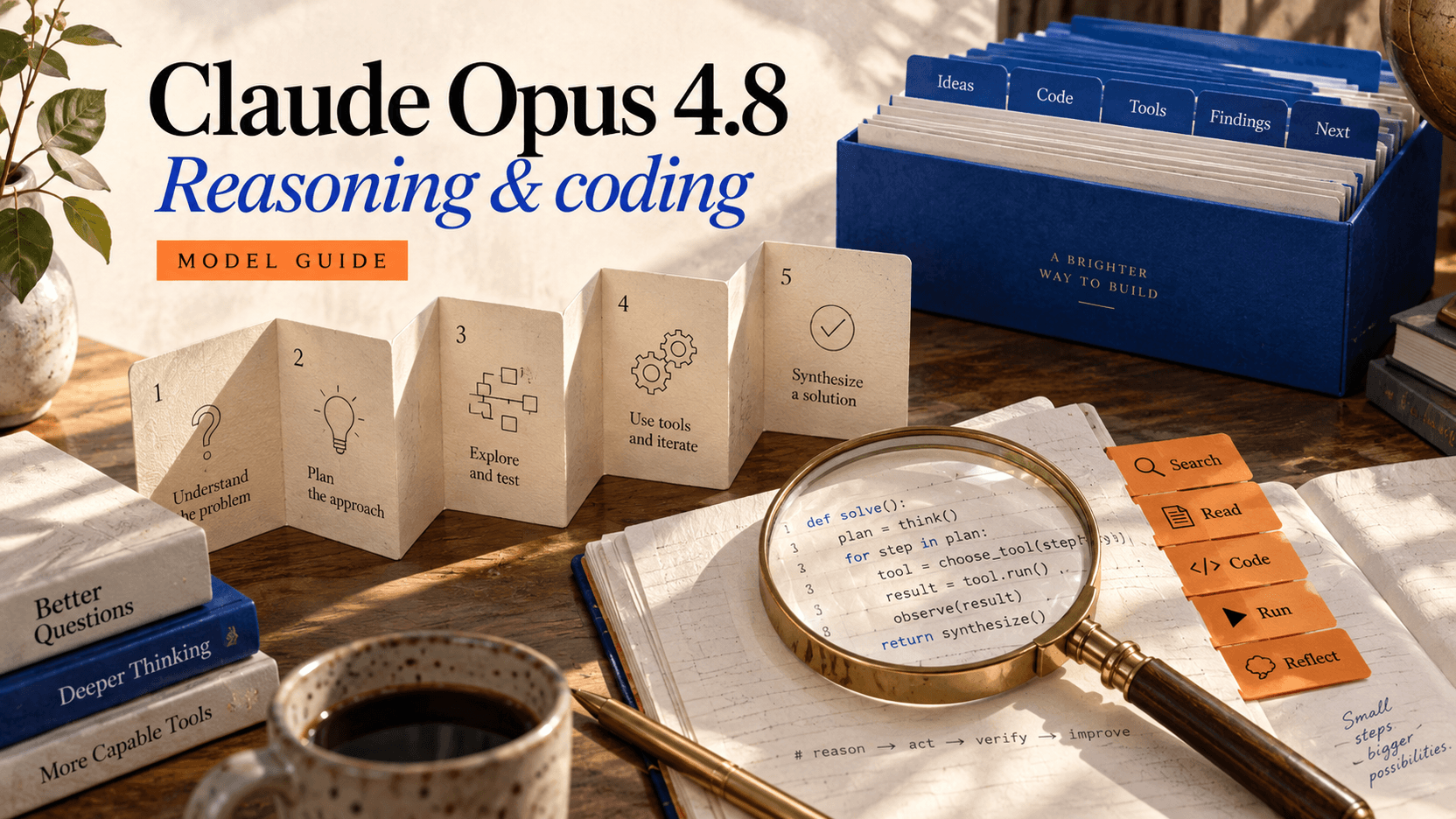
Claude Opus 4.8 is Anthropic's most capable model for high-autonomy engineering work — multi-service refactors, codebase-scale migrations, and agent runs that have to stay on-task across many steps. Early testers report sharper judgement: it asks the right questions, catches its own mistakes, and pushes back when a plan isn't sound.

Read the API docs

Claude Opus 4.8 reasoning carefully through a high-stakes task

High-stakes reasoning where mistakes are costly

One of the most prominent changes in Opus 4.8 is honesty: Anthropic's evaluations show it is around four times less likely than its predecessor to let flaws in the code it writes pass unremarked, and more likely to flag uncertainty instead of overclaiming. Pick it when a confident-but-wrong answer has real downstream cost.

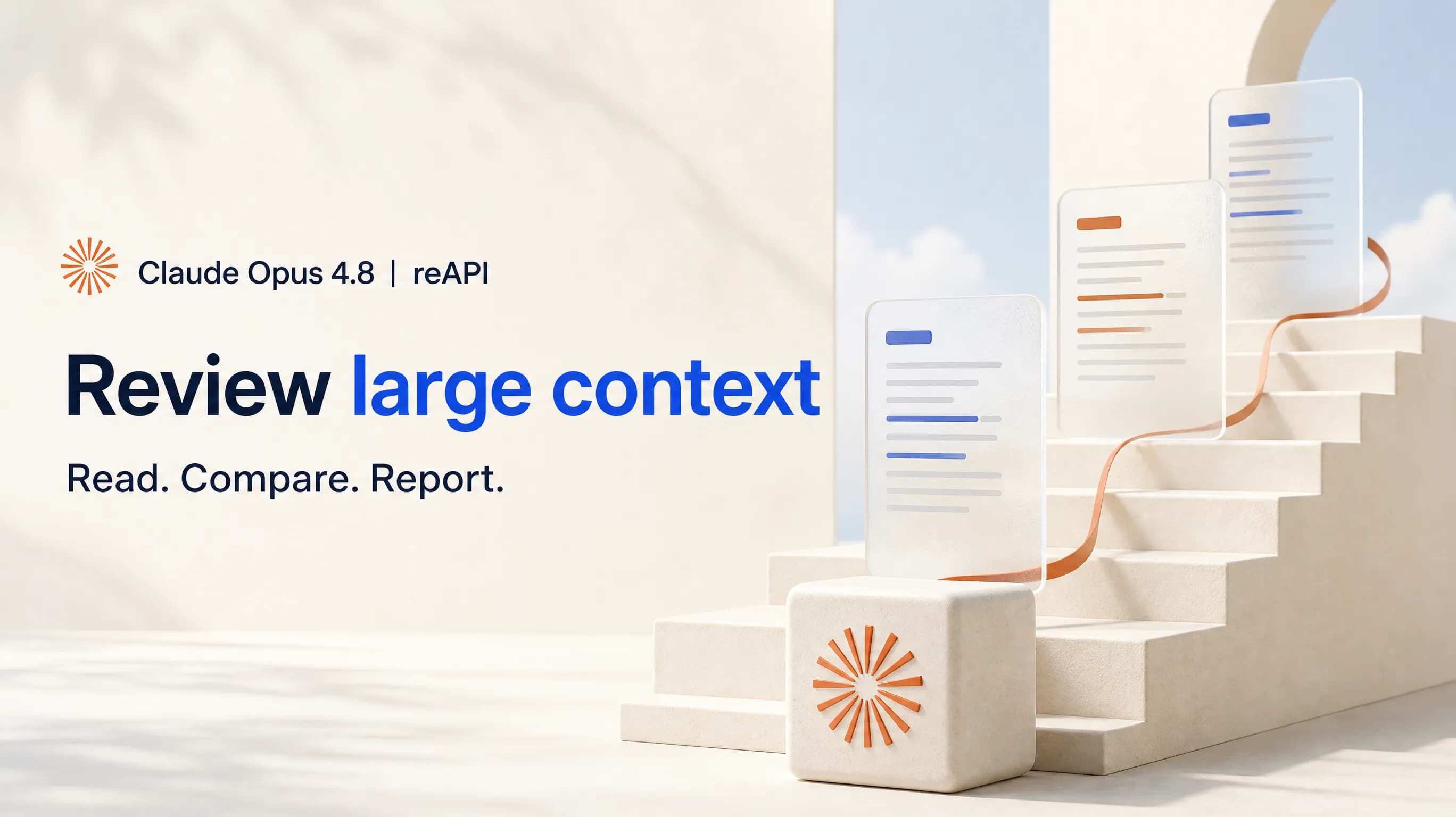
Claude Opus 4.8 reasoning across a 1M-token analysis pack

Large-context analysis and review

Feed entire codebases, long research packs, multi-file technical material, or full policy documents into a single Claude Opus 4.8 request. The 1M token context window means analysis-heavy workflows rarely need chunking — the model sees the whole input and returns a coherent answer.

Pricing

Credit-based — 1 credit = $0.001 USD. Pay only for completed generations.

First test cost
$0.01515 credits

One sample at the cheapest tier (request).

Testing budget guide
Add credits
$10
≈ 666 tests
$50
≈ 3333 tests
$100
≈ 6666 tests
ModelCategoryPrice
TokensInput tokens
$4
1M tokens
Output tokens
$20
1M tokens
Cache read
$0.5
1M tokens
ToolsWeb search
$0.015
request

Why reAPI

Drop-in access for Anthropic's top model

The Claude Opus 4.8 API speaks OpenAI Chat Completions verbatim. Moving an existing OpenAI integration to Anthropic's most capable model is a base URL, an API key, and a model-string change — not a platform rewrite. The same `messages` array, the same streaming format, and the native Anthropic /v1/messages surface is available too for SDK callers that prefer it.

Most-capable reasoning and agentic coding

Claude Opus 4.8 is Anthropic's most capable model — built on Opus 4.7 with improvements across benchmarks, available at the same price. Adaptive thinking and an effort control that defaults to high mean it puts real work into hard problems. Route premium coding and high-autonomy agent traffic here; send simpler calls to cheaper Claude or GPT models on the same key.

One key across GPT, Claude, and Gemini

A single api.reapi.ai key unlocks Claude Opus 4.8 alongside GPT-5.5, Gemini 3.1 Pro, and every other frontier chat model on the platform. Compare vendors, add fallbacks, and route traffic per call with a configuration change instead of an integration project.

Claude Opus 4.8 vs Claude Opus 4.7

Opus 4.8 is built on Opus 4.7 and ships at the same per-token price, so the upgrade is a one-line model-string change. Here is what Anthropic says actually changed between the two generations.

Capability
Claude Opus 4.8 on reAPI
Claude Opus 4.7
Capability tier
Anthropic's most capable model for complex reasoning and long-horizon agentic coding.
Previous flagship Opus generation; still available on the same key.
Per-token price
Same input and output rates as Opus 4.7 — the upgrade carries no price increase.
Same input and output rates as 4.8.
Code self-checking (honesty)
Around four times less likely to let flaws in its own code pass unremarked, per Anthropic's evaluations.
Higher rate of unremarked code flaws than 4.8.
Agentic judgement & tool use
Sharper judgement on agentic tasks; more efficient tool calling — fewer steps for the same result.
Capable agentic model, with more tool-calling steps than 4.8.
Fast mode
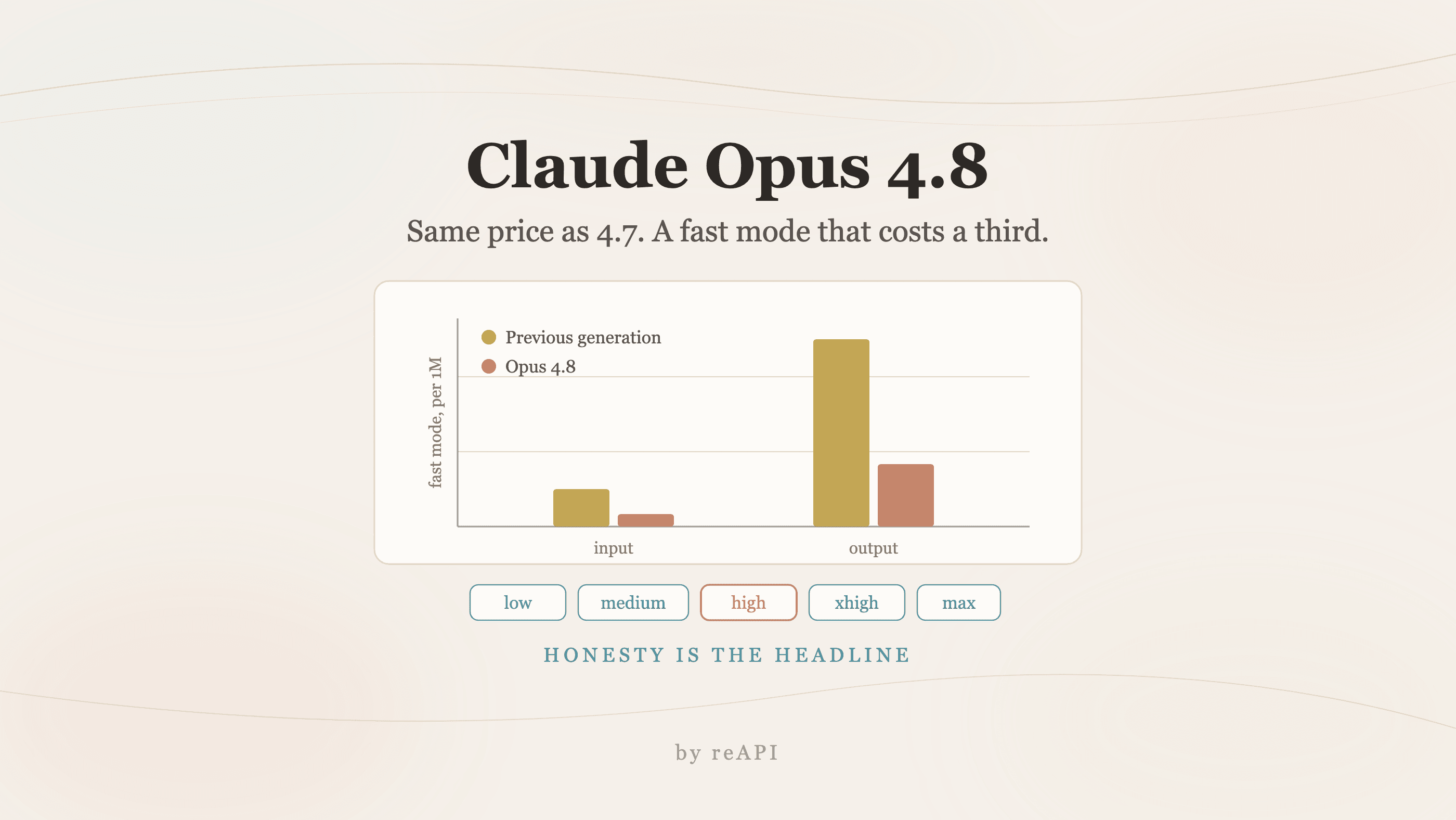
Runs at 2.5× speed, now three times cheaper than fast mode was on previous models.
Fast mode available at the previous, higher pricing.
Context, output & vision
1M-token context, 128K max output, text + image input — at parity with 4.7.
1M-token context, 128K max output, text + image input.

Comparison reflects publicly documented behavior from Anthropic's Claude Opus 4.8 announcement and model documentation at the time of writing. Model behavior and pricing can change; check the pricing card above and the API docs for current values.

Ship the Claude Opus 4.8 API in three steps

  1. step 01

    Create an account and key on api.reapi.ai

    Sign up at api.reapi.ai, open the console, generate an API key under API Keys, and top up tokens under Top Up. The chat workspace is separate from the reapi.ai image/video gateway — keys do not cross over.

    Open
  2. step 02

    Send your first request

    POST https://api.reapi.ai/v1/chat/completions with `model: "claude-opus-4-8"`, your `messages` array, and `max_tokens` set generously. The endpoint uses the standard chat-completions format, including streamed responses; the native Anthropic /v1/messages format works too.

    Open
  3. step 03

    Tune for cost and stability

    Use prompt caching for stable system prompts and recurring long inputs to bring repeated-context costs down. Reserve Claude Opus 4.8 for the highest-value calls and route everything else to a cheaper model on the same key.

    Open
docs/api/claude-opus-4-8

API reference

Drop-in code and the full parameter table.

curl https://api.reapi.ai/v1/chat/completions \
  -H "Authorization: Bearer YOUR_API_KEY" \
  -H "Content-Type: application/json" \
  -d '{
    "model": "claude-opus-4-8",
    "group": "default",
    "messages": [
      { "role": "user", "content": "Hello" }
    ],
    "stream": true,
    "max_tokens": 4096,
    "temperature": 0.7
  }'

Parameter validation failed

Rejected synchronously with the failing field named. Check enum values, ranges, and URL fields — nothing is charged.

Authentication or balance issue

401 means a missing or invalid Bearer key; 402 means the reserve exceeds your balance. Manage keys and credits in the console.

Content or material rejected

Reference material and outputs pass automated moderation. Rejected tasks fail with a clear error and a full refund.

Task failed or timed out

A task that reaches a failed state is never charged — the reserve refunds automatically. Keep the task id and retry when ready.

Frequently asked questions

Common questions about this model.

Claude Opus 4.8 is billed pay-as-you-go in USD against your api.reapi.ai token balance — see the pricing card on this page for the live per-1M-token input and output rates. The same card lists the prompt-caching cache-read rate and the per-request web-search rate. Cache hits are dramatically cheaper than re-sending the same tokens. Failed requests are not charged.

start building

Ready to ship?

Try it in the playground or grab an API key to integrate now.