Seedance 2.5 is live — 30-second cinematic video with native audio & real-person referencesfrom $0.071/s

Claude Opus 5 — 1M Context, Agentic Coding

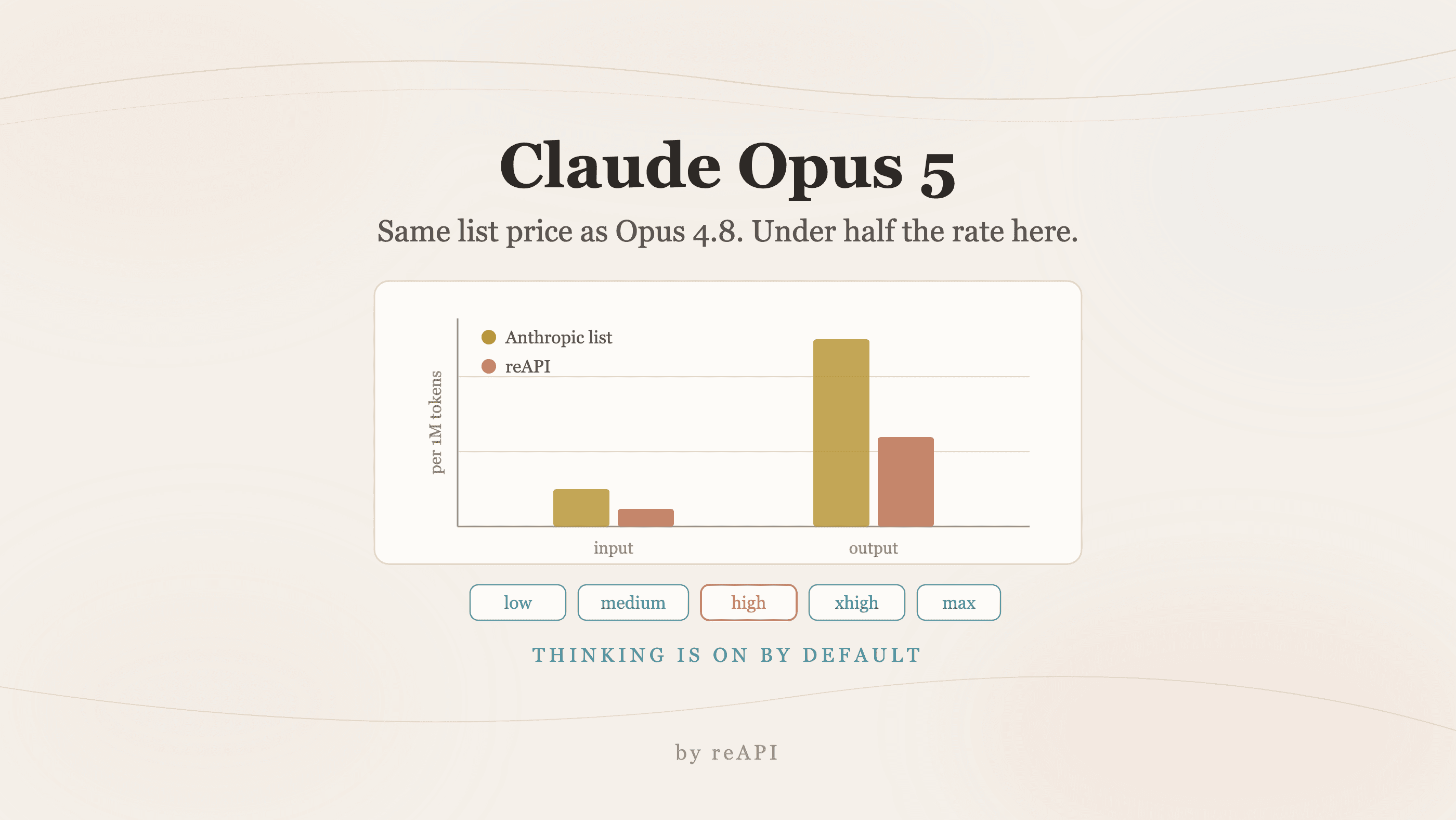
Claude Opus 5 is Anthropic's model for complex agentic coding and enterprise work. Claude Opus 5 reads a 1M-token context window, writes up to 128k tokens back, and runs adaptive thinking on by default with an effort dial from low through max. On reAPI, Claude Opus 5 bills at less than half Anthropic's published per-token rate on both input and output.

Claude Opus 5modelclaude-opus-5

Claude Opus 5 playground

Chat models run on the api.reapi.ai gateway, which has its own console and its own key. Open the console to run Claude Opus 5 through the OpenAI-compatible Chat Completions surface.

What is the Claude Opus 5 API?

Claude Opus 5 is Anthropic's model for complex agentic coding and enterprise work, served on an OpenAI-compatible /v1/chat/completions endpoint. It gives you a 1M-token context window, up to 128k output tokens per call with thinking tokens counted inside that budget, adaptive thinking that is on by default, and a five-level effort dial — low, medium, high, xhigh, max — that takes the place of the sampling knobs, since temperature, top_p and top_k are rejected on this model. Usage is billed per million tokens, with input and output priced separately.

What you can build with this model

Real-world workflows and production use cases you can build and ship with this model.

Claude Opus 5 working through a multi-file code change in one session

Long-horizon agentic coding that finishes the job

Anthropic positions Claude Opus 5 for complex agentic coding and enterprise work, and the shape of the model matches that: a 1M-token context window means a whole repository, its tests and its issue history fit in one request, and 128k output tokens is room for a multi-file change rather than a stub. Adaptive thinking is on by default, so Claude Opus 5 holds a plan together across tool calls instead of restarting its reasoning each turn. The practical advice from Anthropic's own migration guidance is to give Claude Opus 5 the complete task specification up front in a single well-specified turn and let it run, rather than revealing the task across many short interactive turns.

Read the API docs


Claude Opus 5 reviewing a pull request and reporting findings with severity

Code review and debugging with the filter turned off

Claude Opus 5 finds real bugs at high precision and high recall, and it stays accurate at lower effort — which makes a cheap fast pass at review time plus a thorough pass later a practical pattern. One caveat worth designing around: Claude Opus 5 follows severity instructions literally. A review prompt that says only report high-severity issues will get exactly that, and your measured recall drops even though the underlying bug-finding improved. Ask Claude Opus 5 to report everything with a confidence level and a severity, then filter in a separate pass.

Claude Opus 5 reading a large document set and producing a structured deliverable

Whole-document enterprise work without a chunking layer

Text, images and PDF are all inputs to Claude Opus 5, and the million-token window is large enough that a contract set, a research bundle or a year of filings goes in whole. That removes the retrieval layer whose only job was working around a small context. Claude Opus 5 also generates and edits complex multi-sheet spreadsheets with real formulas and builds slide decks that follow design conventions, and it can be told to follow a specific template when one is required. Vision is strong enough on charts and dense documents that giving Claude Opus 5 tools to crop and re-examine its own output beats simply raising the thinking depth.

Pricing

Credit-based — 1 credit = $0.001 USD. Pay only for completed generations.

First test cost
$2.42,400 credits

One sample at the cheapest tier (1M tokens).

Testing budget guide
Add credits
$10
≈ 4 tests
$50
≈ 20 tests
$100
≈ 41 tests
ModelCategoryPrice
Token pricingInput
$2.4
1M tokens
Output
$12
1M tokens

Why reAPI

Under half the published rate

Anthropic publishes a per-million-token rate for Claude Opus 5 input and output. On reAPI, Claude Opus 5 bills at less than half of both — no subscription underneath it, no minimum commitment, pay-as-you-go in USD against your gateway balance. The exact numbers are in the pricing table on this page.

OpenAI-compatible drop-in

Claude Opus 5 is served from a standard `/v1/chat/completions` endpoint. If your code already speaks that shape, adopting Claude Opus 5 is a base URL, a key and a model string — the same SDKs work once the base URL points at the gateway. No SDK swap, no bespoke client.

One key across Claude, GPT and Gemini

The same api.reapi.ai key that calls Claude Opus 5 calls the GPT and Gemini families too. Comparing Claude Opus 5 against another frontier model, or failing over when one provider has a bad hour, is a model string rather than a second integration, a second invoice and a second set of credentials.

Claude Opus 5 vs Claude Opus 4.8

This comparison is not about price. Anthropic publishes the same per-token rate, the same one-million-token context window and the same 128k output ceiling for both models. Claude Opus 5 is the capability step-change on top of that, and it quietly changes two request-surface defaults that will break code carried straight over — thinking now runs by default, and turning it off is capped at high effort.

Capability
Claude Opus 5 on reAPI
Claude Opus 4.8
Anthropic's positioning
For complex agentic coding and enterprise work; the current Opus generation
The most capable model of the Opus 4 series, now the previous generation
Published rate
Identical published per-token rate — and less than half of it on reAPI
Identical published per-token rate
Context and output limits
1M-token context, 128k max output
Identical — 1M-token context, 128k max output
Thinking default
On — omitting the thinking parameter runs adaptive thinking
Off — adaptive thinking has to be set explicitly
Disabling thinking
Accepted only at effort high or lower; rejected at xhigh and max
Accepted at any effort level
Prompt-cache minimum
512-token minimum cacheable prefix, so shorter prompts now cache
1024-token minimum — twice as long a prefix before caching starts

Comparison reflects behavior documented on Anthropic's own model-overview page at the time of writing. Rates are described as relationships rather than amounts; the live numbers for Claude Opus 5 are in the pricing table above.

Ship Claude Opus 5 in three steps

  1. step 01

    Create an account and key on api.reapi.ai

    Sign up at api.reapi.ai, open the console and generate an API key. That one key reaches Claude Opus 5 and every other model on the gateway, billed from a single balance.

    Open
  2. step 02

    Point your client at the gateway

    Set your base URL to api.reapi.ai and your key to the one you just created. Any client that already speaks OpenAI Chat Completions works unchanged — no SDK swap is needed to reach Claude Opus 5.

    Open
  3. step 03

    Send `claude-opus-5` as the model

    Set the model field to `claude-opus-5` and post your messages. Turn on streaming for long outputs, and remember that Claude Opus 5 thinks by default, so leave room in max tokens for the reasoning as well as the answer.

    Open
docs/api/claude-opus-5

API reference

Drop-in code and the full parameter table.

curl https://api.reapi.ai/v1/chat/completions \
  -H "Authorization: Bearer YOUR_API_KEY" \
  -H "Content-Type: application/json" \
  -d '{
    "model": "claude-opus-5",
    "group": "default",
    "messages": [
      { "role": "user", "content": "Hello" }
    ],
    "stream": true,
    "max_tokens": 16000
  }'

Parameter validation failed

Rejected synchronously with the failing field named. Check enum values, ranges, and URL fields — nothing is charged.

Authentication or balance issue

401 means a missing or invalid Bearer key; 402 means the reserve exceeds your balance. Manage keys and credits in the console.

Content or material rejected

Reference material and outputs pass automated moderation. Rejected tasks fail with a clear error and a full refund.

Task failed or timed out

A task that reaches a failed state is never charged — the reserve refunds automatically. Keep the task id and retry when ready.

Frequently asked questions

Common questions about this model.

Claude Opus 5 is billed pay-as-you-go in USD per token against your api.reapi.ai balance, with separate input and output rates and no subscription. Both rates sit at less than half Anthropic's published per-token rate. Current numbers are in the pricing table on this page.

start building

Ready to ship?

Try it in the playground or grab an API key to integrate now.