Claude Opus 5 vs GPT-5.6 Sol: Which Is Better for Coding? (2026)
Claude Opus 5 vs GPT-5.6 Sol for coding: compare official benchmarks, API prices, reasoning controls, tool use, and which model fits each workflow.
Claude Opus 5 is the better default for long-running software work, while GPT-5.6 Sol has the stronger result on one important agentic coding benchmark and a more ambitious orchestration stack. That is the practical answer to Claude Opus 5 vs GPT-5.6 Sol. It is also less decisive than either vendor's launch page makes it sound.
Anthropic's own comparison has Opus 5 ahead on Frontier-Bench, computer use, knowledge work, and business automation. The same table has GPT-5.6 Sol ahead on DeepSWE v1.1. Prices split differently depending on where you call them: their official input rates match, but Opus output is cheaper; on reAPI, Opus 5 is substantially less expensive on both dimensions.[1][2]
TL;DR
- Choose Claude Opus 5 for long-horizon coding, code review, computer use, and workflows that benefit from careful self-verification.
- Choose GPT-5.6 Sol when DeepSWE-style repository work, OpenAI's Responses API tools, or native multi-agent orchestration matter most.
- The benchmark result is split. Opus 5 leads Frontier-Bench 43.3% to 34.4%; Sol leads DeepSWE v1.1 72.7% to 68.8%.[1]
- Official prices: Opus 5 is $5 input / $25 output; Sol is $5 / $30 per million tokens.[2][3]
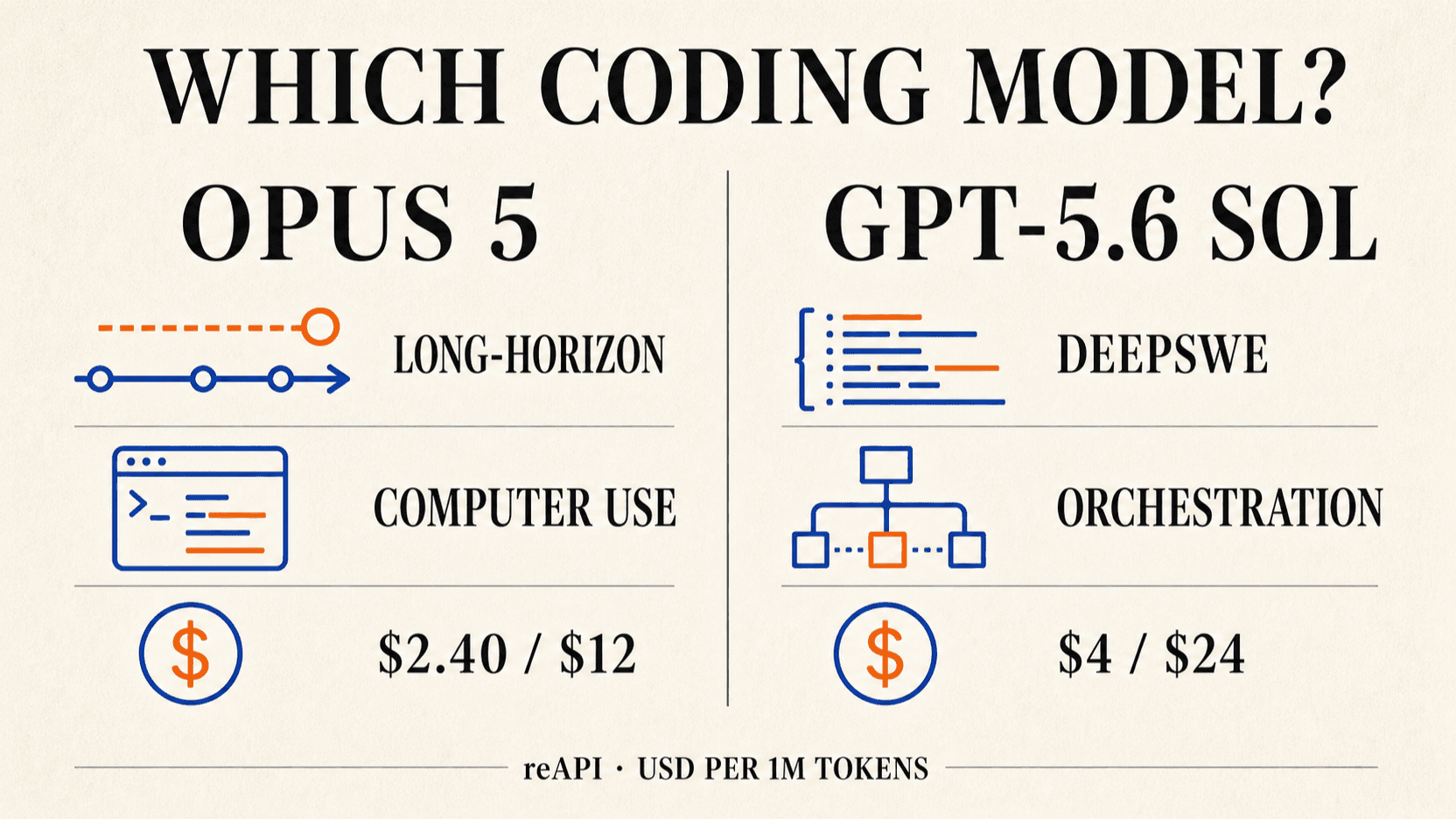
- Current reAPI prices: Opus 5 is $2.40 / $12; Sol is $4 / $24 per million tokens.
- Do not pick from one score. Run the same repository tasks at the same effort level and compare accepted-result cost, not token rate alone.
Claude Opus 5 vs GPT-5.6 Sol at a glance
| Category | Claude Opus 5 | GPT-5.6 Sol |
|---|---|---|
| Best fit | Long-running coding, review, enterprise workflows | Frontier coding, tool-heavy agents, orchestration |
| Context window | 1M tokens | 1.05M tokens |
| Max output | 128K tokens | 128K tokens |
| Reasoning controls | low through max; default high | none through max; Pro mode and multi-agent in Responses |
| Thinking default | Adaptive thinking on | Medium reasoning when omitted |
| Official input/output | $5 / $25 per MTok | $5 / $30 per MTok |
| reAPI input/output | $2.40 / $12 per MTok | $4 / $24 per MTok |
| Clear benchmark win | Frontier-Bench, OSWorld, AutomationBench | DeepSWE v1.1 |
Both accept text and image input and expose tool calling. Both also have a million-token-class context window, so context size is not a useful tie-breaker by itself.[3][4]
What the official coding benchmarks actually show
Anthropic published a direct table containing both models. It is vendor-run, and several rows use different harnesses or fallback behavior, so the numbers are evidence—not a neutral final verdict.[1]
| Evaluation | Opus 5 | GPT-5.6 Sol | Lead |
|---|---|---|---|
| Frontier-Bench v0.1 | 43.3% | 34.4% | Opus 5 |
| GDPval-AA v2 | 1861 Elo | 1736 Elo | Opus 5 |
| ARC-AGI-3 | 30.2% | 7.8% | Opus 5 |
| BrowseComp | 90.8% | 90.4% | Near tie |
| OSWorld 2.0 | 70.6% | 62.6% | Opus 5 |
| DeepSWE v1.1 | 68.8% | 72.7% | GPT-5.6 Sol |
| AutomationBench | 26.0% | 18.1% | Opus 5 |
| HealthBench Professional | 59.8% | 60.5% | GPT-5.6 Sol |
The split is useful. Frontier-Bench measures long, open-ended engineering tasks; Opus 5's lead supports Anthropic's positioning around persistence and self-verification. DeepSWE is closer to autonomous repository-level software engineering, where Sol holds a 3.9-point lead.
BrowseComp differs by 0.4 points and should be treated as a tie. A purchasing decision built on that margin would be false precision.
Which model is better for real coding work?
Feature development and difficult debugging: Opus 5
Opus 5 is the safer first choice when the job lasts many turns and the model must keep checking its own work. Anthropic specifically designed it for complex agentic coding and long-horizon tasks, and its largest official gains appear on evaluations that reward persistence rather than a single answer.[1]
That makes it well suited to code review, root-cause debugging, migrations,
and feature work where requirements change during implementation. Thinking is
on by default, and effort is the main cost dial. Start at high, then compare
medium and xhigh against your own acceptance tests.
Repository agents and OpenAI-native tooling: GPT-5.6 Sol
Sol deserves the first test when DeepSWE-style performance or the Responses API ecosystem is the priority. GPT-5.6 adds Programmatic Tool Calling, persisted reasoning controls, Pro mode, and beta multi-agent orchestration.[3]
Those features matter when one agent must coordinate searches, shell work, file operations, and subagents without an orchestration layer built entirely in application code. They do not make every coding answer better, but they change what one API request can coordinate.
Frontend and computer use: Opus 5
Opus 5 leads OSWorld 2.0 by eight points in Anthropic's table and is also ahead on the vendor's Frontier-Bench and automation results. For browser-based QA, visual debugging, and workflows that alternate between code and UI inspection, the evidence points toward Opus 5.[1]
Still test your own stack. Browser harnesses, screenshot resolution, tool latency, and retry rules can move the result more than a small model upgrade.
Price comparison: official API and reAPI
| Route | Input / MTok | Output / MTok |
|---|---|---|
| Anthropic Claude Opus 5 | $5.00 | $25.00 |
| OpenAI GPT-5.6 Sol | $5.00 | $30.00 |
| reAPI Claude Opus 5 | $2.40 | $12.00 |
| reAPI GPT-5.6 Sol | $4.00 | $24.00 |
At official list prices, the input rate is identical and Opus output is 16.7% cheaper. On reAPI, Opus costs 40% less for input and 50% less for output than Sol. That changes the default for high-volume agent loops, where reasoning and tool transcripts create a large output bill.
Price per token is only the first layer. The useful metric is:
cost per accepted task
= token cost × attempts + tool fees + human review
If Sol solves a repository task once and Opus needs two attempts, the cheaper rate loses. If both pass, Opus has the clearer cost advantage.
Reasoning controls are not interchangeable
Claude Opus 5 exposes low, medium, high, xhigh, and max, defaulting
to high. Thinking is adaptive and on by default. Disabling it while asking
for xhigh or max returns an error, and max_tokens must cover hidden
thinking plus visible text.[4]
GPT-5.6 supports none, low, medium, high, xhigh, and max, with
medium as the default. OpenAI recommends preserving the current effort during
migration and testing one level lower because the new family can maintain
quality with fewer output tokens.[3]
For a fair evaluation, match by cost or latency—not by identical setting
names. high on one vendor is not a standardized amount of compute on the
other.
Calling both models through one API
reAPI exposes both models through an OpenAI-compatible Chat Completions endpoint. The integration difference is the model string:
from openai import OpenAI

client = OpenAI(
    api_key="YOUR_REAPI_KEY",
    base_url="https://api.reapi.ai/v1",
)

def run(model: str, prompt: str):
    return client.chat.completions.create(
        model=model,
        messages=[{"role": "user", "content": prompt}],
        max_tokens=16000,
    )

opus = run("claude-opus-5", "Review this migration for rollback risks.")
sol = run("gpt-5.6-sol", "Review this migration for rollback risks.")
Use the same prompt, repository snapshot, tools, timeout, and acceptance rubric. Record total tokens and retries rather than comparing two attractive outputs by eye.
FAQ
Is Claude Opus 5 better than GPT-5.6 Sol for coding?
For long-horizon coding and computer use, the official evidence favors Opus 5. For DeepSWE v1.1 repository tasks, GPT-5.6 Sol leads. The better production model depends on your task distribution and agent harness.
Which model is cheaper?
Opus 5. Official input prices match, but Opus output is $25 versus Sol's $30. On reAPI, Opus is $2.40/$12 and Sol is $4/$24 per million input/output tokens.
Do both models support one-million-token context?
Yes. Opus 5 has a 1M window and Sol has a 1.05M window. Long-context pricing and performance still depend on the route and request size.
Which model is better for multi-agent workflows?
Sol has native beta multi-agent orchestration in OpenAI's Responses API. Opus 5 can work in multi-agent systems, but orchestration is generally supplied by the application or Claude tooling.
Can I switch between them without rewriting my app?
On reAPI, yes for standard Chat Completions workloads. Keep one OpenAI SDK
client and change model between claude-opus-5 and gpt-5.6-sol. Vendor-
specific reasoning and tool features still need conditional request fields.
Verdict
The Claude Opus 5 vs GPT-5.6 Sol decision is conditional, but it is not vague. Start with Opus 5 for long-running development, review, computer use, and lower token cost. Start with Sol for DeepSWE-like repository agents and workflows that benefit from OpenAI's native orchestration features. Then keep the winner only if it reduces cost per accepted task on your own code.
References
- Anthropic. Introducing Claude Opus 5 — official benchmark table and methodology notes. anthropic.com/news/claude-opus-5
- Anthropic. Claude model pricing. platform.claude.com/docs/en/about-claude/pricing
- OpenAI. GPT-5.6 model guidance, pricing, and Responses API features. developers.openai.com/api/docs/guides/latest-model
- Anthropic. What's new in Claude Opus 5. platform.claude.com/docs/en/about-claude/models/whats-new-opus-5
Further reading
- reAPI. How to use Claude Opus 5. reapi.ai/blog/how-to-use-claude-opus-5
- reAPI. How to use GPT-5.6. reapi.ai/blog/how-to-use-gpt-5-6
- reAPI. Claude Opus 5 model page. reapi.ai/models/claude-opus-5
Author

Categories
More Posts

Which Wan Models Run Locally? Weights and GPU Memory
Choose Wan models for local use with official 2.1 and 2.2 downloads, runtime-specific VRAM guidance, ComfyUI file paths and a way to measure generation costs.

Best WaveSpeed Alternatives in 2026: 5 Options Compared
Looking for WaveSpeed alternatives in 2026? Compare fal.ai, Replicate, Together AI, RunPod, and reAPI on model range, pricing, speed, and API design.

DeepSeek Harness vs OpenCode vs Claude Code
Compare DeepSeek Harness, OpenCode, and Claude Code by runtime ownership, model choice, plugins, permissions, setup burden, and the cost of agent loops.