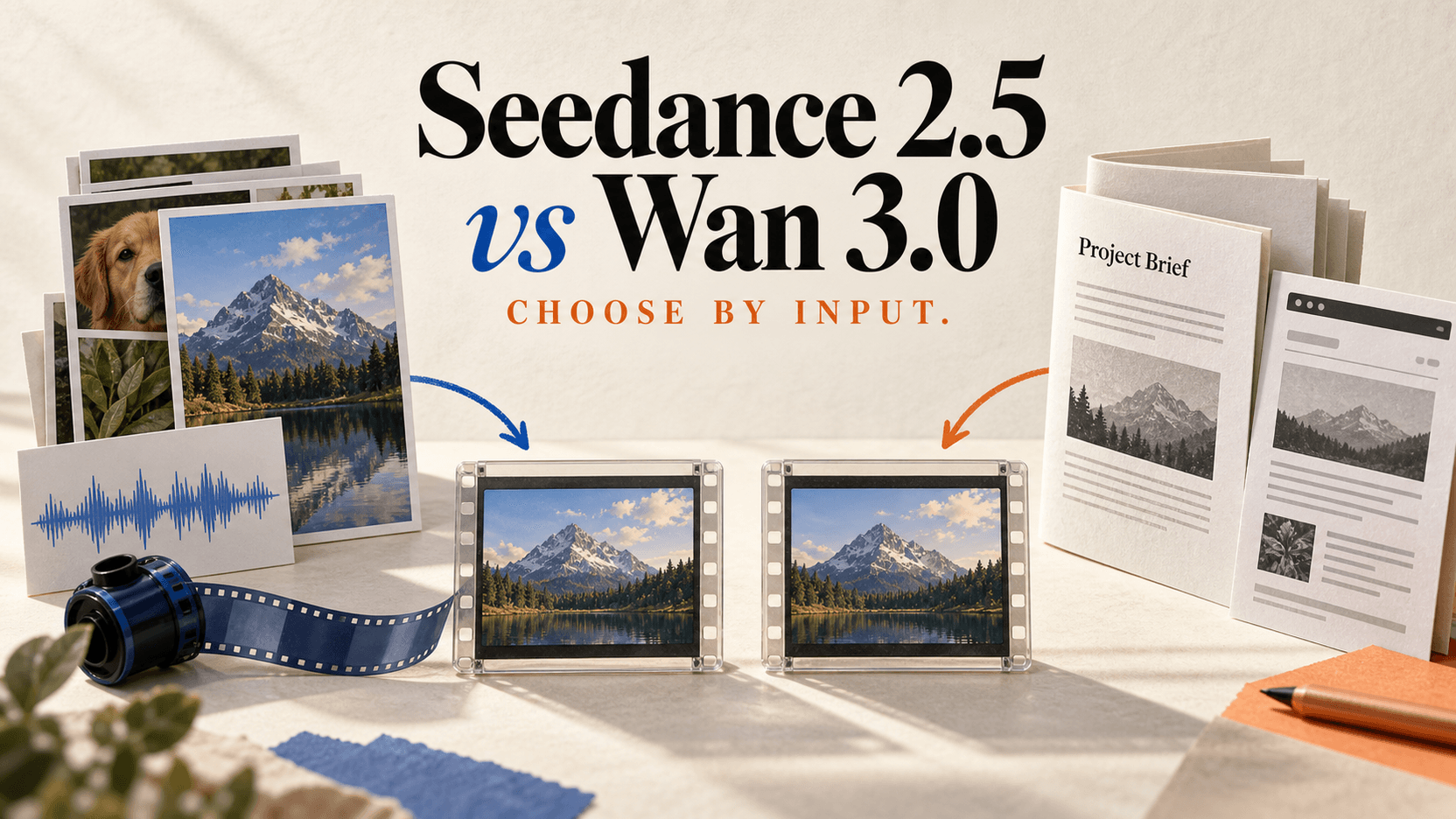
Seedance 2.5 vs Wan 3.0: References, Length, and Cost
Compare Seedance 2.5 vs Wan 3.0 with current availability, 30-second output, reference limits, document inputs, resolution choices, and current API pricing.
Seedance 2.5 vs Wan 3.0 now compares two available models that can generate up to 30 seconds. Seedance 2.5 on reAPI accepts the larger image, video, and audio reference set. Wan 3.0 on reAPI adds document and public web-page inputs, and its current 720p rate is lower: $0.068 per second versus Seedance's $0.266824 without video references[1][2].
The old “coming soon” premise no longer fits. Alibaba Cloud now describes the Wan 3.0 Video API as generally available with no application required. Its official page confirms 30-second generation and multimodal references. The useful question on September 12, 2026 is which input and output contract fits your material, rather than whether a Wan 3.0 listing is only a placeholder[3].
TL;DR
- Both models support up to 30 seconds in a fresh request. reAPI lists 4–30 seconds for Seedance 2.5 and 2–30 seconds for Wan 3.0[1][2].
- Seedance 2.5 accepts up to 30 images, 10 videos, and 10 audio tracks. Wan 3.0 accepts up to 10 images, five videos, and five audio clips, with document and web-page inputs also documented[1][2][3].
- A 10-second 720p request without video references costs $2.669 on reAPI Seedance 2.5 and $0.68 on reAPI Wan 3.0, after applicable credit rounding[1][2].
- Wan 3.0 is available through the reAPI API; its browser playground configures requests but disables browser generation. Seedance 2.5 has an interactive generation playground[2][1].
- For changing an existing clip, Seedance 2.5 documents a video-editing task. Wan 3.0 on reAPI documents reference-video input, but does not expose a video-editing mode[4][2].
Seedance 2.5 vs Wan 3.0 now compares two available models
Confirm availability at the place where you intend to generate. The current reAPI Wan 3.0 page explicitly says the API is available and provides a rate card and documentation. Its disabled browser generation button is an interface restriction, not evidence that the model has yet to launch[2].
Alibaba's official Model Studio page separately describes Wan 3.0 as generally available. It publishes API examples, duration and reference claims, and Standard pricing. This gives the comparison a first-party foundation beyond a third-party catalog entry[3].
The table below covers regular Wan 3.0 and Seedance 2.5. Wan 3.0 Video Prime has a separate product listing and is not used for the prices in this article.
| Requirement | Seedance 2.5 on reAPI | Wan 3.0 on reAPI |
|---|---|---|
| Availability | API and browser generation playground | API; browser request configuration only |
| Duration | 4–30 seconds | 2–30 seconds |
| Listed output tiers | 480p / 720p / 1080p | 480P / 720P / 1080P / 2K / 4K |
| Image references | Up to 30 | Up to 10 |
| Video references | Up to 10 | Up to 5 |
| Audio references | Up to 10 | Up to 5 |
| Generated audio | Supported | Supported |
| First/last frames | Supported | Supported |
| Document and public web-page input | No equivalent dedicated mode in the documented request | Supported, up to 1080P |
| Video editing | Explicit edit task | Not exposed on reAPI |
The table describes documented product limits. Fidelity and generation speed were not measured in a matched test[1][2][4].
A lower rate and more input types do not establish better output for your shot. Use the specification to identify viable options, then judge the output against the scene you need.
Both reach 30 seconds; the inputs make the difference
Duration alone no longer separates this pair at the top end. If your requirement is a fresh 20- or 30-second scene, both are eligible. Seedance starts at four seconds on reAPI, while Wan starts at two, which can matter when the entire intended result is a very short insert[1][2].
The source material often makes the choice clearer. Seedance's documented input set covers text, images, videos, and audio, with several ways to assign frame or reference roles. Wan also accepts documents and public web pages. A source PDF or slide deck therefore points toward a different workflow from a folder of subject and motion references[4][2][3].
Document input does not establish that every fact or chart in a document will be reproduced correctly. When trying that mode, identify the specific information the video must preserve and check the generated result against the source. Treat this as a content-review step, particularly when the document contains names, figures, or instructions.
For reference-heavy generation, counts can eliminate a model before testing. A request that needs 12 separate images exceeds Wan's documented ten-image allowance but fits within Seedance's 30-image allowance. That arithmetic says nothing about whether all 12 images are useful. Assign each reference a clear purpose and remove conflicting material[1][3].
Seedance's reference durations also constrain the bundle. Its video clips have a combined 30-second limit, and its audio tracks have a separate combined 30-second limit. Do not interpret ten video references as permission to send ten long source videos[4].
Resolution needs equally careful labels. reAPI lists Wan output tiers through 4K, while the official Alibaba page retrieved for this article presents 480P, 720P, and 1080P. The reAPI listing supports a claim about its available delivery tiers; it does not, by itself, prove native Alibaba rendering at 2K or 4K. If native pixel resolution is a fixed requirement, confirm that separately before treating the two lists as the same specification[2][3].
What 10 and 30 seconds cost without video references
Wan 3.0 is less expensive in the matching no-video-reference configurations below. Prices are current reAPI rates checked on September 12, 2026. The calculated totals assume one completed request and round its full cost to whole credits.
| Output | Seedance 2.5 exact rate | Wan 3.0 exact rate | Seedance: 10 seconds | Wan: 10 seconds |
|---|---|---|---|---|
| 480p | $0.118589/s | $0.034003/s | $1.186 | $0.341 |
| 720p | $0.266824/s | $0.068/s | $2.669 | $0.68 |
| 1080p | $0.461856/s | $0.136/s | $4.619 | $1.36 |
The exact rates come from the public pricing data on the model pages. The visible one-second credit amount can be rounded up, so multiplying that displayed amount by ten is not the same calculation[1][2].
At the shared 30-second ceiling, the same calculation gives:
| Output | Seedance 2.5: 30 seconds | Wan 3.0: 30 seconds |
|---|---|---|
| 480p | $3.558 | $1.021 |
| 720p | $8.005 | $2.04 |
| 1080p | $13.856 | $4.08 |
These are expected generation charges from the published rates, not paid-run results from this article[1][2].
Do not apply this table unchanged after adding a reference video to Seedance. Its video-input rate is lower, but the billing window includes source duration and a minimum based on output length. At 720p, a three-second source plus a 10-second output bills 17 seconds at $0.160094/s, or $2.722 after rounding[1][4].
For a reference-guided comparison, obtain the complete quote for each request using the same source files. The no-video table is a useful starting point; it is not a substitute for that input-specific calculation.
Keep Alibaba offer prices separate from reAPI prices
Alibaba Cloud ran a time-limited Standard offer that ended on September 24, 2026 at 00:00 UTC+8. As of October 22, 2026, its official Wan 3.0 page still displays the offer ($0.035/s at 480P, $0.07/s at 720P and $0.14/s at 1080P) next to list prices of $0.05, $0.10 and $0.20 per second, and says the final price is subject to the console[3].
| Alibaba Cloud Wan 3.0 Standard | Listed regular rate | Offer rate (ended September 24, 2026) | 30 seconds at the listed rate |
|---|---|---|---|
| 480P | $0.05/s | $0.035/s | $1.50 |
| 720P | $0.10/s | $0.07/s | $3.00 |
| 1080P | $0.20/s | $0.14/s | $6.00 |
This table describes buying through Alibaba Cloud Model Studio. The earlier tables describe buying through reAPI. They are separate customer prices; one should not be presented as a change to the other[3][2].
The offer above has already ended, which is why its end date belongs next to the price. Budget a continuing workload on the listed rate, and recheck the console quote when a recurring workload begins rather than storing a promotional price as a permanent constant.
Use the exact model name when checking. Alibaba's page also offers a Prime selection, but the Standard figures above belong to regular Wan 3.0. This article does not transfer Prime's positioning or price to that model.
Reference capacity and editing decide the practical fit
Choose Seedance when the existing material needs its larger reference bundle or its explicit editing task. The reAPI documentation supports a source-video edit request, with automatic duration required so the output follows the editing workflow. That is different from asking for a new scene inspired by a clip[4].
Choose Wan when the material naturally starts as a document or public URL, or when its lower matching no-video price makes it worth testing. On reAPI, Wan's video input supplies reference material; the page explicitly says it does not expose a video-editing mode. Do not send an edit prompt merely because a video URL field exists[2].
For someone evaluating in a browser, the interface difference affects effort. Seedance's page provides a generation playground. Wan's page lets you configure inputs and inspect the request, then requires API execution. That does not make either model more capable visually, but it can decide which one you can evaluate first with your current setup[1][2].
If both can handle the material, compare a shared brief before choosing. Keep duration, resolution, aspect ratio, and the intended sound fixed. Review whether the subject keeps its identity, the action completes, and the final frame gives you the ending you asked for. Record the accepted result and its cost separately from the advertised maximum capabilities.
No speed or quality winner is established by this article. The official examples demonstrate particular outputs, while the price cards describe billing. Neither replaces a test using your own source material. If the cheaper Wan output meets your criteria, its lower rate is useful; if Seedance's controls are necessary, that is the reason to pay for them.
FAQ
Seedance 2.5 vs Wan 3.0
Both are available and support up to 30-second generation. Seedance accepts the larger media reference set; Wan adds document and web-page inputs and has lower current reAPI no-video-reference rates at matching resolutions[1][2][3].
Seedance 2.5 duration
Seedance 2.5 supports 4–30 seconds on reAPI. Wan 3.0 supports 2–30 seconds there, and Alibaba's official page confirms its 30-second maximum[1][2][3].
Seedance 2.5 references
Seedance 2.5 supports up to 30 images, 10 videos, and 10 audio tracks. Wan 3.0's documented reference counts are ten images, five videos, and five audio clips[1][3].
Seedance 2.5 reference to video
Seedance can use source clips to guide a new generation or perform an explicitly declared editing task. Wan's reAPI video input is for reference generation, with no video-editing mode exposed. The field's presence does not make these workflows equivalent[4][2].
Seedance 2.5 cost per second
Without video references, Seedance 2.5 on reAPI costs $0.118589/s at 480p, $0.266824/s at 720p, and $0.461856/s at 1080p. Wan's matching rates are $0.034003, $0.068, and $0.136 per second[1][2].
Seedance 2.5 4K
Seedance 2.5 on reAPI offers generation up to 1080p. reAPI lists Wan delivery tiers through 4K, but the official Alibaba page checked here presents up to 1080P; this article does not label Wan's higher delivery tiers native 4K[1][2][3].
Choose the model that can accept the source material
For a broader view of Seedance's controls, see Seedance 2.5 features. The Seedance duration guide covers longer workflows.
For a straightforward no-video-reference request, Wan's current rate makes it the less expensive model to evaluate. For larger reference bundles or changes to an existing clip, Seedance's documented controls can matter more than that price gap.
The Seedance 2.5 vs Wan 3.0 decision is now about available products. Check the inputs on Seedance 2.5 and Wan 3.0, then compare a matching output at the resolution and duration you intend to use.
References
- reAPI. Seedance 2.5: capabilities and current pricing. Retrieved September 12, 2026 from reapi.ai/models/seedance-2-5.
- reAPI. Wan 3.0: API availability, input modes, resolution tiers, and current pricing. Retrieved September 12, 2026 from reapi.ai/models/wan-3-0.
- Alibaba Cloud Model Studio. Wan 3.0: capabilities, general availability, and Standard pricing. Retrieved September 12, 2026; re-checked October 22, 2026, from modelstudio.console.alibabacloud.com/model-releases/wan3.0-video.
- reAPI. Seedance 2.5 API reference: media limits, editing, and pricing rules. Retrieved September 12, 2026 from reapi.ai/docs/seedance-2-5.
Author

Categories
More Posts

Sora Alternatives After Shutdown: Tools and APIs Compared
Choose a Sora replacement for browser creation or API workflows. Compare ClipDance, Runway, Seedance, Kling, Veo and Wan by task, duration and cost.
Seedance 2.5 API Quickstart: Your First Video Request
Use the Seedance 2.5 API with a key, a valid cURL request and Python polling. Learn input modes, frame chaining and the cost of your first video generation.

Open Source Video Upscalers: video2x and Real-ESRGAN Setup
Open source video upscaler guide: video2x vs Real-ESRGAN, engines, Vulkan GPU support beyond NVIDIA, anime models, low-VRAM tiling, and commercial licensing.