GPT Image 2.5 is live — OpenAI's newest image model, targeted edits that leave the rest of the frame alone

Gemini 4 Argon — Google's Frontier Model for Complex Work

Gemini 4 Argon brings adjustable reasoning to coding, research and agent workflows. Give Gemini 4 Argon a clear task, work within its shared 1M-token context and choose the thinking level you need.

Highlights
Gemini 4 Argon: shared 1M-token context · adjustable thinking · text generation
Best for
Gemini 4 Argon for codebase migrations, document research and tool-based agents
Input
Gemini 4 Argon accepts text, images, video, audio and PDF, per Google
Output
Gemini 4 Argon generates text; 32,768 tokens per JSON request or 65,536 per stream
Gemini 4 Argon

Ask Gemini 4 Argon

Start with the prompt in the composer or choose an example.

Enter to send · Shift+Enter for a new line

Pricing

Credit-based — 1 credit = $0.001 USD. Pay only for completed generations.

First test cost
$0.00484.8 credits

One 1K-token prompt with a 1K-token answer at the cheapest tier.

Testing budget guide
Add credits
$10
≈ 2083 tests
$50
≈ 10416 tests
$100
≈ 20833 tests
Input tokens
$0.8
Price · 1M tokens
Output tokens
$4.0
Price · 1M tokens

What is Gemini 4 Argon?

Gemini 4 Argon is Google's reasoning model for complex coding, research and multi-step agent workflows. Announced on September 30, 2026 and released more broadly on October 13, it is documented in the Gemini API and Google AI Studio with the model ID gemini-4-argon. Gemini 4 Argon shares 1,048,576 tokens across input, thinking and output, so large source material leaves less room for generation. Longer work can continue across requests; reAPI returns each request separately and leaves continuation to your client. Use the Gemini 4 Argon examples and request reference to choose a format, then evaluate the same task at different thinking levels.

Gemini 4 Argon poster for codebase migration and research

What you can build with this model

Real-world workflows and production use cases you can build and ship with this model.

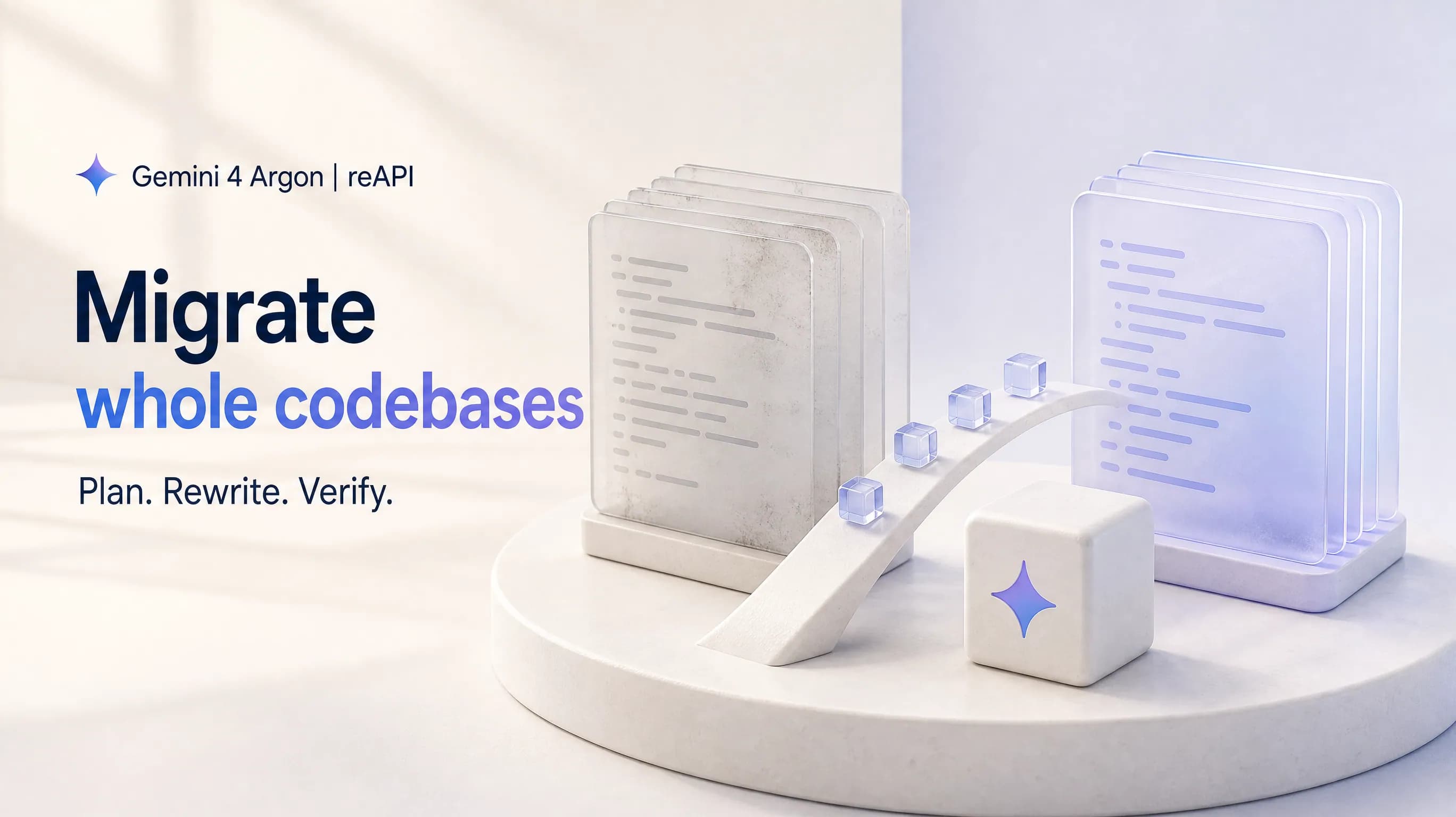
Gemini 4 Argon poster for long codebase migrations

Plan a migration with Gemini 4 Argon

Google's September 30 announcement describes Gemini 4 Argon agents migrating C and C++ code to Rust, including work on the Fuchsia Zircon kernel, with automated and manual review before shipping. Use Gemini 4 Argon to work through a module's dependencies, propose changes and identify the tests that should pass. For a large Gemini 4 Argon migration, keep source material within the shared context and handle continuation explicitly when generation needs another request.


Gemini 4 Argon poster for legal and finance research

Research documents with Gemini 4 Argon

Gemini 4 Argon scored highest on Vals Finance Agent v2 and Harvey's Legal Agent Benchmark in Google's September 30 comparison. Google documents image, video, audio and PDF input alongside text, extending Gemini 4 Argon beyond plain-text prompts. Give Gemini 4 Argon a specific research question and ask it to connect each conclusion to the supplied evidence; review the sources before relying on the result.

Gemini 4 Argon poster for defensive security reviews

Review security fixes with Gemini 4 Argon

Google introduced Gemini 4 Argon with examples of finding, validating and patching software vulnerabilities; it tied for first on CWE-bench v1 in Google's launch table. For an authorized code review, ask Gemini 4 Argon to explain the suspected flaw, propose a bounded fix and identify regression checks. The Gemini 4 Argon benchmark reflects Google's evaluation, while your own tests decide whether a proposed patch is ready.

Why reAPI for Gemini 4 Argon

Use your reAPI key with Gemini 4 Argon

Send Gemini 4 Argon requests with the same reAPI key you use for other supported models. Keep the key on your server and start with a small task whose answer you can check before expanding the workload.

Choose your Gemini 4 Argon request format

Gemini 4 Argon supports a native Gemini request surface on reAPI alongside chat-compatible requests. Use the native Gemini 4 Argon reference for thinking settings, structured output and function-call conversations; your application remains responsible for executing tools and sending their results back.

Budget Gemini 4 Argon by token usage

Gemini 4 Argon usage is billed by token, with current rates on this page. Include thinking and any continuation requests when comparing task costs; a short visible answer does not necessarily mean a small generation budget.

Gemini 4 Argon vs Claude Opus 5.5

Gemini 4 Argon leads on several coding, legal and video tasks in Google's September 30 comparison; Claude Opus 5.5 leads on terminal work. Compare the dated results below, then test the same workload and budget on both models.

Capability
Gemini 4 Argon
Claude Opus 5.5
Availability
Native Gemini and chat-compatible requests on reAPI
Available on reAPI now
Output and continuation
32,768 per native JSON request; 65,536 per stream; longer output via continuation
128K standard output limit in the referenced model specification
Context window
1,048,576 tokens shared by input, thinking and output
1M tokens
DeepSWE v1.1 (long-horizon coding)
77.9%
74.2%
Terminal-bench 4.0 (terminal work)
57.4%
66.4%
Harvey's Legal Agent Benchmark
19.6%
3.8%
LVBench (long video)
91.7%
83.7%

Scores are from Google's September 30, 2026 announcement; most non-Gemini scores were reported by their creators, with differing evaluation conditions. Gemini 4 Argon request limits follow Google's developer guides, checked October 14, 2026. Claude limits retain the specification used in the original comparison.

How to use Gemini 4 Argon

  1. step 01

    Create a key for Gemini 4 Argon

    Create an API key in your dashboard and keep it in server-side configuration. Use that key to authenticate Gemini 4 Argon requests; a Google API key is a different credential.

    Open
  2. step 02

    Try Gemini 4 Argon on a verifiable task

    Start Gemini 4 Argon with a short prompt or a small source excerpt. Compare the Gemini 4 Argon answer against your acceptance criteria, then adjust the thinking level and generation budget for that workload.

    Open
  3. step 03

    Connect Gemini 4 Argon to your application

    Follow the Gemini 4 Argon request reference for native JSON, streaming and chat-compatible examples. Preserve function-call history and continuation information when your Gemini 4 Argon workflow needs multiple requests.

    Open
docs/api/gemini-4-argon

API reference

Drop-in code and the full parameter table.

curl https://reapi.ai/api/v1beta/models/gemini-4-argon:generateContent \
  -H "x-goog-api-key: YOUR_API_KEY" \
  -H "Content-Type: application/json" \
  -d '{"contents":[{"role":"user","parts":[{"text":"Plan a C++ to Rust migration for this module"}]}],"generationConfig":{"maxOutputTokens":4096,"thinkingConfig":{"thinkingLevel":"medium"}}}'

Parameter validation failed

Rejected synchronously with the failing field named. Check enum values, ranges, and URL fields — nothing is charged.

Authentication or balance issue

401 means a missing or invalid Bearer key; 402 means the reserve exceeds your balance. Manage keys and credits in the console.

Content or material rejected

Reference material and outputs pass automated moderation. Rejected tasks fail with a clear error and a full refund.

Task failed or timed out

A task that reaches a failed state is never charged — the reserve refunds automatically. Keep the task id and retry when ready.

Frequently asked questions

Common questions about this model.

Gemini 4 Argon is Google's reasoning model for complex coding, research and multi-step agents. It produces text and has a unified 1,048,576-token window shared by input, thinking and output. Google documents multimodal input; the request reference explains the formats available through reAPI.

start building

Ready to ship?

Try it in the playground or grab an API key to integrate now.