· reAPI Team
Gemini 4 Argon vs Opus 5.5: The Viral Test That Got Challenged
The Gemini 4 Argon vs Opus 5.5 gummy bear test drew rebuttals. Follow the demo, reported reproductions and creator replies to see what the evidence shows.
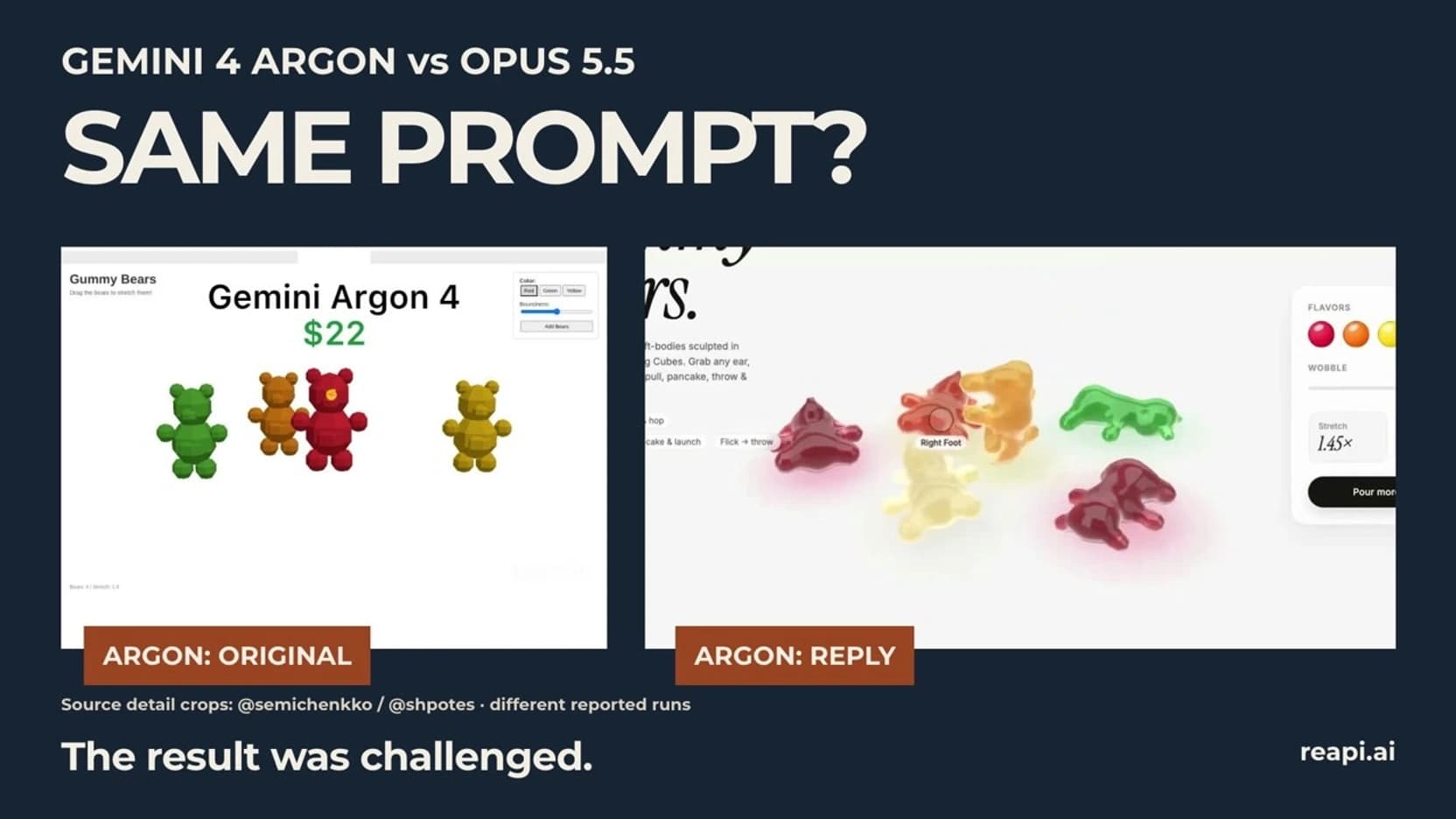
A gummy bear simulation turned Gemini 4 Argon vs Opus 5.5 into a dispute about how much a coding demo can prove. In a comparison posted by Semichenko, the output labeled Claude Opus 5.5 stretched and squashed more convincingly than the output labeled Gemini 4 Argon. The creator said both received the same prompt[1]. Another developer then posted a visibly different Argon result, also reporting use of that prompt[2].
The follow-up matters as much as the original clip: Semichenko acknowledged that the Gemini run might have failed and said more testing was needed[3]. The available posts document a disagreement over particular outputs. They leave the broader model ranking unresolved. Here is the evidence, the author's response, and a practical way to judge the next comparison.
TL;DR
- Semichenko's original post presents two interactive gummy bear simulations and reports an identical prompt. The striking visual contrast belongs to those reported runs[1].
- @shpotes reports a different result with Argon in Antigravity. That example challenges the inference that the first clip establishes Argon's limits[2].
- The original author explicitly allowed for a failed Gemini run and called for more testing[3].
- In another reply, the author proposed selecting the best of three attempts for each model next time. This was a proposed method, not a completed rerun[4].
- Our accompanying video reviews these third-party examples. reAPI did not conduct a new controlled benchmark or independently verify the complete setups and reported costs[5].
Watch the comparison and the responses
Our 2-minute, 18-second video follows the original demonstration, the reported reproduction and the author's replies. It is a companion to this analysis, with source credits in the description[5].
Jump to the original demonstration at 0:19, the reported reproduction at 0:46, or the author's response at 1:11.
The footage concerns code that produces an interactive simulation. It should be evaluated as a coding task. A recording of the resulting animation does not turn it into a text-to-video model comparison. The cover uses the thumbnail from our video; use the video and linked source posts to inspect the reported outputs.
What the Gemini 4 Argon vs Opus 5.5 demo showed
The original post places Opus above Argon and describes a sequence of interactions: pulling, compressing, throwing and adding more bears. Its criticism combines how the objects deform, how they interact and how the material looks[1].
Those are useful things to inspect separately. For this task, we would assess whether a bear changes shape when dragged, whether it recovers after release, whether a crowded scene remains usable, and whether its surface looks like the requested material. These are proposed evaluation criteria, not measurements we collected from the underlying applications.
Separating the criteria prevents an attractive surface from deciding the whole coding comparison. A viewer can prefer the lighting while still needing to check the interactions. Conversely, an unpolished object could satisfy a functional requirement. Decide which requirements matter before choosing a winning clip.
There is also a difference between evaluating the presented result and explaining why it happened. A recording can support a narrow observation about what appears on screen. Establishing the cause would require the instructions, generated project, execution history and settings. We did not obtain a complete matching record for both original runs, so we cannot isolate the model as the cause of the gap.
How the reported reproductions changed the argument
@shpotes described their result as: “Same prompt got radically different result on Argon + Antigravity.” The attached demonstration shows stretching and deformation in the result attributed to Argon[2]. It gives viewers a concrete reason to question whether the first output represents what Argon can produce on this task.
A separate post by @Caxvalencia is labeled “Argon - Medium” and includes another interaction example[6]. That label is the author's report of the setting. It does not independently establish identical instructions, the same starting files, or the same sequence of tool calls.
| Public record | What it contributes | What remains unverified here |
|---|---|---|
| Semichenko's original comparison | A visible contrast between two labeled outputs; a same-prompt claim | Complete, matched execution records for both runs |
| @shpotes' follow-up | A reported same-prompt Argon result using Antigravity | Equality of the full setup with the original comparison |
| @Caxvalencia's example | Another Argon-labeled interaction example, marked Medium | A fully matched reproduction protocol |
| Semichenko's replies | Acknowledgment of uncertainty and a proposed best-of-three approach | Results from a completed comparison using that proposal |
Sources: the original posts and replies[1][2][3][4][6].
The original post also carries a Community Note directing readers to reproductions[1]. Follow those links and inspect their evidence. A note is additional context, and its claims still need to be checked against the underlying sources.
Taken at face value, the follow-ups weaken a blanket claim that Argon cannot produce deformable bears. They do not establish how frequently either model succeeds, how much intervention each needs, or which will perform better on a different coding task. A strong counterexample can challenge an absolute claim without producing a general ranking.
The author's response belongs in the account
Semichenko wrote: “Hmm, maybe my Gemini failed, I need to test more”[3]. An earlier reply thanked another tester and proposed using the best of three attempts from each model in a future comparison[4].
That response narrows the disagreement. There is no need to pretend the original visual difference disappeared, and no basis in these posts to assign deceptive intent. The author acknowledged uncertainty about the run. Readers should see that acknowledgment alongside the clip they are being asked to judge.
Best-of-three would answer a particular question: how good a result can each model produce within three attempts under the chosen rules? It would still leave first-attempt reliability unanswered if only the winning attempt were shown. For a future test, we would publish all attempts and identify which one was selected, keeping the strongest result and the failure record available for inspection.
A more useful way to compare the coding results
The following is an editorial testing proposal. We have not run it, and it is not a reconstruction of the creators' private sessions. Its purpose is to make the next result easier to interpret.
Save the complete starting point. Keep the exact prompt, attachments, starter project and any additional instructions. If the test starts with an empty directory, say so. A prompt copied into a different project does not, by itself, establish that the models received equivalent context.
Record the environment and settings. Name the model, application or coding agent, available tools and settings actually used. Keep the request or session record where possible. Record an unknown setting as unknown; do not infer it from how good the output looks. The mention of Antigravity in the follow-up is a useful disclosed detail, but it cannot supply missing details about the other sessions.
Choose the attempt policy in advance. Decide whether the comparison measures first attempts, a fixed number of attempts, or completion within a defined budget. Apply the same intervention rules. If one result required a repair prompt, include that prompt and count the extra work instead of presenting the final application as an untouched first response.
Run the same interaction checks. For this gummy bear task, define a repeatable sequence: drag a limb, release it, compress the body, move a bear into another, and add several objects. Record whether each requested interaction works, where it fails and whether the application remains usable. This is a proposed acceptance checklist, not a claim that the showcased simulations implement physically accurate materials.
Keep quality and expense separate until the task is scored. The original clip includes creator-reported cost figures. We have not independently verified the billing records or complete work behind them[5]. For your own test, retain the usage and cost for every included attempt, then compare expense against the same acceptance criteria. A failed attempt still belongs in the evaluation record.
If you want to run an evaluation through reAPI, consult the Gemini 4 Argon model page and Claude Opus 5.5 model page for the current model information and pricing. Those pages are starting points for your own setup; they do not reproduce the tools or sessions shown in the social posts.
For the separate question of published model benchmarks, see our Gemini 4 Argon, GPT-6 Astra and Claude Opus 5.5 comparison. It covers a dated vendor benchmark table. This article addresses the specific gummy bear dispute.
FAQ
Did the viral test prove that Opus 5.5 is better at coding?
It presents a result favoring Opus in that particular visual comparison. The posts we reviewed do not provide a controlled, repeated evaluation that establishes a general coding advantage[1][3].
Did the Argon follow-up use the same prompt?
@shpotes explicitly says it did. That is a source-attributed claim. We did not independently verify all prompt content, surrounding context, settings and execution steps against the original sessions[2].
Does the reproduction prove that Argon wins instead?
No general winner follows from these examples. The reported reproduction challenges the inference drawn from the first Argon result; it does not establish a success rate or an advantage across coding tasks[2].
Did the creator acknowledge the criticism?
Yes. Semichenko said the Gemini run might have failed and more testing was needed. The author also proposed best-of-three selection for a future comparison[3][4].
Was this an AI video-generation test?
The published examples concern interactive simulations built through coding. Our video discusses recordings of those outputs. It does not compare text-to-video generation models[5].
Did reAPI rerun the benchmark?
No. This article and the linked video analyze third-party reported runs. We did not independently reproduce the complete setups, inspect their full billing records or produce a new benchmark score[5].
What to ask for before choosing a winner
Start with the original demonstration, then read the reproduction and the author's response. If you need a model decision, ask for the complete setup and all attempts under a stated evaluation rule. Until those are available, the Gemini 4 Argon vs Opus 5.5 gummy bear test is useful as a specific case to investigate. Choose a model for your own work after checking the behavior you need under conditions you can repeat.
References
-
Semichenko (@semichenkko). Original gummy bear comparison and attached Community Note. Retrieved October 19, 2026 from x.com/semichenkko/status/2110131790136401989
-
@shpotes. Reported same-prompt Argon + Antigravity reproduction. Retrieved October 19, 2026 from x.com/shpotes/status/2110222482632286672
-
Semichenko (@semichenkko). Reply acknowledging a possible failed Gemini run and the need for more testing. Retrieved October 19, 2026 from x.com/semichenkko/status/2110375383686135996
-
Semichenko (@semichenkko). Reply proposing best-of-three selection for a future comparison. Retrieved October 19, 2026 from x.com/semichenkko/status/2110282000246472931
-
reAPI. Gemini 4 Argon vs Opus 5.5: The Viral Test That Got Challenged. Retrieved October 19, 2026 from youtu.be/QR9HChbtym0
-
@Caxvalencia. Argon - Medium interaction example. Retrieved October 19, 2026 from x.com/Caxvalencia/status/2110170790444269766