ChatDeepSeek
DeepSeek V4
The DeepSeek V4 API — Flash + Pro, 1M context, thinking by default, frontier reasoning at a low per-token price.
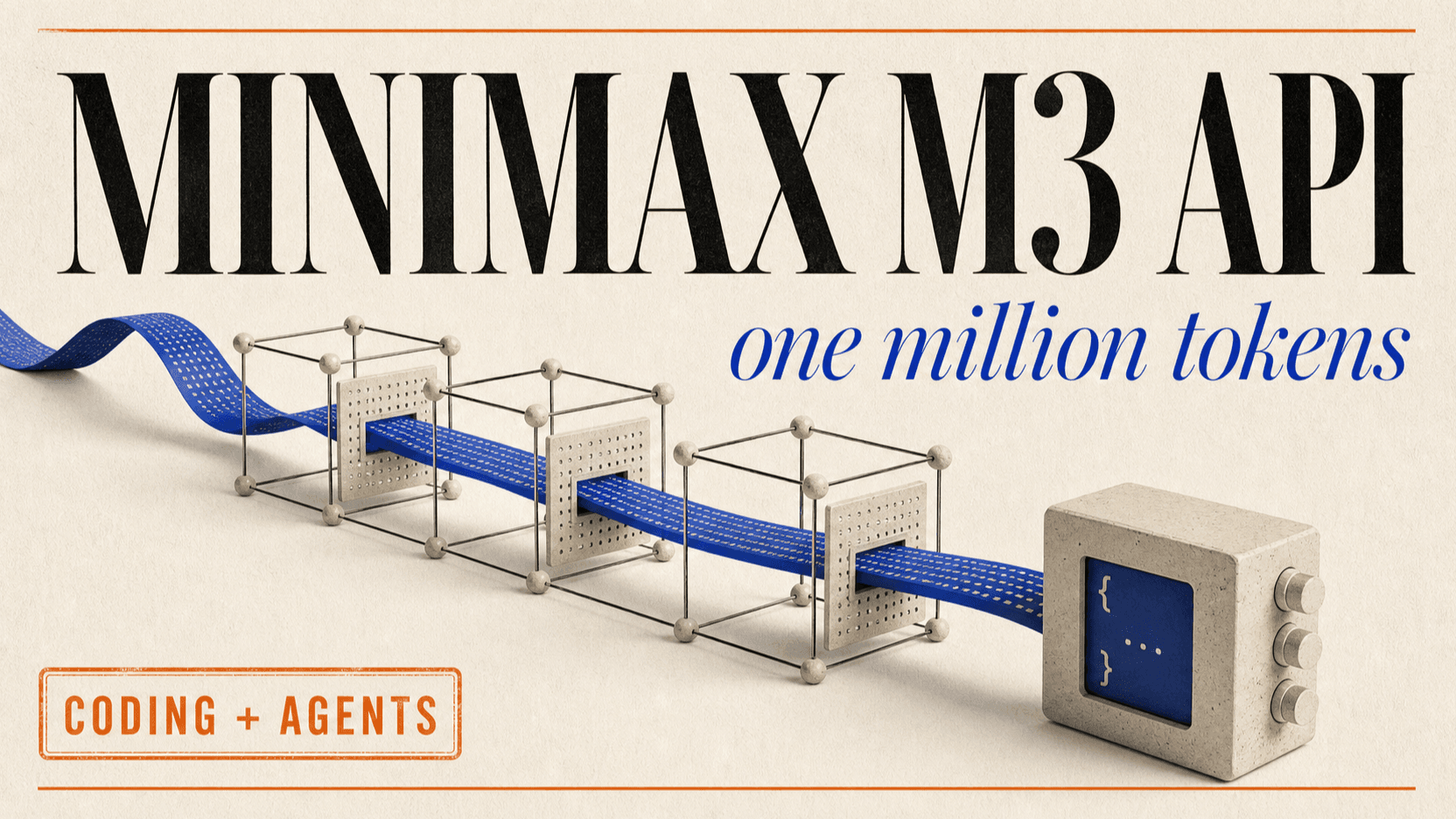
MiniMax M3 is an open-weight model that pairs frontier coding and agentic benchmarks with a 1M-token context window and native multimodal input. MiniMax M3 reasons before it answers, calls tools across long-horizon runs, and reads images and video in the same call — exposed on api.reapi.ai as a drop-in OpenAI-compatible endpoint. Pay-as-you-go in USD at a fraction of closed-source frontier rates.
minimax/minimax-m3Open the chat playground to run MiniMax M3 through the OpenAI-compatible chat completions surface with your api.reapi.ai key.
Real-world workflows and production use cases you can build and ship with this model.

Agentic coding is the headline of the MiniMax M3. MiniMax reports frontier-level results on software-engineering benchmarks — 59.0% on SWE-Bench Pro and 66.0% on Terminal-Bench 2.1 — putting MiniMax M3 in range of the top closed-source coding models while staying open-weight. Point a coding agent at the MiniMax M3 and it scopes the task, calls tools, reasons through multi-step work, and self-corrects across a long run, all in one session.
Read the API docs

The MiniMax M3 defaults to a 1M-token context window — enough to load a whole mid-size repository, a long research pack, or a multi-turn agent trace in a single call. MiniMax Sparse Attention keeps long-context inference efficient, so MiniMax M3 workloads like architecture review, dependency audits, and migration planning rarely need chunking. Stable prompt prefixes hit the low cache-read rate on every repeat.

The MiniMax M3 is multimodal from the ground up: send images and video alongside text in the same Chat Completions call — screenshots, diagrams, document scans, and clips — and the model reasons over all of it. Combined with reliable function calling and JSON output, the MiniMax M3 drives browser agents, document pipelines, and tool-using workflows that mix vision, retrieval, and code.
Credit-based — 1 credit = $0.001 USD. Pay only for completed generations.
| Category | Unit | Price |
|---|---|---|
| Token pricing | ||
| Input | 1M tokens | $0.6 |
| Output | 1M tokens | $2.4 |
| Cache read | 1M tokens | $0.12 |
The MiniMax M3 speaks OpenAI Chat Completions verbatim. Moving an existing OpenAI integration to MiniMax M3 is a base URL, an API key, and a model-string change — `minimax/minimax-m3` — not a platform rewrite. The same `messages` array, the same streaming format, the same tool-calling shape.
MiniMax M3 is open-weight and priced to match. It posts frontier coding and agentic benchmarks while costing a fraction of closed-source models per token — and prompt caching drops the price again on repeated context. Run premium agentic work without premium per-token bills.
A single api.reapi.ai key unlocks the MiniMax M3 alongside GPT-5.5, Claude Opus 4.8, DeepSeek V4, Gemini, and every other frontier chat model on the platform. Compare vendors, add fallbacks, and route traffic per call with a configuration change instead of an integration project.
MiniMax M3 and DeepSeek V4 are both open-weight, value-priced models with a 1M-token context window, thinking, and tool use. Here is how MiniMax M3 is positioned against DeepSeek V4 on the dimensions that matter for agentic and coding work.
Comparison reflects publicly documented behavior from MiniMax's M3 release notes and DeepSeek's V4 documentation at the time of writing. Benchmark figures are vendor-reported. Model behavior and pricing can change; check the pricing card above and the API docs for current values.
Sign up at api.reapi.ai, open the console, generate an API key under API Keys, and top up tokens under Top Up. The chat workspace is separate from the reapi.ai image/video gateway — keys do not cross over.
OpenPOST https://api.reapi.ai/v1/chat/completions with `model` set to `minimax/minimax-m3`, your `messages` array, and `max_tokens`. The MiniMax M3 endpoint is OpenAI-compatible, including streamed responses, so most SDKs work with only a base URL change.
OpenMiniMax M3 thinks adaptively — it reasons when a task is hard and answers directly when it is not. Reuse stable system prompts and tool schemas across calls to hit the low cache-read rate, and set `max_tokens` high enough to fit the chain-of-thought on reasoning-heavy work.
OpenCommon questions about this model.
Explore more models in the same category.
ChatDeepSeek
The DeepSeek V4 API — Flash + Pro, 1M context, thinking by default, frontier reasoning at a low per-token price.
ChatOpenAI
OpenAI's GPT-5.4 with 1M context and 128K max output — the cost-efficient GPT route.
ChatAnthropic
Anthropic's Claude Opus 4.7 — 1M context, 128K output, premium coding and agent reasoning.
ChatAnthropic
Anthropic's Claude Sonnet 4.6 — balanced quality and speed for everyday production chat, code review, and mid-complexity agents.
Try it in the playground or grab an API key to integrate now.