MiniMax M3 API: 1M Context, Pricing, and Coding Guide (2026)
Use the MiniMax M3 API for coding, agents, and multimodal work. Compare official and reAPI pricing, 1M context behavior, thinking modes, and limits.
The MiniMax M3 API is built for coding agents, long-running tool workflows, and multimodal analysis. It accepts text, images, and video, supports up to one million tokens of context, and exposes thinking controls for trading latency against deeper reasoning. The open weights are also available, but the hosted API is the practical route for teams that do not want to operate an 800GB-class checkpoint.
This guide separates MiniMax's direct API behavior from the current reAPI route. That distinction matters because model IDs, pricing bands, and request surfaces are not identical.
TL;DR
- MiniMax released M3 on June 1, 2026, then published the model weights under the MiniMax Community License.[1]
- The hosted model supports up to 1M tokens, with native text, image, and video input.[2]
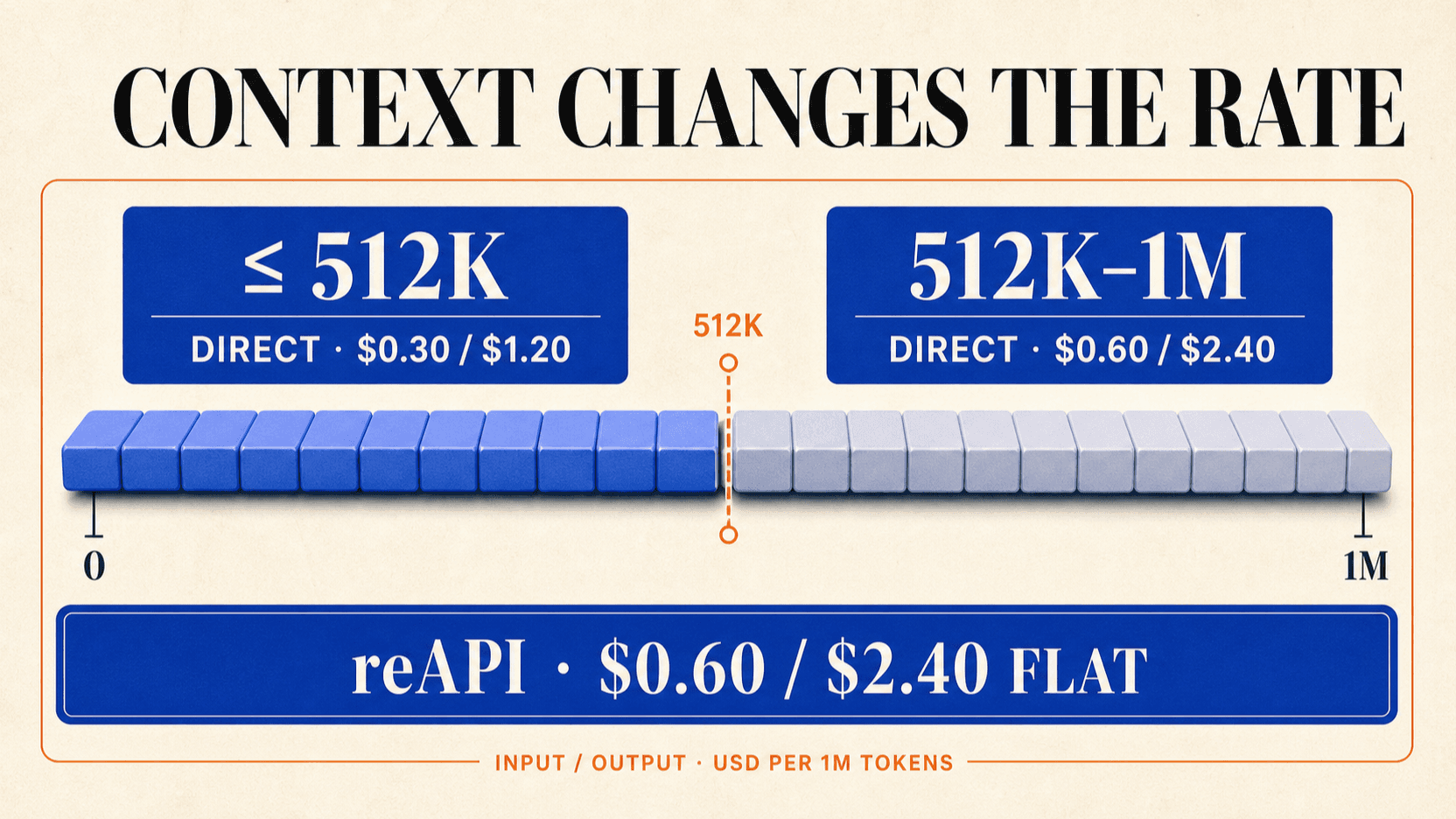
- MiniMax prices direct API calls differently below and above 512K input tokens.
- reAPI currently uses one flat rate: $0.60 input, $2.40 output, and $0.12 cache read per million tokens.
- Use M3 for repository analysis, coding agents, document-heavy work, and multimodal tasks. Do not assume that a 1M window makes retrieval, compaction, or prompt organization unnecessary.
MiniMax M3 API specifications
| Specification | MiniMax M3 |
|---|---|
| Release date | June 1, 2026 |
| Context window | Up to 1M tokens |
| Guaranteed hosted context | At least 512K tokens |
| Input modalities | Text, image, video |
| Output | Text |
| Native API maximum generation budget | 524,288 tokens; recommended 131,072, not a documented default[5] |
| Reasoning modes | Enabled, adaptive, disabled |
| Recommended sampling | temperature: 1.0, top_p: 0.95 |
| reAPI model ID | minimax/minimax-m3 |
| reAPI endpoint | /v1/chat/completions |
| Weights | Published on Hugging Face and GitHub |
MiniMax describes M3 as a coding and agentic model powered by MiniMax Sparse Attention. The architecture is designed to reduce the compute and memory cost of million-token attention. That is a vendor claim about its architecture, not a guarantee that every one-million-token request will be fast or equally accurate across the entire sequence.
The published checkpoint is about 427 billion parameters and the main Hugging Face repository is roughly 854GB before local serving overhead. Local deployment is possible through frameworks such as SGLang, vLLM, Transformers, and KTransformers, but it is not a casual single-GPU model.[1]
MiniMax M3 API pricing explained
MiniMax's direct API separates ordinary and long-context calls. Its current promotional rate card lists the following standard-service prices:
| Route | Input / 1M | Output / 1M | Cache read / 1M |
|---|---|---|---|
| MiniMax direct, input ≤512K | $0.30 | $1.20 | $0.06 |
| MiniMax direct, input 512K–1M | $0.60 | $2.40 | $0.12 |
| reAPI current rate | $0.60 | $2.40 | $0.12 |
The direct prices above are discounted rates shown by MiniMax on August 1, 2026. The page also displays higher crossed-out list prices, so production budgets should store the retrieval date rather than treating the discount as a permanent property of the model.[3]
reAPI uses a flat token rate instead of changing the price at the 512K boundary. This is easier to estimate, although short-context calls can be cheaper through MiniMax's direct promotional tier.
A realistic cost example
Suppose a repository-analysis job sends 180,000 uncached input tokens and returns 12,000 output tokens through reAPI:
input  = 180,000 / 1,000,000 × $0.60 = $0.1080
output =  12,000 / 1,000,000 × $2.40 = $0.0288
total  = $0.1368
The same workflow becomes cheaper when repeated prefixes hit the cache. Put stable tool definitions, repository instructions, and system context first; keep changing task details near the end. MiniMax says automatic prompt caching uses prefix matching and applies to inputs of at least 512 tokens.[4]
How to call MiniMax M3 through reAPI
The reAPI route uses the familiar OpenAI Chat Completions shape. The important detail is the namespaced model ID.
curl https://api.reapi.ai/v1/chat/completions \
  -H "Authorization: Bearer $REAPI_API_KEY" \
  -H "Content-Type: application/json" \
  -d '{
    "model": "minimax/minimax-m3",
    "messages": [
      {
        "role": "system",
        "content": "Review code conservatively. State assumptions before editing."
      },
      {
        "role": "user",
        "content": "Find the race condition in this queue worker and propose a minimal patch."
      }
    ],
    "temperature": 1,
    "top_p": 0.95,
    "max_tokens": 8192
  }'
Use the exact ID returned by model discovery when integrating with a production key. The MiniMax M3 model page and API documentation show the current reAPI surface.
MiniMax's direct endpoint uses MiniMax-M3 rather than the reAPI namespaced ID.
Do not copy one provider's model string into another provider's request and
assume the gateway will normalize it.
What is MiniMax M3’s maximum output?
MiniMax's native OpenAI-compatible API lists a maximum generation budget of 524,288 tokens and recommends 131,072. Its current control field is max_completion_tokens; max_tokens is deprecated in that native reference. The recommendation does not specify the value used when the field is omitted, or guarantee the visible answer length. The reAPI example above explicitly requests max_tokens: 8192; that is the example's budget, not the model ceiling. Follow the documentation of the endpoint you call instead of assuming another service accepts the same fields or limits[5].
Thinking modes and agent behavior
The open model card documents three reasoning modes:
enabled: always use explicit reasoning.adaptive: let M3 decide when additional reasoning is useful.disabled: minimize latency and maximize throughput.
For code review, debugging, multi-step planning, and tool-heavy agents, start with adaptive or enabled reasoning. For autocomplete, classification, and short transformations, disabled reasoning can reduce delay. MiniMax says thinking on and off share the same direct API token rates; the cost difference comes from how many tokens the request ultimately consumes, not a separate reasoning surcharge.[2]
Reasoning controls can differ across hosted routes. If an application depends
on a particular thinking field, test the accepted request schema before
shipping rather than assuming all OpenAI-compatible endpoints forward it.
Where the one-million-token window helps
A long context window is most useful when the model needs several related artifacts at once:
- a repository plus issue history and build logs;
- a long contract set with cross-document references;
- a video transcript paired with selected frames;
- multi-step agent traces that should remain available for later decisions.
It is less useful when the prompt is an unfiltered dump. Large inputs increase latency and can bury the relevant evidence. A production agent should still deduplicate files, retrieve likely sections first, summarize completed tool traces, and preserve exact source locations for verification.
If your decision is mainly about open weights and managed reliability, compare Kimi K3 with Claude Opus 5. For another lower-cost one-million-token coding model, see the GLM-5.2 API guide.
MiniMax M3 limitations
The main constraint is operational scale. Publishing the weights gives teams deployment control, but it does not make a 427B-parameter multimodal model easy to serve. Quantization reduces memory, while long contexts add KV-cache and throughput pressure back into the system.
Benchmark claims also need context. MiniMax reports 59.0% on SWE-Bench Pro and 66.0% on Terminal-Bench 2.1, but the release notes explain that different models sometimes used different scaffolds and that several results came from internal infrastructure.[2] Treat those scores as evidence of intended capability, not a forecast of success in your own agent.
Finally, one-million-token availability can depend on service capacity. MiniMax describes 512K as guaranteed and the upper band as up to 1M. Test the exact region, account, concurrency, and request size you plan to use.
FAQ
Is MiniMax M3 open weight?
Yes. MiniMax publishes M3 weights on Hugging Face and code on GitHub under the MiniMax Community License. Review that license before commercial deployment.
What is the MiniMax M3 API context window?
The hosted API supports up to one million tokens, with MiniMax describing 512K as the guaranteed minimum. Calls above 512K use a higher direct pricing band.
Does MiniMax M3 support images and video?
Yes. MiniMax describes M3 as natively multimodal with text, image, and video input. Its output is text rather than generated images or video.
What model ID does reAPI use?
Use minimax/minimax-m3 with https://api.reapi.ai/v1/chat/completions.
Is MiniMax M3 cheaper than GPT or Claude?
Its token rates are lower than many frontier managed models, but cost per token is not cost per completed task. Compare tool reliability, retries, output length, latency, and review effort on your own workload.
Conclusion
The MiniMax M3 API is a strong fit for teams that need long context, coding agents, multimodal input, and the option to self-host later. Use the hosted route first when you want predictable operations; evaluate the open weights when data control or customization justifies the infrastructure. Most importantly, budget the correct context band and test the agent harness—not only the model name.
References
- MiniMax AI. MiniMax M3 official model repository and local deployment guidance. huggingface.co/MiniMaxAI/MiniMax-M3
- MiniMax. MiniMax M3: Frontier Coding, 1M Context, Native Multimodality. minimax.io/blog/minimax-m3
- MiniMax API Platform. MiniMax M3 pay-as-you-go pricing. platform.minimax.io
- MiniMax API Docs. Automatic prompt caching. platform.minimax.io/docs/api-reference/text-prompt-caching
- MiniMax. Native Chat Completions API — maximum generation budget and recommended value. Retrieved September 8, 2026 from platform.minimax.io/docs/api-reference/text-chat-openai
Author

Categories
More Posts
How to Use GPT Image 2: Text Rendering and Thinking Mode
How to use GPT Image 2: the 99% text rendering that removes the composite step, what Thinking Mode does, where it loses to Nano Banana 2, and prompt changes.

Kling Motion Control API: v2.6 vs v3, Prices, and Input Prep
Use Kling Motion Control v2.6 or v3 with the right orientation mode, source length, price tier, and reference image to reduce face and body drift.

GPT Image 2.5 Flare vs Sunburst: Which Should You Use?
Compare GPT Image 2.5 Flare vs Sunburst for speed, editing precision and API controls, with a practical test plan and clear limits on pricing comparisons.