Kimi K3 vs Claude Opus 5: Open Weights or Managed Reliability?
Kimi K3 vs Claude Opus 5: compare open weights, 1M context, reasoning, multimodal input, API prices, deployment demands, and the right model for each team.
Choose Kimi K3 when open weights, native multimodal input, and deployment control justify serious infrastructure. Choose Claude Opus 5 when you want a managed model with a mature enterprise API and stronger published evidence for long-running agentic work. That is the useful Kimi K3 vs Claude Opus 5 split.
It is tempting to turn this comparison into one benchmark leaderboard. There is no credible apples-to-apples table yet. Moonshot's K3 report predates Opus 5 in its comparison set, while Anthropic's Opus 5 launch table does not include K3.[1][2] Combining scores from different harnesses would look precise and answer the wrong question.
TL;DR
- Kimi K3 is open weight. Its 2.8T-parameter MoE checkpoint is available under the Kimi K3 License; 104B parameters activate per token.[1]
- Claude Opus 5 is managed only. You get a mature API, multiple cloud platforms, adaptive thinking, and no model-serving infrastructure.
- Both have roughly 1M context and 128K-class default output capacity. K3 can expose a much larger completion ceiling, but using it is expensive.
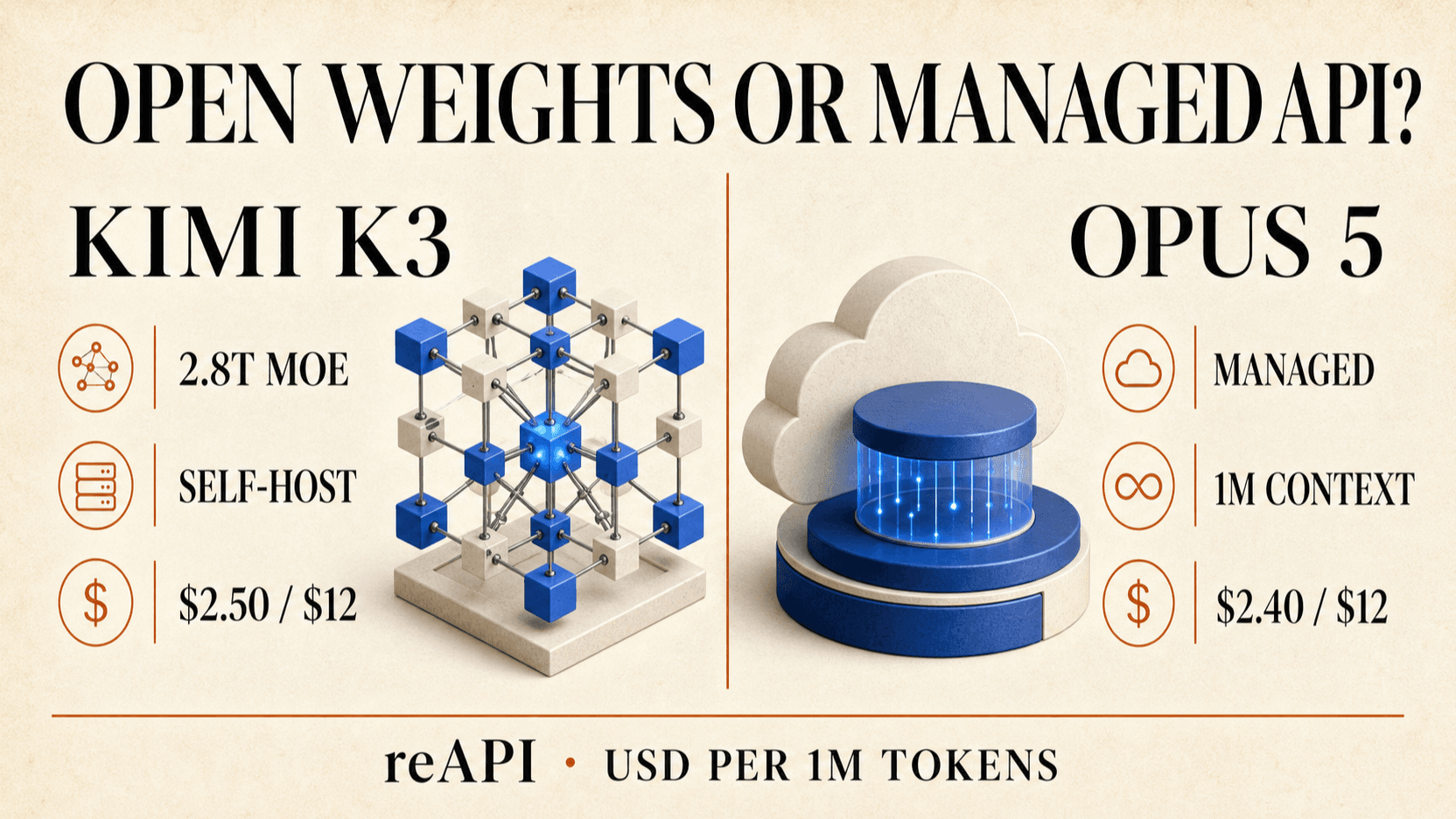
- Hosted price does not follow openness. On reAPI, K3 is $2.50 input / $12 output while Opus 5 is $2.40 / $12 per million tokens.
- Self-hosting K3 is a cluster decision. Native MXFP4 weights alone have a raw floor around 1.4TB before runtime overhead.
- There is no honest universal winner. K3 wins deployment control; Opus 5 wins operational simplicity and published agent reliability.
Kimi K3 vs Claude Opus 5 at a glance
| Category | Kimi K3 | Claude Opus 5 |
|---|---|---|
| Distribution | Open weights under Kimi K3 License | Proprietary managed API |
| Architecture | 2.8T MoE, 104B active per token | Undisclosed |
| Context | 1,048,576 tokens | 1M tokens |
| Output | 128K default; API can allow up to 1M | 128K maximum |
| Input | Text, image, native visual understanding | Text and image |
| Thinking | Always on; low, high, max | Adaptive; low through max |
| Sampling | Fixed temperature/top-p | Vendor-controlled with effort dial |
| Official token price | $3 / $15 | $5 / $25 |
| reAPI token price | $2.50 / $12 | $2.40 / $12 |
| Self-hosting | Permitted under license; very demanding | Not available |
Open weights change control, not just price
Kimi K3 gives teams the checkpoint. Moonshot describes it as a 2.8T-parameter sparse Mixture-of-Experts model with 104B activated parameters, 896 routed experts, native MXFP4 weights, and a one-million-token context window.[1]
That enables private deployment, adaptation, infrastructure experiments, and research that a closed API cannot support. It does not automatically mean cheap local inference. Four bits across 2.8 trillion parameters produce a raw weight floor of roughly 1.4TB decimal before scales, indexes, activations, and runtime state. The active 104B parameters reduce computation, not the full checkpoint that must remain accessible.
Claude Opus 5 makes the opposite trade. Anthropic runs the serving stack, controls updates and safeguards, and exposes the model through Claude API, Amazon Bedrock, Google Cloud, and Microsoft Foundry.[3] You give up checkpoint access and gain an operational surface that can be adopted without a multi-node inference project.
Why benchmark claims need restraint
Moonshot's official K3 report compares K3 with Claude Fable 5, Claude Opus 4.8, GPT-5.6 Sol, GPT-5.5, and GLM-5.2. Opus 5 is absent.[1] Anthropic's Opus 5 launch compares against Fable 5, Opus 4.8, and GPT-5.6 Sol, but not K3.[2]
There are common benchmark names across external leaderboards, but harness,
effort, tool access, fallback rules, and dates differ. A score from Kimi Code
at max is not automatically comparable with a Claude Code or mini-SWE-agent
run published by another vendor.
What can be said safely:
- K3's own report positions it near the frontier on coding, knowledge work, multimodal tasks, and browser agents.
- Anthropic's launch data positions Opus 5 strongly on long-horizon coding, computer use, automation, and self-verification.
- Neither source establishes a controlled K3-versus-Opus-5 winner.
A production comparison should run both models with the same tools, timeouts, task set, and success rubric.
Reasoning and conversation state
K3 always reasons. Its top-level reasoning_effort accepts low, high, and
max, defaulting to max. Preserved Thinking is always active, which means a
multi-turn application must send the complete assistant message back—including
reasoning_content and tool calls. Changing effort mid-conversation also
invalidates prefix-cache reuse.[4]
Opus 5 also turns thinking on by default, but its ladder has five levels from
low through max, defaulting to high. Thinking can be disabled at high
or below, although Anthropic recommends keeping it adaptive and lowering
effort to control cost.[3]
The practical difference is flexibility. Opus lets one application reserve maximum reasoning for hard cases and run routine work lower. K3 provides a smaller ladder and requires the application to preserve reasoning state exactly.
Multimodal input and long context
K3 is natively multimodal and Moonshot documents image and video understanding. Its API does not accept arbitrary public image URLs: visual input must use a base64 data URI or Moonshot file reference.[5]
Opus 5 accepts image input and has a 1M context window, but it is not presented as a native video-understanding model. Video workflows normally extract frames, transcripts, or structured events before sending them to Claude.
For long codebases and document sets, both windows are large enough that retrieval strategy matters more than the last 48K tokens. Sending an entire repository on every turn can be slower and more expensive than combining search, summaries, and targeted file loading.
API pricing: open weight is not automatically cheaper
| Route | Input / MTok | Cached input | Output / MTok |
|---|---|---|---|
| Moonshot Kimi K3 | $3.00 | $0.30 | $15.00 |
| Anthropic Claude Opus 5 | $5.00 | $0.50 cache hit | $25.00 |
| reAPI Kimi K3 | $2.50 | Not separately published | $12.00 |
| reAPI Claude Opus 5 | $2.40 | Not separately published | $12.00 |
Direct vendor pricing makes K3 clearly cheaper. On reAPI the difference nearly disappears: Opus input is ten cents cheaper and output costs the same. That is a useful reminder that model licensing and hosted inference pricing are different markets.
Self-hosting changes the calculation again. K3 eliminates per-token vendor fees but adds accelerators, storage, networking, inference engineering, monitoring, and underutilized capacity. It wins economically only when control or sustained scale pays for that stack.
Which model should you choose?
Choose Kimi K3 when
- weights must run inside your own controlled environment;
- native image and video understanding matters;
- you can operate a large MoE inference stack;
- license-level modification and deployment control are requirements;
- a lower direct vendor token rate matters more than managed ecosystem depth.
Choose Claude Opus 5 when
- you need production API reliability without serving the model;
- long-running coding, computer use, and self-verification are core workloads;
- deployment across Anthropic, Bedrock, Vertex AI, or Foundry matters;
- five effort levels and managed fallbacks fit the application;
- time-to-production is more valuable than checkpoint control.
Evaluate both when
The workload is a hosted coding agent. On reAPI their output price is identical, so a controlled A/B test can decide on completion rate, latency, and token use without separate integrations.
Calling Kimi K3 and Opus 5 on reAPI
from openai import OpenAI

client = OpenAI(
    api_key="YOUR_REAPI_KEY",
    base_url="https://api.reapi.ai/v1",
)

def ask(model, prompt):
    return client.chat.completions.create(
        model=model,
        messages=[{"role": "user", "content": prompt}],
        max_tokens=12000,
    )

kimi = ask("kimi-k3", "Find the root cause and propose a minimal patch.")
opus = ask("claude-opus-5", "Find the root cause and propose a minimal patch.")
For K3 multi-turn sessions, preserve the complete returned assistant message.
Do not reconstruct it from visible content alone.
FAQ
Is Kimi K3 better than Claude Opus 5?
No controlled official comparison establishes that. K3 is better when open weights and deployment control are requirements; Opus 5 is better when managed reliability and long-horizon agent tooling matter more.
Is Kimi K3 open source?
It is safest to call K3 open weight. Moonshot publishes the weights under the Kimi K3 License, which permits broad use and modification subject to its terms. That is not the same claim as publishing every training component and dataset.
Can Kimi K3 run on a consumer GPU?
Not as a normal local deployment. Its native four-bit weights have a raw floor around 1.4TB, so practical self-hosting is a cluster-scale project.
Which model has the larger context window?
They are effectively tied for ordinary planning: K3 has 1,048,576 tokens and Opus 5 has 1M. Application-side retrieval and compaction usually matter more.
Which model is cheaper on reAPI?
Opus 5 is slightly cheaper on input at $2.40 versus K3's $2.50 per million tokens. Both are $12 per million output tokens at the current listed rate.
Verdict
Kimi K3 vs Claude Opus 5 is a control-versus-operations decision before it is a benchmark fight. K3 opens the checkpoint and asks you to carry a formidable serving stack. Opus 5 closes the weights and removes that stack from your job. For hosted API workloads, test both; for private deployment, K3 is the only one of the pair that gives you the weights.
References
- Moonshot AI. Kimi K3 official repository and technical report. github.com/MoonshotAI/Kimi-K3
- Anthropic. Introducing Claude Opus 5. anthropic.com/news/claude-opus-5
- Anthropic. What's new in Claude Opus 5. platform.claude.com/docs/en/about-claude/models/whats-new-opus-5
- Moonshot AI. Kimi K3 Quickstart and reasoning effort. platform.kimi.ai/docs/guide/kimi-k3-quickstart
- Moonshot AI. Using Kimi vision models. platform.kimi.ai/docs/guide/use-kimi-vision-model
Further reading
- reAPI. Kimi K3 complete guide. reapi.ai/blog/kimi-k3-complete-guide
- reAPI. Can Kimi K3 run on a 4GB GPU? reapi.ai/blog/unbelievable-run-kimi-k3-2-8-trillion-parameters-on-a-single-4gb-gpu
- reAPI. How to use Claude Opus 5. reapi.ai/blog/how-to-use-claude-opus-5
Author

Categories
More Posts

Seedance 2.5 Pricing: 53% More Per Token Than Seedance 2.0
Seedance 2.5 pricing is $10.70 per million tokens on BytePlus. See the per-second conversion, reference-video clock, and current reAPI rates.

Which Grok Imagine Model to Use: 1.0 vs 1.5 vs Image 2.0
Three Grok Imagine models in four months, split across video and images. Which one has an API, which is cheaper, and the naming trap that costs an afternoon.

Image to Video API in 2026: Prices, Inputs, and Free Limits
Image to video API routes compared: source-image, reference, and first/last-frame inputs across six models, with live per-second prices from $0.03/s.