GPT-6 Sol vs Terra vs Luna: Where Astra and 6.1 Sol Fit
GPT-6 Sol vs Terra vs Luna explained: OpenAI's GPT-6 lineup has Astra, Sol, 6.1 Sol and Luna but no GPT-6 Terra. Prices, efforts, scores and which to use.
GPT-6 Sol, Terra and Luna are OpenAI language models, not the Solana or Terra Luna cryptocurrencies. If you searched "GPT-6 Sol vs Terra vs Luna" and got coin prices, some assistants read the query that way. This article is about the API models.
The short version: OpenAI's GPT-6 family has four models in its API catalogue, namely GPT-6 Astra, GPT-6 Sol, GPT-6.1 Sol and GPT-6 Luna. None of them is called Terra[1]. Terra exists only in the previous generation, as GPT-5.6 Terra[2]. Below is one table that places all five, what OpenAI and an independent benchmark say about how they differ, and which one to pick for which job.
TL;DR
- There is no GPT-6 Terra. OpenAI's model catalogue lists GPT-6 Astra, GPT-6 Sol, GPT-6.1 Sol and GPT-6 Luna, plus GPT-5.6 Sol, Terra and Luna from the July generation[1].
- Astra is the top tier. OpenAI calls GPT-6 Astra "our most capable model for the most demanding work", at $10 input and $50 output per million tokens[1][3].
- Sol is the middle tier and already has a successor. GPT-6 Sol shipped on September 22, 2026; GPT-6.1 Sol followed on September 29 at the same $2 input and $10 output, with cheaper cached input[4].
- Luna is the efficient tier at $0.10 input and $0.50 output, built "for focused, high-volume tasks"[1][3].
- Scores follow price. On Artificial Analysis's Intelligence Index at max effort, GPT-6 Astra scores 53, GPT-6.1 Sol 52, GPT-6 Sol 48 and GPT-6 Luna 38[5].
The GPT-6 lineup in one table
| Model | API model id | Released | OpenAI's description | Reasoning effort | Input / cached input / output (per 1M tokens) |
|---|---|---|---|---|---|
| GPT-6 Astra | gpt-6-astra | Sep 3, 2026 | Most capable model, for the most demanding work | low to max | $10 / $1 / $50 |
| GPT-6.1 Sol | gpt-6.1-sol | Sep 29, 2026 | Near-Astra performance for complex work at a lower cost | low to max | $2 / $0.10 / $10 |
| GPT-6 Sol | gpt-6-sol | Sep 22, 2026 | Built for complex coding and agentic workflows | none to max | $2 / $0.20 / $10 |
| GPT-6 Luna | gpt-6-luna | Sep 22, 2026 | Most efficient model, for focused, high-volume tasks | none to max | $0.10 / $0.01 / $0.50 |
| GPT-5.6 Terra | gpt-5.6-terra | Jul 9, 2026 | Balances intelligence and cost; roughly the old "mini" tier | none to max | $2 / $0.20 / $12 |
Sources: model catalogue and model pages[1], OpenAI API changelog[4], OpenAI Standard pricing for prompts up to 272K input tokens[3], GPT-5.6 Terra model page[2].
All five share the same limits on paper: a 1,050,000-token context window, up to 922,000 input tokens and 128,000 output tokens, text and image input, text output[1]. Prompts above 272K input tokens are billed at 2x the input rate and 1.5x the output rate for the whole request on every model in the table[1]. What separates them is the tier, the price and, at the edges, the API surface.
Is there a GPT-6 Terra?
No, not in OpenAI's API. OpenAI's catalogue has no GPT-6 Terra entry, and the model page you would expect at gpt-6-terra does not exist[1]. The GPT-6 Sol and Luna announcement, the GPT-6.1 Sol announcement and OpenAI's GPT-6 model guide do not mention a Terra either[6][7][8].
The name comes from GPT-5.6. That generation launched on July 9, 2026 as three tiers: GPT-5.6 Sol for frontier capability, GPT-5.6 Terra for a balance of intelligence and cost, and GPT-5.6 Luna for efficient, high-volume work[4]. OpenAI's own pages map them onto the older naming: Sol to the unsuffixed model, Terra to the "mini" tier and Luna to the "nano" tier[2].
GPT-6 kept Sol and Luna and moved the top of the range to a new name, Astra. A popular Reddit thread argues that GPT-6 Sol is effectively Terra renamed, but OpenAI has published nothing that says so. What the price list does show is that GPT-6 Sol now costs the same per input token as GPT-5.6 Terra ($2) and less per output token ($10 against $12)[3]. If you were using Terra for cost reasons, GPT-6 Sol is the natural model to test against it.
GPT-6 Sol and GPT-6.1 Sol are the same tier
GPT-6.1 Sol is an upgrade to GPT-6 Sol, released one week after it[7]. OpenAI's GPT-6 Sol model page now points readers to "GPT-6.1 Sol for the newer Sol model", and the GPT-6 guide lists Astra, 6.1 Sol and Luna as the three current choices[1][8].
The two Sol models share input and output prices. The differences that matter in practice:
- Cached input: $0.10 per million on GPT-6.1 Sol against $0.20 on GPT-6 Sol[3].
- Reasoning effort: GPT-6 Sol accepts
none; GPT-6.1 Sol does not, and starts atlow[8]. - Tools in Chat Completions: GPT-6 Sol supports function calling there only with effort
none; GPT-6.1 Sol needs the Responses API for any tool calling[8]. - Scores: OpenAI reports GPT-6.1 Sol beating GPT-6 Sol's best DeepSWE score by 6.4 points and matching GPT-6 Astra on that benchmark at roughly a fifth of the cost[7].
If someone tells you "Sol is near-Astra", they are usually quoting the 6.1 announcement. Check which Sol a comparison actually used before you rely on it.
GPT-6 Sol vs Luna: what the scores say
OpenAI says it trained Sol and Luna "with similar methods as GPT-6 Astra" and cut their API prices by 50% against GPT-5.6's promotional pricing[6]. The gap between them is wide on price: Luna's per-token rates are a twentieth of Sol's on input and output[3].
Artificial Analysis ran both at max effort on its own benchmark suite:
| Measure (max effort) | GPT-6 Sol | GPT-6 Luna |
|---|---|---|
| Intelligence Index | 48 | 38 |
| Terminal-Bench 4.0 (agentic coding and terminal use) | 44% | 13% |
| AA-LCR (long-context reasoning) | 84% | 83% |
| Cost per task | $1.04 | $0.07 |
| Output speed | 95 tokens/s | 128 tokens/s |
Source: Artificial Analysis, retrieved October 7, 2026[5].
The pattern is clear. On long-context reading Luna is close to Sol. On multi-step agentic coding in a terminal, it falls well behind. OpenAI's own numbers are friendlier to Luna on coding: on DeepSWE v1.1, Luna at max effort scored 66.6% against Sol's 68.8%[6]. The two benchmarks measure different things, so read them as a range, not a contradiction.
Picking a GPT-6 model by task
OpenAI publishes a ladder of model and effort pairs, ordered from cheapest to most capable. It is the clearest official answer to "which one should I use":
| Step | Model and effort | OpenAI's example work |
|---|---|---|
| 1 | Luna, Low | Fine-grained edits, well-scoped problem-solving, simple data extraction |
| 2 | Luna, Extra high | Finding context across apps, prioritizing work, problems with clear constraints |
| 3 | GPT-6.1 Sol, Medium | Complex technical work and coordinated deliverables you expect to revise |
| 4 | GPT-6.1 Sol, Extra high | Polished deliverables, decisions built from conflicting evidence |
| 5 | Astra, Low | Concise writing and content adaptation that preserve facts and nuance |
| 6 | Astra, Medium | Ambitious projects that need broad context and complete results |
| 7 | Astra, Extra high | Demanding analysis and complex deliverables with exacting requirements |
Source: OpenAI model selection guide[9].
OpenAI's guidance is to start low and keep "the lightest setting that meets your quality bar". It also says that if cost and latency are not a concern you can default to Astra[9]. In practice:
- Classification, extraction, tagging, routing: Luna. OpenAI's own examples are invoice fields, request classification and structured summaries[8].
- Coding agents, debugging, document-heavy analysis: Sol. OpenAI's guidance now names GPT-6.1 Sol for this tier; GPT-6 Sol remains the option where you need effort
none. - The hardest reasoning, research and computer-use work: Astra[8].
- Mixed traffic: route by difficulty, with Luna taking the bulk and Sol or Astra taking what Luna gets wrong.
Calling GPT-6 Sol, Luna and Astra on reAPI
reAPI serves GPT-6 Sol, GPT-6 Luna and GPT-6 Astra through one Chat Completions endpoint and one API key. The model ids are gpt-6-sol, gpt-6-luna and gpt-6-astra. GPT-6.1 Sol is not on reAPI's model list as of October 7, 2026.
A few request details differ between the three on reAPI[10]:
- Sol and Luna accept all six
reasoning_effortvalues,nonethroughmax, withmediumas the default. Astra acceptslowthroughmax;nonereturns400. temperature,top_p,frequency_penaltyandpresence_penaltyreturn400on Sol and Luna. Leave them out.- Function calling returned
tool_callsatmediumeffort as well asnoneon Sol and Luna when measured on September 24, 2026.
Current per-token prices are on each model page. For the cost side in detail, see GPT-6 Sol pricing and GPT-6 Luna API pricing; for the Sol versus Astra decision, see GPT-6 Sol vs Astra.
FAQ
What is GPT-6 Sol and Luna?
They are two OpenAI models released on September 22, 2026. GPT-6 Sol is built for complex coding and agentic workflows; GPT-6 Luna is OpenAI's most efficient model, for focused, high-volume tasks[1][4]. Both take text and images and return text. They sit below GPT-6 Astra in the GPT-6 family.
Where would Terra fit in this new generation?
It doesn't, so far. OpenAI's catalogue has no GPT-6 Terra[1]. Terra is the middle tier of GPT-5.6, and at $2 input GPT-6 Sol now lists at the same input price as GPT-5.6 Terra with a lower output price[3].
Is GPT-6 Luna higher than Terra?
Not on price tier: Luna is the low-cost tier and GPT-5.6 Terra was the middle one. GPT-6 Luna costs $0.10 input and $0.50 output per million tokens against Terra's $2 and $12[3]. OpenAI has not published a direct Luna versus Terra benchmark, so test both on your own tasks if you are moving off Terra.
Is Astra the same as GPT-6?
GPT-6 Astra is one model in the GPT-6 family, the most capable one. The family also includes GPT-6 Sol, GPT-6.1 Sol and GPT-6 Luna[1]. Astra was released first, on September 3, 2026[4].
GPT-6 Luna vs 6.1 Sol
GPT-6.1 Sol costs 20 times more per input and output token than GPT-6 Luna ($2 and $10 against $0.10 and $0.50)[3]. On Artificial Analysis's Intelligence Index at max effort, 6.1 Sol scores 52 and Luna 38[5]. OpenAI's ladder puts Luna at the first two steps and 6.1 Sol at the next two[9].
GPT-6 Sol or Luna for coding?
For agentic coding, Sol. Artificial Analysis measured 44% for Sol and 13% for Luna on Terminal-Bench 4.0 at max effort[5]. Luna is closer on OpenAI's DeepSWE run (66.6% against 68.8%), so it can be worth testing for well-scoped fixes where its lower price matters[6].
GPT-6 Sol vs Terra vs Luna: what to use today
Read the lineup as three tiers, not three names: Astra at the top, Sol in the middle, Luna at the bottom, with GPT-5.6 Terra as the previous generation's middle tier that GPT-6 did not carry over. For high-volume, checkable tasks, start on Luna. For coding agents and hard analysis, use Sol, and compare the 6.1 version where your platform offers it. Keep Astra for work where a wrong answer costs more than the tokens. That is the practical answer to GPT-6 Sol vs Terra vs Luna.
References
- OpenAI. Models (API model catalogue) and the GPT-6 Astra, GPT-6 Sol, GPT-6.1 Sol and GPT-6 Luna model pages. Retrieved October 2026 from developers.openai.com/api/docs/models
- OpenAI. GPT-5.6 Terra model page. Retrieved October 2026 from developers.openai.com/api/docs/models/gpt-5.6-terra
- OpenAI. API pricing. Retrieved October 2026 from developers.openai.com/api/docs/pricing
- OpenAI. API changelog. Retrieved October 2026 from developers.openai.com/api/docs/changelog
- Artificial Analysis. GPT-6 Sol (Max) vs GPT-6 Luna (Max) and GPT-6.1 Sol (Max) vs GPT-6 Astra (Max): model comparisons. Retrieved October 2026 from artificialanalysis.ai/models/comparisons/gpt-6-sol-vs-gpt-6-luna
- OpenAI. Introducing GPT-6 Sol and Luna. Retrieved October 2026 from openai.com/index/introducing-gpt-6-sol-and-luna
- OpenAI. Introducing GPT-6.1 Sol. Retrieved October 2026 from openai.com/index/introducing-gpt-6-1-sol
- OpenAI. Using GPT-6 (API guide) and A model guide for the GPT-6 family. Retrieved October 2026 from developers.openai.com/api/docs/guides/latest-model and openai.com/index/practical-guide-building-gpt-6
- OpenAI. Model selection. Retrieved October 2026 from developers.openai.com/api/docs/guides/model-selection
- reAPI. GPT-6 Sol, GPT-6 Luna and GPT-6 Astra API docs. Retrieved October 2026 from reapi.ai/docs/gpt-6-sol, reapi.ai/docs/gpt-6-luna and reapi.ai/docs/gpt-6-astra
Author

Categories
More Posts

Best Together AI Alternatives in 2026: 5 Options Compared
Looking for Together AI alternatives in 2026? Compare OpenRouter, Replicate, RunPod, Hugging Face, and reAPI on models, pricing, speed, and API design.
Open Source Video Upscalers: video2x and Real-ESRGAN Setup
Open source video upscaler guide: video2x vs Real-ESRGAN, engines, Vulkan GPU support beyond NVIDIA, anime models, low-VRAM tiling, and commercial licensing.
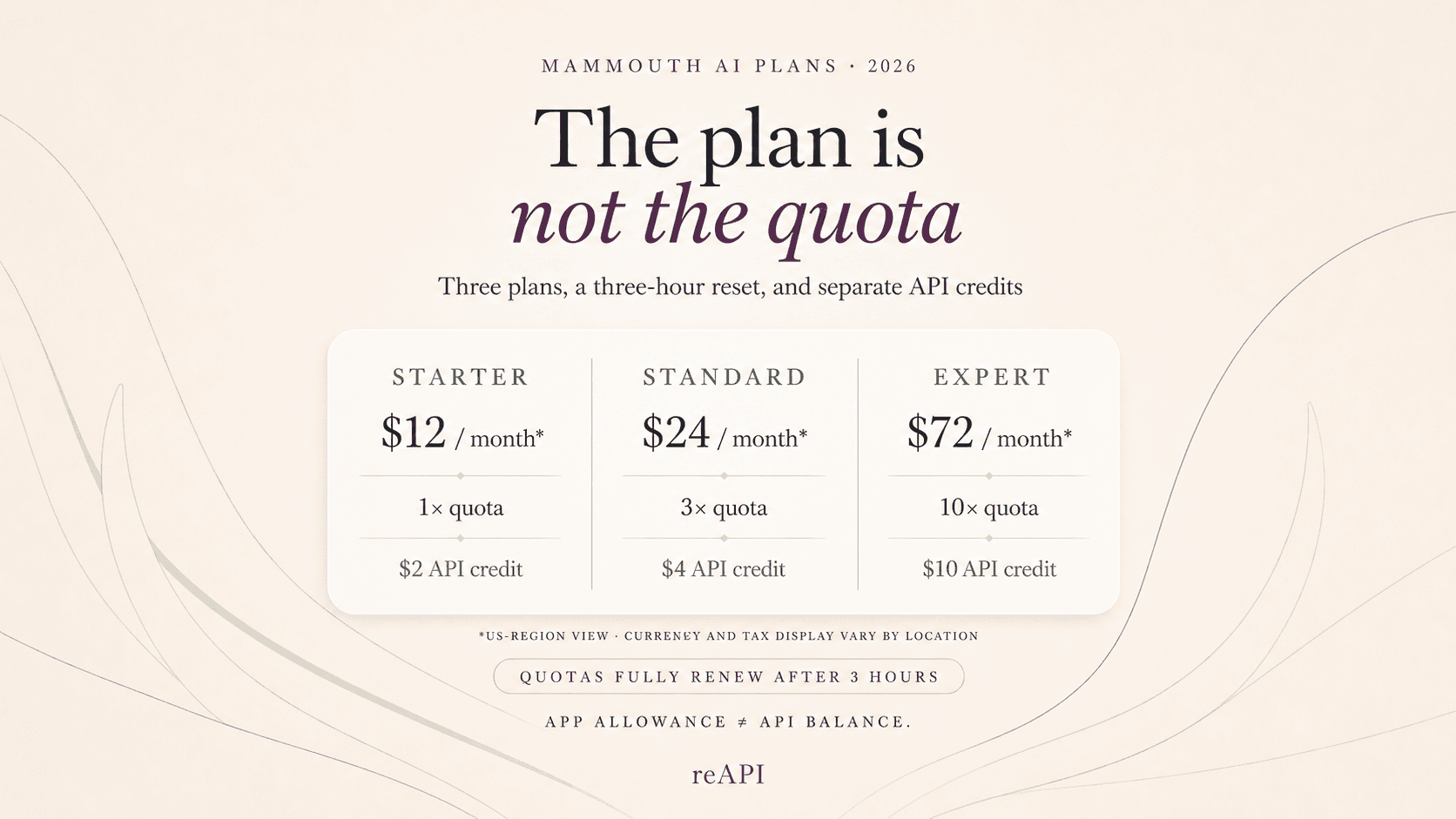
Mammouth AI Pricing: Plans, Limits, and API Access (2026)
Mammouth AI pricing explained: compare Starter, Standard, and Expert plans, three-hour quota resets, included API credits, PAYG access, and file limits.