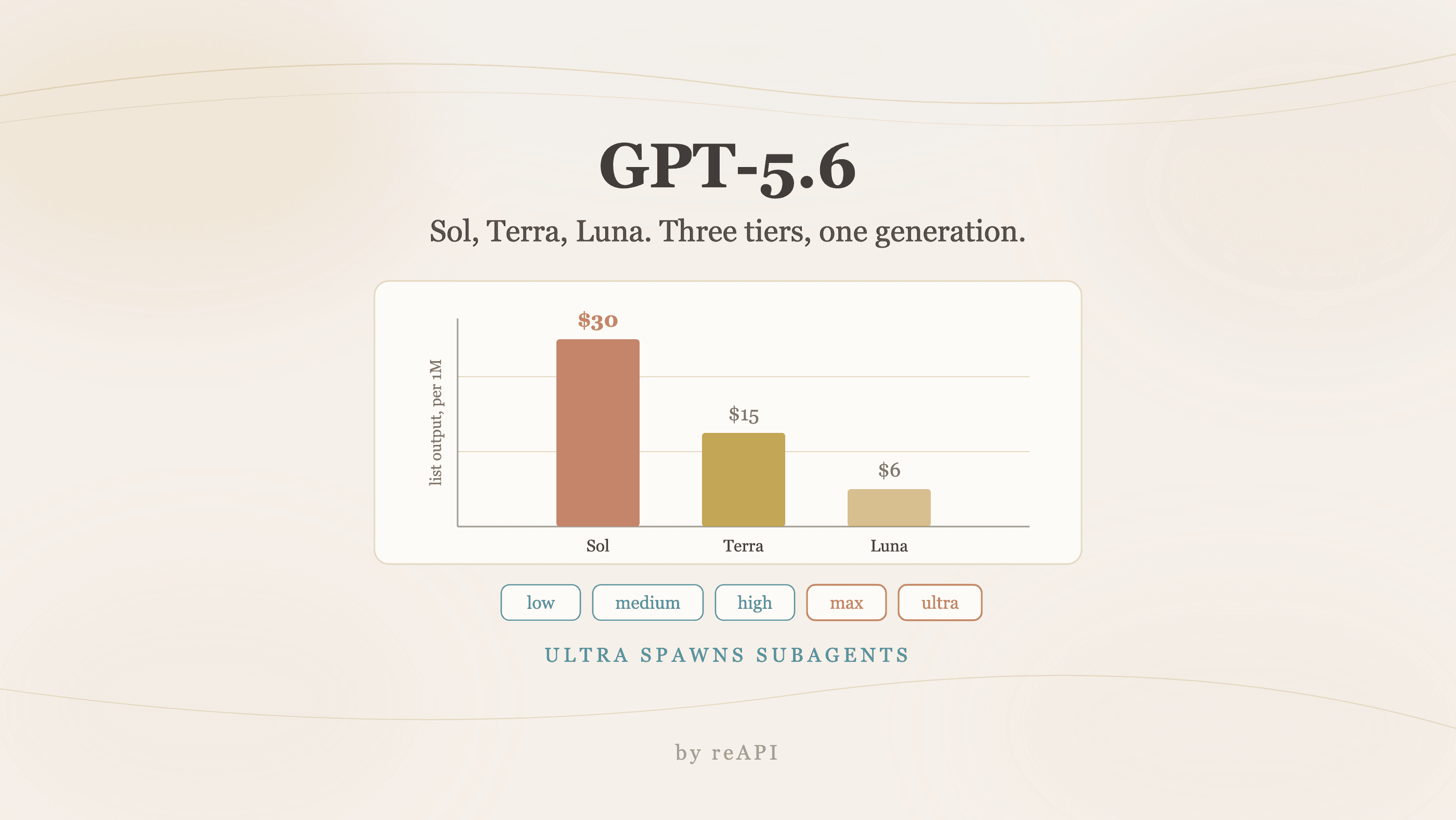
How to Use GPT-5.6: Sol, Terra, and Luna Tiers Compared
How to use GPT-5.6: what Sol, Terra, and Luna cost, the Terminal-Bench table and its four asterisks, the new max and ultra modes, and which tier to pick.
For the GPT-5.6 Sol vs Terra vs Luna decision, start with the least expensive tier that passes your own quality checks: Luna for cost-sensitive volume, Terra when Luna's errors or retries justify an upgrade, and Sol for difficult professional work where the extra capability pays for itself. The current OpenAI Standard input/output rates are $0.20/$1.20 for Luna, $2/$12 for Terra, and $4/$20 for Sol per million tokens, for prompts up to 272K input tokens. All three share the same documented context and output limits; paying more does not buy a larger window.[3][4][5]
Prices and current API limits below were checked on October 23, 2026. The launch and Terminal-Bench discussion is retained as historical context; it is not a fresh benchmark run or a promise that every launch evaluation mode is an API parameter.
OpenAI began a limited preview of GPT-5.6 on June 26, 2026, and the strangest thing about that launch was that almost nobody could use it. Access went to roughly twenty vetted partners through the API and Codex, in a phased rollout OpenAI says the U.S. government requested[1].
That gate has since lifted. Knowing how to use GPT-5.6 is now a practical question rather than a waiting game, and the answer is mostly about picking one of three tiers: Sol the flagship, Terra the balanced workhorse, and Luna the budget tier. Each is a durable capability tier under one generation number, not a temporary variant.
This guide covers the current three-tier decision, prices and limits, alongside the launch benchmark and its four asterisks, the historical ultra evaluation setting, and the cybersecurity review that shaped the rollout.
TL;DR
- Three tiers with shared limits. Sol is the flagship, Terra balances intelligence and cost, and Luna targets cost-sensitive volume. All three support
maxreasoning effort.[3][4][5] - In the launch Terminal-Bench 2.1 table, Sol scores at 88.8% single-agent, or 91.9% in
ultramode. The single-agent lead over Claude Mythos 5 is 0.8 points, which is inside the noise band[1]. ultrais not one agent. It orchestrates subagents in parallel, so its score is not a like-for-like comparison against single-agent baselines[1].- Choose by accepted task, not tier name. Test Luna first for routine volume, compare Terra on tasks it misses, and use Sol where the improvement covers its higher cost.
- On reAPI, short-context input/output prices are 80% of OpenAI's current Standard rates: Sol $3.20 / $16.00, Terra $1.60 / $9.60, Luna $0.16 / $0.96 per million tokens (checked October 23, 2026). This percentage does not describe every long-context rate.[8]
- The evaluation window was deliberately narrow. OpenAI published coding, biology, and cybersecurity only, holding back SWE-bench, GDPval, math, and hallucination numbers[1].
gpt 5.6 sol vs terra vs luna
GPT-5.6 succeeds GPT-5.5, the fully retrained agentic model from April 2026. Where GPT-5.5 was one model with reasoning-effort levels, GPT-5.6 is a family of three tiers under one generation number. OpenAI's framing is explicit: the number identifies a generation, while Sol, Terra, and Luna identify durable capability tiers that can advance on their own cadence[1].
That sentence is the most consequential design decision in the release. It decouples "how smart" from "how new." A future generation could ship a new Luna without touching Sol, and a Sol upgrade does not force everyone on Terra to re-test their pipelines.
| Tier | Positioning |
|---|---|
| GPT-5.6 Sol | Flagship for complex professional work; evaluate it where harder tasks justify the higher rate |
| GPT-5.6 Terra | Balance of intelligence and cost; evaluate it when Luna does not meet the task requirements |
| GPT-5.6 Luna | Fast and affordable, aimed at high-volume routine tasks |
gpt 5.6 context window
OpenAI now documents the same limits for all three GPT-5.6 tiers: a 1,050,000-token total context window, 922,000 maximum input tokens, and 128,000 maximum output tokens. The input ceiling is not the total context window. Each accepts text and image input and produces text; the model pages list streaming, structured outputs and function calling. Their hosted-tool lists are specifically labeled for the Responses API, so they should not be read as a guarantee that every compatible endpoint exposes the same tools.[3][4][5]
All three support none, low, medium, high, xhigh, and max, with medium as the default. The present model references do not list minimal or ultra as effort values. Reasoning tokens use context space and bill as output; an output allowance must cover both the hidden reasoning and the visible answer.[6]
Terminal-Bench 2.1, and its four asterisks
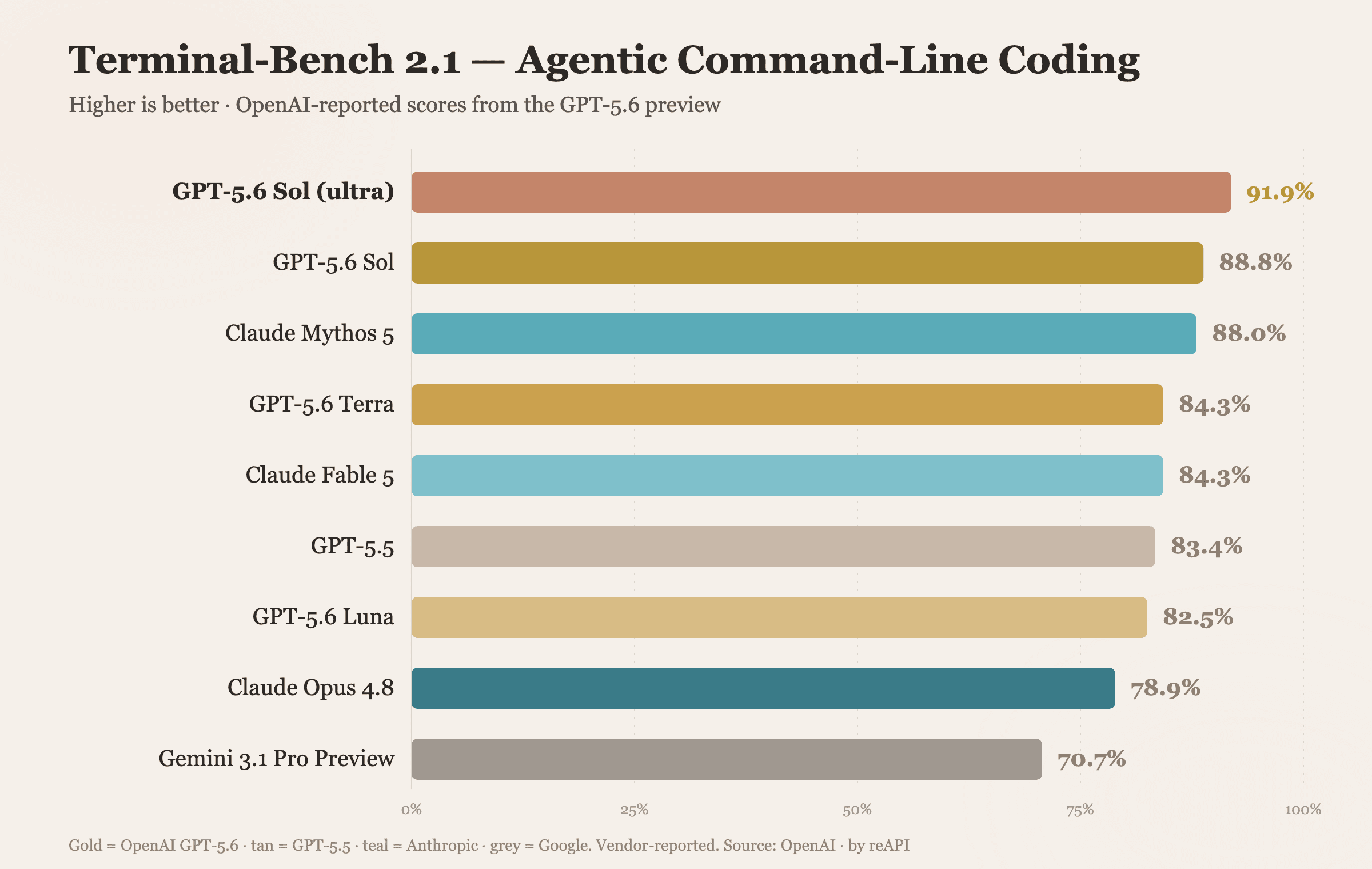
OpenAI published only three benchmark areas in the preview, coding, biology, and cybersecurity, explicitly holding back the rest for general availability[1]. The one it wants you to remember is Terminal-Bench 2.1, which tests command-line agentic workflows requiring planning, iteration, and tool coordination.
| Model | Terminal-Bench 2.1 |
|---|---|
GPT-5.6 Sol (ultra mode) | 91.9% |
| GPT-5.6 Sol | 88.8% |
| Claude Mythos 5 | 88.0% |
| GPT-5.6 Terra | 84.3% |
| Claude Fable 5 | 84.3% |
| GPT-5.5 | 83.4% |
| GPT-5.6 Luna | 82.5% |
| Claude Opus 4.8 | 78.9% |
| Gemini 3.1 Pro Preview | 70.7% |
Read carefully, this table is more honest than the "new state of the art" headline suggests, in four ways[1].
The 91.9% record uses ultra, which is not a single agent. It comes from Sol orchestrating subagents. Against single-agent baselines it is not apples to apples. The fair comparison is Sol's 88.8%.
Single-agent Sol beats Claude Mythos 5 by 0.8 points. Two runs of the same model can disagree by more than that. OpenAI holds a real lead at the top of the coding curve, but on this benchmark it is narrow, not a blowout.
Terra ties Claude Fable 5 and barely edges GPT-5.5. 84.3% matches Fable 5 exactly and sits less than a point above the model it replaces. Paired with the price cut, that is the actual commercial story: a similar reported Terminal-Bench result at a lower launch price, not proof of equal coding ability across tasks.
Gemini 3.1 Pro Preview trails by about 21 points. That gap is real but benchmark-specific. Gemini leads elsewhere on long-context retrieval and multimodal work not shown here.
On biology, OpenAI reports Sol achieving stronger GeneBench v1 results than GPT-5.5 while using fewer tokens, without publishing raw numbers, so that is a directional claim rather than a verifiable score[1].
max and ultra
The launch comparison used max and an ultra multi-agent evaluation setting. For current API integration, keep that historical label separate from the documented parameter contract: max is supported by Sol, Terra and Luna, and ultra is not one of their six current reasoning-effort values.[3][4][5]
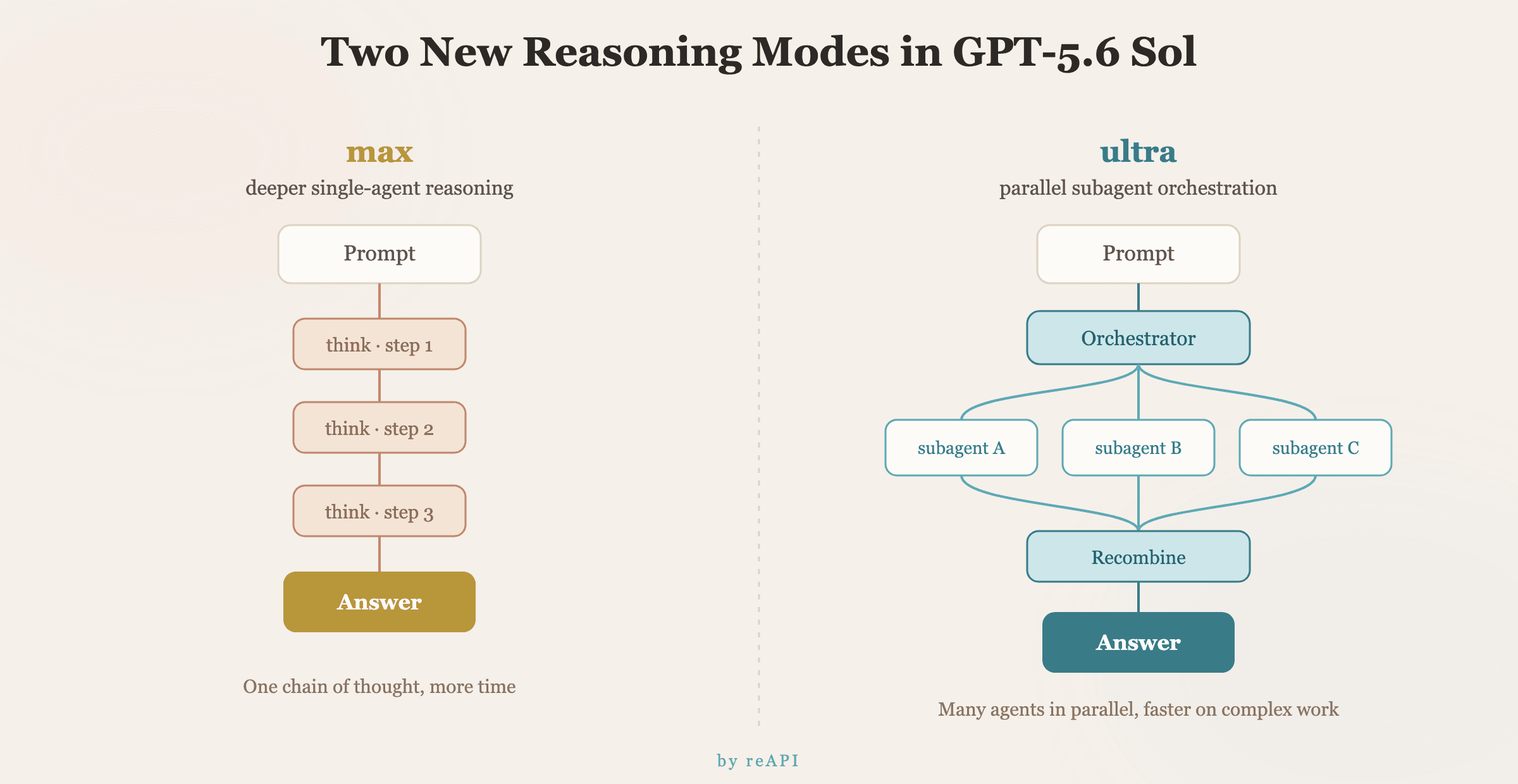
The illustration describes the launch comparison. Its ultra score uses subagents and is not a like-for-like single-agent result. It does not establish a callable ultra parameter or built-in orchestration through reAPI.
OpenAI's current Responses API instead documents independent reasoning effort and reasoning mode controls. reasoning.mode selects standard or pro; Pro mode performs more model work and bills the resulting tokens at that model's standard token rates. It can therefore cost more even without a different per-token rate. Effort defaults to medium in both modes for GPT-5.6.[6]
reAPI's public route for these models is Chat Completions. It exposes reasoning_effort; do not assume that OpenAI's Responses-only mode, persisted reasoning or hosted-agent features can be enabled by copying fields into that request.
gpt 5.6 pricing
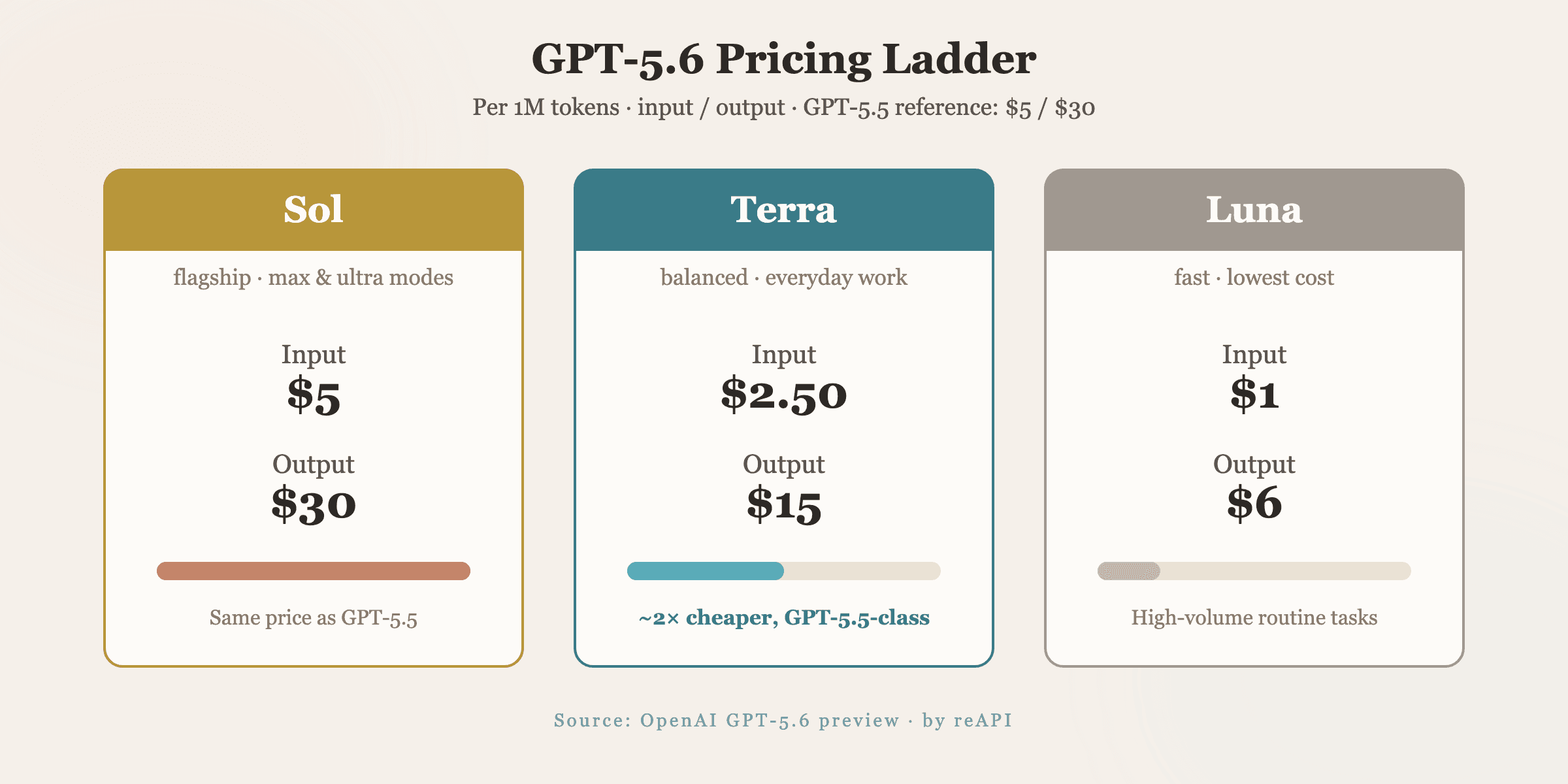
The image preserves launch pricing. The current columns below are short-context input/output prices, per million tokens, not universal rates for every prompt size or processing mode.[2][8]
| Tier | OpenAI list at launch (input / output per 1M) | OpenAI Standard, October 23, 2026 | On reAPI, October 23, 2026 |
|---|---|---|---|
| GPT-5.6 Sol | $5 / $30 | $4 / $20 | $3.20 / $16.00 |
| GPT-5.6 Terra | $2.50 / $15 | $2 / $12 | $1.60 / $9.60 |
| GPT-5.6 Luna | $1 / $6 | $0.20 / $1.20 | $0.16 / $0.96 |
Two things stood out in OpenAI's launch numbers. Sol held GPT-5.5's exact $5 / $30 pricing while adding capability and the new modes, which is a rare case of more for the same money. And Terra reported a similar launch Terminal-Bench result to GPT-5.5 at lower launch prices, which made it worth evaluating[1]. Layer Sol's token-efficiency gains on top, since it reaches comparable results with fewer output tokens, and the effective drop in cost per task is larger than the headline rates imply.
OpenAI has since cut all three list prices, Sol's as a promotion it says runs at least through November 21, 2026[2]. Sol is now below GPT-5.5's $5 / $30 rather than level with it. The current short-context reAPI input/output rates are 80% of OpenAI Standard, but the relative prices between tiers changed: Luna's $0.20/$1.20 is one-tenth of Terra's $2/$12, whereas their launch rates were not in that ratio. Treat Sol's November date as a minimum promotional period, not a guaranteed price increase the next day. Choose the lowest-cost tier that meets your measured quality requirement, rather than making Terra the automatic default.
For more than 272K input tokens, OpenAI charges 2x input and 1.5x output for the full request, not only the tokens beyond the threshold. Its current Standard cache and long-context rates are:[2]
| Tier | Short cache read / 30m write / 12h write | Long input / output | Long cache read / 30m write / 12h write |
|---|---|---|---|
| GPT-5.6 Sol | $0.40 / $5.00 / $10.00 | $8.00 / $30.00 | $0.80 / $10.00 / $20.00 |
| GPT-5.6 Terra | $0.20 / $2.50 / $5.00 | $4.00 / $18.00 | $0.40 / $5.00 / $10.00 |
| GPT-5.6 Luna | $0.02 / $0.25 / $0.50 | $0.40 / $1.80 | $0.04 / $0.50 / $1.00 |
OpenAI supports implicit and explicit caching. Its default 30-minute writes cost 1.25x ordinary input; the Responses API also offers a 12-hour minimum at 2.5x. Those are total write rates, not surcharges to add on top of ordinary input. Reads cost 0.1x on these three models. The minimum cacheable prefix is 1,024 tokens. A 12-hour setting is a minimum lifetime, not a deletion deadline.[7]
For an illustrative 20,000-token uncached input and 5,000 billed output tokens, OpenAI Standard costs (20,000 × input rate + 5,000 × output rate) / 1,000,000: Sol $0.18, Terra $0.10, Luna $0.01. The reAPI short-context input/output prices give $0.144, $0.08 and $0.008, respectively. The fixed counts include reasoning in billed output and exclude tools, taxes and cache operations; these are calculations, not measured task-completion costs.
At 300,000 uncached input tokens and 5,000 billed output tokens, OpenAI's full-request long rates give Sol $2.55, Terra $1.29 and Luna $0.129. The lower short-context rates no longer apply. For cached requests, separate ordinary input, cache reads and cache writes before multiplying by their respective rates; counting cached tokens again as ordinary input would overstate the bill.
reAPI's rendered long-context input/output rates on October 23 were Sol $6.40/$24.00, Terra $3.20/$14.50, Luna $0.320/$1.440 per million tokens. Terra's displayed long-output rate is $14.50, so an all-rates “80%” claim would be inaccurate. Check the exact category on the model page; this table does not promise OpenAI's selectable cache lifetimes through reAPI.[8]
The OpenAI figures above use Standard processing and exclude separately priced tools and regional-processing uplifts. Batch, Flex and Fast mode have separate price tables; do not compare one model's alternative processing mode with another model's Standard rate as though the service conditions were identical.[2]
The review that shaped the rollout
This part is worth understanding even now that access has opened, because it is a precedent rather than a footnote.
OpenAI restricted the initial release to about twenty vetted partners at the U.S. government's request, after previewing the models' capabilities ahead of launch[1]. The trigger was cybersecurity capability. Sol meaningfully advances vulnerability research, and in evaluations involving Chromium and Firefox it identified bugs and exploitation primitives, the building blocks of an exploit, without autonomously producing a functional full-chain exploit under the conditions tested. OpenAI states Sol does not cross the Cyber Critical threshold in its Preparedness Framework, and that distinction is the entire basis for releasing it[1].
Notably, OpenAI did not endorse the arrangement as permanent, saying this kind of government access process should not become the long-term default because it keeps the best tools from the defenders who need them[1].
The safety stack shipped alongside it is worth knowing because it previews how high-capability models will ship generally: trained-in refusals, real-time cyber and biology classifiers that can pause generation for review by a larger model, account-level review of flagged activity, and differentiated access to the most sensitive capabilities. OpenAI dedicated over 700,000 A100-equivalent GPU hours to automated red-teaming for universal jailbreaks[1].
OpenAI is candid that these safeguards misfire: legitimate security researchers may hit refusals on dual-use requests.
Where the case is strong and where it is thin
Strong. Agentic command-line coding, where single-agent Sol tops the benchmark and ultra extends it. Token efficiency, which compounds for high-volume agents. Mid-tier value, where Terra's price cut is the most broadly useful change in the release. The launch ultra result includes multi-agent orchestration; it should be interpreted as an evaluation setup rather than a current reAPI feature promise[1].
Thin. The headline is a 0.8-point win on one benchmark. The evaluation window was deliberately small, with no SWE-bench, GDPval, math, or hallucination numbers published, so whether GPT-5.6 fixed the confident-hallucination problem that dogged GPT-5.5 is still unknown. And everything is vendor-reported under OpenAI's own harness[1].
Until an expanded suite and independent scoring land, judgment on general capability should stay reserved.
How to use GPT-5.6: which tier to pick
Luna for cost-sensitive routine volume, when it passes your checks. Start with representative classification, extraction or short-answer tasks and record accepted outputs, retries and review effort. Its lower token price is useful only if the output meets the job's requirements.
Terra when the additional capability improves the result enough to justify its price. Compare it on Luna's actual failure cases rather than assuming every production request needs the middle tier. The launch coding benchmark is evidence about that evaluation, not proof of equal capability on every task.
Sol for complex professional work where the improvement covers the extra cost. Test difficult coding or long-horizon tasks with the same tools and acceptance criteria. All three tiers support max; neither the larger effort setting nor a larger context window is exclusive to Sol. Do not choose a reAPI tier on the assumption that ultra is a supported request value.
Calling GPT-5.6 on reAPI
All three tiers are registered on reAPI's OpenAI-compatible https://reapi.ai/api/v1/chat/completions endpoint. Use your current reAPI workspace key and the exact suffixed wire ID, keeping OpenAI's dots:
from openai import OpenAI

client = OpenAI(
    api_key="YOUR_REAPI_KEY",
    base_url="https://reapi.ai/api/v1",
)

resp = client.chat.completions.create(
    model="gpt-5.6-terra",
    messages=[{"role": "user", "content": "Refactor this module and add tests."}],
    max_tokens=16000,
    stream=True,
)
Swap gpt-5.6-terra for gpt-5.6-sol or gpt-5.6-luna to compare tiers through the same Chat Completions shape. OpenAI documents a bare gpt-5.6 alias, but reAPI's current registration uses the three suffixed IDs; use those exact strings here. reAPI's configured output ceiling is 128,000 tokens for each, and the documented effort values are none, low, medium, high, xhigh, and max.[8]
OpenAI supports both Chat Completions and Responses for this family and recommends Responses for its reasoning workflows. reAPI does not publish a /v1/responses route. Parameter forwarding does not establish feature equivalence: do not assume OpenAI's hosted-tool suite, Pro reasoning mode or persisted reasoning contract is reproduced by this Chat endpoint. The linked reAPI endpoint references describe its integration; no production generation was performed for this article update.[6][8]
Current rates are on reapi.ai/models/gpt-5-6-sol, reapi.ai/models/gpt-5-6-terra, and reapi.ai/models/gpt-5-6-luna.
FAQ
What is the difference between max and ultra mode?
max is a current reasoning-effort value on all three GPT-5.6 tiers. The historical ultra benchmark result used subagents and produced the 91.9% Terminal-Bench headline; it is not one of the current six effort values. OpenAI's separate reasoning.mode: "pro" belongs to Responses and should not be confused with an ultra field or a reAPI Chat feature.[1][3][6]
Is GPT-5.6 Sol better than Claude for coding?
On Terminal-Bench 2.1, single-agent Sol at 88.8% edges Claude Mythos 5 at 88.0% by 0.8 points, a real but narrow lead. With ultra Sol reaches 91.9%, but that uses subagents and is not a like-for-like single-agent comparison[1].
Which GPT-5.6 tier should I use?
Evaluate Luna for routine volume, Terra when Luna does not meet your requirements, and Sol for difficult work where the extra quality justifies the cost. All three share the documented context window, output ceiling and effort ladder; use accepted-task cost and your own tests to choose, not an assumed ultra integration.
Why was the U.S. government involved in the release?
Sol meaningfully advances cybersecurity capability, including vulnerability research, without crossing OpenAI's Cyber Critical threshold. At the government's request OpenAI ran a phased preview to about twenty vetted partners while a cyber framework was developed[1].
Does GPT-5.6 fix GPT-5.5's hallucination problem?
Unknown. OpenAI published only coding, biology, and cybersecurity evaluations in the preview and held back hallucination and knowledge-work numbers[1]. Pair the model with source-grounded verification for high-stakes output.
How big is GPT-5.6 Sol's context window?
OpenAI now documents a 1,050,000-token total context window, 922,000 maximum input tokens and 128,000 maximum output tokens. Terra and Luna have the same limits. The older 1.5-million-token report is not the current official specification.[3][4][5]
What changed in prompt caching?
OpenAI supports implicit caching and explicit cache breakpoints, with default 30-minute writes at 1.25x ordinary input and an optional Responses API 12-hour minimum at 2.5x. Reads cost 0.1x for these three models. Write rates are totals, and a minimum lifetime is not a deletion deadline; reAPI's Chat route is not a promise of the same configurable cache controls.[7]
How do I call GPT-5.6 with the OpenAI SDK?
Point the OpenAI client at https://reapi.ai/api/v1, use your reAPI workspace key, and set model to gpt-5.6-sol, gpt-5.6-terra, or gpt-5.6-luna. Keep the dots and tier suffix; the bare OpenAI alias is not registered here.[8]
Reading a three-tier release
GPT-5.6 is two releases wearing one announcement. One is an ordinary, well-executed family update: a sensible naming reset, a mid-tier with lower launch prices and a similar reported Terminal-Bench result to GPT-5.5, and a launch ultra benchmark that used multi-agent orchestration. The other is a frontier model whose initial availability was set in coordination with a government, shipped behind a 700,000-GPU-hour safety stack.
For a current integration, start with the least expensive tier that passes your checks, budget for reasoning and the long-context threshold, and verify the API features your workflow needs. The launch benchmark remains useful historical evidence, but the current model references and pricing conditions determine what to request and what to budget.
For a comparison across generations, read GPT-6 Sol vs Luna and GPT-6 Luna vs GPT-5.6 Luna. Those articles answer the GPT-6 migration question; this guide keeps the choice between the three GPT-5.6 tiers separate.
References
-
OpenAI. Models — the GPT-5.6 family, reasoning modes, and specifications. Retrieved July 2026 from platform.openai.com/docs/models
-
OpenAI. Pricing — per-token rates by model and tier. Retrieved July 2026 and re-checked October 23, 2026. https://developers.openai.com/api/docs/pricing
-
OpenAI. GPT-5.6 Sol model reference. Checked October 23, 2026. https://developers.openai.com/api/docs/models/gpt-5.6-sol
-
OpenAI. GPT-5.6 Terra model reference. Checked October 23, 2026. https://developers.openai.com/api/docs/models/gpt-5.6-terra
-
OpenAI. GPT-5.6 Luna model reference. Checked October 23, 2026. https://developers.openai.com/api/docs/models/gpt-5.6-luna
-
OpenAI. Reasoning models: effort, mode and token accounting. Checked October 23, 2026. https://developers.openai.com/api/docs/guides/reasoning
-
OpenAI. Prompt caching: minimum lifetime and write/read pricing. Checked October 23, 2026. https://developers.openai.com/api/docs/guides/prompt-caching
-
reAPI. Rendered model-page prices and endpoint references, checked October 23, 2026. https://reapi.ai/models/gpt-5-6-sol — https://reapi.ai/models/gpt-5-6-terra — https://reapi.ai/models/gpt-5-6-luna — https://reapi.ai/docs/gpt-5-6-sol — https://reapi.ai/docs/gpt-5-6-terra — https://reapi.ai/docs/gpt-5-6-luna
Further reading
- reAPI. How to use Claude Opus 5. reapi.ai/blog/how-to-use-claude-opus-5
- reAPI. How to use Claude Fable 5. reapi.ai/blog/how-to-use-claude-fable-5
- reAPI. Model catalog. reapi.ai/models
Author

Categories
max and ultragpt 5.6 pricingThe review that shaped the rolloutWhere the case is strong and where it is thinHow to use GPT-5.6: which tier to pickCalling GPT-5.6 on reAPIFAQWhat is the difference between max and ultra mode?Is GPT-5.6 Sol better than Claude for coding?Which GPT-5.6 tier should I use?Why was the U.S. government involved in the release?Does GPT-5.6 fix GPT-5.5's hallucination problem?How big is GPT-5.6 Sol's context window?What changed in prompt caching?How do I call GPT-5.6 with the OpenAI SDK?Reading a three-tier releaseReferencesFurther readingMore Posts

GPT-6 Sol vs 5.6 Sol: Price, Specs and Which Is Better
GPT-6 Sol vs 5.6 Sol: OpenAI's price cut, the same context limits, a newer knowledge cutoff, request changes to plan for, and when migrating is worth it.
Gemini Omni API: Preview Specs, Pricing, and Limits
Google's Gemini Omni API preview explained: model ID, Interactions API, 720p output, pricing, input limits, multi-turn editing, and reAPI differences.
How to Use Claude Sonnet 5: Effort, Cost, and Limits
How to use Claude Sonnet 5: benchmarks against Opus 4.8, the effort ladder that drives cost, the denser tokenizer that inflates bills, and migration steps.