
Best AI Video Generation API in 2026: Five Models Compared
Compare Seedance 2.5, MiniMax H3, Kling 3.0, Veo 3.1, and Vidu Q3 by duration, references, audio, resolution, billing unit, and real workload fit.
The best AI video generation API depends on the shot: Seedance 2.5 for 16–30-second continuity, MiniMax H3 for short 2K shots and audio references, Kling 3.0 for affordable video with sound, Veo 3.1 for fixed-cost eight-second output, and Vidu Q3 for inexpensive drafts. No single model wins all five jobs.
That answer is less exciting than ranking demo reels, but it survives contact with an API. Duration ceilings, reference inputs, resolution and billing units eliminate most candidates before subjective image quality becomes the deciding factor.
The five-model decision table
| Model | Use it first for | Max clip | Main limitation |
|---|---|---|---|
| Seedance 2.5 | Continuous scenes and large reference sets | 30 s | High-resolution retries get expensive |
| MiniMax H3 | Short 2K shots and audio references | 15 s | Community-license territory limits |
| Kling 3.0 | Affordable clips with audio; 4K option | 15 s | Smaller reference set |
| Veo 3.1 | Predictable eight-second jobs | 8 s on common tier | Fixed price does not buy more duration |
| Vidu Q3 | Low-cost motion drafts | Tier-dependent | Cheapest tier is 540p |
These are API constraints, not quality scores. A five-second product insert and a 30-second dialogue scene should not use the same selection rule.
Seedance 2.5 is the long-take choice
Seedance 2.5 generates from four to 30 seconds in one pass and accepts up to 30 reference images, 10 videos and 10 audio clips on the current route.[1][6] Its timed prompt segments and edit or extend modes are useful when several actions must happen inside one continuous scene.
The cost follows that capacity. A plain 720p request on reAPI is currently $0.266824 per output second: $1.335 for five seconds, $2.669 for ten and $8.005 for 30 after credit rounding.[6] A source video selects a lower rate but adds input duration to the billing clock. The lower rate is not automatically a lower total.
Choose Seedance when removing a join is worth paying for. Do not make every social insert pay for a 30-second ceiling it never uses.
MiniMax H3 is the short 2K and audio-reference choice
H3 runs from four to 15 seconds, generates stereo sound and accepts mixed image, video and audio references.[2] The current reAPI tiers reach 2K, while the 768P tier provides a cheaper place to test motion and prompt timing.[7]
H3 is also the only model in this group with public weights. That does not make it Apache- or MIT-licensed. The MiniMax H3 Community License excludes the United States, European Union, United Kingdom and South Korea from its applicable territory unless separate written authorization is obtained.[3] Teams considering self-hosting should settle that question before optimizing a ComfyUI workflow.
Use H3 for product shots, music-driven scenes and short dialogue where a supplied audio reference matters. Its 15-second ceiling is a problem only when the shot really must remain continuous beyond it.
Kling 3.0 is the practical budget-with-audio option
Kling 3.0 exposes separate tiers for resolution and audio. On reAPI, the current standard 720p tier is about $0.077/s without audio and $0.110/s with it; the 1080p with-audio tier is about $0.149/s, and a listed 4K route is about $0.369/s.[8]
That puts an eight-second 720p clip with sound near $0.88. Kling accepts a smaller reference set than Seedance 2.5 or H3, so the low price should not override a workflow that depends on many identity angles or audio references.
Veo 3.1 makes the bill easy to predict
Several Veo 3.1 routes use flat per-generation billing. reAPI's current Fast route lists about $0.161 per generation at 720p or 1080p, with a common fixed duration of eight seconds.[9] A four-second idea does not become cheaper on that route, and a longer idea does not fit inside it.
That pricing is attractive for a product built around a fixed clip format. Veo also has official per-second tiers with separate resolution and audio prices, so the exact model ID matters. “Veo 3.1 price” is not one number.
Vidu Q3 is useful before final resolution matters
Vidu Q3 Turbo currently starts near $0.037/s at 540p, while Q3 Pro costs more and reaches higher resolutions. Five seconds at the Turbo entry tier is about $0.185.[10]
That is a good unit for testing whether a pan, subject movement or composition works. It is not a reason to deliver 540p when the brief requires 1080p. Draft economics and delivery economics belong in separate rows of the budget.
Why the price column cannot rank these models
Two billing units coexist in this category: per second and per generation. Source-video jobs can introduce a third variable by charging for input duration.
| Route | Billing unit | Example | What the number omits |
|---|---|---|---|
| Veo 3.1 Fast | Per generation | $0.161 | Fixed eight-second format |
| Vidu Q3 Turbo 540p | Per second | $0.185 / 5 s | Draft resolution |
| Kling 3.0 720p + audio | Per second | $0.88 / 8 s | Smaller reference surface |
| Seedance 2.5 720p | Per second | $2.135 / 8 s | Pays for longer/reference-heavy jobs |
This is why our separate AI video API pricing guide converts every rate into cost per clip before comparing it.
Run a workload test, not a beauty contest
Pick two models that satisfy the hard constraints, then run the same five jobs through both. Record:
- completed and accepted outputs;
- identity, motion and audio failures;
- wall-clock latency;
- total charge after retries;
- any manual work needed before delivery.
The useful metric is cost per accepted clip. A cheap model that takes eight attempts can lose to an expensive one that takes two.
Every API here is asynchronous: submission returns a task identifier and completion happens later. Polling or webhooks, retry handling, public input URLs and failed-job billing belong in the architecture from the first prototype. Those details can cost more to change than the model ID.
Frequently asked questions
What is the best AI video generation API overall?
There is no overall winner. Seedance 2.5 covers the longest continuous scene and largest reference set; H3 offers 2K and audio references; Kling is inexpensive with audio; Veo 3.1 offers predictable fixed-format billing; Vidu Q3 is a cheap draft route.
Which AI video API is cheapest?
At the entry configurations compared here, Veo 3.1 Fast and Vidu Q3 Turbo are the lowest per job. They are different products: Veo is a fixed-format generation, while Vidu's lowest price is a 540p per-second tier.
Can one API generate a one-minute video?
Not as one ordinary text-to-video generation. Seedance 2.5 reaches 30 seconds; longer work is assembled from generated segments or produced through a separate storyboard and editing workflow. The long-video guide covers chaining and its failure modes.
Do I need five separate integrations to test five models?
Not necessarily. reAPI exposes the linked models through one asynchronous media task pattern. Custom model deployment and fine-tuning are outside that scope; a serverless marketplace is a better fit for those requirements.
References
- ByteDance Seed. One-take Creation, Flexible Referencing: Introducing Seedance 2.5. Published July 31, 2026. seed.bytedance.com
- MiniMax. MiniMax H3 launch and video generation guide. Published July 31, 2026. minimax.io
- MiniMaxAI. MiniMax H3 Community License. Retrieved August 23, 2026. huggingface.co
- Kling AI. Developer pricing. Retrieved August 23, 2026. klingai.com
- Google AI for Developers. Generate videos with Veo. Retrieved August 23, 2026. ai.google.dev
- reAPI. Seedance 2.5 model page and live pricing. Retrieved August 23, 2026. reapi.ai
- reAPI. MiniMax H3 model page and live pricing. Retrieved August 23, 2026. reapi.ai
- reAPI. Kling 3.0 model page and live pricing. Retrieved August 23, 2026. reapi.ai
- reAPI. Veo 3.1 model page and billing tiers. Retrieved August 23, 2026. reapi.ai
- Vidu. Vidu API documentation. Retrieved August 23, 2026. platform.vidu.com
Author

Categories
More Posts

Which Kling Model Should You Use? Every Version Compared
Kling 3.0, 3.0 Omni, 3.0 Turbo, O1, 2.6, and 2.5 Turbo compared on duration, resolution, audio, and references, plus which Kling model fits each job.

Seedance 2.5 Prompt Library: 20 Tested Shot Templates
Copy 20 Seedance 2.5 prompt templates for product shots, actor movement, camera control, references and audio, with real videos, settings and recorded costs.
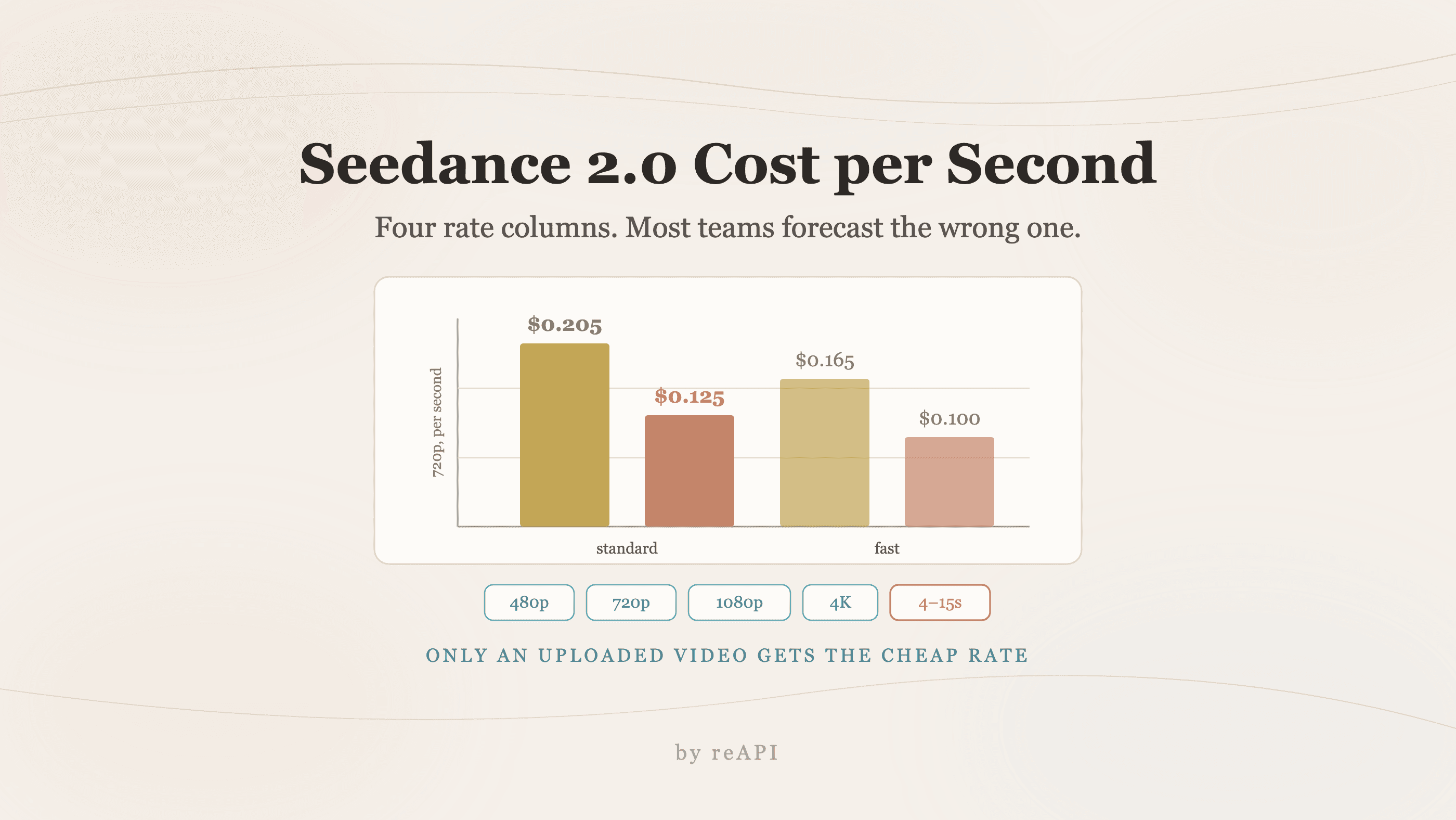
Seedance 2.0 Cost Per Second: The Real Billing Model
The Seedance 2.0 cost per second, by resolution and tier, plus the cheaper rate that only an uploaded video unlocks and the forecasting mistake it causes.