
Claude API pricing
Compare Claude API pricing for input, output and caching, with official and reAPI rates, Batch discounts, long-context rules and practical request-cost examples.
Claude API pricing starts at $0.10 per million input tokens and $0.50 per million output tokens for Haiku 5.5 prompts of up to 100,000 tokens. Sonnet 5.5 costs $2/$10, Opus 5.5 $4/$20, and Fable 5.1 $10/$50 at Anthropic's standard direct rates. Input and output are separate charges, and cache use changes the calculation.[1]
On reAPI, the public Sonnet 5.5 page shows $1.40/$7.00 and the Opus 5.5 page $2.80/$14.00 per million input/output tokens.[2][3] reAPI is not cheaper in every category: direct Haiku short-context pricing and some direct cache-read rates are lower. The tables and calculations below keep those differences visible. All prices were checked on October 23, 2026 and are in USD.
claude api pricing per million tokens
Anthropic's standard rate card separates ordinary input, generated output, cache creation and cache reads. One million tokens is abbreviated MTok. A cache-write token uses its applicable write rate; do not also count it as ordinary uncached input in your worksheet.[1]
| Claude model | Input / MTok | Output / MTok | 5-minute cache write / MTok | 1-hour cache write / MTok | Cache read / MTok |
|---|---|---|---|---|---|
| Haiku 5.5, prompt up to 100,000 tokens | $0.10 | $0.50 | $0.125 | $0.20 | $0.01 |
| Haiku 5.5, prompt over 100,000 tokens | $0.50 | $2.50 | $0.625 | $1.00 | $0.05 |
| Sonnet 5.5 | $2.00 | $10.00 | $2.50 | $4.00 | $0.10 |
| Sonnet 5 | $2.00 | $10.00 | $2.50 | $4.00 | $0.20 |
| Sonnet 4.6 | $3.00 | $15.00 | $3.75 | $6.00 | $0.30 |
| Opus 5.5 | $4.00 | $20.00 | $5.00 | $8.00 | $0.20 |
| Opus 5 | $5.00 | $25.00 | $6.25 | $10.00 | $0.50 |
| Opus 4.8 | $5.00 | $25.00 | $6.25 | $10.00 | $0.50 |
| Opus 4.7 | $5.00 | $25.00 | $6.25 | $10.00 | $0.50 |
| Fable 5.1 | $10.00 | $50.00 | $12.50 | $20.00 | $0.25 |
| Fable 5 | $10.00 | $50.00 | $12.50 | $20.00 | $1.00 |
These are the official rates for the models covered here, not every historical Claude model. Fast mode, US-only inference and separately billed tools can change the total; the ordinary rates above should not be presented as an all-inclusive quote.[1]
The reAPI snapshot below comes from the rendered model-detail pages, not from a calculated discount. A dash means the page did not display that cache category. It does not mean the category is free. The displayed cache-write rows do not specify a lifetime, so they are not labeled as one-hour rates here.
| reAPI model page | Input / MTok | Output / MTok | Displayed cache write / MTok | Displayed cache read / MTok | Workspace |
|---|---|---|---|---|---|
| Haiku 5.5[4] | $0.3500 | $1.7500 | $0.4375 | $0.0350 | Unified |
| Sonnet 5.5[2] | $1.40 | $7.00 | $1.75 | $0.14 | Unified |
| Opus 5.5[3] | $2.80 | $14.00 | $3.50 | $0.14 | Unified |
| Fable 5[5] | $7.000 | $35.000 | $8.750 | $0.175 | Unified |
| Fable 5.1[6] | $7.00 | $35.00 | $8.75 | $0.70 | Unified |
| Opus 4.8[7] | $2.8 | $14.0 | — | — | Unified |
| Opus 4.7[8] | $2 | $10 | — | — | Legacy |
| Opus 5[9] | $2.4 | $12.0 | — | — | Legacy |
| Sonnet 4.6[10] | $2.4 | $12.0 | — | — | Legacy |
The current unified Chat Completions service covers the six rows labeled Unified. Native Messages covers Haiku 5.5, Sonnet 5.5, Opus 5.5, Fable 5 and Fable 5.1; Opus 4.8 uses Chat Completions. The three legacy rows have separate api.reapi.ai credentials. Follow the exact model's API documentation before choosing a key or endpoint.[11]
Haiku's reAPI page displays one rate pair without prompt-length labels. Its $0.3500/$1.7500 pair is above Anthropic's short-context $0.10/$0.50 pair. Do not infer a cheaper unlisted reAPI tier or describe the model as universally discounted. This is a comparison of public price displays; no billable requests were run for this article.
claude api cache pricing
On Anthropic's direct API, a five-minute cache write costs 1.25 times base input and a one-hour write costs twice base input. Read multipliers vary: Fable 5.1 uses 0.025 times base input; Opus 5.5 and Sonnet 5.5 use 0.05; the other models in the official table use 0.1.[1]
That distinction changes a model comparison. Fable 5 and Fable 5.1 have identical ordinary input/output rates, but their direct cache-read rates are $1.00 and $0.25. The existing Fable 5.1 cache-cost analysis explains why a large read discount can produce a much smaller reduction in the cost of a whole task.
For reAPI, use the displayed category rather than multiplying every official price by a single percentage. Fable 5 shows $0.175 for cache reads, while Fable 5.1 shows $0.70. Sonnet 5.5 shows $0.14, compared with $0.10 direct. These differences do not establish a billing defect; they establish that the published schedules differ.[2][5][6]
Budget a first cache write separately from subsequent reads. If your estimate assumes reuse, record the actual cache-creation and cache-read counts when evaluating your application. An accepted cache setting alone does not prove a hit; the Sonnet 5.5 API reference distinguishes accepted parameters from observed cache behavior.[11]
claude api pricing calculator
Use the token counts for each charge category, then multiply by that category's USD-per-million rate:
cost = (uncached_input × input_rate
      + cache_write_5m × write_5m_rate
      + cache_write_1h × write_1h_rate
      + cache_reads × read_rate
      + output × output_rate) / 1,000,000
This formula uses Anthropic's separately published cache lifetimes. For another service, substitute its documented categories instead of assuming both lifetimes have the same rate. Add any separately billed tools or other applicable modifiers. The examples below are hypothetical arithmetic from the dated tables, not measured invoices or performance tests.
Sonnet 5.5, ordinary uncached requests. Assume 20,000 input tokens and 5,000 billed output tokens per request, with no cache or extra tool charges:
| Calculation | Direct Anthropic | reAPI displayed rates |
|---|---|---|
| Input | 0.02 × $2 = $0.04 | 0.02 × $1.40 = $0.028 |
| Output | 0.005 × $10 = $0.05 | 0.005 × $7 = $0.035 |
| One request | $0.09 | $0.063 |
| 1,000 identical requests | $90 | $63 |
That workload costs 30% less at the displayed reAPI rates. The conclusion is specific to these input/output quantities and exclusions; it is not a promise about every Sonnet task.
Fable 5.1, a cache-heavy request. Assume 500,000 cache-read tokens, 10,000 fresh input tokens and 2,000 output tokens, with no new cache writes:
Direct = 0.5 × $0.25 + 0.01 × $10 + 0.002 × $50 = $0.325
reAPI  = 0.5 × $0.70 + 0.01 × $7  + 0.002 × $35 = $0.490
Here direct Anthropic is cheaper by $0.165 per request despite reAPI's lower ordinary input/output rates. Reusing an existing cache changes which column matters most. A new cache write would need its own additional calculation.
Haiku 5.5 at the direct long-context boundary. With 1,000 output tokens and no caching, a 100,000-token prompt costs 0.1 × $0.10 + 0.001 × $0.50 = $0.0105. At 100,001 prompt tokens, the higher tier applies: 0.100001 × $0.50 + 0.001 × $2.50 = $0.0525005. The threshold changes the rates for the request, not just the final token.[1]
claude api pricing batch
Anthropic's Batch API discounts input and output tokens by 50%. For example, Sonnet 5.5 becomes $1/$5 per MTok, Opus 5.5 $2/$10 and Fable 5.1 $5/$25. Cache modifiers can stack with the Batch discount.[1]
For the earlier Sonnet example, direct Batch input/output would total $0.045 per request, or $45 for 1,000 requests. That is below the $63 reAPI illustration, but Batch is asynchronous processing. Choose it when your workload can use that delivery model. A live chat turn and a queued background job have different requirements.
This article does not establish reAPI Batch support or entitlement to Anthropic's Batch discount through reAPI. Sending many ordinary requests is not itself a Batch API submission.
claude api pricing and limits
Anthropic's pricing guide says Claude 4.6 and later models, except Haiku 5.5, include the full one-million-token context window at standard token rates. For those models, a 900,000-token input has the same unit rate as a 9,000-token input; it still contains 100 times as many tokens.[1]
Haiku 5.5 is the exception. The higher tier begins over 100,000 prompt tokens, counting ordinary input, cache reads and cache writes together. Each request is priced independently. Splitting a conversation across calls does not justify applying a previous call's lower rate to a later larger prompt.
Other modifiers deserve separate budget lines. Anthropic's US-only inference adds a 1.1 multiplier to token categories for supported models. Its Opus 5.5 fast mode is $8/$40 per MTok and cannot be combined with Batch. These are direct-service rules, not a claim that every option is available on reAPI.[1]
sonnet 5 pricing
Claude Sonnet 5 currently appears in Anthropic's official table at $2 input and $10 output per MTok, with $2.50 five-minute writes, $4 one-hour writes and $0.20 cache reads.[1] Sonnet 5.5 shares the $2/$10 headline pair but has a lower $0.10 direct cache-read rate.
The current reAPI unified registry does not include claude-sonnet-5, and there is no corresponding model-detail page. An existing Sonnet 5 blog is not evidence of a callable model. If you need a documented unified reAPI route, review Sonnet 5.5 and its own request contract rather than silently replacing one model ID with another.[11]
claude api pricing vs subscription
Keep API token charges separate from Claude app and Claude Code plan allowances, but account for current subscription benefits. Anthropic now documents monthly API credits for eligible Max and Team subscribers. Max 5x includes $100 and Max 20x $200; Free, Pro and Enterprise are not eligible for that particular program.[12]
Credits require linking a Console organization and claiming them. New eligible subscribers can claim after seven days. Credits expire at the end of each billing cycle, or monthly on annual plans, without rolling over. They apply to the specified Claude Platform services and do not cover Claude Code, extra usage in the Claude apps, or reAPI. They do not change the subscription's Claude or Claude Code usage limits.[12]
How much does each Claude API call cost?
There is no single per-call fee in the token rate card. Multiply each billed token category by the selected model's rate. For 20,000 uncached input and 5,000 output tokens, the Sonnet 5.5 example above is $0.09 direct or $0.063 at the observed reAPI prices, excluding other charges.
How to calculate API pricing?
Keep uncached input, cache writes, cache reads and output separate. Apply the correct model and prompt-length tier, then add any applicable tool fees or modifiers. For a multi-call task, sum all its calls; the price of one response is not the price of the entire workflow.
Can I have Claude API for free?
Do not assume a Claude Free account includes API credit. The current subscriber API-credit program excludes Free and Pro; eligible Max and Team plans have a separate claim process.[12] Check the Console balance and the terms of any account-specific offer before treating API usage as funded.
For a usable Claude API pricing estimate, choose the exact model, workspace and token mix first. Follow the linked model page for its current quote and API reference, then compare direct, Batch and reAPI costs for the same workload. The lowest input price alone cannot answer that decision.
References
- Anthropic. Pricing: models, caching, Batch and long context. Checked October 23, 2026. platform.claude.com/docs/en/about-claude/pricing
- reAPI. Claude Sonnet 5.5: rendered pricing. Checked October 23, 2026. reapi.ai/models/claude-sonnet-5-5
- reAPI. Claude Opus 5.5: rendered pricing. Checked October 23, 2026. reapi.ai/models/claude-opus-5-5
- reAPI. Claude Haiku 5.5: rendered pricing. Checked October 23, 2026. reapi.ai/models/claude-haiku-5-5
- reAPI. Claude Fable 5: rendered pricing. Checked October 23, 2026. reapi.ai/models/claude-fable-5
- reAPI. Claude Fable 5.1: rendered pricing. Checked October 23, 2026. reapi.ai/models/claude-fable-5-1
- reAPI. Claude Opus 4.8: rendered pricing. Checked October 23, 2026. reapi.ai/models/claude-opus-4-8
- reAPI. Claude Opus 4.7: rendered pricing. Checked October 23, 2026. reapi.ai/models/claude-opus-4-7
- reAPI. Claude Opus 5: rendered pricing. Checked October 23, 2026. reapi.ai/models/claude-opus-5
- reAPI. Claude Sonnet 4.6: rendered pricing. Checked October 23, 2026. reapi.ai/models/claude-sonnet-4-6
- reAPI. Model-specific API contracts. Checked October 23, 2026. Sonnet 5.5, Haiku 5.5, Opus 5.5, Fable 5, Fable 5.1, Opus 4.8, Opus 4.7, Opus 5, Sonnet 4.6.
- Anthropic. API credits for subscribers. Checked October 23, 2026. platform.claude.com/docs/en/about-claude/api-credits-for-subscribers
Author

Categories
More Posts
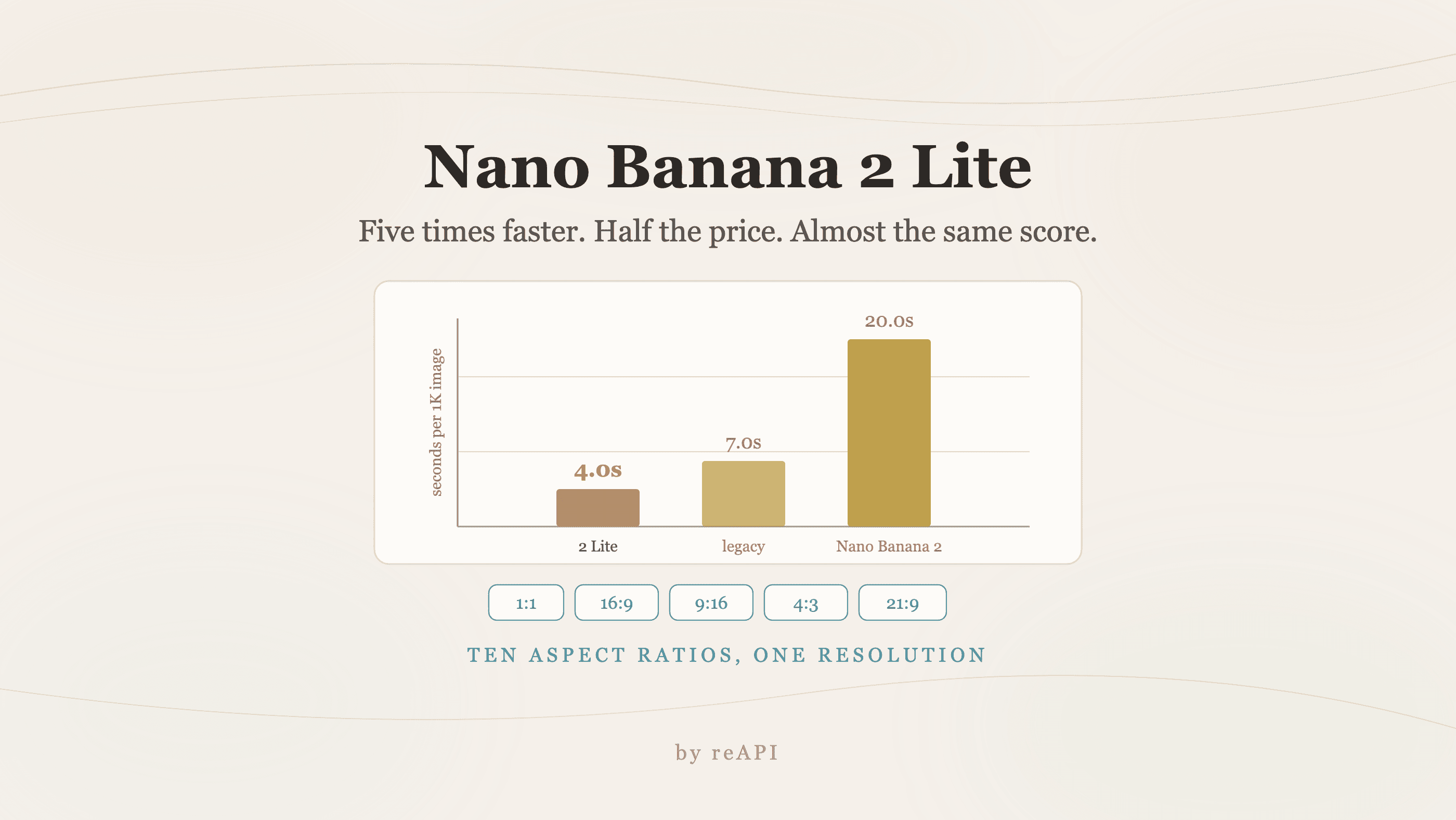
How to Use Nano Banana 2 Lite: Speed, Price, and Limits
How to use Nano Banana 2 Lite: four-second 1K images, the official benchmarks, the corrected cost math, what the 1K ceiling rules out, and how to prompt it.
Use ChatGPT Without Sounding Like AI: A Human-First Workflow
Use ChatGPT without generic AI prose. Turn a real thesis, evidence, constrained drafting, and careful human editing into publishable writing.
Qwen Image 3.0 API Pricing: Pro vs Standard Cost per Image
Qwen Image 3.0 API pricing explained: Alibaba's per-image rates for Standard and Pro at 1K and 2K, how reference images are billed, and when Pro is worth it.