Is Claude Fable 5.1 Cheaper? The Cache Math Explained
Claude Fable 5.1 keeps Fable 5's $10/$50 rates but cuts cache reads to $0.25. Calculate the real task cost and avoid subscription-meter confusion.
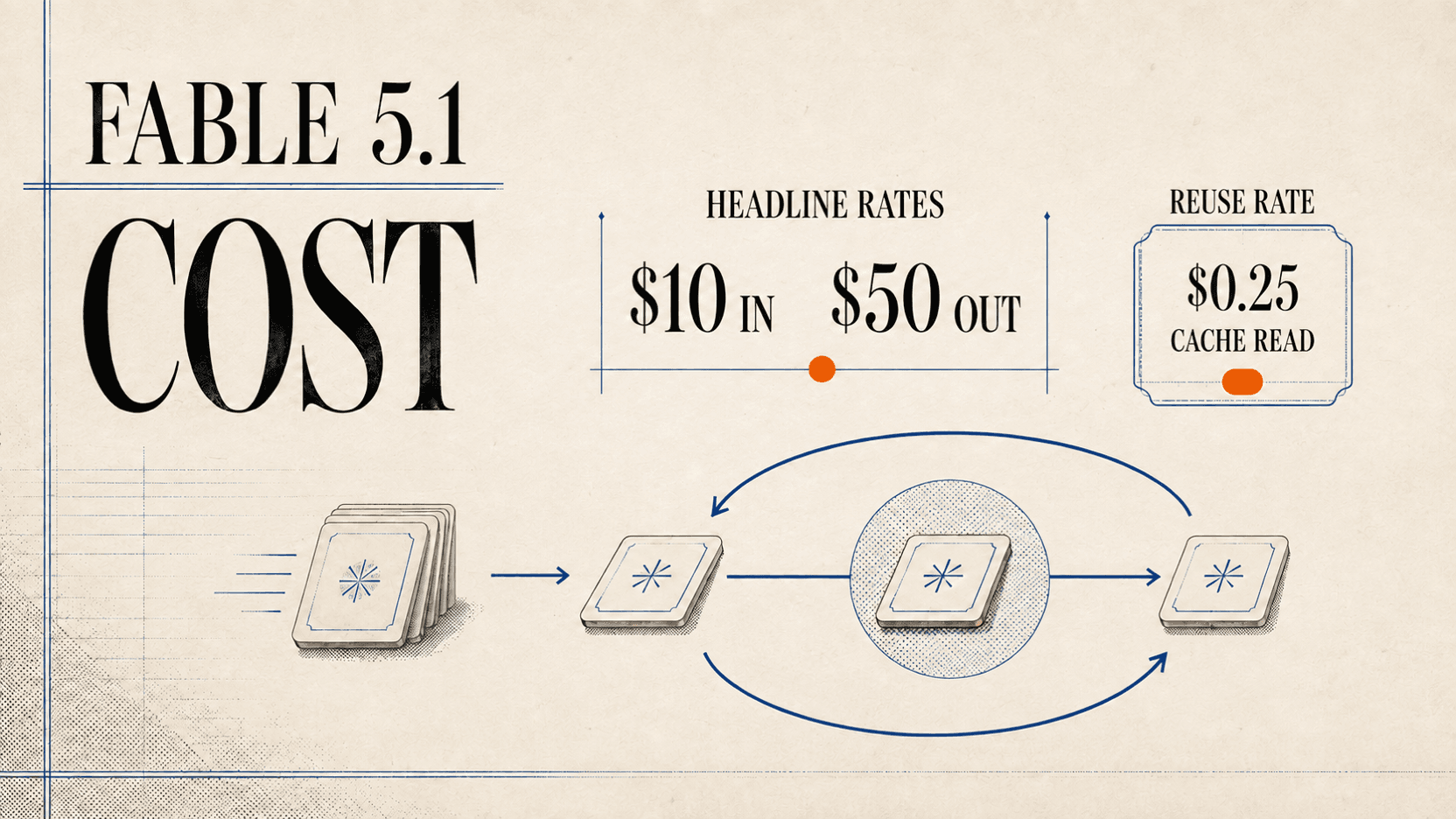
Claude Fable 5.1 is not cheaper than Claude Fable 5 at the headline API rates: both cost $10 per million input tokens and $50 per million output tokens. The saving is narrower and potentially substantial. A Fable 5.1 cache read costs $0.25 per million tokens, down from $1 on Fable 5. Cache writes cost the same on both models.[1]
That does not guarantee a lower bill for every task. A job with few cache hits, longer outputs, more tool turns, or higher effort can cost the same or more after migration. It also does not mean a Claude subscription usage meter will fall by 75%; subscription allowances and API token invoices are different billing systems. Use the current Claude Fable 5.1 model page for the route you plan to call, then calculate with that route's actual usage record rather than an upstream headline copied into a spreadsheet.
Quick answer
- Fable 5.1 keeps Fable 5's $10/MTok input and $50/MTok output rates.[1]
- The measurable discount is cache reads: $0.25/MTok instead of $1/MTok. Cache-write prices are unchanged.
- A 500K-token cache hit therefore saves $0.375 before output, tools, retries, and rejected work are counted.
- Do not translate that API discount into a Claude plan allowance claim; subscription meters and API invoices are separate.[4]
“Cheaper” can refer to four different numbers
Most arguments about this release mix at least two of these:
| Number | What it measures | Can the cache-rate cut change it? |
|---|---|---|
| API list price | Vendor rate for each token category | Yes, but only the cache-read category changed |
| Request charge | Token quantities multiplied by the applicable rates | Yes, in proportion to cache-read tokens |
| Cost per completed task | All requests, retries, tools, and failed attempts needed for one accepted result | Possibly; behavior and output length also matter |
| Subscription usage meter | Allowance or usage credits inside Claude and Claude Code plans | Not through a simple $0.75-per-MTok conversion |
The first two can be computed directly from an API usage object and rate card. The third requires an application-level task ID and an acceptance rule. The fourth requires the official rules for the relevant Claude plan.
If someone says “Fable 5.1 is 75% cheaper,” ask which row they mean. Only the cache-read unit rate fell by 75%.
The rate card, side by side
All prices below are direct Anthropic API list prices in US dollars per million tokens as of September 7, 2026.[1]
| Token category | Claude Fable 5 | Claude Fable 5.1 | Change |
|---|---|---|---|
| Base input | $10.00 | $10.00 | None |
| 5-minute cache write | $12.50 | $12.50 | None |
| 1-hour cache write | $20.00 | $20.00 | None |
| Cache hit or refresh | $1.00 | $0.25 | −75% |
| Output | $50.00 | $50.00 | None |
| Batch input | $5.00 | $5.00 | None |
| Batch output | $25.00 | $25.00 | None |
The cache-read multiplier is 0.025 times base input on Fable 5.1, compared with the usual 0.1 multiplier on Fable 5. A five-minute write is 1.25 times base input; a one-hour write is twice base input. Anthropic says those cache modifiers can stack with other modifiers such as Batch and data residency.[1]
For example, requesting US-only inference adds a 1.1 multiplier to input, output, cache writes, and cache reads on supported recent Claude models. Partner-operated cloud services have their own regional pricing. A cost worksheet should therefore record provider and inference region, not just the model name.[1]
The formula that belongs in the cost report
Let each token count be measured in millions:
U   = uncached input tokens / 1,000,000
W5  = tokens written to a 5-minute cache / 1,000,000
W60 = tokens written to a 1-hour cache / 1,000,000
R   = cache-read tokens / 1,000,000
O   = output tokens / 1,000,000
At direct list rates, a Fable 5.1 request is:
request_cost_5_1 = 10U + 12.5W5 + 20W60 + 0.25R + 50OFor Fable 5, only the cache-read term changes:
request_cost_5 = 10U + 12.5W5 + 20W60 + 1.00R + 50OIf token quantities remain identical, the saving is therefore:
saving = 0.75RIn plain language, every million cache-read tokens saves $0.75. The formula is deliberately conditional. Model behavior can change U, R, and O, as well as the number of requests needed to finish the task.
A worked session with a 500K cached prefix
Consider a hypothetical ten-request coding session. Each request sees the same 500,000-token repository prefix, adds 20,000 uncached input tokens, and produces 5,000 output tokens. The first request creates a five-minute cache entry; the next nine hit it. This is a pricing illustration, not a measured model benchmark.
First request: identical cost
500K cache write  = 0.5 × $12.50 = $6.25
20K fresh input   = 0.02 × $10   = $0.20
5K output         = 0.005 × $50  = $0.25
first request                         $6.70
Both versions cost $6.70 because their write, uncached-input, and output rates match.
Each later cache hit
| Line item | Fable 5 | Fable 5.1 |
|---|---|---|
| 500K cache read | $0.500 | $0.125 |
| 20K uncached input | $0.200 | $0.200 |
| 5K output | $0.250 | $0.250 |
| Request total | $0.950 | $0.575 |
Across the nine hits:
Fable 5 total   = $6.70 + (9 × $0.950) = $15.250
Fable 5.1 total = $6.70 + (9 × $0.575) = $11.875
saving                                    $3.375
The reduction is about 22.1% for this constructed session, even though the cache-read rate fell by 75%. The unchanged cache write, fresh input, and output dilute the saving. A session with a larger share of cache reads would save a larger percentage; one with no cache hits would save nothing at identical token counts.
When does writing the cache pay off?
Compare caching with repeatedly sending the same tokens as ordinary input.
For a five-minute Fable 5.1 cache, the first write costs 1.25 times the normal input rate and one hit costs 0.025 times. Across an initial request and one reuse, the stable prefix costs 1.25 + 0.025 = 1.275 input-rate units instead of 2.0 units uncached. It pays off after one cache read.
For a one-hour entry, the first write costs 2.0 units. Adding one read produces 2.025, slightly more than two uncached sends. Adding a second read produces 2.05, compared with 3.0 uncached. Anthropic's pricing guide accordingly says the five-minute duration pays off after one cache read and the one-hour duration after two.[1]
That arithmetic assumes a hit. A changing prefix can turn expected reads into new writes. Keep stable content first, place volatile instructions later, and monitor cache creation and read counts rather than assuming the prompt is cached. The Fable 5.1 API documentation covers the route-specific request shape; billing confirmation still comes from the returned usage fields and invoice.
Why a cheaper cache can still produce a more expensive task
Cache price is one term in a multi-request job. Track these sources of movement after migration:
Output length
Output costs five times as much per token as base input at the published rates. An extra 10,000 output tokens cost $0.50. In the earlier example, that equals more than one 500K cache-read saving of $0.375. Set output limits and grade useful completion rather than rewarding length.
Tool turns
Anthropic notes that Fable 5.1 may issue one tool call per turn in situations where Fable 5 might batch independent calls. Extra round trips can replay cached context cheaply, but they can also add fresh instructions, tool results, outputs, and latency.[3] Count the whole loop.
Effort
Fable 5.1 supports five effort levels and defaults to high. A task moved from a lower old setting to xhigh or max may consume more reasoning and time even if caching improves. Compare settings on accepted outcomes instead of treating the model name as the only variable.[3]
Cache invalidation
Changing a cached prefix, tool definition, or conversation history can reduce reuse. Fable 5.1 also binds preserved thinking to the prefix that produced it; careless history edits can drop reasoning and restart work. The Fable 5.1 migration checklist covers those compatibility rules.
Failed and rejected runs
A lower per-request charge does not help if more runs need human correction. Define an accepted task—tests pass, schema valid, sources supported, no prohibited files changed—and divide the total spend by accepted tasks rather than raw requests.
cost_per_accepted_task = total_cost_for_task_cohort / accepted_tasksHow to read Anthropic's 25% and 45% estimates
Anthropic says Fable 5.1 costs about 25% less than Fable 5 for typical token-billed workloads and may save up to about 45% for highly agentic work.[2] Its launch notes explain that the comparison used four weeks of August 2026 usage at default effort; the “typical” mix covered Claude Enterprise, Claude Code, and API traffic, while the agentic mix was context-heavy and tool-heavy.
Those figures are useful planning priors, not replacements for an invoice model. Your cache-read share may be lower. The new model may take a different number of turns. A gateway can also have a different rate card from Anthropic's direct API. Label the estimates as vendor-reported whenever they appear in a budget proposal.
If the API calculation falls but the Claude Code usage meter does not, compare them as separate billing systems before investigating cache behavior. The meter may be applying plan allowances or usage-credit rules rather than exposing a direct API-token invoice.
API billing is not the Claude subscription meter
Anthropic's Help Center says Fable 5 and Fable 5.1 work the same way across paid Claude plans.[4]
- On Max plans, premium Team seats, and premium seats on legacy seat-based Enterprise plans, Fable usage is included up to 50% of the weekly usage limit. It draws from that limit faster than other Claude models; after the Fable limit, a user can switch models or continue with usage credits.
- On Pro plans and standard Team seats, Fable 5 and 5.1 use pay-as-you-go usage credits rather than the plan's included usage.
- Standard seats on seat-based Enterprise need organization-enabled usage credits.
- Usage-based Enterprise and the Claude API are billed at standard API rates.
An earlier promotion allowed some Fable 5 use within weekly limits, ended July 19, 2026, and never applied to Fable 5.1. Old posts and screenshots can therefore describe rules that no longer apply.[4]
The practical distinction is simple: an API invoice exposes token categories that can be multiplied by a rate card. A Claude or Claude Code plan meter represents plan policy and usage allocation. Do not reverse-engineer one from the other unless Anthropic publishes the exact conversion for that account and surface.
FAQ
Is Claude Fable 5.1 75% cheaper than Fable 5?
Only its cache-read unit rate is 75% lower. Base input, cache writes, and output retain the same rates. Total savings equal the cache-read reduction after accounting for every unchanged line item and any change in model behavior.
Will I save money if I do not use prompt caching?
Not from the published rate change when token counts are equal. Fable 5.1 could still change task cost through output length, tool turns, effort, retries, or acceptance rate, but those are workload results rather than list-price reductions.
Is automatic prompt caching free?
No. Cache creation, cache reads, and ordinary input have separate charges. Automatic caching changes how breakpoints are managed; it does not remove the cache-write charge.[1]
Does a cache refresh use the lower Fable 5.1 rate?
Anthropic's table groups cache hits and refreshes at $0.25 per million tokens for Fable 5.1. Confirm the relevant usage fields in the response and billing report rather than estimating refreshes from request count alone.
Does Batch make Fable 5.1 half price?
Anthropic lists Batch input and output at 50% below standard rates for both Fable versions. Cache and other modifiers can stack, so calculate each token category instead of dividing an entire mixed invoice by two.[1]
Why did my Claude Code usage not fall after switching?
The plan meter is not simply the API cache-read line item. First identify whether the session used included plan allowance or usage credits, then compare like-for-like sessions. Also check output, effort, tool turns, cache hits, and whether the prompt prefix stayed stable.
The invoice test to run before switching the default
Export at least one normal billing cycle and group requests by application task ID. For each model, total uncached input, five-minute writes, one-hour writes, cache reads, output, retries, and accepted tasks. Reprice the old token quantities with the new rate card to isolate the cache discount; then compare that estimate with actual Fable 5.1 quantities to expose behavioral changes.
If the repriced estimate is lower but the observed task cost is higher, the cache discount is working—the workload shape changed. That finding is more actionable than arguing about the word “cheaper”: it points directly to output growth, lost cache hits, extra turns, or failed work.
References
- Anthropic, API pricing, accessed September 7, 2026.
- Anthropic, Introducing Claude Fable 5.1 and Mythos 5.1, September 1, 2026.
- Anthropic, Migrating to Claude Fable 5.1 and Claude Mythos 5.1, accessed September 7, 2026.
- Anthropic Help Center, Claude Fable models on your plan, accessed September 7, 2026.
Author

Categories
More Posts

Document-to-Video AI API: PDF, PPT, XLS, DOCX, or Web Page
Use Wan 3.0 to generate video from a PDF, presentation, spreadsheet, document, or public web page, with input limits, cost math, and request examples.

Fal AI Pricing, Free Credits and a Cheaper Alternative
Fal AI pricing explained: what fal.ai charges for Seedance, Wan and Nano Banana, how its free credits work, and a cheaper alternative with lower list prices.

How to Keep AI Video Continuity Across Multiple Clips
Learn to extend AI video across multiple clips with a state ledger, boundary frames, continuation prompts, API calls, continuity checks, and repair rules.