Use ChatGPT Without Sounding Like AI: A Human-First Workflow
Use ChatGPT without generic AI prose. Turn a real thesis, evidence, constrained drafting, and careful human editing into publishable writing.
The best way to use ChatGPT without sounding like AI is not to request a complete article and then swap a few synonyms. Give the model a real argument, real source material, and a narrow drafting job. Then edit the result as an author, not a proofreader.
That is the gap between AI-assisted writing and AI-finished writing. In the first, software helps with structure, alternatives, and compression while a person remains responsible for the thesis, evidence, voice, and final claims. In the second, a generic prompt produces a generic page and the writer becomes its delivery system.
This workflow is designed for publishable blog content. It does not promise to “beat” AI detectors. Its goal is more useful: produce work a reader would choose to finish.
TL;DR
- Start with a point of view and a reader decision, not “write 2,000 words about X.”
- Build a claim ledger from primary sources before drafting. ChatGPT should not invent the reporting layer.
- Give the model a voice sample and explicit anti-goals, but do not ask it to impersonate a living writer.
- Draft one section at a time with a defined job, evidence packet, and output limit.
- Perform separate substance, voice, and line edits. One vague “make it human” prompt cannot replace them.
- Verify every number, quote, date, product specification, and external link against the source.
- Treat detector results as one quality signal. Optimize for specificity and trust, not a guaranteed score.
Why “write me an article” produces AI-sounding prose
A broad prompt gives the model almost no information about what makes this article yours. It still has to fill the requested space, so it reaches for statistically safe defaults: a scene-setting introduction, balanced sections, conventional transitions, generalized benefits, and an optimistic conclusion.
The output is not generic because ChatGPT has a secret vocabulary. It is generic because the assignment is generic.
Usman's essay, “This is Why Nobody Can Tell I Used ChatGPT,” makes the useful distinction between creators who paste the first output and creators who barely use the tool at all.[1] There is a practical middle: use ChatGPT heavily where it is good, while keeping authorship decisions outside the model.
| Let ChatGPT help with | Keep under human control |
|---|---|
| Outline variants | Thesis and point of view |
| Counterarguments | Which evidence is trustworthy |
| Compression and reordering | First-hand experience |
| Headline alternatives | Ethical and disclosure decisions |
| Awkward sentence repair | Final factual responsibility |
| Consistency checks | What the conclusion actually recommends |
The seven-stage human-first writing workflow
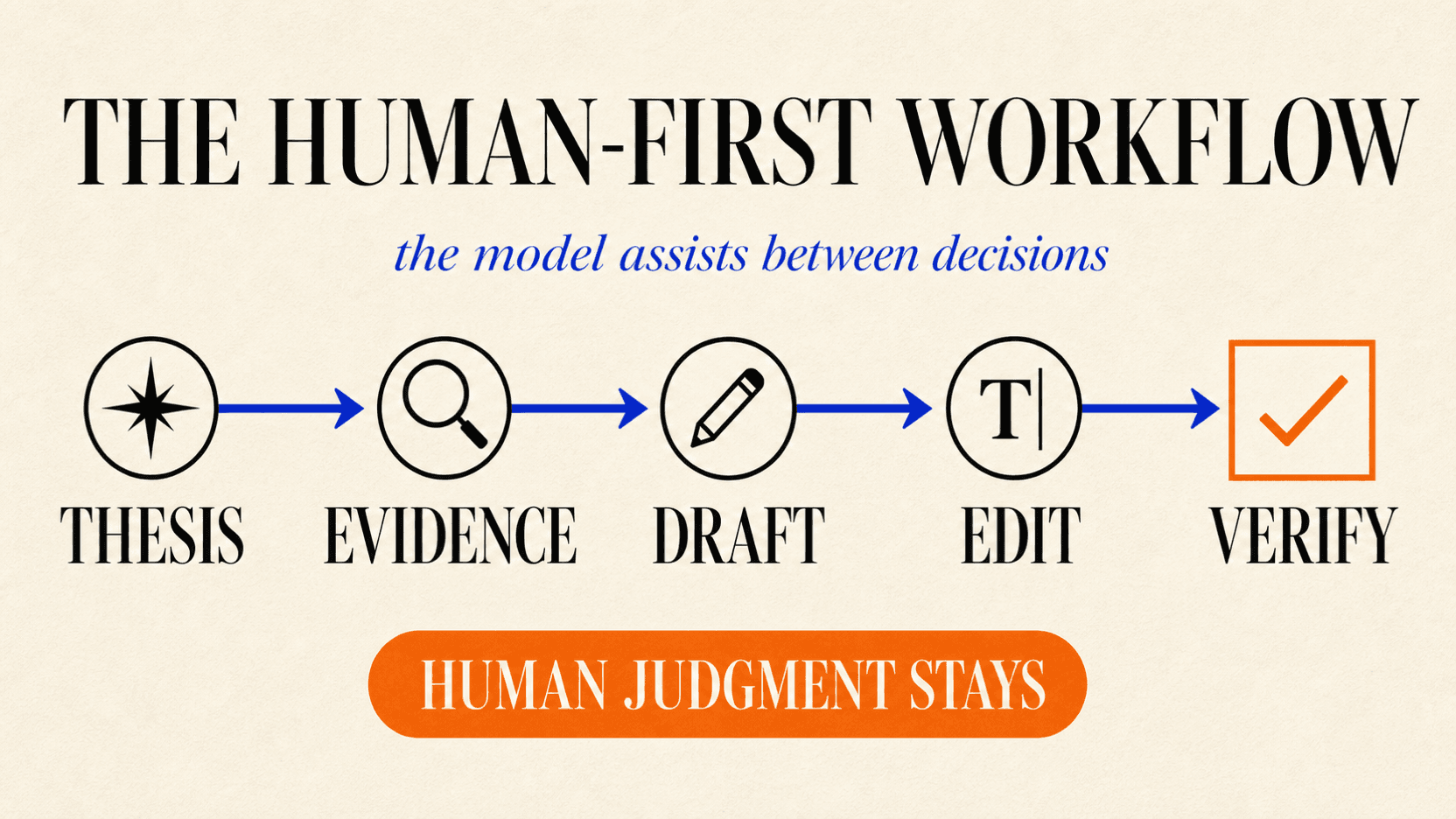
1. Write the one-sentence thesis yourself
Before opening ChatGPT, complete this sentence:
After reading this article, [specific reader] should understand that
[contestable claim], and therefore [decision or action].
“This article explains email marketing” is a topic, not a thesis. A useful version is: “After reading, a solo SaaS founder should understand that a smaller behavior-based onboarding sequence outperforms a large calendar-based sequence when product usage is sparse, and should launch three triggered emails before building ten scheduled ones.”
The claim narrows the research. The decision gives the conclusion somewhere to go.
2. Build a claim ledger, not a pile of tabs
Create a small table before the outline:
| Claim | Best source | Evidence | Limitation | Status |
|---|---|---|---|---|
| Product supports feature X | Official documentation | Exact specification and date | Beta availability | Verified |
| Workflow reduces editing time | Your timed test | 42 vs 67 minutes across five drafts | Small sample | Verified with caveat |
| Industry is adopting approach Y | None yet | — | — | Remove or research |
The ledger prevents the most common failure in AI-assisted content: smooth sentences appearing before anyone has earned the claim inside them. It also makes fact-checking finite. At the end, every consequential sentence should trace back to one row.
For SEO content, prefer primary sources: official documentation for product behavior, public rate cards for pricing, original papers for research findings, and your own disclosed test for first-hand claims. Use commentary articles to find questions, not as the final authority on technical facts.
3. Make a voice brief from your real writing
Do not ask for “a human tone.” That phrase is too broad to constrain anything. Build a short voice brief from two or three pieces you actually wrote and like.
Record observable choices:
- average paragraph length;
- whether openings start with a claim, scene, or question;
- preferred level of formality;
- how often you use first person;
- words or constructions you avoid;
- how you qualify uncertain claims;
- whether humor is dry, warm, rare, or absent;
- what a typical conclusion does.
Then include a 300–600 word sample you own. Ask ChatGPT to identify patterns first, and approve the analysis before it drafts. OpenAI's prompt guidance recommends clear instructions, explicit context, and examples of the desired output format; those principles apply directly to voice work.[2]
Do not ask it to write “exactly like” a living author. Borrowing structural techniques is one thing. Passing off a recognizable person's voice is another.
4. Design an outline around reader questions
Each section needs a job. A practical outline labels four fields:
Section: Why generic prompts create generic prose
Reader question: What exactly causes the problem?
Claim: Missing editorial constraints push the model toward safe defaults.
Evidence: Before/after prompt and output comparison.
Exit: The reader can diagnose the prompt before blaming vocabulary.
This exposes filler before it becomes paragraphs. If two headings answer the same reader question, combine them. If a section has no evidence or decision, cut it.
5. Use ChatGPT as a constrained section drafter
Now give the model one section, not the whole article. A strong working prompt looks like this:
You are helping me draft one section of an article. I remain the author and
will verify and edit the result.

ARTICLE THESIS
[one-sentence thesis]

SECTION JOB
[reader question, claim, and intended exit]

SOURCE PACKET
[only the verified notes and links relevant to this section]

VOICE
[brief plus a short sample I own]

CONSTRAINTS
- 300–450 words
- start with the claim, not scene-setting
- distinguish source facts from my inference
- no invented examples, quotations, statistics, or personal experience
- use headings only if they help scanning
- avoid inflated adjectives and generic future-facing conclusions
- flag missing evidence in [brackets] instead of filling the gap

Return the draft, then list every factual claim that needs verification.
The last line turns the model into a preliminary auditor. It does not make the claims true, but it creates a checklist for the next pass.
6. Edit in three separate passes
Trying to fix facts, structure, voice, and punctuation simultaneously makes each pass shallow.
Substance edit. Check whether the argument follows, the strongest evidence receives the most space, and every section changes what the reader knows or decides. Remove fabricated certainty and unsupported generalization.
Voice edit. Replace phrases you would never say. Add the distinction, objection, or hard-earned detail that came from your judgment. Vary paragraph shape where the logic demands it. Do not manufacture typos or awkwardness; humans are not defined by lower quality.
Line edit. Cut repeated setup, throat-clearing, redundant conclusions, ornamental metaphors, and transitions that explain obvious movement. Read the page aloud. The sentence that makes you speed up to get through it usually needs to be split or deleted.
The reAPI Humanize API can support this pass at scale by rewriting AI-sounding text, but it should receive a voice brief and a verified draft. Rewriting cannot repair a missing thesis or turn a false claim true.
7. Run a publication integrity check
Before publishing:
- Open every citation and confirm it supports the adjacent claim.
- Search the draft for every number, date, superlative, and quotation.
- Remove personal stories the model supplied; it has no lived experience.
- Confirm that examples are real, clearly hypothetical, or reproducible.
- Check names, model IDs, pricing units, and version dates.
- Verify internal and external links.
- Follow the destination's AI-use and disclosure rules.
Google says generative AI can be useful for research and structure, while warning that many automated pages without added value can violate scaled-content policies. Its current advice emphasizes accuracy, quality, relevance, and useful context about automation.[3] That is a sensible publication standard even when search traffic is not the goal.
Before-and-after: improving the assignment, not disguising the output
Weak request
Write a 2,000-word SEO article about AI writing. Make it engaging and human.This request supplies a length, topic, and vague adjective. The model must invent the reader, thesis, evidence, level of expertise, and editorial position.
Strong request
Draft the “detector limitations” section for editors at SaaS companies.
The claim is that detector scores should trigger review, not automatic rejection.
Use only the attached OpenAI classifier page and Liang et al. study.
Explain what each source found and state that the evidence does not evaluate
every current detector. End with a five-line review policy. 450 words maximum.
The stronger prompt is not a trick for hiding AI. It is a better brief. A human editor could hand the same assignment to another human and expect a more useful draft.
Five edits that recover the author's presence
Replace category language with observed detail
“Businesses can improve efficiency” says nothing. “The editor reduced source-checking from 14 tabs to a five-row ledger” gives the reader an object and a result.
State where your inference begins
Write “The documentation confirms X; my inference is Y” when moving beyond a source. This small boundary creates more trust than confident fluency.
Keep the exception next to the rule
Do not hide limitations three sections later. If a benchmark used one language, a price excludes caching, or a workflow was tested on five drafts, say so where the result appears.
Let important points occupy unequal space
A model likes balance. An author chooses. Give the decisive issue six paragraphs and the minor caveat two sentences if that is what the evidence warrants.
End with a decision
Do not conclude that “AI will continue to transform writing.” Tell the specific reader what to do on Monday and what not to delegate.
What about AI detectors?
You can run a draft through the reAPI AI text detector to identify passages worth another look, especially in a high-volume workflow. But do not edit toward a promised zero score. Classifiers vary, and a 2023 peer-reviewed study found false-positive risks for non-native English writing.[4]
A better target is an editorial scorecard:
| Dimension | Passing question |
|---|---|
| Specificity | Could these examples appear only in this article? |
| Evidence | Can every important claim be traced to a source? |
| Voice | Does the reasoning sound like the named author? |
| Utility | Can the reader make a decision or perform a task? |
| Integrity | Are assistance, uncertainty, and limitations handled honestly? |
If the page passes those tests, it has become better writing rather than merely less detectable writing.
FAQ
How do I make ChatGPT writing sound less AI-generated?
Start with your own thesis and evidence, provide a concrete voice brief, draft in constrained sections, and edit separately for substance, voice, and line quality. Do not rely on synonym swaps or instructions to “sound human.”
Can ChatGPT copy my writing style?
It can identify and follow observable patterns from samples you provide, such as tone, paragraph length, pacing, and degree of formality. Review the result carefully, and use samples you own rather than requesting imitation of a living writer.
Should I edit the entire ChatGPT draft at once?
For short copy, perhaps. For a researched article, section-by-section drafting is easier to constrain and verify. It also makes it less likely that an early factual error will be repeated throughout the piece.
Can a humanizer replace editing?
No. A humanizer can improve phrasing, rhythm, and stylistic variation. It cannot supply genuine experience, choose a defensible thesis, or verify a source. Use it inside an editorial workflow, not in place of one.
Is AI-assisted content bad for SEO?
Google's published guidance focuses on helpfulness, originality, accuracy, and value rather than a blanket ban on AI assistance. Large-scale low-value generation is the risk.[3]
Keep the author in the loop where judgment compounds
ChatGPT is most useful between blank page and final page. It can propose structures, expose counterarguments, compress research notes, and produce a section worth editing. Those are substantial contributions.
The author still has to decide what is true, what matters, what came from experience, which caveat changes the result, and what the reader should do next. Keep those decisions human and the writing stops feeling like a model trying to fill space. It begins to feel like someone had a reason to publish.
References
- Usman. This is Why Nobody Can Tell I Used ChatGPT. Write A Catalyst, March 2026. medium.com
- OpenAI. Best practices for prompt engineering with the OpenAI API. Updated 2026. help.openai.com
- Google Search Central. Guidance on using generative AI content on your website. Updated December 2025. developers.google.com
- Weixin Liang et al. GPT detectors are biased against non-native English writers. Patterns, 2023. pubmed.ncbi.nlm.nih.gov
Further reading
- reAPI. Humanize API. reapi.ai/docs/humanize
- reAPI. AI text detector API. reapi.ai/docs/ai-text-detector
- reAPI. AI essay writer API. reapi.ai/docs/ai-essay-writer
- reAPI. Can you tell if a writer used ChatGPT? reapi.ai/blog/can-you-tell-if-writer-used-chatgpt
Author

Categories
More Posts

Grok Imagine Video 1.5 API: Pricing, 1080p, and Limits (2026)
Use the Grok Imagine Video 1.5 API for image-to-video with native audio. Compare 480p, 720p, and 1080p pricing, limits, reAPI routes, and code.

Best-Value Seedance 2.0 API in 2026: Prices Compared
A matched Seedance 2.0 API price comparison across reAPI, Atlas, Replicate, fal, and WaveSpeed, including billing rules and best-value picks.
What Is Claude Opus 4.8? Anthropic's New Model Explained
Claude Opus 4.8 is Anthropic's most capable model for reasoning and agentic coding. Here is what's new, its benchmarks, pricing, and how to access it.