GPT API Price Cut: 5 Models Now Cost 20% Less on reAPI
Five GPT models now cost 20% less on reAPI than OpenAI's standard list price. Compare GPT-5.4, GPT-5.5, and all three GPT-5.6 tiers.
The latest GPT API price cut is easy to misunderstand. OpenAI has not announced a blanket reduction to its public API list prices. What changed for reAPI users is the route: five current GPT models are now listed at 20% below OpenAI's standard input and output token rates.
The discount covers GPT-5.4, GPT-5.5, and the complete GPT-5.6 family—Sol, Terra, and Luna. There is no new SDK or migration project. Existing OpenAI-compatible code can use the lower rates by changing the base URL and, where necessary, the model id.
This guide compares every rate, calculates the savings on a real workload, and explains when OpenAI's Batch API or prompt caching can still change the answer.
TL;DR
- Five GPT models are 20% below OpenAI's standard list price on reAPI: GPT-5.4, GPT-5.5, GPT-5.6 Sol, GPT-5.6 Terra, and GPT-5.6 Luna.
- This is a reAPI discount, not an OpenAI-wide price cut. OpenAI's current public prices remain unchanged.[1][2]
- The cheapest route is GPT-5.6 Luna at $0.80 input and $4.80 output per million tokens on reAPI.
- Terra and GPT-5.4 share the same token price on reAPI: $2 input and $12 output per million tokens. Benchmark both before choosing.
- GPT-5.5 and GPT-5.6 Sol also share a price: $4 input and $24 output per million tokens on reAPI.
- A 20% token discount produces a 20% bill reduction when request mix and token usage stay the same. A model that uses fewer output tokens can reduce cost per completed task by more.
GPT API prices before and after the discount
All prices below are USD per 1 million tokens. "OpenAI list" means standard processing, not Batch, Flex, Priority, regional processing, or a negotiated enterprise contract. reAPI figures are from its live public rate card on August 1, 2026.[3]
| Model | OpenAI input | reAPI input | OpenAI output | reAPI output | Reduction |
|---|---|---|---|---|---|
| GPT-5.4 | $2.50 | $2.00 | $15.00 | $12.00 | 20% |
| GPT-5.5 | $5.00 | $4.00 | $30.00 | $24.00 | 20% |
| GPT-5.6 Sol | $5.00 | $4.00 | $30.00 | $24.00 | 20% |
| GPT-5.6 Terra | $2.50 | $2.00 | $15.00 | $12.00 | 20% |
| GPT-5.6 Luna | $1.00 | $0.80 | $6.00 | $4.80 | 20% |
OpenAI publishes a separate cached-input price for these models. The current reAPI rate card does not expose a cached-input rate for the discounted default routes, so this comparison does not invent one. Treat repeated prompt prefixes as a separate benchmark rather than assuming the same 20% relationship.
What the GPT API price cut means for a real bill
Suppose an agent processes 100 million input tokens and generates 20 million output tokens each month. With identical token usage, the monthly calculation is:
monthly cost = input MTok × input rate + output MTok × output rate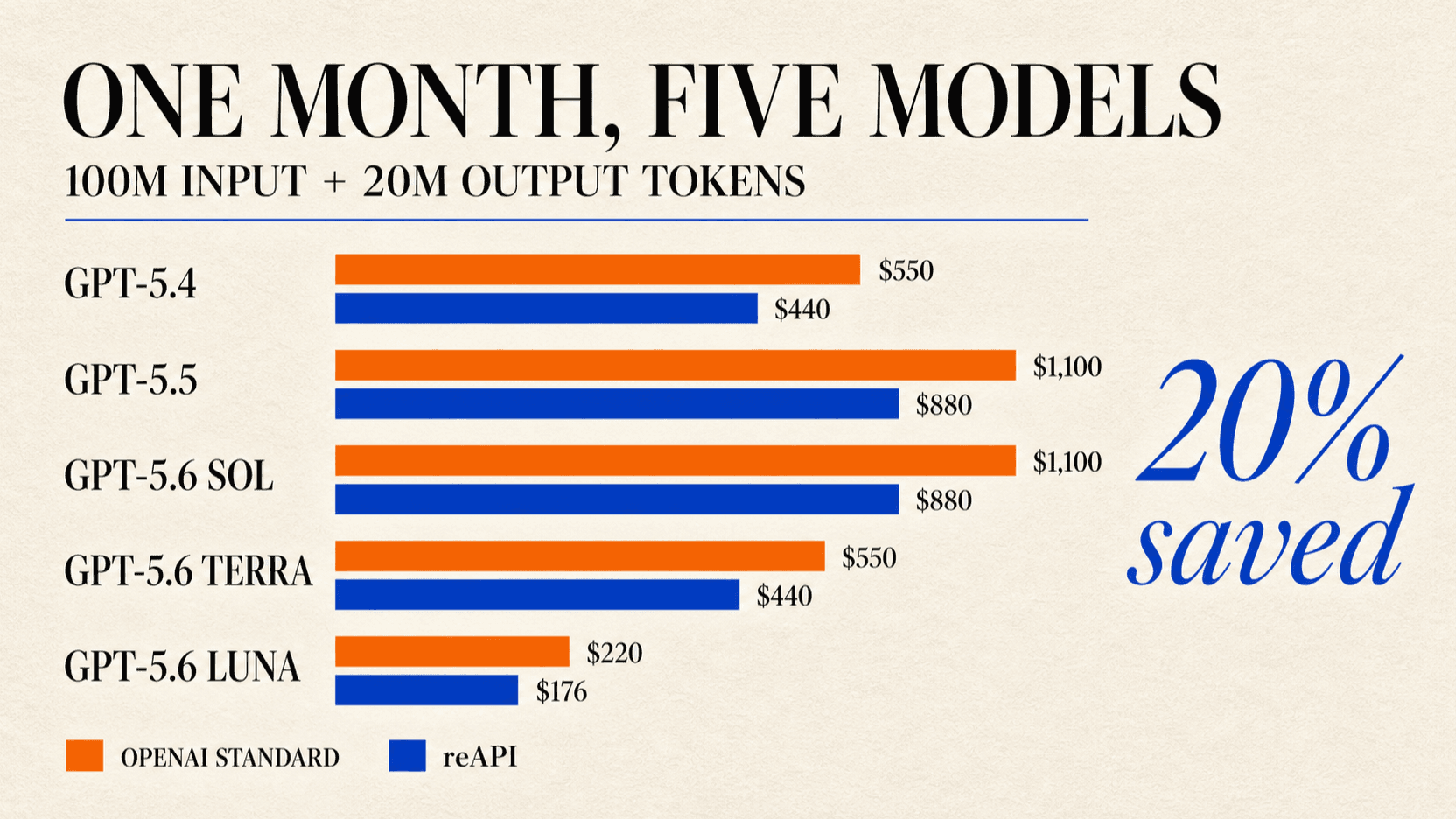
| Model | OpenAI standard | reAPI | Monthly savings |
|---|---|---|---|
| GPT-5.4 | $550 | $440 | $110 |
| GPT-5.5 | $1,100 | $880 | $220 |
| GPT-5.6 Sol | $1,100 | $880 | $220 |
| GPT-5.6 Terra | $550 | $440 | $110 |
| GPT-5.6 Luna | $220 | $176 | $44 |
The percentage is constant, but the dollar impact grows with spend. A team currently paying $10,000 per month for the same mix of uncached standard traffic would retain roughly $2,000 after moving it, before considering any change in model behavior or token consumption.
That last condition matters. API cost is not merely price per token:
cost per successful task
= price per token × tokens per attempt × attempts per success
A cheaper model that needs two retries can cost more than an expensive model that succeeds once. A more concise model can beat the table by emitting fewer billable output tokens. OpenAI says GPT-5.6 improves token efficiency, so a carefully evaluated migration may save more than the headline 20% per-token discount.[1]
Which discounted GPT model should you use?
The table creates two same-price pairs, which makes the buying decision more interesting than simply choosing the newest model.
GPT-5.6 Luna: the volume default
Luna is the lowest-priced model in this group. OpenAI positions it for cost-sensitive, high-volume work, with a 1.05M-token context window and 128K maximum output. It is the first candidate for classification, extraction, ranking, routine support, and inexpensive agent subtasks.[4]
At $0.80 input and $4.80 output per million tokens on reAPI, Luna is 60% cheaper than Terra on both dimensions. Use the price gap to run a proper eval, not to skip one: measure task completion, retries, latency, and total output tokens.
GPT-5.6 Terra versus GPT-5.4: same price, newer tier
Both cost $2 input and $12 output per million tokens on reAPI. Terra is the natural first test because OpenAI describes it as the balanced GPT-5.6 tier, competitive with GPT-5.5 while priced below the flagship.[1]
GPT-5.4 remains useful when an existing production prompt has already been validated against it. A same-price migration is not automatically free: model behavior, reasoning defaults, cache behavior, and output length can change. Run a shadow comparison before moving all traffic.
GPT-5.6 Sol versus GPT-5.5: capability at the same rate
Both cost $4 input and $24 output per million tokens on reAPI. OpenAI's own standard list price is also identical for the pair at $5 and $30. Sol is the new flagship and adds the GPT-5.6 generation's updated reasoning, tool use, and explicit prompt-caching controls, while GPT-5.5 is the stable baseline for teams that have already tuned around it.[1][2]
For new high-complexity deployments, start the evaluation with Sol. Keep GPT-5.5 only when regression tests show that its established behavior wins on your workload.
When 20% off is not the cheapest option
A clean price table is useful, but three billing details can reverse a narrow comparison.
Batch and Flex processing
OpenAI offers Batch and Flex processing at 50% of standard rates for GPT-5.4 and GPT-5.5, and Batch processing for supported GPT-5.6 requests.[2][5] If a workload can wait and does not need an immediate response, compare those asynchronous prices with reAPI's live rate instead of comparing standard processing alone.
The 20% reAPI discount is most directly relevant to synchronous, standard API traffic. A nightly offline enrichment job has different economics from a live coding agent.
Prompt caching
OpenAI lists cached reads for GPT-5.6 at 10% of uncached input price. GPT-5.6 also bills explicit cache writes at 1.25 times the uncached input rate, so the net result depends on how often the prefix is reused.[1]
For a long system prompt reused hundreds of times, cache hit rate can matter more than a 20% reduction in ordinary input price. Track uncached input, cache-write tokens, cache-read tokens, and output separately.
Long-context requests
For GPT-5.4 and GPT-5.6 models with 1.05M context windows, OpenAI prices prompts above 272K input tokens at 2x input and 1.5x output for the full request.[4][6] The reAPI public rate card shows base model ratios, not a complete long-context invoice example. If your prompts cross that threshold, test a representative request and verify billed usage before projecting savings.
How to use the lower GPT API rates
reAPI exposes an OpenAI-compatible endpoint, so the Python client only needs a different base URL. This example uses Terra, the balanced tier:
from openai import OpenAI

client = OpenAI(
    api_key="YOUR_REAPI_KEY",
    base_url="https://api.reapi.ai/v1",
)

response = client.chat.completions.create(
    model="gpt-5.6-terra",
    messages=[
        {"role": "user", "content": "Review this pull request for data-loss risks."}
    ],
)

print(response.choices[0].message.content)
The available model ids are:
gpt-5.4gpt-5.5gpt-5.6-solgpt-5.6-terragpt-5.6-luna
Do not replace the dots with hyphens in API requests. The reAPI website uses hyphenated page slugs, but the wire model ids preserve OpenAI's dotted version numbers.
A safe migration checklist
Moving an API route is simple; proving that the new route is economical takes a little more work.
- Export a representative sample. Include short and long prompts, tool calls, structured output, and known failure cases.
- Pin the model id. Do not compare moving aliases if you need a stable before-and-after result.
- Run both routes. Measure answer quality, first-token latency, total latency, input tokens, output tokens, retries, and errors.
- Calculate cost per accepted result. Token price alone hides retries and human review.
- Inspect feature compatibility. Validate tools, structured outputs, streaming, and image input used by the application.
- Move traffic gradually. Start with a small percentage and keep the old route available until error rates and bills match the test.
- Check the live rate card. Pricing can change after an article is published; treat the model page and API rate card as the source of truth.
FAQ
Did OpenAI lower GPT API prices?
Not across the five models in this comparison. OpenAI's current public list prices remain $2.50/$15 for GPT-5.4, $5/$30 for GPT-5.5 and GPT-5.6 Sol, $2.50/$15 for GPT-5.6 Terra, and $1/$6 for GPT-5.6 Luna, per million input and output tokens. The 20% reduction described here is the current reAPI rate relative to those standard prices.[1][2]
Which GPT models are 20% cheaper on reAPI?
GPT-5.4, GPT-5.5, GPT-5.6 Sol, GPT-5.6 Terra, and GPT-5.6 Luna. The discount applies to the published input and output token rates on reAPI's default routes.[3]
What is the cheapest GPT-5.6 API model?
GPT-5.6 Luna. It costs $1 input and $6 output per million tokens at OpenAI's standard rate, or $0.80 input and $4.80 output on reAPI's current default route.[3][4]
Is GPT-5.6 Terra cheaper than GPT-5.4?
No. They have the same token prices in this comparison: $2/$12 on reAPI and $2.50/$15 at OpenAI. Terra is newer, but the best value depends on task success, token efficiency, and migration risk.
Is GPT-5.6 Sol cheaper than GPT-5.5?
No. Both are $4/$24 per million input/output tokens on reAPI and $5/$30 at OpenAI's standard rate. Sol offers the newer capability tier at the same per-token price.[1]
Does reAPI offer discounted cached input?
The current public rate card does not publish a separate cached-input ratio for these discounted default routes. Do not assume one. Compare a real cached workload and check live billing before migration.
Can I keep using the OpenAI Python SDK?
Yes. Set base_url to https://api.reapi.ai/v1, use a reAPI key, and keep the
canonical dotted GPT model id.
The price cut is useful; cost per result is the decision
A uniform 20% reduction is unusually easy to budget. Keep the workload and model fixed, and a $1,000 standard-token bill becomes roughly $800. The more valuable opportunity is model routing: Luna for routine volume, Terra for the balanced default, and Sol only where frontier capability improves the success rate enough to pay for itself.
The honest headline is therefore narrower than "OpenAI cut prices" and more useful to developers: five current GPT models now run at 80% of OpenAI's standard token rates on reAPI. Verify your cache pattern, long-context usage, and asynchronous options, then measure cost per accepted result before moving production traffic.
References
- OpenAI. GPT-5.6: Frontier intelligence that scales with your ambition. Pricing and tier details. openai.com/index/gpt-5-6
- OpenAI. Introducing GPT-5.5. API pricing and processing options. openai.com/index/introducing-gpt-5-5
- reAPI. Live public API pricing. Retrieved August 1, 2026. api.reapi.ai/api/pricing
- OpenAI. GPT-5.6 Luna model. Specifications, pricing, caching, and long-context rules. developers.openai.com/api/docs/models/gpt-5.6-luna
- OpenAI. API pricing. Standard and Batch processing rates. openai.com/api/pricing
- OpenAI. GPT-5.4 model. Pricing and long-context rules. developers.openai.com/api/docs/models/gpt-5.4
Further reading
- reAPI. How to use GPT-5.6. reapi.ai/blog/how-to-use-gpt-5-6
- reAPI. How to use GPT-5.5. reapi.ai/blog/how-to-use-gpt-5-5
- reAPI. GPT-5.6 model catalog. reapi.ai/models
Author

Categories
More Posts
GLM-5.2 API Guide: 1M Context, Pricing, and Coding (2026)
Use the GLM-5.2 API with OpenAI-compatible code. Learn its 1M context, $1.40/$4.40 official pricing, reAPI rates, reasoning controls, and limits.

Atlas Cloud vs Higgsfield: API Platform or Creator Studio?
Atlas Cloud vs Higgsfield vs reAPI for Seedance: compare API access, creator workflows, pricing, model breadth, and which platform fits your team.

Best CometAPI Alternatives in 2026: 5 Options Compared
Looking for CometAPI alternatives in 2026? Compare OpenRouter, WaveSpeed, Together AI, Replicate, and reAPI on models, pricing, speed, and API design.