· reAPI Team
Claude Fable 5.5 vs Claude Opus 5.5: When Switching Pays Off
Compare Claude Fable 5.5 vs Claude Opus 5.5 using live Opus 5.5 and Fable 5.2 baselines, Anthropic's effort-retry data, advisor costs, and upgrade criteria.
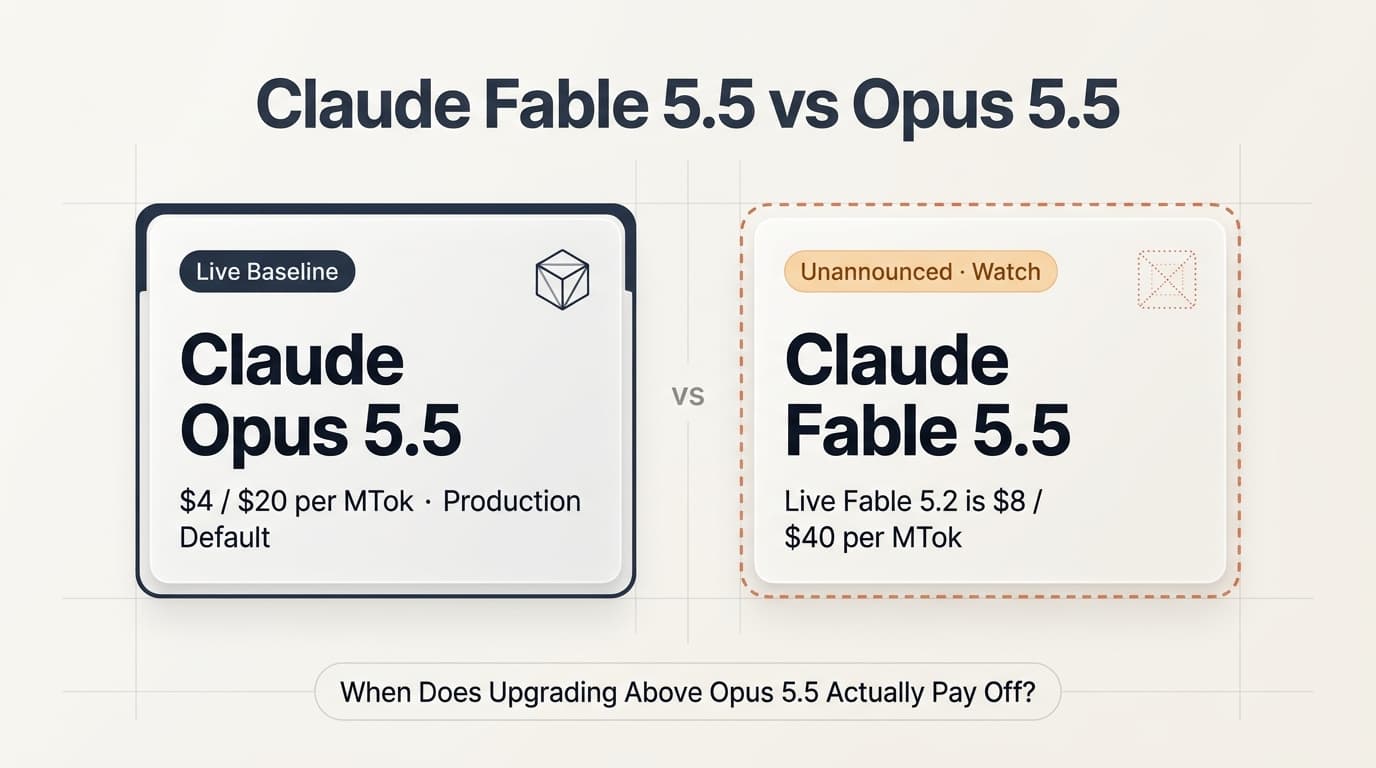
Keep Claude Opus 5.5 as your production default if it already passes your acceptance tests. As of November 23, 2026, Anthropic has not released or published specs for Claude Fable 5.5, so no verified head-to-head benchmark between Fable 5.5 and Opus 5.5 exists.[1] What Anthropic actually shipped on November 9, 2026 is Claude Fable 5.2 (claude-fable-5-2) at $8 input and $40 output per million tokens, exactly double Claude Opus 5.5's direct $4/$20 rate.[2]
Even hours after launching Fable 5.2, Anthropic's own claude.dev model-selection guide still recommended starting most coding and knowledge work on Claude Opus 5.5 at medium effort rather than moving blindly to the top Fable tier.[3] Whether you are evaluating live Claude Fable 5.2 today or preparing an evaluation harness for a future Fable 5.5 release, this guide shows what you can compare right now, why Opus 5.5 is already a tough baseline to beat, and the exact math that decides when moving up a tier actually pays off.
What You Can Actually Compare Right Now
A fair comparison separates live, documented models from unannounced candidates. (For the full timeline of Azure catalog sightings and rumor tracking, see our Claude Fable 5.5 release date status page.)
| Decision Input | Claude Opus 5.5 (Live Baseline) | Claude Fable 5.2 (Live Top Tier) | Claude Fable 5.5 (Candidate) |
|---|---|---|---|
| Release status | Released September 22, 2026 | Released November 9, 2026 | Unannounced (not live) |
| Official API ID | claude-opus-5-5 | claude-fable-5-2 | Not confirmed |
| Direct input / output (per MTok) | $4.00 / $20.00 | $8.00 / $40.00 | Unannounced |
| Direct cache read (per MTok) | $0.20 | $0.20 | Unannounced |
| reAPI displayed input / output | $2.80 / $14.00 (cache read $0.14) | Check live Fable 5.2 page | Not available |
| Context / max output | 1M / 128K tokens | 1M / 128K tokens | Unverified |
| Default API effort | medium | high | Unverified |
| Production role | Default for coding & agents[3] | Escalation for hardest runs | Evaluate only after live access |
Notice the default effort difference between Opus 5.5 (medium) and Fable 5.2 (high). If a team swaps model IDs without pinning output_config.effort, they end up comparing Opus 5.5 on medium against Fable on high, which inflates both latency and output token spend before the model even gets a fair test.
Why Opus 5.5 Is Already a Hard Baseline to Beat
Older guides assumed any "Fable" model automatically beats any "Opus" model. Public September–November 2026 data disproves that assumption. When Claude Opus 5.5 launched three weeks after Fable 5.1, it actually outscored Fable 5.1 across almost every major engineering and knowledge-work benchmark while costing 60% less per token:[4][5]
| Benchmark | Claude Opus 5.5 | Claude Fable 5.1 | Advantage |
|---|---|---|---|
| Terminal-Bench 4.0 | 66.4% | 55.8% | Opus 5.5 (+10.6 pts) |
| CursorBench 4.0 | 57.8% | 51.8% | Opus 5.5 (+6.0 pts) |
| FrontierCode v1.1 | 54.4% | 50.3% | Opus 5.5 (+4.1 pts) |
| AutomationBench | 40.0% | 31.4% | Opus 5.5 (+8.6 pts) |
| GDPval-AA v2.1 (Elo) | 1,846 | 1,735 | Opus 5.5 (+111 Elo) |
| Artificial Analysis Intelligence Index | 58 | 53 | Opus 5.5 (+5 pts) |
| LMArena Elo (community votes) | 1,819 | 1,741.9 | Opus 5.5 (+77 Elo) |
Note: Anthropic's published Opus 5.5 evaluations run with production safety fallbacks enabled (routing flagged cybersecurity tasks to Opus 4.8 and flagged biology tasks to Opus 5), and Terminal-Bench 4.0 used xhigh effort.[6]
Fable 5.2 subsequently stepped ahead of Opus 5.5 on Anthropic's newest hard-reasoning evaluations and dropped Fable's token price from $10/$50 down to $8/$40. Still, the lesson for any future Claude Fable 5.5 launch is clear: a bigger name or newer version number does not automatically justify paying 2x per token over Opus 5.5. You have to measure where Opus 5.5 actually fails on your own repository.
Fix Three Cheaper Things Before Paying 2x for Fable
Anthropic's November 9 engineering guide lays out an explicit escalation sequence before moving a workload off Opus 5.5:[3]
- Add self-verification first. Give Opus 5.5 a concrete test command, typechecker, or schema validator so it can catch its own mistakes in a second turn. Verification loops frequently close quality gaps without touching a more expensive model.
- Try the low-then-high retry pattern. In Anthropic's SWE-bench Pro measurements, running every task at
higheffort scored 95.3% at $0.29 per task. Running every task atloweffort first and re-running only the failures athighscored ~97% at $0.17 per task—higher accuracy for 41% less money.[3] - Only then escalate to Fable 5.2 (or a future Fable 5.5). Reserve the 2x tier for tasks that still fail Opus 5.5 at
higheffort: long unattended engineering sessions, multi-hour research synthesis, complex financial modeling, or subtle cross-module bugs where human review time dwarfs API token cost.
Does Using Fable Only as an Advisor Save Money?
On paper, pairing a cheaper Opus 5.5 executor with a Fable advisor sounds clever. In practice, check the math carefully. Anthropic's own guide reported that pairing an Opus 5.5 executor with a Fable 5.1 advisor raised benchmark accuracy by 1.7 points for roughly 2.1x the total cost.[3]
By contrast, top-down bulk orchestration paid off much better: on a defect-search benchmark spanning ~22 million tokens of code, using an Opus 5.5 lead to coordinate Sonnet 5.5 workers matched solo Opus 5.5 accuracy while cutting total spend by roughly one-third.[3]
There are also two hidden switching penalties built into Anthropic's API architecture that hurt naive mid-thread model hopping:
- Prompt caches are model-scoped. Switching from Opus 5.5 to Fable mid-conversation forces a brand-new cache write for the entire prefix instead of reading the warm cache.[3]
- Thinking blocks are only partially portable. Moving from Fable 5.2 back down to any other generally available model drops Fable 5.2's signed thinking blocks.[2][3] If you escalate or hand off between models, pass a crisp written summary and exact error log into a fresh turn rather than expecting the second model to inherit the first model's hidden reasoning state.
Cost per Accepted Task: How to Judge an Upgrade
Token price tables only tell half the story. Once Fable 5.5 ships (or when testing live Fable 5.2 today), compare configurations using cost per accepted task:[6]
Cost per accepted task = Total spend across all attempts (incl. retries & cache writes) / Accepted tasksKeep API evaluations separate from Claude Code workflow evaluations. In an API test, you lock the exact prompt, tool definitions, effort setting, and token cap. In a Claude Code test, client version, CLAUDE.md rules, subagent routing, and automatic context compaction all move together—so treat that as a full workflow comparison rather than attributing every gain to the raw model.
Consider an illustrative 20-task hard-debugging bake-off (50,000 fresh input tokens + 6,000 output tokens per attempt, direct standard rates):
| Configuration (20 hard tasks) | Pass Rate | Total Attempts Needed | Direct Spend | Cost / Accepted Task |
|---|---|---|---|---|
Opus 5.5 (medium) — 15/20 pass, 5 fail after 2 tries | 75% | 25 | $8.00 | $0.53 (5 tasks still unresolved) |
Opus 5.5 (high) — 18/20 pass, 2 fail after 2 tries | 90% | 22 | $7.04 | $0.39 (2 tasks unresolved) |
Fable 5.2 (high) — 19/20 pass on first try, 1 needs retry | 95% | 21 | $13.44 | $0.71 (1 task unresolved) |
Opus 5.5 (high) + Fable 5.2 escalation on failures | 95% | 20 Opus + 2 Fable | $7.68 | $0.40 (best total outcome) |
Illustrative arithmetic using Anthropic direct rates ($4/$20 for Opus 5.5; $8/$40 for Fable 5.2) to demonstrate the decision formula, not measured benchmark results.
Look at the bottom row. Replacing Opus 5.5 wholesale with Fable nearly doubles your API bill ($13.44 vs $7.04) for one extra solved ticket. Escalating only the two failed tickets to Fable achieves the exact same 95% pass rate for $7.68—saving 43% over an all-Fable default.
Retain, Escalate, or Replace?
When Fable 5.5 eventually hits /v1/models (or when deciding on live Fable 5.2 today), sort every workload into one of three clear lanes:
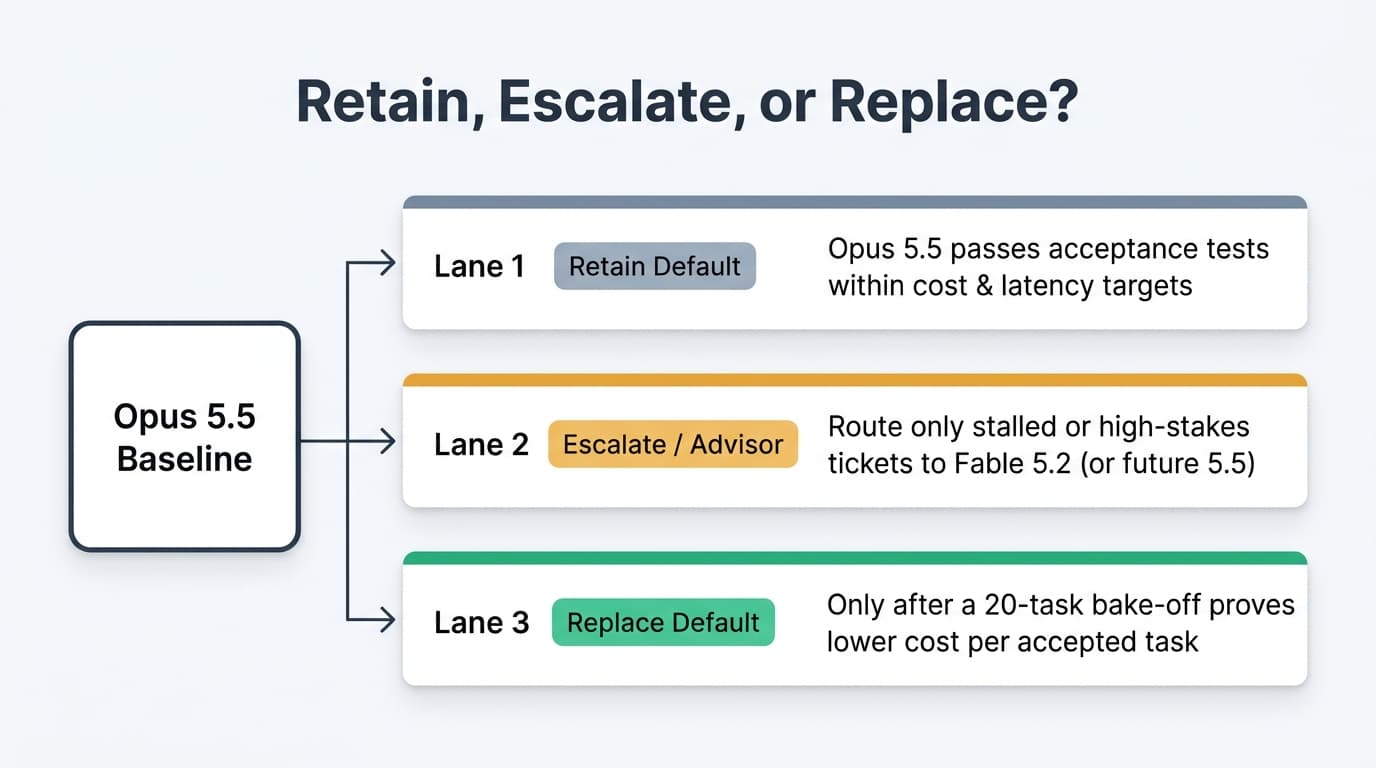
- Retain Opus 5.5 as default: Your 20-task suite passes acceptance checks within latency and budget limits. Keep Opus 5.5 on
medium(orlowwithhighretry) and pair it with Claude Sonnet 5.5 for high-volume routine lanes. - Escalate selectively to Fable: Fable solves concrete, high-value tickets where Opus 5.5 at
higheffort fails repeatedly, and the saved engineering hours outweigh the 2x token cost. Route only those task classes or retry failures to Fable. - Replace Opus 5.5 as default: Only do this if a controlled 20-task bake-off shows the new Fable model delivers a lower cost per accepted task (by eliminating retries and human repair) and preserves acceptable latency and fallback behavior on routine tickets.
Frequently Asked Questions
Is Claude Fable 5.5 better than Claude Opus 5.5?
No verified answer exists yet because Anthropic has not released Claude Fable 5.5 as of November 23, 2026. Between currently live models, Claude Fable 5.2 ($8/$40) edges ahead of Opus 5.5 ($4/$20) on the hardest long-horizon reasoning tasks, while Opus 5.5 remains Anthropic's recommended default for most coding and knowledge work.[3]
Should Claude Opus 5.5 remain my default model?
Yes for most engineering teams. Opus 5.5 costs half as much per token as live Fable 5.2, defaults to faster medium effort, and powers Claude Code by default. Only move work upward after proving that self-verification and raising Opus 5.5's effort level still leave unacceptable failures.
Should I compare Fable and Opus at the exact same effort setting?
Test both ways and label them clearly. Comparing default settings (medium on Opus 5.5 vs high on Fable 5.2) shows out-of-the-box behavior, whereas pinning both to high isolates pure model capability at a matched reasoning tier. Never report a default-effort comparison as a matched-effort benchmark.
Can I decide between Fable and Opus using token prices alone?
No. Token prices ignore retry counts, output verbosity, cache writes, and engineer repair time. A 2x more expensive model can still be cheaper overall if it resolves a multi-hour bug in one pass instead of four failed attempts—and a half-price model wins whenever both pass on the first try.
Where should I check official Fable 5.5 release status?
Check Anthropic's official platform.claude.com/docs/en/models/overview page and query /v1/models with your actual API key. Treat cloud catalog leaks and social media screenshots as unverified leads until an official model ID is live.
Ready to benchmark Anthropic's live tiers on your own codebase today? Open the Claude Opus 5.5 and Claude Fable 5.2 pages, or create a unified key in API Keys to test both behind one /v1/messages integration.
References
- Anthropic. Models overview (confirmed Claude lineup). Checked November 23, 2026. platform.claude.com/docs/en/models/overview
- reAPI. Claude Fable 5.2 vs 5.1: What Changes When You Upgrade? ($8/$40 pricing and thinking-block compatibility). reapi.ai/resources/claude-fable-5-2-vs-5-1
- i10x AI. Which Claude Model to Use: Summary of Anthropic's November 9
claude.devOpus 5.5 & Fable 5.2 Guide (low-then-high retry, advisor cost, cache scope). Checked November 23, 2026. i10x.ai/news/claude-model-guide-opus-5-5-fable-haiku-subagents - MultiAI. Claude Fable 5.1 vs Opus 5.5: Benchmarks, Real Costs, and Test Results. Checked November 23, 2026. multiai.co/blog/fable-5-1-vs-opus-5-5
- ArtificialWatch. Claude Opus 5.5 vs Claude Fable 5.1: 4 Leaderboards & API Pricing Compared. Checked November 23, 2026. artificialwatch.com/compare/opus-5-5-vs-fable-5-1
- EvoLink. Claude Fable 5.5 vs Opus 5.5: When Would Switching Pay Off? (evaluation methodology & safety fallback notes). Checked November 23, 2026. evolink.ai/blog/claude-fable-5-5-vs-claude-opus-5-5