· reAPI Team
Claude Sonnet 5.5 vs Claude Opus 5.5: Pricing, Effort Curves, and Routing
Compare Claude Sonnet 5.5 vs Claude Opus 5.5 across direct and reAPI pricing, effort-token tradeoffs, API contract differences, and hybrid two-tier routing.
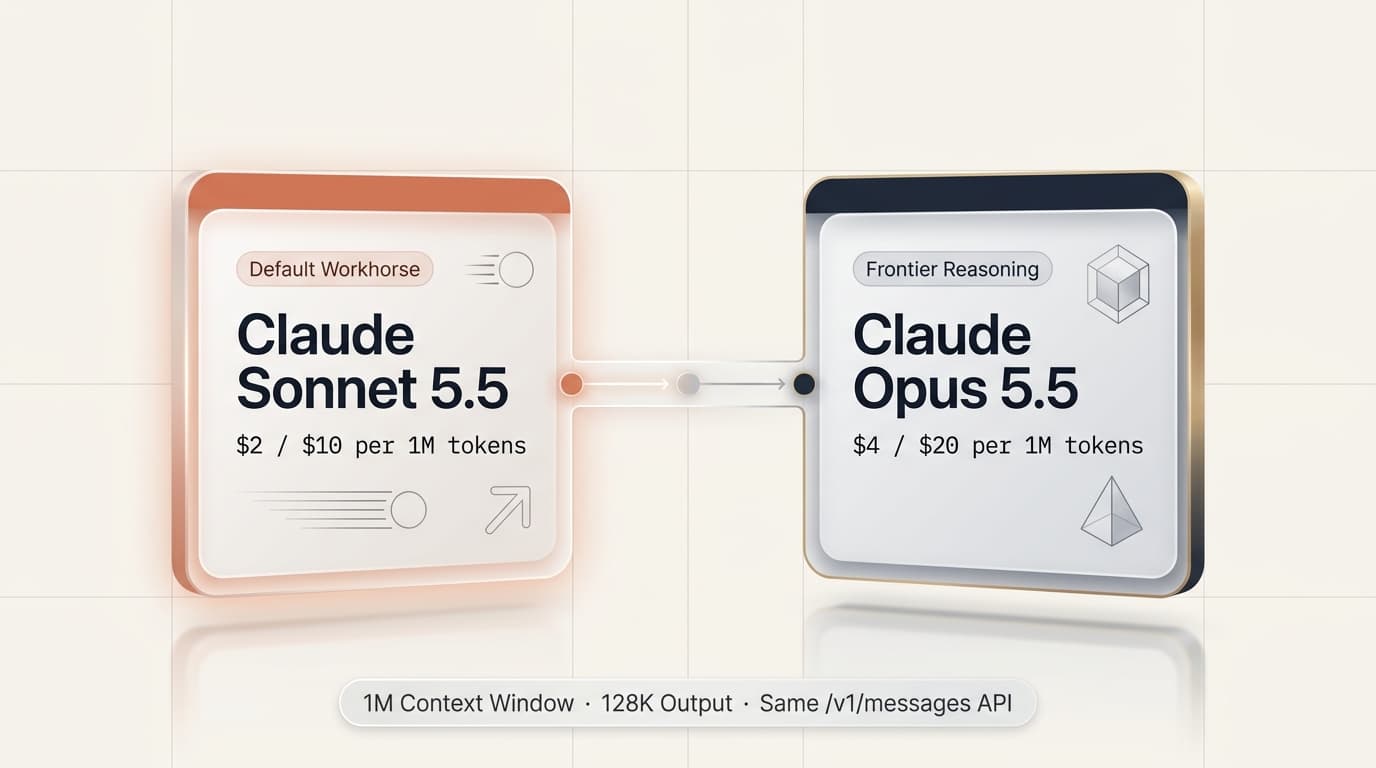
Claude Sonnet 5.5 (claude-sonnet-5-5) costs exactly half of Claude Opus 5.5 (claude-opus-5-5) per token—$2/$10 vs $4/$20 per million input/output tokens on Anthropic direct, and $1.40/$7.00 vs $2.80/$14.00 on reAPI—while matching the same 1M-token context window and 128K-token output ceiling.[1][2][3] Yet swapping every Opus call to Sonnet does not automatically cut your bill in half. On ambiguous, multi-file engineering work, pushing Sonnet 5.5 up to xhigh or max effort can burn enough extra reasoning tokens—and trigger enough retry loops—to cost more per accepted result than running Opus 5.5 once at medium or high effort.
That effort-cost crossover is the real decision boundary between the two models. Route well-scoped, high-volume engineering work, tool-calling loops, structured extraction, and document generation to Claude Sonnet 5.5 at low through high effort. Reserve Claude Opus 5.5 for open-ended architecture, multi-file refactors that must merge cleanly on the first pass, computer-use automation, and hard root-cause debugging where a single flawed assumption wastes twenty minutes of downstream agent calls.
Side-by-Side Specifications and API Controls
Both models shipped in late September 2026—Opus 5.5 on September 22 and Sonnet 5.5 six days later on September 28—and share Anthropic's native /v1/messages contract.[1][2] Still, four API-level differences will bite a team that treats the model string as a blind find-and-replace.
| Dimension | Claude Sonnet 5.5 (claude-sonnet-5-5) | Claude Opus 5.5 (claude-opus-5-5) |
|---|---|---|
| Release date | September 28, 2026 | September 22, 2026 |
| Context window | 1,000,000 tokens (standard rates across full window) | 1,000,000 tokens (standard rates across full window) |
| Max output tokens | 128,000 tokens (including thinking) | 128,000 tokens (including thinking) |
| Anthropic direct input / output | $2.00 / $10.00 per MTok | $4.00 / $20.00 per MTok |
| Anthropic direct cache write (5m / 1h) | $2.50 / $4.00 per MTok | $5.00 / $8.00 per MTok |
| Anthropic direct cache read | $0.10 per MTok | $0.20 per MTok |
| reAPI displayed input / output | $1.40 / $7.00 per MTok | $2.80 / $14.00 per MTok |
| reAPI displayed cache write / read | $1.75 / $0.14 per MTok | $3.50 / $0.14 per MTok |
| Default API effort | high | medium |
| Effort levels | low, medium, high, xhigh, max | low, medium, high, xhigh, max |
| Thinking control | Adaptive by default; between_tools at low/medium/high | Adaptive, always on |
| Forced named tool selection | Not recommended; use automatic tool_choice or none | Standard tool-use support |
| Anthropic fast mode | Not listed | $8.00 / $40.00 per MTok (direct only, excludes Batch) |
Pricing snapshot verified against Anthropic's rate card and reAPI's public model pages; check Claude Sonnet 5.5, Claude Opus 5.5, and our Claude API pricing breakdown for live quotes.[3][4]
Two operational details stand out in that table:
- Default effort is higher on Sonnet 5.5 than on Opus 5.5. If your client omits the
effortfield when migrating from Opus 5.5 to Sonnet 5.5, you silently move frommediumtohigh. Always pineffortexplicitly in production configs so latency and reasoning-token spend stay predictable across model swaps. - Tool choice and thinking behavior diverge. Sonnet 5.5 introduces
thinking.type: "between_tools"atlow,medium, andhigheffort—letting the model skip upfront deliberation before firing an obvious first lookup, then think after tool output arrives.[5] Conversely, Sonnet 5.5's migration guidance steers callers toward automatic tool selection rather than forced named tool calls; in reAPI's October 9 capability probes, sending a forced named tool parameter to Sonnet 5.5 returned an upstream error.[6] If a step strictly requires forced tool invocation, either switch to structured JSON (output_config.format) or evaluate Claude Haiku 5.5 vs Sonnet 5.5.
Where Sonnet 5.5 Wins—and Where Opus 5.5 Pulls Ahead
Public evaluations and developer field reports paint a clear split rather than a single linear hierarchy.
Where Claude Sonnet 5.5 is the better first pick
- Terminal-heavy agent loops with crisp acceptance tests. On Anthropic's launch evaluations, Sonnet 5.5 actually edges out Opus 5.5 on Terminal-Bench 4.0 (70.6% vs 66.4%), where the agent can execute commands, inspect stack traces, and iterate rapidly against concrete test output.[1][7]
- High-throughput coding, PR reviews, and structured extraction. When a pull request touches two or three files and the spec is explicit, Sonnet 5.5 delivers faster token generation at half the unit rate, making it ideal for CI review bots, schema normalization, and support triage.
- Document, slide, and spreadsheet production. Knowledge-work generation tasks with clear templates rarely justify Opus 5.5's 2x token multiplier; Sonnet 5.5's output quality stays close enough that reviewers rarely spot a difference.
- Latency-sensitive interactive features. End-user copilots that stream responses under strict time-to-first-token budgets benefit from Sonnet 5.5's faster generation speed and
between_toolsmode when the first step is a deterministic retrieval call.
Where Claude Opus 5.5 earns its 2x token rate
- Merge-ready autonomous refactors across many files. Anthropic's own guidance still positions Opus 5.5 as the stronger model for complex, open-ended engineering and large-scale refactoring—and Claude Code defaults to Opus 5.5 for precisely that reason.[2][8] When an edit touches shared state, database migrations, or cross-service contracts, Opus 5.5 is less likely to fix a symptom while breaking an invariant two modules away.
- Ambiguous debugging and architectural trade-offs. If the prompt cannot hand the model a failing unit test up front—for example, diagnosing an intermittent race condition, reviewing a security boundary, or designing a schema migration rollback plan—Opus 5.5's stronger sustained judgment reduces dead-end hypotheses.
- Computer-use and vision-heavy GUI automation. Opus 5.5 maintains an edge on multi-step desktop/browser interaction benchmarks such as OSWorld 2.1, where misreading one UI state derails the rest of the trajectory.[2][8]
- Deep multidisciplinary research and synthesis. On open-ended analytical synthesis (including Humanity's Last Exam with tools), Opus 5.5 retains higher peak accuracy when contradictions across sources must be resolved carefully.
The Effort-Cost Crossover: Why Half Price Isn't Always Half Cost
The single biggest misconception in Claude Sonnet 5.5 vs Claude Opus 5.5 comparisons is multiplying per-token rates by an assumed identical token count. Thinking tokens are billed as output tokens on both models, and Sonnet 5.5 tends to spend significantly more output tokens when pushed to its highest effort tiers.
Independent benchmark tracking and Anthropic's system-card curves highlight the exact crossover: at low, medium, and high effort, Sonnet 5.5 cleanly undercuts Opus 5.5 on cost per task. Once teams crank Sonnet 5.5 to xhigh or max trying to close a quality gap on an open-ended task, Sonnet's output volume expands—reported at roughly 60% more output tokens per index task at max effort—causing total task spend to match or exceed Opus 5.5 running at medium or high while still scoring slightly below Opus.[7]
Worked Cost-Per-Successful-Task Comparison
Instead of comparing raw price tables, measure cost per accepted task:
Cost per successful task = Total billed spend across all attempts / Accepted tasksEvery failed attempt, retry, and repair call stays in the numerator. Consider a concrete multi-file coding workflow where each turn sends 40,000 cached prefix tokens (repository context + system prompt), 8,000 fresh input tokens (diff + test output), and generates 4,000 output tokens (including thinking):
| Scenario (100 tasks, reAPI displayed rates) | Calls needed | Cached read cost | Fresh input cost | Output cost | Total spend | Cost / accepted task |
|---|---|---|---|---|---|---|
Sonnet 5.5 (medium) — 92% first-pass, 8% need 1 retry (108 calls) | 108 | $0.60 | $1.21 | $3.02 | $4.83 | $0.048 |
Opus 5.5 (medium) — 96% first-pass, 4% need 1 retry (104 calls) | 104 | $0.58 | $2.33 | $5.82 | $8.73 | $0.087 |
Sonnet 5.5 (max) — 6,500 output tokens/call, 25% need 1 retry (125 calls) | 125 | $0.70 | $1.40 | $5.69 | $7.79 | $0.078 |
Opus 5.5 (high) — 4,500 output tokens/call, 98% first-pass (102 calls) | 102 | $0.57 | $2.28 | $6.43 | $9.28 | $0.093 |
Sonnet 5.5 (max) on hard open-ended tasks — 6,500 out, avg 2.2 attempts (220 calls) | 220 | $1.23 | $2.46 | $10.01 | $13.70 | $0.137 |
Illustrative arithmetic using reAPI's published rates ($1.40/$7.00/$0.14 for Sonnet 5.5; $2.80/$14.00/$0.14 for Opus 5.5) excluding initial cache-write amortization. Direct Anthropic rates scale proportionally on input/output, with a lower $0.10 direct cache-read rate on Sonnet 5.5 vs $0.20 on Opus 5.5.[3]
Look at the first row versus the last row:
- On well-scoped tasks where Sonnet 5.5 passes on the first attempt 92% of the time, it saves 45% over Opus 5.5 (
$0.048vs$0.087). - On hard, ambiguous tasks where Sonnet 5.5 needs
maxeffort and an average of 2.2 attempts to pass review, it ends up 47% more expensive than Opus 5.5 athigheffort ($0.137vs$0.093)—plus your engineers wait more than twice as long.
Also notice a subtle detail on reAPI's published schedule: both Sonnet 5.5 and Opus 5.5 display the exact same $0.14 / MTok cache-read rate.[3] That means in cache-heavy agent sessions where 80%+ of prompt tokens hit the warm prefix cache, the input-side price gap between Sonnet 5.5 and Opus 5.5 narrows significantly, making output token efficiency and first-pass success rate the dominant cost lever.
Production Pattern: Hybrid Two-Tier Routing on One Endpoint
You do not need to pick one model for an entire product. Because claude-sonnet-5-5 and claude-opus-5-5 share the exact same /v1/messages schema and authentication header on reAPI, the highest-leverage architecture is a two-tier router that sends roughly 80% of traffic to Sonnet 5.5 and escalates the remaining 20%—or any task that fails a verification check—to Opus 5.5.
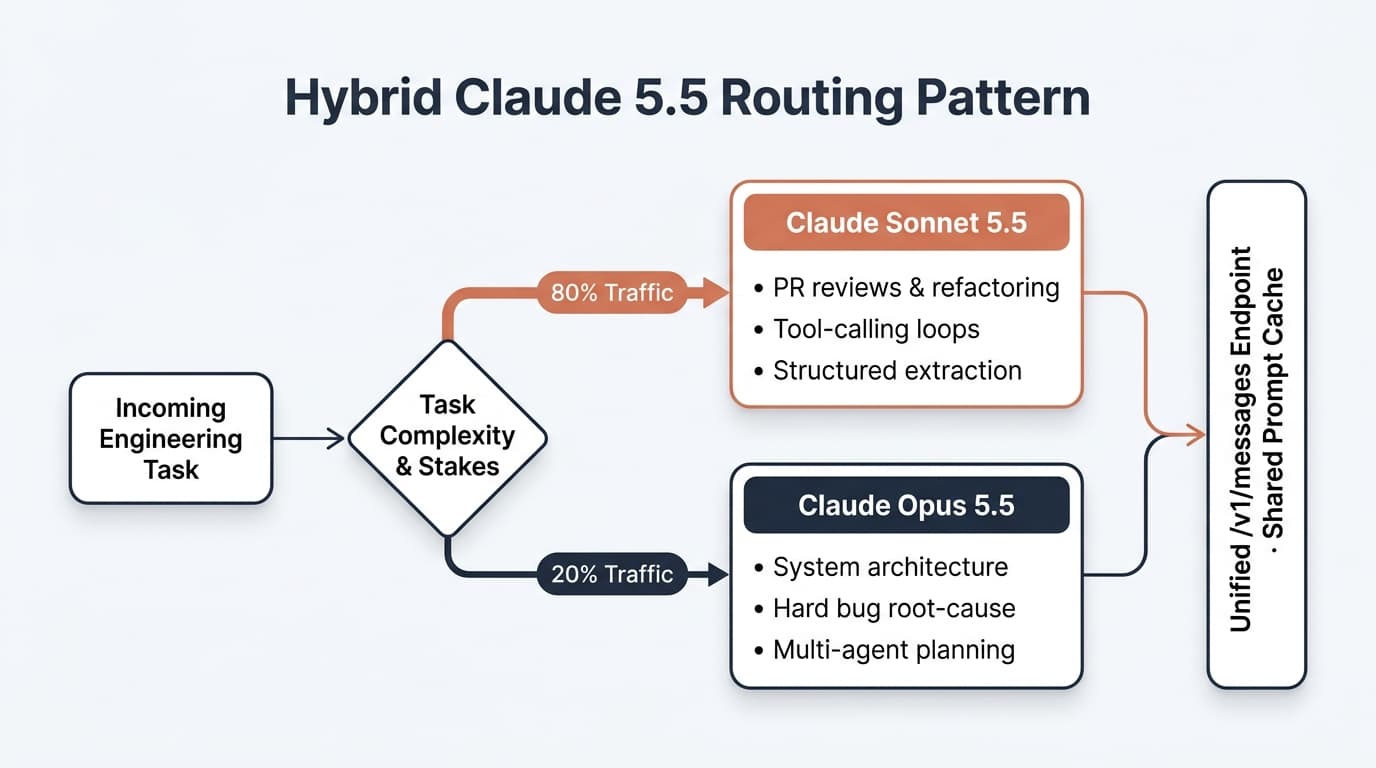
A clean routing policy separates pre-flight classification from failure escalation:
- Pre-flight routing: Route single-file edits, unit-test generation, log summarization, structured extraction, and tool-driven lookups directly to
claude-sonnet-5-5atmediumorhigheffort. Route architectural RFCs, multi-service migrations, security audits, and computer-use loops straight toclaude-opus-5-5atmediumorhigheffort. - Automatic escalation on verification failure: When a Sonnet 5.5 patch fails
tsc,pytest, or a schema validator twice, do not bump Sonnet tomaxeffort. Escalate the failure trace and original diff directly toclaude-opus-5-5athigheffort. - Preserve thinking blocks within a model thread, reset cleanly on escalation: Anthropic's signed thinking blocks belong to the model that generated them. When escalating from Sonnet 5.5 to Opus 5.5, summarize the attempted patch and exact compiler/test failure into a fresh user turn rather than replaying Sonnet's raw thinking blocks to Opus.
Here is a minimal TypeScript router calling both models through a single reAPI key:
type TaskClass = 'scoped_code' | 'tool_loop' | 'architecture' | 'hard_debug';

interface RouteDecision {
  model: 'claude-sonnet-5-5' | 'claude-opus-5-5';
  effort: 'low' | 'medium' | 'high';
  thinking?: { type: 'adaptive' | 'between_tools' };
}

function selectClaudeRoute(task: TaskClass, priorFailures: number): RouteDecision {
  // Never push Sonnet 5.5 to xhigh/max after repeated test failures—escalate to Opus 5.5
  if (priorFailures >= 2 || task === 'architecture' || task === 'hard_debug') {
    return {
      model: 'claude-opus-5-5',
      effort: priorFailures >= 2 ? 'high' : 'medium',
      thinking: { type: 'adaptive' },
    };
  }

  return {
    model: 'claude-sonnet-5-5',
    effort: task === 'tool_loop' ? 'medium' : 'high',
    thinking: task === 'tool_loop'
      ? { type: 'between_tools' }
      : { type: 'adaptive' },
  };
}

export async function runEngineeringTask(
  task: TaskClass,
  prompt: string,
  priorFailures = 0,
) {
  const route = selectClaudeRoute(task, priorFailures);

  const response = await fetch('https://api.reapi.ai/v1/messages', {
    method: 'POST',
    headers: {
      'Content-Type': 'application/json',
      'x-api-key': process.env.REAPI_API_KEY!,
      'anthropic-version': '2023-06-01',
    },
    body: JSON.stringify({
      model: route.model,
      max_tokens: 8192,
      output_config: { effort: route.effort },
      thinking: route.thinking,
      messages: [{ role: 'user', content: prompt }],
    }),
  });

  if (!response.ok) {
    throw new Error(`reAPI error ${response.status}: ${await response.text()}`);
  }
  return response.json();
}
If you also run Claude Code locally against a unified gateway, see our Claude Code third-party API setup guide for configuring ANTHROPIC_DEFAULT_SONNET_MODEL and ANTHROPIC_DEFAULT_OPUS_MODEL so /model switches seamlessly between both routes.
How Haiku 5.5 and Fable 5.2 Complete the Lineup
Evaluating Sonnet 5.5 vs Opus 5.5 in isolation misses the two outer tiers of Anthropic's late-2026 catalog:
- Below Sonnet 5.5 — Claude Haiku 5.5: Shipped October 7, 2026 ($0.10/$0.50 direct up to 100K prompt tokens; $0.35/$1.75 on reAPI). Use Haiku 5.5 for high-volume classification, routing gates, or steps that explicitly need
thinking.type: "disabled"or forced named tool selection.[3][6] - Above Opus 5.5 — Claude Fable 5.2: Shipped November 9, 2026 ($8/$40 direct—twice Opus 5.5). Only step up from Opus 5.5 to Fable 5.2 when your own evaluation suite shows Opus 5.5 at
high/xhigheffort still missing acceptance criteria on long-horizon reasoning or multi-hour autonomous work.[8]
How to Run a 30-Minute Bake-Off on Your Own Codebase
Before locking in a default model for your team, run a controlled 20-task test instead of trusting leaderboard averages:
- Pick 20 real, graded tasks: 10 clearly scoped tickets (bug fixes with failing tests, JSON extraction, single-module refactors) and 10 open-ended tickets (cross-module refactors, ambiguous root-cause traces, architectural reviews).
- Pin
effortexplicitly: Testclaude-sonnet-5-5atmediumandhigh, andclaude-opus-5-5atmediumandhigh. Do not compare Sonnet's default (high) against Opus's default (medium) without recording the difference. - Log all four usage fields: Record
input_tokens,output_tokens,cache_creation_input_tokens, andcache_read_input_tokens, plus wall-clock latency and pass/fail against your automated test suite. - Compute cost per accepted task: Keep whichever model wins each bucket, and codify the split in your router rather than forcing one model onto both buckets.
Frequently Asked Questions
What is the best Claude model—Opus 5.5 or Sonnet 5.5?
Neither wins every workload. Claude Opus 5.5 is stronger on complex, open-ended reasoning, multi-file autonomous refactors, and computer-use tasks where first-pass judgment matters most. Claude Sonnet 5.5 is faster, half the per-token price, and leads on tightly scoped terminal-driven tasks like Terminal-Bench 4.0. Most production teams get the best economics by defaulting to Sonnet 5.5 for scoped tasks and escalating ambiguous work to Opus 5.5.
Is Claude Sonnet 5.5 really half the price of Claude Opus 5.5?
Per token, yes: Anthropic's direct rates are $2/$10 per MTok for Sonnet 5.5 versus $4/$20 for Opus 5.5, and reAPI displays $1.40/$7.00 versus $2.80/$14.00. However, total task cost depends on output token volume and retries. On well-scoped tasks at low–high effort, Sonnet 5.5 typically saves 40–50%. On hard tasks where Sonnet requires max effort or multiple retries, Opus 5.5 at medium/high can cost the same or less.
Does Claude Opus 5.5 use more tokens than Claude Sonnet 5.5?
Usually the opposite at high effort settings. At matching low or medium effort, token counts are comparable, but when pushed to xhigh or max effort, Sonnet 5.5 frequently generates substantially more thinking/output tokens per task than Opus 5.5. Always inspect actual output_tokens in API usage responses rather than estimating from visible reply length alone.
Can I switch between Sonnet 5.5 and Opus 5.5 without changing my API code?
Mostly yes—both use /v1/messages with the same 1M context window and 128K output limit—but check three parameters before swapping: pin effort explicitly (defaults differ: high on Sonnet vs medium on Opus), use automatic tool_choice on Sonnet instead of forced named tool selection, and only pass thinking.type: "between_tools" when targeting Sonnet 5.5 at low/medium/high effort.
Can I route a failed Sonnet 5.5 task directly to Opus 5.5?
Yes, and it is one of the most effective ways to cap tail spend. Pass the original task specification, the failed patch or output, and the exact test/compiler error into a fresh Opus 5.5 request—without forwarding Sonnet 5.5's raw signed thinking blocks across models.
Ready to benchmark both models side by side on your own prompts? Open the Claude Sonnet 5.5 and Claude Opus 5.5 model pages or generate a unified key in API Keys to route both through a single /v1/messages endpoint.
References
- Anthropic. Claude Sonnet 5.5 overview. Checked November 23, 2026. platform.claude.com/docs/en/models/sonnet-5-5/overview
- Anthropic. Claude Opus 5.5 overview. Checked November 23, 2026. platform.claude.com/docs/en/models/opus-5-5/overview
- reAPI. Claude API pricing (official direct and reAPI displayed schedules). Checked October 23, 2026. reapi.ai/blog/claude-api-pricing
- Anthropic. Pricing: models, caching, Batch and long context. platform.claude.com/docs/en/about-claude/pricing
- Anthropic. Claude Sonnet 5.5 migration guidance (
between_toolsthinking & tool choice). platform.claude.com/docs/en/models/sonnet-5-5/migration-guide - reAPI. Claude Haiku 5.5 vs Sonnet 5.5: Tools, Thinking, and Cost (October 9 capability probes). reapi.ai/blog/claude-haiku-5-5-vs-sonnet-5-5
- Apidog. Claude Sonnet 5.5 vs Opus 5.5: Half the Price, How Close on Quality, and When to Pay for Opus. Accessed November 23, 2026. apidog.com/blog/claude-sonnet-5-5-vs-opus-5-5
- ToolColumn. Claude Sonnet 5.5 vs Opus 5.5: When Is Sonnet Enough? Updated November 21, 2026. toolcolumn.com/learn/claude-sonnet-5-5-vs-opus-5-5