Hailuo H3 Explained: MiniMax H3 Specs, Pricing, API, and Limits (2026)
Learn how Hailuo H3, MiniMax H3, and Hailuo 03 relate, with verified 2K video specs, native audio, pricing, API limits, and integration code.
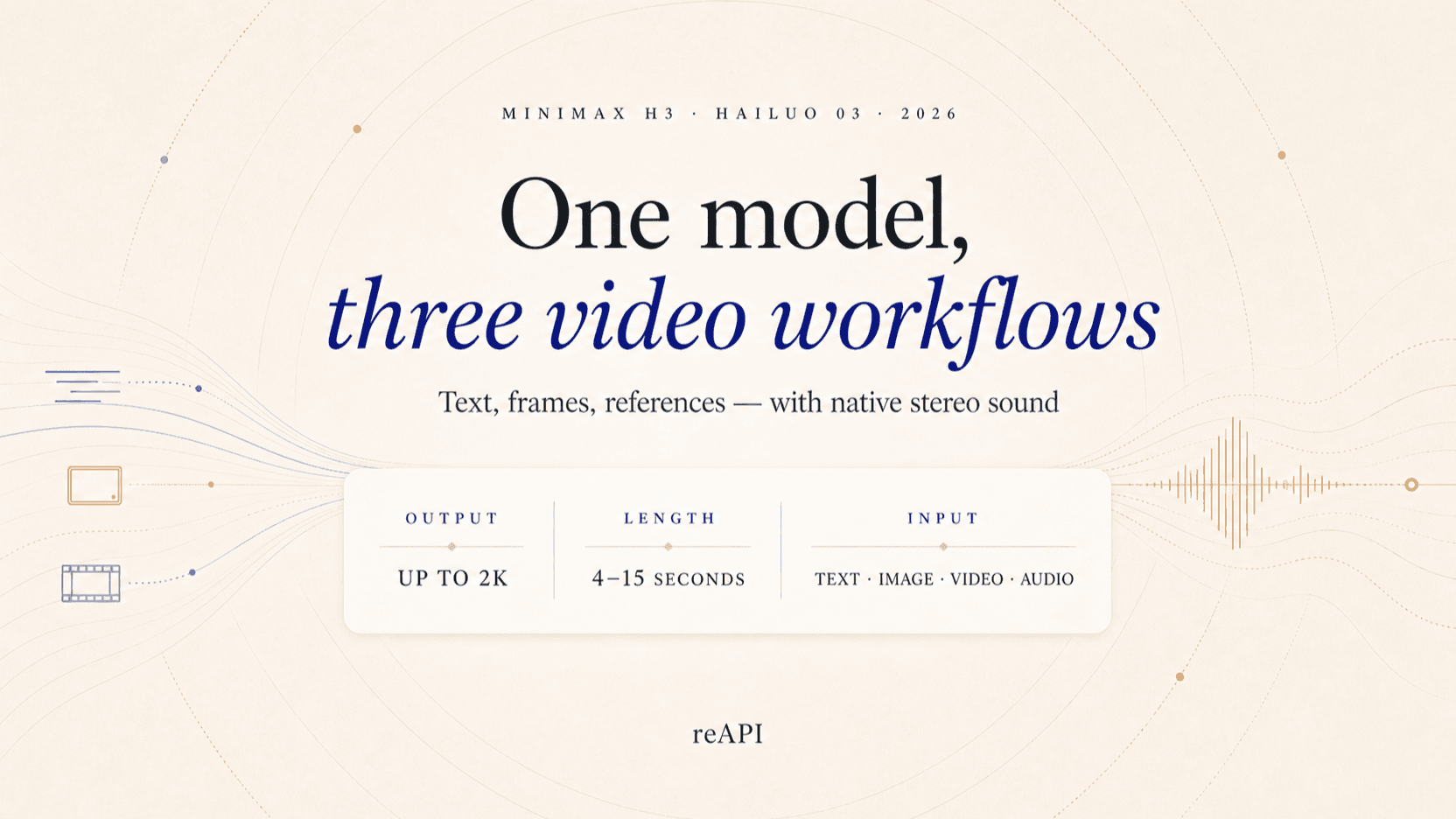
Hailuo H3 is the search name people are using for MiniMax H3, the video model MiniMax launched on July 31, 2026. Its API documentation also calls the release Hailuo 03. Those names refer to the same model: a multimodal system that accepts text, images, video, and audio, then generates a 4–15 second video with native stereo sound at up to 2K.[1][2]
The naming is the easy part. The useful distinction is between the model's three workflows: prompt-only text-to-video, first/last-frame image-to-video, and reference-to-video with mixed image, video, and audio inputs. This guide maps those modes to the exact API rules, separates MiniMax's direct price from reAPI pricing, and shows the request shape that works on reAPI today.
Hailuo H3 specs at a glance
| Item | MiniMax H3 / Hailuo 03 |
|---|---|
| Release date | July 31, 2026 |
| Input | Text, images, video, and audio |
| Output | MP4 video with native stereo audio |
| Resolution | Up to 2K |
| Duration | 4–15 seconds, in whole-second increments |
| Generation modes | Text-to-video, image-to-video, reference-to-video |
| Reference capacity | Up to 9 images, 3 videos, and 3 audio clips |
| Aspect ratios | 21:9, 16:9, 4:3, 1:1, 3:4, and 9:16 |
| MiniMax direct price | $0.13/s at 2K; $0.09/s at 768p |
| reAPI model ID | minimax-h3 |
MiniMax describes H3 as a general-purpose omni-modal generation model rather than only a video renderer. The launch post says it can understand context across the four input modalities and generate video, audio, images, and text, although the public video API is the product surface documented in detail at launch.[1]
MiniMax also calls H3 an open model. Its launch article says model weights will be released "in the coming days," subject to applicable laws and regulations. Until the weights and license are actually published, treat self-hosting as an announced next step rather than an available deployment path.
Why Hailuo H3 and Hailuo 03 are the same model
The official release uses two naming layers. MiniMax H3 is the model name
in MiniMax's launch article and the model value in its V2 generation API.
Hailuo 03 appears in product and API descriptions for the same release.
“Hailuo H3” combines the product-family name with the model version, which is
why it has become a natural search term even though it is not the exact API
identifier.
Use the name that matches the context:
- Search and editorial copy can mention Hailuo H3, MiniMax H3, and Hailuo 03 together once, then settle on MiniMax H3.
- MiniMax's direct V2 endpoint expects
MiniMax-H3. - reAPI expects the lowercase model ID
minimax-h3.
That last character-level difference matters. Model IDs are contract values, not branding, so copying the display name into code will produce an invalid request.
One model routes three different video workflows
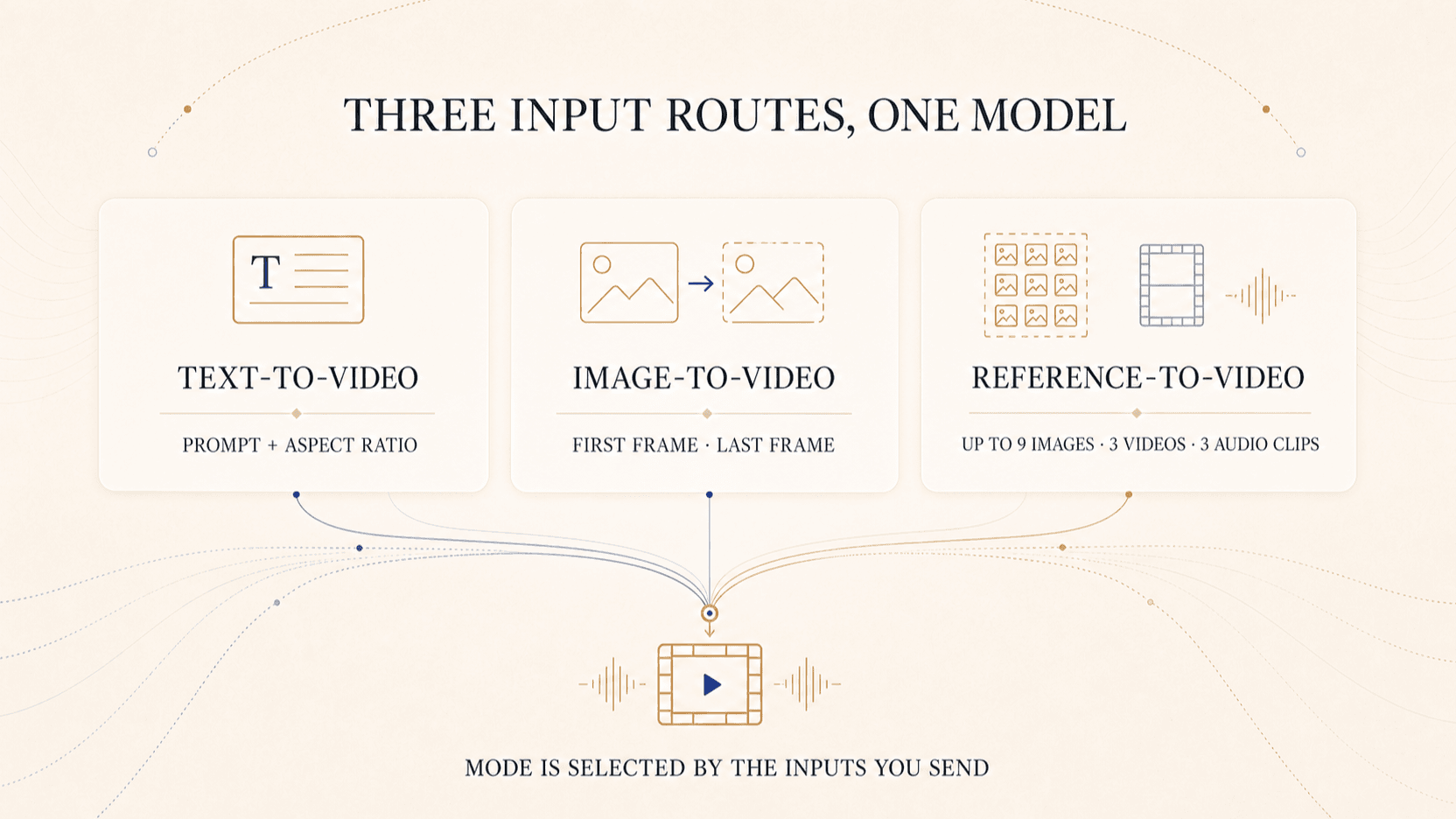
MiniMax H3 selects its generation mode from the media attached to the request. The three routes share the same underlying model, but their validation rules are not interchangeable.[3]
Text-to-video: prompt plus an explicit aspect ratio
Text-to-video is the simplest route. Send a prompt with no media references and choose one of six aspect ratios. The prompt can describe the visuals, camera movement, dialogue, music, ambience, and sound effects in the same brief.
On reAPI, aspect_ratio is required for text-to-video and cannot be
adaptive. Use 16:9 for landscape, 9:16 for vertical social video, or one
of the four intermediate formats when the delivery surface needs it.
Image-to-video: first frame, last frame, or both
Image-to-video accepts a first frame, a last frame, or both. Supplying two frames gives the model a visual start and destination, making it useful for a planned transition, a product reveal, or a shot that must land on a specific composition.
The image controls the output orientation, so reAPI rejects aspect_ratio in
this mode. Crop the source frames to the intended delivery format before
submitting them. First/last-frame inputs also cannot be mixed with the separate
reference arrays in one request.
Reference-to-video: assign identity, motion, and sound separately
Reference-to-video is the most flexible route. A request can carry up to nine images, three video clips, and three audio clips. This makes it possible to use one image for character or product identity, a video for motion and camera language, and audio for voice or sound direction.
There are hard limits behind those headline counts:
- each reference video must be 2–15 seconds, with all video references totaling no more than 15 seconds;
- each reference audio file must be 2–15 seconds, with all audio references totaling no more than 15 seconds;
- audio cannot be the only reference—it must accompany at least one image or video;
- reference mode can use an explicit aspect ratio or default to
adaptive.
Do not send references as an undifferentiated pile. State each asset's job in the prompt: identity from the portrait, motion from the clip, voice from the audio, and lighting from the product frame. The API accepts many inputs, but a clear division of responsibility gives the model fewer conflicting signals.
Native stereo audio changes how the prompt is written
MiniMax H3 generates stereo audio with the video instead of adding a separate audio track after the visual pass.[1] The prompt therefore needs to direct sound as deliberately as the camera.
A useful H3 prompt has four layers:
- Subject and action: what is visible and what changes during the shot.
- Camera and timing: framing, movement, focus, cuts, and pace.
- Spoken content: exact dialogue and the intended speaker.
- Sound bed: music, ambience, Foley, volume relationships, and silence.
For example:
A six-second close-up of a brushed-metal espresso machine at sunrise. Slow dolly from left to right, warm window reflections, shallow depth of field. A soft switch click, rising steam, quiet café ambience, and one restrained piano chord. No dialogue.
Native audio removes an initial synchronization step; it does not guarantee a final mix. Dialogue clarity, lip sync, music continuity, and unwanted effects still need review on every accepted clip. For production budgeting, the relevant metric is cost per usable result, not cost per generated second.
MiniMax H3 pricing: direct API versus reAPI
MiniMax's direct pay-as-you-go table lists 2K output at $0.13 per second and 768p at $0.09 per second.[4] A 10-second 2K output therefore starts at $1.30 before billable input media.
Direct MiniMax billing adds three rules:
- audio input is free;
- the first five input images are free, then each additional image is $0.04;
- input video is billed by duration at the selected output-resolution rate.
reAPI has its own product contract. The MiniMax H3 model page lists $0.119 per second for 2K output and $0.074 per second at 768P. Reference-video seconds are added to generated-video seconds, the first five reference images are free, and images six through nine cost
$0.036The reAPI formula is:
cost = per-second rate × (output seconds + reference-video seconds)
     + extra-image rate × max(0, reference images - 5)
The billable quantities matter more than the arithmetic: a 10-second output using a 6-second motion reference bills 16 seconds, not 10. Seven reference images add two extra-image charges on top, because five are free. Audio references add no charge.
These are two different price sheets for two different integrations. Do not present the $0.13 MiniMax direct rate as the reAPI rate, or the reAPI rate as MiniMax's official list price. Both can change after launch, so production code should read the current model page rather than hard-code an article's number into the UI.
How to call the MiniMax H3 API on reAPI
reAPI exposes all three H3 modes through its standard asynchronous video endpoint. A minimal text-to-video request is:
curl https://reapi.ai/api/v1/videos/generations \
  -H "Authorization: Bearer $REAPI_API_KEY" \
  -H "Content-Type: application/json" \
  -d '{
    "model": "minimax-h3",
    "prompt": "A rain-soaked night market, slow handheld push forward, vendors calling softly, distant thunder and natural street ambience",
    "aspect_ratio": "16:9",
    "duration": 6
  }'
Submission returns a task ID. Poll the shared task endpoint until the result is complete:
curl https://reapi.ai/api/v1/tasks/TASK_ID \
  -H "Authorization: Bearer $REAPI_API_KEY"
The completed response contains output.video_urls. Polling does not consume
credits, and failed generations are refunded automatically.[5]
Change the request shape to select another mode:
{
  "model": "minimax-h3",
  "prompt": "The character turns naturally and smiles as the camera pushes in",
  "first_frame_url": "https://example.com/first-frame.jpg",
  "last_frame_url": "https://example.com/last-frame.jpg",
  "duration": 6
}
For reference-to-video, replace the frame fields with
reference_image_urls, reference_video_urls, and
reference_audio_urls. All media inputs must be public HTTP(S) URLs; base64
and data: URLs are rejected.
The full MiniMax H3 API reference documents the media formats, file-size limits, task response, errors, and billing behavior.
Where Hailuo H3 fits—and what still needs testing
H3 is best evaluated as a shot generator, not a one-click long-form video studio. Fifteen seconds can cover a product beat, a dialogue exchange, a social clip, or one section of a commercial. A 60-second piece still needs multiple generations, continuity planning, editing, and a final sound pass.
The mixed-reference route is the reason brand, character, and previsualization teams should test it. The first/last-frame route is the reason motion designers should care. Native stereo audio is the reason short-form teams may remove one rough-cut step. None of those capabilities proves that H3 will hold a face, logo, label, or voice across every brief.
MiniMax calls the model production-ready and publishes polished examples for brand films, narrative content, social video, advertising, UI/UX, and gaming. Those are vendor demonstrations, not independent benchmarks. A serious evaluation should include hands touching products, small printed text, two speakers in one frame, fast motion, long dialogue, and consistency across separately generated shots.
The model launched one day before this article, so there is not yet enough credible public testing for a quality ranking. That limitation is more useful than an invented verdict: run a fixed prompt set, record accepted outputs per ten attempts, and compare the total cost of approved shots against the model already in your workflow.
Frequently asked questions
Are Hailuo H3, MiniMax H3, and Hailuo 03 the same model?
Yes. MiniMax H3 is the official launch and API model name; Hailuo 03 is the
product/API description for the same release. Hailuo H3 is the common hybrid
search term. On reAPI, use the model ID minimax-h3.
How long can a MiniMax H3 video be?
Each generation can be 4–15 seconds in whole-second increments. Longer videos must be split into shots and assembled in an editor.
Does Hailuo H3 generate audio?
Yes. It generates native stereo audio with the picture and can direct dialogue, music, ambience, and effects in the same prompt.
Can MiniMax H3 use an audio reference by itself?
No. Reference audio must be paired with at least one reference image or video. The audio-reference total cannot exceed 15 seconds.
How much does MiniMax H3 cost?
MiniMax's direct API lists $0.13/s at 2K and $0.09/s at 768p. reAPI lists $0.119/s at 2K and $0.074/s at 768P, with input-video seconds billed at the same rate and extra-image charges after the first five.
Is MiniMax H3 open source?
MiniMax announced H3 as an open model, but the July 31 launch post said weights would be released in the coming days. Check the current weights and license before planning a self-hosted deployment.
The practical reading of MiniMax H3
Hailuo H3 is a naming problem wrapped around a useful model design: one MiniMax H3 endpoint covers prompt-only generation, first/last-frame animation, and mixed-reference video with native stereo sound. Its 15-second ceiling keeps it at the shot level, while the reference limits make those shots more directable than a prompt-only workflow.
Start with the six-second default, assign every reference a clear role, and judge H3 by accepted clips rather than launch demos. Developers can test the same request shapes in the MiniMax H3 playground or move directly to the API documentation.
Disclosure: reAPI publishes this article and operates the routed MiniMax H3 endpoint described above. MiniMax specifications and direct prices come from MiniMax's public launch materials and documentation; reAPI contract details come from our published model page and API reference.
References
- MiniMax. MiniMax H3: An Open Model Breaking the Boundaries Between Tasks and Modalities. Published July 31, 2026. minimax.io/blog/minimax-h3
- MiniMax API. Video Generation Guide — MiniMax H3 capabilities, duration, resolution, and media inputs. Retrieved August 1, 2026. platform.minimax.io/docs/guides/video-generation
- MiniMax API. Create a Video Generation Task V2 — request modes and validation rules. Retrieved August 1, 2026. platform.minimax.io/docs/api-reference/video-generation-v2-create
- MiniMax API. Pay as You Go Pricing — MiniMax H3 output and input-media rates. Retrieved August 1, 2026. platform.minimax.io/docs/guides/pricing-paygo
- reAPI. MiniMax H3 API reference — modes, parameters, billing, output, and errors. Retrieved August 1, 2026. reapi.ai/docs/minimax-h3
- reAPI. MiniMax H3 model page and live pricing. Retrieved August 1, 2026. reapi.ai/models/minimax-h3
Further reading
- reAPI. MiniMax H3 vs Seedance 2.5. reapi.ai/blog/minimax-h3-vs-seedance-2-5
- reAPI. AI Video Generation API Pricing: Cost per Second Compared. reapi.ai/blog/ai-video-generation-api-pricing
- reAPI. Gemini Omni API: Preview Specs, Pricing, and Limits. reapi.ai/blog/gemini-omni-api-preview-specs-pricing-2026
- reAPI. Best Open-Source AI Video Models for Local GPUs. reapi.ai/blog/best-open-source-ai-video-models-local-gpu-2026
Author

Categories
More Posts

AI Image API Content Filters: How Refusals Happen
Image API filtering runs in several layers. The same prompt can pass one host and fail another, but certain boundaries never change regardless of configuration.
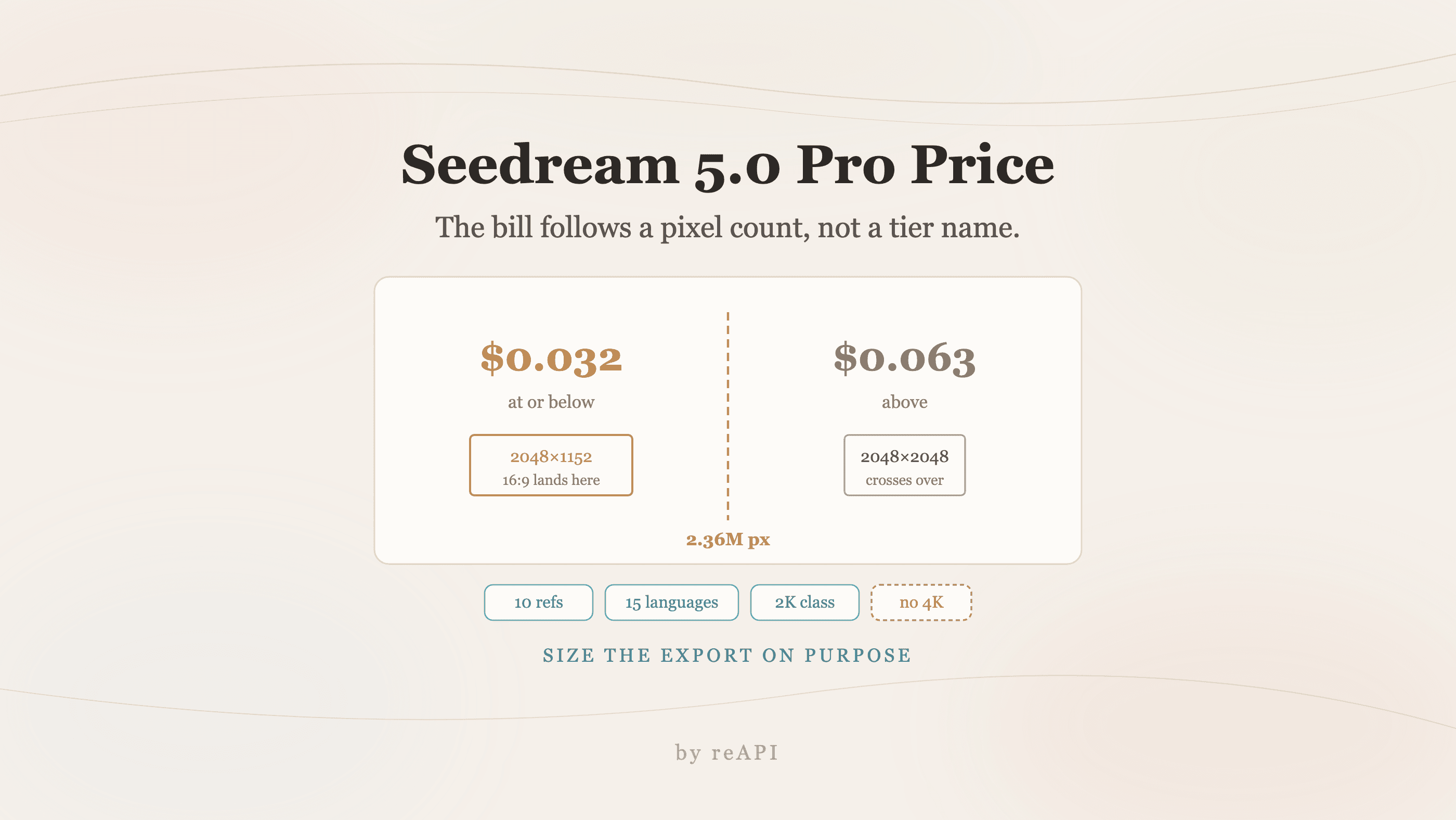
Seedream 5.0 Pro Price: The Pixel Line That Decides It
The Seedream 5.0 Pro price splits at 2.36 million pixels, not at a tier label. What each tier costs, and how to size a 16:9 export to stay in the cheap one.

AI Music Video Generator API: Full Songs, Photos, and Lyrics
Turn a 10-second to 5-minute song and 1–7 reference images into a complete music video, with API examples, subtitle options, and exact cost tables.