
MiniMax H3 vs Seedance 2.5: Which AI Video Model Wins?
Compare MiniMax H3 vs Seedance 2.5 on duration, 2K output, native audio, multimodal references, editing, pricing, API access, and best use cases.
Choose MiniMax H3 when 2K output and its lower direct rate matter; choose Seedance 2.5 when 30-second continuity, larger reference sets, or video editing matter more. Both are callable now. reAPI serves Seedance 2.5 as doubao-seedance-2.5-face at 480p or 720p with published prices and billing rules.[5][6]
API availability no longer decides the comparison. The useful differences are resolution, duration, reference capacity, editing, and the full cost of each request.
TL;DR
- MiniMax H3 is callable now: 4–15 seconds, up to 2K, native stereo audio, and a public V2 API.[1]
- Seedance 2.5 supports longer continuity: 4–30-second output, timed segments, and video edit or extend workflows.[2][6]
- H3 documents up to nine images, three videos, and three audio references. Seedance 2.5 accepts up to 30 images, 10 videos, and 10 audio clips.[6]
- MiniMax lists H3 at $0.13/s for 2K and $0.09/s for 768p. reAPI lists Seedance 2.5 at $0.118589/s for 480p and $0.266824/s for 720p without source video.[3][5]
- Developers can test both through reAPI: MiniMax H3 and Seedance 2.5.
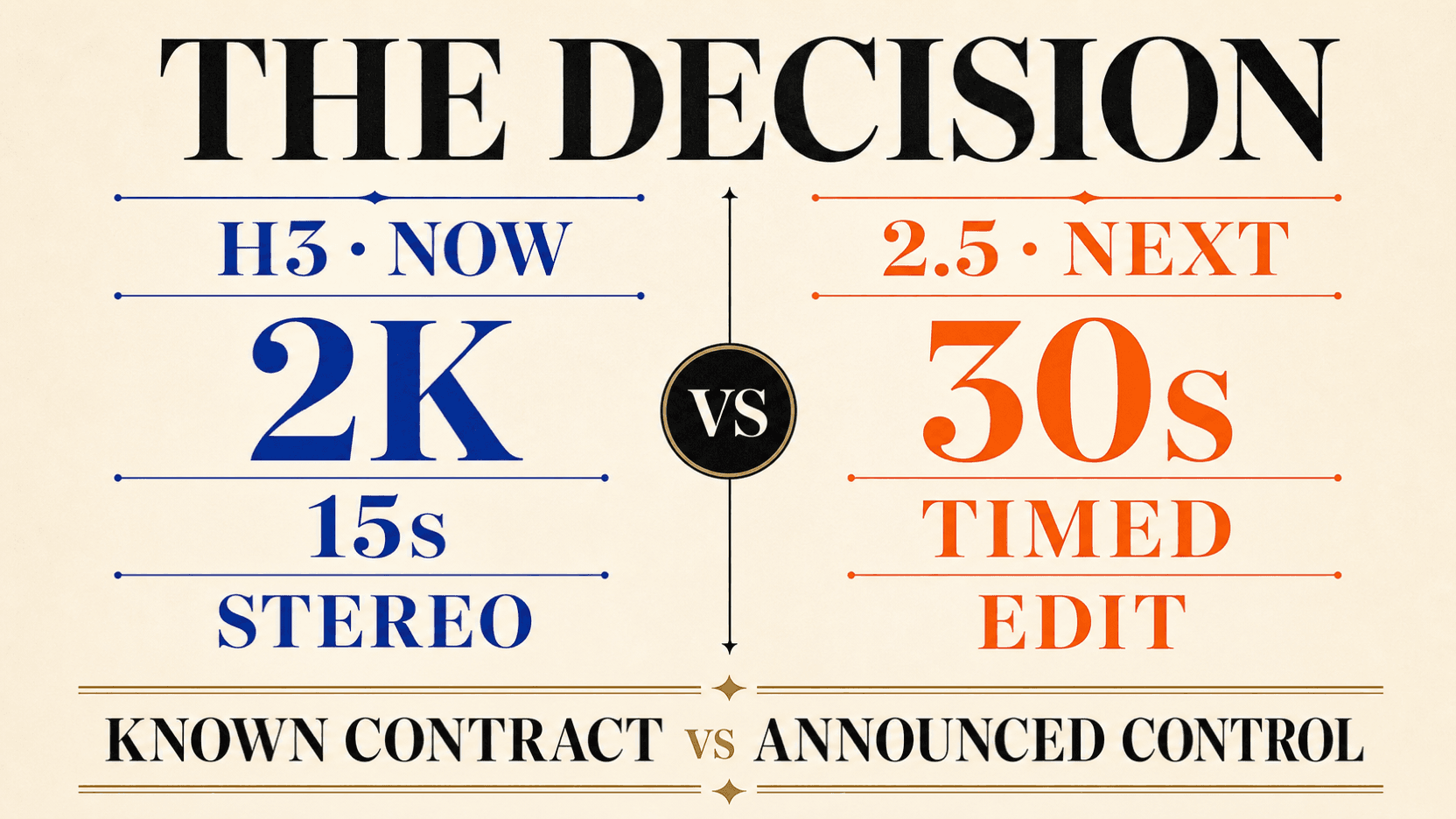
MiniMax H3 vs Seedance 2.5 specs
| Capability | MiniMax H3 | Seedance 2.5 |
|---|---|---|
| API status | Public launch and documented API | Live on reAPI as doubao-seedance-2.5-face |
| Output duration | 4–15 seconds | 30 seconds demonstrated |
| Resolution | Up to 2K | 480p or 720p on reAPI |
| Audio | Native stereo audio | Multilingual speech/lip-sync demonstrated |
| Reference inputs | Up to 9 images, 3 videos, 3 audio clips | Up to 30 images, 10 videos, 10 audio clips |
| First/last frame | Documented image-to-video mode | Documented through image_with_roles |
| Timeline direction | Prompt-directed | Second-level timed segments demonstrated |
| Existing-video editing | Generalized reference/editing is part of the model design; API surface needs task-level verification | Selective edit demonstrated |
| Published price | $0.13/s 2K; $0.09/s 768p direct | reAPI: $0.118589/s 480p; $0.266824/s 720p without source video |
| Weights | Announced for release; verify current license/download | No open-weight announcement |
The table deliberately leaves cells uncertain where the vendor has not published a contract. A promotional capability and a stable API parameter are different evidence levels.
Both models have current API access
MiniMax launched H3 on July 31 and published an API guide covering text-to-video, first/last-frame image-to-video, and reference-to-video. The output duration accepts whole seconds from four through 15, and the same model generates native stereo sound.[1]
Seedance 2.5 is also callable now. reAPI's live schema defines doubao-seedance-2.5-face, 480p/720p output, 4–30-second duration, reference limits, and task-specific constraints.[5][6]
For production planning, both models now provide documented constraints. H3's advantage is 2K output; Seedance 2.5's is a longer take and a broader edit/reference surface.
Seedance 2.5 wins the announced duration story
Thirty seconds in one pass reduces edit seams. A 60-second sequence needs at least four 15-second H3 generations, but only two 30-second Seedance generations in the ideal case. Every removed join lowers the chance of wardrobe, lighting, voice, and screen-direction drift.
Longer output also concentrates failure cost. If second 28 is unusable, a 30-second render may need a full reroll. Seedance's timed prompt segments make the clip behave like a compact shot list, but their precision still needs testing on the material you actually use.
Choose duration based on continuity, not headline size. Short product beats and social shots fit H3's current range. Dialogue scenes and longer blocking are where Seedance 2.5 could matter more.
H3 has the clearer native-audio contract
H3 generates stereo sound and video together. Prompts can direct dialogue, music, ambience, and effects, while audio files can also serve as references when paired with an image or video.[1]
ByteDance demonstrates multilingual performance and synchronized presentation for Seedance 2.5, and reAPI now documents audio references and generated-audio controls in the request schema.[6] Language and voice quality still need a fixed test set.
For an automated pipeline, either request can now be validated before submission. For multilingual performance quality, neither launch reel replaces a fixed test set with the voices and languages you actually use.
Reference control is a different kind of strength
H3 publishes exact mixed-reference ceilings: nine images, three videos, and three audio files, with total video and audio reference durations capped at 15 seconds each. It asks the creator to describe relationships in natural language—identity from one image, movement from a video, voice from audio.[1]
Seedance 2.5 accepts up to 30 images, 10 videos, and 10 audio files on reAPI.[6] Its more distinctive feature is timed direction: assigning events to parts of a 30-second clip and editing an existing video without regenerating everything.
Both now offer a known reference budget. Seedance 2.5 offers the larger one; H3 offers the higher output resolution.
Price comparison
MiniMax's direct rate makes H3 easy to estimate:
| Example output | 768p direct | 2K direct |
|---|---|---|
| 6 seconds | $0.54 | $0.78 |
| 10 seconds | $0.90 | $1.30 |
| 15 seconds | $1.35 | $1.95 |
Input-video seconds and extra images can add charges under MiniMax's published rules.[3] Routed providers have their own prices; for example, reAPI's MiniMax H3 page should be checked for the live rate rather than assuming MiniMax direct pricing.
Seedance 2.5 is also straightforward to estimate without source video. At reAPI's 720p rate, 6 seconds costs $1.601, 10 seconds $2.669, 15 seconds $4.003, and 30 seconds $8.005 after credit rounding.[5] For source-video jobs, billable seconds are max(output + ceil(total source-video duration), ceil(5 / 3 × output)).[6]
Which model should you choose?
Choose MiniMax H3 when
- the application must launch now;
- 2K delivery is useful;
- native stereo audio and mixed references are required;
- a 15-second shot ceiling is acceptable;
- cost predictability matters more than maximum duration.
For this route, start with MiniMax H3 on reAPI. The live page exposes the request modes, current rate, and a playground, so the model decision can be tested with real inputs instead of launch examples.
Choose Seedance 2.5 when
- one-pass 30-second scenes could remove costly continuity joins;
- timestamped direction and selective video editing are central to the workflow;
- 480p or 720p delivery is sufficient;
- the larger reference budget offsets its higher per-second price.
Keep Seedance 2.0 when
- your existing pipeline is stable;
- the migration would not solve a measurable production problem;
- you need 1080p or 4K, or lower-cost Seedance tiers.
FAQ
Is MiniMax H3 better than Seedance 2.5?
Both have callable APIs. H3 is better when 2K output is required; Seedance 2.5 is better when a single 16–30-second take or edit/extend workflow removes more production work. There is not enough reproducible evidence in this article to declare one higher quality overall.
Which model makes longer videos?
Seedance 2.5 officially demonstrates 30-second continuous generation. MiniMax H3 documents a 4–15-second range.
Does MiniMax H3 generate audio?
Yes. It generates native stereo sound and supports audio references alongside image or video references.
Does Seedance 2.5 support 4K?
Not on the current reAPI route. Seedance 2.5 accepts 480p and 720p; choose Seedance 2.0 for 1080p or 4K.[6]
Can I call both through an API?
Yes. MiniMax H3 is callable through reAPI, and Seedance 2.5 is callable as doubao-seedance-2.5-face through the same media task workflow.[5][6]
The practical verdict
The choice is now workload-specific. Pick H3 for 2K delivery and its lower direct rate. Pick Seedance 2.5 for 30-second takes, larger reference sets, and edit or extend jobs. Run both against the same prompts and score accepted outputs rather than comparing launch reels.
References
- MiniMax. MiniMax H3 launch and Video Generation Guide. Published July 31, 2026. minimax.io
- ModelArk. Doubao Seedance 2.5 official promotion. Retrieved August 2, 2026. ark.volcengine.com
- MiniMax API. Pay-as-you-go pricing. Retrieved August 2, 2026. platform.minimax.io
- reAPI. Seedance 2.5 — live production pricing. Retrieved August 17, 2026 from reapi.ai/models/seedance-2-5
- reAPI. doubao-seedance-2.5-face — model ID, request limits, resolutions, task types, and billing. Retrieved August 17, 2026 from reapi.ai/docs/seedance-2-5
Further reading
- reAPI. Hailuo H3 API guide. reapi.ai/blog/hailuo-h3-minimax-h3-api-guide
- reAPI. Seedance 2.5 launch status. reapi.ai/blog/seedance-2-5-release-status
- reAPI. Best Seedance 2.5 alternatives. reapi.ai/blog/best-seedance-2-5-alternatives
Author

Categories
More Posts

Seedance 2.5 Local Use: Can You Run 2.0 or 2.5 Offline?
Can you run Seedance 2.5 locally? Check official weight listings, distinguish ComfyUI API nodes from local inference, and compare two downloadable alternatives.

Midjourney V8.2 Features and the Nine Flags V8 Retired
Midjourney V8.2 dropped nine features V6 and V7 had, including Quality and Turbo. What still works, what silently falls back to V7, and what HD really costs.
n8n Image Generation: Five Product Ad Candidates Under $0.20
Build an n8n workflow for five product-ad candidates using a tested $0.075 batch, with bounded polling, retry budgeting, and a practical review checklist.