Best Seedance 2.5 Alternatives: H3, Veo, Sora and More
Compare the best Seedance 2.5 alternatives for video generation, including MiniMax H3, Seedance 2.0, Veo 3.1, Sora 2, Runway, and Kling 3.
The best Seedance 2.5 alternative is MiniMax H3 when you need 2K output, or Seedance 2.0 when you need 4K and lower-cost tiers. Veo 3.1, Runway Gen-4.5, and Kling 3 remain stronger choices for specific ecosystems and creative workflows.
The availability problem that originally motivated this guide has been resolved. As of August 17, 2026, Seedance 2.5 is live on reAPI as doubao-seedance-2.5-face, with 480p/720p/1080p output, documented reference limits, and published pricing.[9][10] The alternatives below now matter when another model's resolution, price, or surrounding workflow fits better.
TL;DR
- MiniMax H3: best callable alternative for mixed media, 2K output, native stereo audio, and clips up to 15 seconds.[2]
- Seedance 2.0: best continuity option for an existing Seedance pipeline; its API and limits are already documented.
- Veo 3.1: best fit for Google Cloud and Gemini teams that value native audio, references, and scene extension.[3]
- Sora 2: API removal scheduled for 2026-09-24; migrate existing workloads and choose another model for new integrations.[4]
- Runway Gen-4.5: focused text-to-video and image-to-video option for teams already using Runway's production tools.[5]
- Kling 3: a practical creator-facing alternative when motion control and an established web workflow matter.
- For API access: reAPI lets a product team test Seedance 2.5, MiniMax H3, and Seedance 2.0 through one media task workflow.
Best Seedance 2.5 alternatives compared
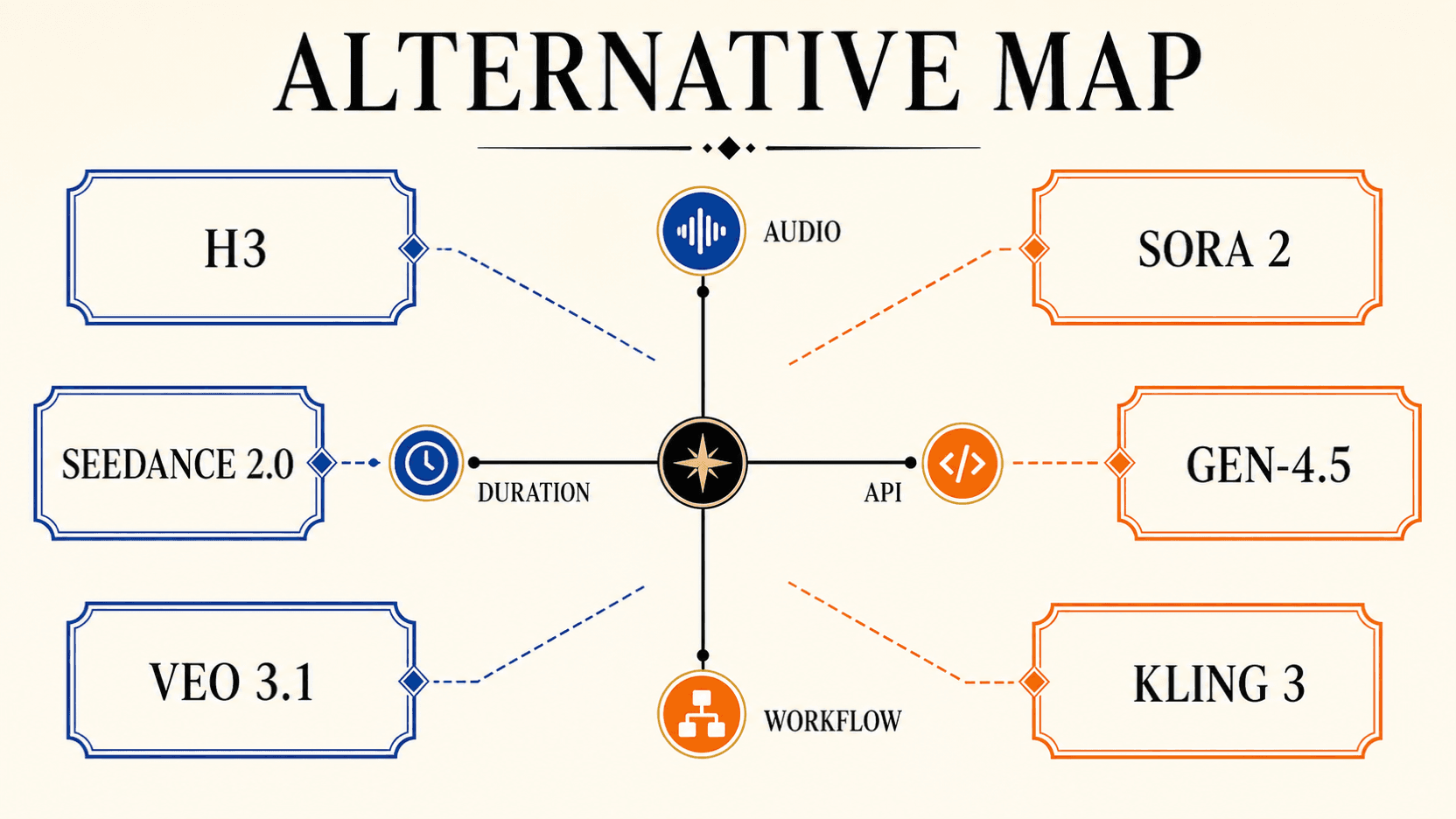
| Alternative | Best for | Verified strength | Main trade-off |
|---|---|---|---|
| MiniMax H3 | Multimodal API projects | 4–15 seconds, up to 2K, native stereo audio | Shorter than Seedance 2.5's demonstrated 30 seconds |
| Seedance 2.0 | Existing Seedance workflows | Shipping API and familiar model family | Earlier generation with shorter clips |
| Veo 3.1 | Google/Gemini stacks | Native audio, references, first/last frame, scene extension | Access and billing follow Google's ecosystem |
| Sora 2 | API removal scheduled for 2026-09-24; migrate existing workloads and choose another model for new integrations. | Videos API | 2026-09-24 |
| Runway Gen-4.5 | Runway production workflow | Text-to-video and image-to-video API | 2–10-second output window |
| Kling 3 | Creator UI and motion work | Established generation and editing workflow | Provider capabilities and prices vary |
These are model alternatives. Higgsfield, Atlas Cloud, fal, Replicate, and reAPI are access platforms that can expose one or more models. Comparing a studio subscription with a model is useful only after naming the underlying model.
For “Seedance 2.5 alternatives to Dreamina,” first decide whether the limitation is Dreamina’s studio or the model itself. If it is access or workflow, keep Seedance 2.5 and evaluate another platform; if it is output behavior or model capability, compare the models below.
Where reAPI fits in this model shortlist
reAPI is not a seventh video model, so ranking it beside H3 or Veo would be misleading. It is the access layer for a product team that wants to evaluate more than one callable model without rebuilding authentication, task polling, and billing each time.
Start with Seedance 2.5 on reAPI when 30-second takes, larger mixed-reference sets, or video editing matter. Start with MiniMax H3 for 2K, or Seedance 2.0 for 4K and cheaper tiers. All three use reAPI's asynchronous media task workflow, while their model-specific fields still need separate validation.
This is also the boundary: reAPI does not replace Higgsfield's finished studio, Google's native Cloud integration, or Runway's creator suite. It is the recommended starting point when the search for a “Seedance 2.5 alternative” is really a search for an API your own product can call.
1. MiniMax H3: best immediate Seedance 2.5 alternative
MiniMax H3 is the closest match to the reason many teams are watching Seedance 2.5: one model can interpret text, images, video, and audio as connected references. Its public video API accepts clips from four to 15 seconds, renders up to 2K, and generates native stereo audio.[2]
H3 also publishes its reference budget: up to nine images, three videos, and three audio files. That makes form validation and cost planning possible. MiniMax lists direct output pricing at $0.09 per second for 768p and $0.13 per second for 2K, before applicable input-media charges.[6]
Choose H3 when 2K output or its lower direct rate matters. Choose Seedance 2.5 when a single 30-second shot, second-level direction, or selective video editing removes more work than the rate difference adds. See the full MiniMax H3 vs Seedance 2.5 comparison.
2. Seedance 2.0: best low-risk replacement
Seedance 2.0 is less exciting than changing vendors, but it is often the correct production answer. It preserves the prompt style and model family while providing a callable API with known duration and input rules.
It is available through several providers, including Seedance 2.0 on reAPI, fal, Replicate, Atlas Cloud, and ByteDance's own cloud surfaces. fal, for example, publishes per-second rates for standard and fast variants, while Replicate provides hosted endpoints and client libraries.[7][8]
Choose Seedance 2.0 when 4K output, lower-cost Fast or Mini tiers, or an established 2.0 workflow matters more than 2.5's longer takes and editing. Keep the model identifier behind configuration so switching remains a controlled test.
3. Veo 3.1: best for Google Cloud and Gemini workflows
Google positions Veo 3.1 as a video model with native audio, reference-image guidance, first-and-last-frame control, and scene extension. It is available through the Gemini API and Vertex AI, making it a natural choice for teams already managing access, observability, and billing in Google Cloud.[3]
Its most useful distinction is ecosystem fit. If your media assets already live in Google Cloud and Gemini handles adjacent reasoning tasks, Veo can reduce platform sprawl. If you primarily want Seedance-style camera behavior or a broad multi-provider gateway, the operational advantage is smaller.
Read Veo 3.1 vs Seedance for a more detailed workflow comparison.
4. Sora 2: migration before September 24
OpenAI has scheduled the Videos API and sora-2 / sora-2-pro aliases for removal on September 24, 2026. As of this September 8 update, that date is still ahead; Sora 2 belongs in a migration discussion, not the shortlist for a new integration. OpenAI’s deprecation table lists no recommended replacement.[4]
For an existing Sora queue, compare Seedance 2.5, MiniMax H3, Veo, or Runway against the actual required duration, references, audio, and delivery workflow before cutting over. None is a drop-in Sora replacement: adapt request fields, polling, and output handling, and validate representative jobs before the shutdown deadline.
5. Runway Gen-4.5: best for a focused production suite
Runway added Gen-4.5 text-to-video and image-to-video to its API in February 2026, with two-to-ten-second generation documented in the changelog.[5] Its advantage is not a single specification. It is the surrounding Runway workflow for generating, reviewing, and continuing creative work in one environment.
Choose it when artists already use Runway and short shots are the unit of production. A developer building a model-agnostic backend may prefer H3 or a gateway with normalized job handling.
6. Kling 3: best for an established creator workflow
Kling 3 is a practical alternative for creators who prioritize visual motion, image-led generation, and a mature web workflow. Exact capabilities, queues, and prices can vary by product surface and provider, so verify the model name and settings at checkout rather than treating every “Kling” option as identical.
Kling becomes more compelling when the desired clip is short and motion-heavy. Seedance becomes more compelling when camera direction and continuity across a longer scene are the deciding factors. Our Seedance 2.0 vs Kling 3 comparison covers that difference, while the live 2.5 request behavior is documented separately.[10]
How to choose without guessing
Use one representative prompt set and score the outputs on the failure that costs your team the most:
- Continuity: identity, wardrobe, props, lighting, and screen direction.
- Instruction timing: whether actions occur in the requested order and window.
- Audio: speech intelligibility, synchronization, ambience, and unwanted sound.
- Recovery cost: rerender time, failed-job billing, and manual editing.
- Integration: request validation, webhooks or polling, storage, and rate limits.
Do not average everything into a vague “quality” score. An ecommerce team may value product fidelity above cinematic motion. A narrative team may accept more rerolls to preserve character continuity. The best alternative is the one that removes the most expensive failure.
FAQ
What is the closest alternative to Seedance 2.5?
MiniMax H3 is the closest newly released multimodal API alternative. Seedance 2.0 is the closest operational alternative because it belongs to the same model family.
Is Seedance 2.5 available through an API?
Yes. reAPI exposes it as doubao-seedance-2.5-face, with 480p / 720p / 1080p output and published live rates.[9][10]
Which alternative creates the longest clips?
This changes by model and product surface. Seedance 2.5 supports up to 30 seconds on reAPI, H3 documents up to 15 seconds, Sora 2 up to 12 seconds in its API, and Runway Gen-4.5 up to 10 seconds.[10] Sora 2: API removal scheduled for 2026-09-24; migrate existing workloads and choose another model for new integrations.[4]
Which alternative has native audio?
MiniMax H3, Veo 3.1, and Sora 2 all document video generation with audio. Test your language, voice, and synchronization needs rather than assuming every audio feature performs equally. Sora 2: API removal scheduled for 2026-09-24; migrate existing workloads and choose another model for new integrations.[4]
Is Higgsfield a Seedance 2.5 alternative?
Higgsfield is a creator platform that currently offers Seedance 2.5, not a different model. The September 8 check found 4–30-second controls and output through 1080p; account and plan permissions apply. See Seedance 2.5 on Higgsfield.
The practical shortlist
Start with Seedance 2.5 when its 30-second takes and edit workflows fit, H3 for 2K, Seedance 2.0 for higher-resolution or lower-cost Seedance output, and Veo 3.1 for a Google-native stack. Product teams can run the first three from reAPI's model catalog and compare accepted outputs under one task workflow. Add Runway Gen-4.5 or Kling 3 only when their particular workflow matches the project.
References
- MiniMax. MiniMax H3 launch and Video Generation Guide. Published July 31, 2026. minimax.io
- Google Developers Blog. Introducing Veo 3.1 and new creative capabilities in the Gemini API. developers.googleblog.com
- OpenAI. Videos API / Sora deprecation schedule. Checked September 8, 2026. developers.openai.com
- Runway. API changelog: Gen-4.5 text-to-video and image-to-video. Updated February 10, 2026. docs.dev.runwayml.com
- MiniMax API. Pay-as-you-go pricing. Retrieved August 2, 2026. platform.minimax.io
- fal. ByteDance Seedance 2.0 text-to-video API. Retrieved August 2, 2026. fal.ai
- Replicate. ByteDance Seedance 2.0 API. Retrieved August 2, 2026. replicate.com
- reAPI. Seedance 2.5 — live production pricing. Retrieved August 17, 2026 from reapi.ai/models/seedance-2-5
- reAPI. doubao-seedance-2.5-face — model ID, request limits, resolutions, and billing. Retrieved August 17, 2026 from reapi.ai/docs/seedance-2-5
Further reading
- reAPI. Seedance 2.5 launch status. reapi.ai/blog/seedance-2-5-release-status
- reAPI. MiniMax H3 vs Seedance 2.5. reapi.ai/blog/minimax-h3-vs-seedance-2-5
- reAPI. Best Higgsfield alternatives. reapi.ai/blog/best-higgsfield-alternatives-ai-video
More Posts
Author

Categories
More Posts

MiniMax H3 vs Seedance 2.5: Which AI Video Model Wins?
Compare MiniMax H3 vs Seedance 2.5 on duration, 2K output, native audio, multimodal references, editing, pricing, API access, and best use cases.
NSFW Video API Guide: Seedream 5.0 Pro to Seedance, Wan, H3
Build a reliable NSFW video API workflow: first create adult-only keyframes in Seedream 5.0 Pro, animate with Seedance, Wan, or H3, and add consent checks.
What Is reAPI? Models, Pricing, and How to Use It in 2026
reAPI provides chat and media APIs for 200+ image, video, audio, and language models. Here is what it does, what it costs, and how to make your first call.