Seedance 2.0 vs Kling 3.0: Benchmarks, Prices, Verdict
Seedance 2.0 vs Kling 3.0 across blind-test Elo, specs, and per-second prices: where ByteDance's leaderboard lead holds, and where Kling's 4K and audio win.
Seedance 2.0 vs Kling 3.0 is the closest thing AI video has to a heavyweight title fight in 2026: ByteDance's blind-test champion against Kuaishou's feature-packed challenger with native 4K and the deepest audio stack in the category. I pulled the specs from both vendors' own documentation, the Elo numbers from the two arenas that matter, and the per-second prices from every route you can actually buy, all verified on July 3, 2026.
The short version holds few surprises for anyone watching the leaderboards, but the details decide real projects: the quality gap is bigger than most people assume, and so is the feature gap running the other way.
TL;DR
- Blind tests favor Seedance 2.0, consistently and by a lot: #1 on Artificial Analysis text-to-video at Elo 1,222 versus Kling 3.0's best variant at #5 with 1,106[1], and #1 on LMArena image-to-video at 1,474 versus 1,360[2].
- Kling 3.0 wins the spec sheet: native 4K generation[3], dialogue in five languages with multi-character voice assignment[4], first-and-last-frame control, and up to 7 reference images on its Omni variant[4].
- Prices are closer than reputations suggest: official API rates run $0.084 to $0.42/s for Kling 3.0[5]; Seedance 2.0 spans $0.0703 to $0.7776/s on official token billing[6].
- On reAPI both undercut their list rates: Kling 3.0 starts at $0.077/s and its 4K tier is $0.3685/s; Seedance 2.0 Mini starts at $0.038/s without source video or $0.024 per billed second with one[7][8].
- Watch the reseller spread on Kling: fal.ai matches official pricing exactly, while Replicate charges up to double for the same tiers[9].
- Both models run on the same reAPI endpoint, so the honest answer to "which one" is a $2 A/B test on your own prompts.
Head-to-head on paper
| Seedance 2.0 | Kling 3.0 | |
|---|---|---|
| Maker, launch | ByteDance, Feb 12, 2026[10] | Kuaishou, Feb 5, 2026[11] |
| Clip length | 4–15s[6] | 3–15s[4] |
| Resolutions | 480p–4K (4K in 10-bit H.265)[6] | 720p, 1080p, native 4K since April 2026[3] |
| Reference inputs | 9 images + 3 videos + 3 audio in one request[6] | Up to 7 images (Omni), 4-image element fusion, video input editing[4] |
| Frame control | First-frame based modes | First AND last frame[4] |
| Audio | Generated jointly with video[6] | Native dialogue + SFX, 5 languages, multi-character voice assignment, voice cloning control[4] |
| Multi-shot | Prompt-driven | Dedicated auto/custom Multi-Shot sequencing[4] |
Read that table one way: Kling 3.0 is built like a production tool, Seedance 2.0 like a reference-fusion engine. Kling gives you storyboard-grade controls, endpoints for dialogue-driven scenes, and a dedicated native 4K tier. Seedance also reaches 4K on its full Face route and takes more source material in a single request, including audio and video references, which is why character-consistent series work gravitates to it.
What the blind tests say
Elo from paired blind votes is the least gameable public signal we have, and it is one-sided here.
On Artificial Analysis, Seedance 2.0 (720p) holds #1 in text-to-video at Elo 1,222; Kling 3.0's best entry, the 1080p Pro tier, sits fifth at 1,106, a 115-point gap, with three more Kling variants clustered at 1,094 to 1,099[1]. Image-to-video is wider: 1,195 against 1,072, a 123-point spread[1]. On LMArena's image-to-video board, built from over 115,000 votes, Seedance 2.0 ranks #1 at 1,474 while kling-v3-pro lands thirteenth at 1,360[2]. Kling 3.0 has no entry at all on LMArena's text-to-video board as of July 3.
A 115-point Elo gap converts to the higher-rated model winning roughly two out of three blind matchups. That is not a rounding error; it is a visible quality difference in photorealism and motion coherence, and it is why Seedance 2.0 stays the default recommendation for social-length realism. Where the votes do not reach: none of these boards measures 4K output, dialogue quality across languages, or multi-shot narrative control, which is precisely the territory Kling 3.0 stakes out.
Where Kling 3.0 actually wins
Native 4K. Kling shipped what it calls the first native 4K video model in April 2026, rendering at 3840×2160 rather than upscaling[3]. Seedance 2.0 also offers 4K through its official API and reAPI's public Face route[6][7]. Kling's current reAPI rate is lower at that resolution, so it remains the cheaper 4K route in this comparison.
The audio stack. Kling 3.0 generates dialogue and effects natively, assigns distinct voices across three or more characters, supports five languages plus dialect accents, and can lock a specific voice via its control feature[4]. Seedance's joint audio generation is strong for ambience and sync, but multi-character scripted dialogue is Kling's home turf.
Directorial control. First-and-last-frame interpolation, element references that fuse up to four images into one subject, and Multi-Shot sequencing with automatic or custom shot breakdowns[4] make Kling the more scriptable camera. Seedance answers with raw reference bandwidth: nine images plus video plus audio in one request[6].
If your work is "make this exact character do exact things across a storyboard with spoken lines," the spec sheet argues Kling. If it is "make the most convincing 15 seconds possible from this pile of references," the votes argue Seedance.
Price per second, every real route
Official list rates first. Kling 3.0's API bills flat per second: $0.084/s at 720p and $0.112/s at 1080p without audio, $0.126 and $0.168 with audio, $0.42/s for 4K[5]. Seedance 2.0's official billing is token-based and converts to $0.0703 (480p), $0.1512 (720p), $0.3742 (1080p), and $0.7776/s (4K)[6].
Two reseller notes from checking the usual suspects: fal.ai lists Kling 3.0 at exactly the official rates, while Replicate charges up to double ($0.168/s for standard without audio, $0.336/s for pro with audio)[9]. Same model, 2x spread; always check the per-second number, not the brand.
On reAPI, both families run below list on one endpoint. The Seedance rows were checked against the production rate card on August 17, 2026:
| Tier | reAPI rate |
|---|---|
| Kling 3.0 Standard | $0.077/s (no audio) · $0.11/s (audio)[8] |
| Kling 3.0 Pro | $0.099/s · $0.1485/s[8] |
| Kling 3.0 4K | $0.3685/s[8] |
| Seedance 2.0 Face | $0.07125–$0.780/s without source video; $0.043125–$0.480 per billed second with one[7] |
| Seedance 2.0 Fast Face | $0.062–$0.132/s without source video; $0.036–$0.080 per billed second with one[7] |
| Seedance 2.0 Mini | $0.038–$0.082/s without source video; $0.024–$0.050 per billed second with one[7] |
The cost verdict depends on the job. At 720p without source video, Seedance Mini is $0.082/s and Fast Face is $0.132/s. At 1080p, Kling Pro with audio at $0.1485/s is below Seedance Face at $0.3825/s without source video. At 4K, Kling's $0.3685/s is about 53% below Seedance Face at $0.78/s. A Seedance source video selects lower rates, but its rounded-up duration is added to the output duration before the final credits are calculated.
Which one for which job
Choose Seedance 2.0 for photoreal social content, character consistency from reference stacks, image-to-video where fidelity to the source matters, and volume pipelines that fit the lower-cost Fast Face or Mini tiers. The blind-test margin is real and your audience votes the same way the arenas do.
Choose Kling 3.0 for 4K deliverables, dialogue scenes in multiple languages, storyboard-driven multi-shot narratives, and first-to-last-frame precision work. The features are not gimmicks; they are the parts of production the leaderboards do not score.
Or stop choosing. Both run on reAPI's videos endpoint with per-second billing; switching is the model string. Run your three toughest prompts through Seedance 2.0 and Kling 3.0, watch them side by side, and let the outputs settle it for a couple of dollars.
FAQ
Is Seedance 2.0 better than Kling 3.0?
On measured quality, yes: it leads Kling 3.0 by 115 to 123 Elo across the Artificial Analysis and LMArena boards[1][2]. On production features (4K, dialogue, shot control), Kling 3.0 is ahead. "Better" depends on which of those your project bills for.
Which is cheaper, Seedance 2.0 or Kling 3.0?
It depends on resolution, audio, and source-video duration. Seedance Mini starts at $0.038/s without source video or $0.024 per billed second with one, but the latter bills source plus output duration[7]. At 4K on reAPI, Kling is $0.3685/s versus Seedance Face at $0.78/s[7][8].
Does Kling 3.0 have better audio than Seedance 2.0?
For scripted dialogue, yes: five languages, multi-character voice assignment, and voice locking are documented Kling 3.0 features[4]. Seedance generates audio jointly with video and takes audio as a reference input, which suits ambience and music-driven clips[6].
Is Kling 3.0's 4K really native?
Kuaishou markets it as the first native 4K generation model, rendering at 3840×2160 rather than upscaling[3]. Independent leaderboards do not yet score 4K output, so treat "native" as documented and "better at 4K" as your own eyeball test.
Why do Kling 3.0 prices differ so much between platforms?
Reseller margin. fal.ai matches Kling's official per-second rates; Replicate lists the same tiers at up to 2x[9]; reAPI runs below list[8]. The model is identical, so the per-second number is the whole comparison.
Can I A/B test both models on one API?
Yes. Both are live on reAPI's async videos endpoint with per-second billing and signup credits; the only change between requests is the model field[7][8].
The verdict that survives contact with projects
Treat Seedance 2.0 vs Kling 3.0 as a division of labor, not a duel. The arena numbers say Seedance for anything where perceived realism decides, and the spec sheets say Kling for lower-cost 4K, dialogue, and shot-by-shot control. Prices overlap enough that neither wins on cost alone, and both sit one model-string apart on the same endpoint. Run the A/B on your own material; in our experience the winner of Seedance 2.0 vs Kling 3.0 changes by use case far more often than by taste.
References
- Artificial Analysis. Text to Video and Image to Video Leaderboards. Retrieved July 2026 from artificialanalysis.ai/video/leaderboard/text-to-video
- LMArena. Image to Video Leaderboard. Retrieved July 2026 from arena.ai/leaderboard/image-to-video
- Kling AI (Kuaishou). Kling AI introduces native 4K video model. Retrieved July 2026 from kling.ai/blog/kling-ai-introduces-native-4k-video-model
- Kling AI (Kuaishou). Kling VIDEO 3.0 model user guide. Retrieved July 2026 from kling.ai/quickstart/klingai-video-3-model-user-guide
- Kling AI (Kuaishou). Developer API pricing. Retrieved July 2026 from kling.ai/dev/pricing
- BytePlus (ByteDance). ModelArk — Seedance 2.0 specifications and pricing. Retrieved July 2026 from docs.byteplus.com/en/docs/ModelArk/1544106
- reAPI. Seedance 2.0 Face, Fast Face, and Mini — model pages, live pricing, and source-video billing. Retrieved August 17, 2026 from reapi.ai/models/seedance-2-0 and reapi.ai/models/seedance-2-0-mini
- reAPI. Kling 3.0 — model page and live pricing. Retrieved July 2026 from reapi.ai/models/kling-3-0
- Replicate. kwaivgi/kling-v3-video — pricing. Retrieved July 2026 from replicate.com/kwaivgi/kling-v3-video
- ByteDance Seed. Seedance 2.0 — official model page. Retrieved July 2026 from seed.bytedance.com/en/seedance2_0
- Kuaishou Investor Relations. Kling AI launches 3.0 model. Retrieved July 2026 from ir.kuaishou.com/news-releases
Further reading
- reAPI. Veo 3.1 vs Seedance 2.0. reapi.ai/blog/veo-3-1-vs-seedance-2-0-2026
- reAPI. Cheapest Seedance 2.0 in 2026: Real Prices, Compared. reapi.ai/blog/cheapest-seedance-2-0-2026
- reAPI. Kling 3.0 API documentation. reapi.ai/docs/kling-3-0
Author

Categories
More Posts
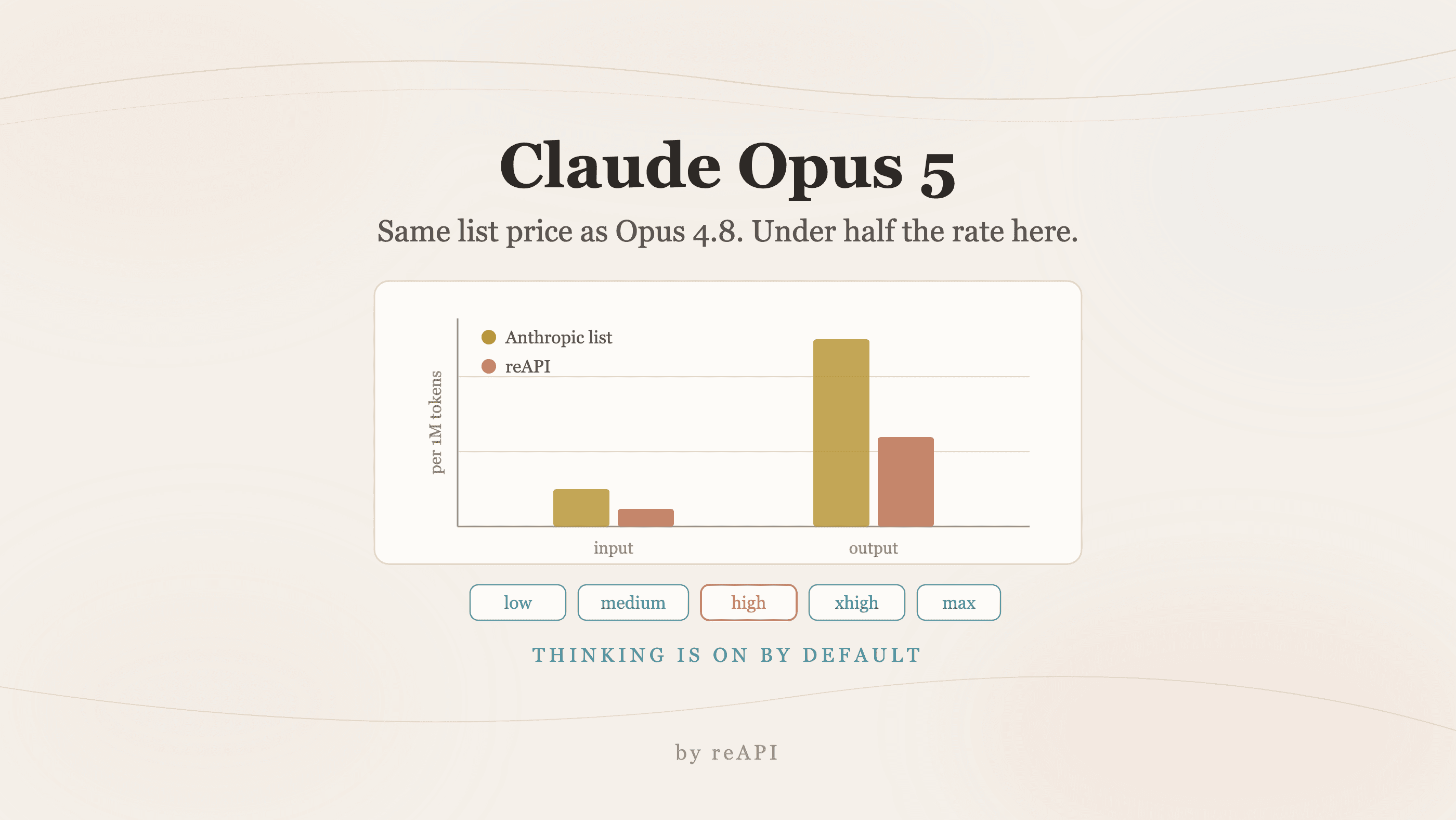
How to Use Claude Opus 5: Benchmarks, Effort, and Cost
How to use Claude Opus 5: the full official benchmark table, the effort ladder that decides your bill, two breaking API changes, and the migration steps.

AI Image Generation Cost vs Video: 2-9x More Per Frame
AI image generation cost per megapixel runs 2 to 9 times a frame of generated video. The per-frame math across eight video tiers and seven image models.
Can You Tell If a Writer Used ChatGPT? Patterns, Not Proof
Can you tell if a writer used ChatGPT? Learn the recurring style signals, why no phrase proves AI authorship, and a fairer way to review suspicious text.