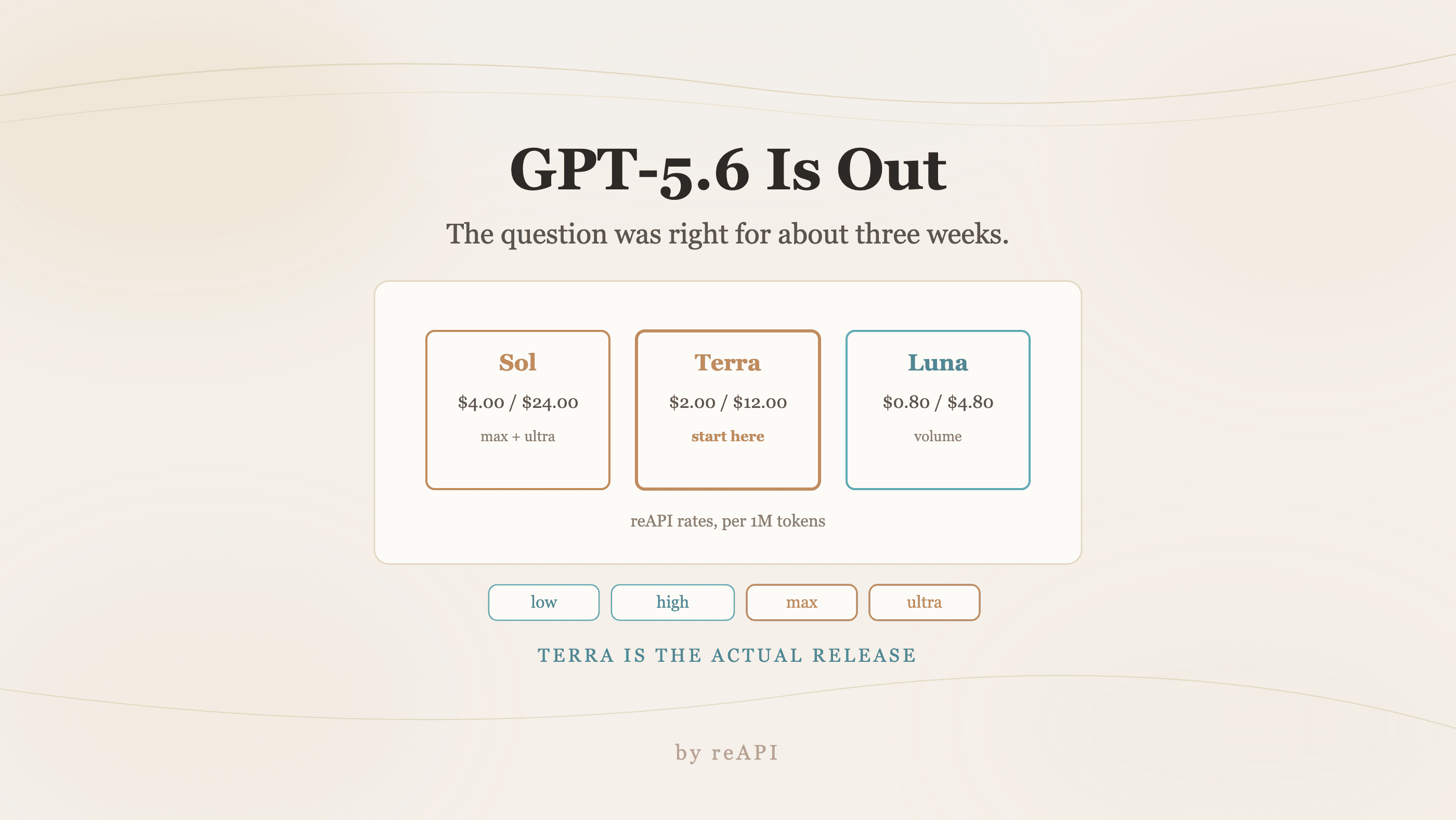
Is GPT-5.6 Out Yet? Yes — and Here Is What Shipped
GPT-5.6 is released. It shipped as three tiers, the rollout was gated for weeks which is why answers conflict, and Terra is the one worth migrating to.
Yes. GPT-5.6 is out, and it has been for a while.
Search volume has not caught up: "when is GPT-5.6 coming out" and its variants still pull tens of thousands of searches a month, all of them asking about a release that already happened. If you arrived here from one of those, the short version is below, followed by what actually shipped and what it costs.
TL;DR
- GPT-5.6 is released. OpenAI previewed it on June 26, 2026 and general availability followed[1].
- It is three models, not one: Sol, Terra, and Luna, as durable capability tiers under one generation number[1].
- The launch was unusual: initial access went to roughly twenty vetted partners at the U.S. government's request, before broader release[1].
- Terra is the tier most teams want: GPT-5.5-class coding at less than half the price[1].
- Sol added two reasoning modes,
maxandultra, the second of which orchestrates subagents[1]. - On reAPI all three run at 80% of list: Sol $3.20/$16.00, Terra $1.60/$9.60, Luna $0.16/$0.96 per million tokens (checked October 22, 2026).
What "released" means here
The rollout is why the search question persisted longer than usual.
OpenAI previewed GPT-5.6 on June 26, 2026, but did not open it broadly. Access went to about twenty vetted partners through the API and Codex, in a phased rollout OpenAI says the U.S. government requested after reviewing the models' cybersecurity capabilities ahead of launch[1].
So for a few weeks there was a model with published benchmarks, published pricing, and almost no one able to use it. That gap is what generated the wave of "is it out yet" searches, and it is also why answers from that period contradict each other.
That gate has since lifted. The models are generally available.
The three tiers
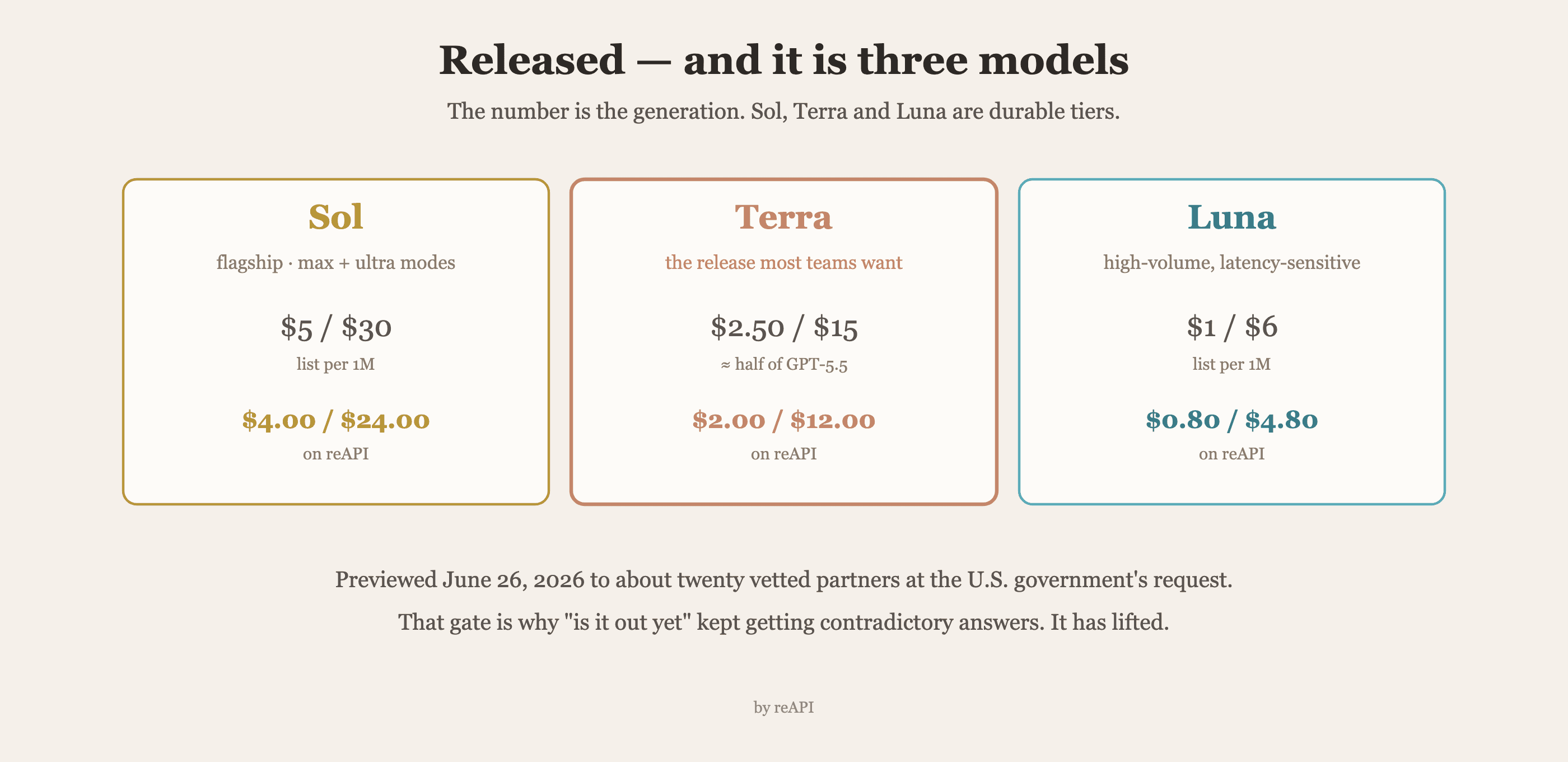
| Tier | Positioning | List price per 1M (in / out), October 22, 2026 | On reAPI |
|---|---|---|---|
| GPT-5.6 Sol | Flagship. The only tier with max and ultra reasoning modes | $4 / $20 | $3.20 / $16.00 |
| GPT-5.6 Terra | Balanced workhorse, about 2.5x cheaper than GPT-5.5 | $2 / $12 | $1.60 / $9.60 |
| GPT-5.6 Luna | Fast and low cost, for high-volume routine work | $0.20 / $1.20 | $0.16 / $0.96 |
Launch list prices were $5/$30 for Sol, $2.50/$15 for Terra, and $1/$6 for Luna. OpenAI has since lowered all three, and says Sol's current rate is promotional through at least November 21, 2026[3].
The naming is deliberate. OpenAI's framing is that the number identifies a generation while Sol, Terra, and Luna identify durable capability tiers that advance on their own cadence[1]. A future generation can ship a new Luna without touching Sol.
For anyone who was waiting: Terra is the release. It matches GPT-5.5-class coding at roughly half the price, which is the change most workloads actually feel[1].
What actually shipped
Terminal-Bench 2.1 at 88.8% single-agent, or 91.9% in ultra mode. The single-agent lead over Claude Mythos 5 is 0.8 points, which is inside the noise band, so read it as a narrow win rather than a generational gap[1].
ultra is not one agent. It orchestrates subagents in parallel, so its headline score is not a like-for-like comparison against single-agent baselines[1].
Sol holds GPT-5.5's exact pricing while adding capability, and prompt caching was overhauled with explicit cache breakpoints and a 30-minute minimum cache life[1].
The evaluation window was deliberately narrow. OpenAI published coding, biology, and cybersecurity results only, holding back SWE-bench, GDPval, math, and hallucination numbers[1]. Whether GPT-5.6 fixed GPT-5.5's confident-hallucination problem is still unknown.
The full breakdown, including the four asterisks on that benchmark table, is in our GPT-5.6 guide.
If you were waiting to migrate
The practical answer for most teams is short.
Move to Terra, not Sol. The price cut is the release's real story, and Terra ties Claude Fable 5 on Terminal-Bench while sitting less than a point above the GPT-5.5 it replaces[1].
Reserve Sol for work that justifies ultra. Subagent orchestration costs more tokens and more wall-clock time. It earns that on a multi-file refactor or an end-to-end audit, and wastes it on routine calls.
Keep verification in place. Until the expanded evaluation suite lands, pair the model with source-grounded checks for anything high-stakes.
from openai import OpenAI

client = OpenAI(api_key="YOUR_REAPI_KEY", base_url="https://api.reapi.ai/v1")

resp = client.chat.completions.create(
    model="gpt-5.6-terra",
    messages=[{"role": "user", "content": "Refactor this module and add tests."}],
    max_tokens=16000,
    stream=True,
)
Swap the model string for gpt-5.6-sol or gpt-5.6-luna to change tiers. Note the wire ids keep the dot. Rates are on reapi.ai/models.
FAQ
Is GPT-5.6 out yet?
Yes. It was previewed on June 26, 2026 with restricted access, and is now generally available across all three tiers[1].
Why did it take so long to become available?
OpenAI ran a phased preview to roughly twenty vetted partners at the U.S. government's request, following a review of the models' cybersecurity capabilities[1].
What is the difference between Sol, Terra, and Luna?
Sol is the flagship and the only tier with max and ultra reasoning modes. Terra is the balanced default at roughly half GPT-5.5's price. Luna is the low-cost tier for high-volume routine work[1].
Which GPT-5.6 tier should I use?
Terra for most production workloads. Sol for long-horizon coding, security work, or anything that justifies ultra. Luna for high-volume, latency-sensitive traffic[1].
How much does GPT-5.6 cost?
As of October 22, 2026, list is $4/$20 for Sol, $2/$12 for Terra, and $0.20/$1.20 for Luna per million tokens, down from $5/$30, $2.50/$15, and $1/$6 at launch. On reAPI each runs at 80% of the current list[3].
Is GPT-5.6 better than GPT-5.5?
On Terminal-Bench, yes, though Terra sits less than a point above GPT-5.5 there. The larger change is the price: Terra delivers GPT-5.5-class capability for about half the cost[1].
What is ultra mode?
A reasoning setting exclusive to Sol that spawns subagents to split complex work in parallel, rather than a single agent reasoning longer[1].
Did GPT-5.6 fix the hallucination problem?
Unknown. OpenAI held back hallucination and knowledge-work evaluations in the preview[1].
Answering the question the search was really asking
"When is GPT-5.6 coming out" was the right question for about three weeks in mid-2026, and the answer stopped being a date some time ago. What most people asking it actually want to know is whether it is worth switching, and that answer is more specific than a release note.
It is worth switching to Terra, because GPT-5.5-class coding at half the price is a real change to unit economics. It is worth reaching for Sol only where ultra earns its cost. And it is worth keeping verification around either, because the evaluation OpenAI published was deliberately narrow and the numbers that would settle the hallucination question were not in it.
References
- reAPI. How to use GPT-5.6 — tiers, the Terminal-Bench table, reasoning modes, pricing, and the phased rollout. reapi.ai/blog/how-to-use-gpt-5-6
- OpenAI. Models — GPT-5.6 specifications and reasoning modes. Retrieved July 2026 from platform.openai.com/docs/models
- OpenAI. Pricing — per-token rates by model and tier. Retrieved July 2026 and re-checked October 22, 2026 from platform.openai.com/docs/pricing
Further reading
- reAPI. How to use GPT-5.6. reapi.ai/blog/how-to-use-gpt-5-6
- reAPI. How to use GPT-5.5. reapi.ai/blog/how-to-use-gpt-5-5
- reAPI. Model catalog. reapi.ai/models
Author

Categories
ultra mode?Did GPT-5.6 fix the hallucination problem?Answering the question the search was really askingReferencesFurther readingMore Posts
Kling 4.0 Flash API: Is It Out Yet, and What to Use Now
Kling 4.0 Flash is in early access, but is there a Kling 4.0 Flash API? What Kling's API docs, price sheets, and changelog show, and what to build on today.
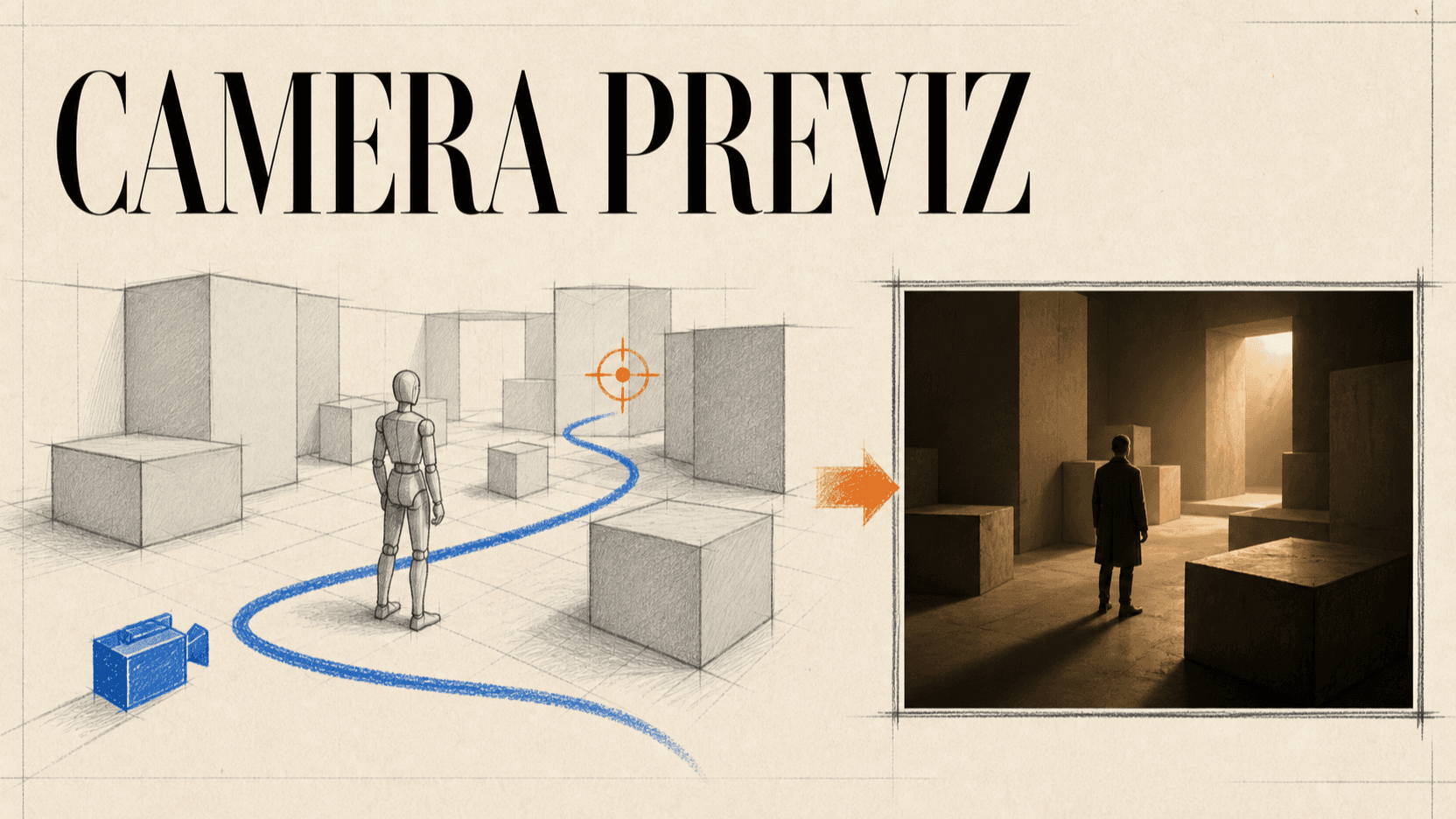
How to Control AI Video Camera Movement with Blender Previz
Build a simple Blender gray-box scene, animate a repeatable camera path, export a preview, and use it as motion guidance for AI video generation.

Atlas Cloud vs Higgsfield: API Platform or Creator Studio?
Atlas Cloud vs Higgsfield vs reAPI for Seedance: compare API access, creator workflows, pricing, model breadth, and which platform fits your team.