Atlas Cloud vs Higgsfield: API Platform or Creator Studio?
Atlas Cloud vs Higgsfield vs reAPI for Seedance: compare API access, creator workflows, pricing, model breadth, and which platform fits your team.
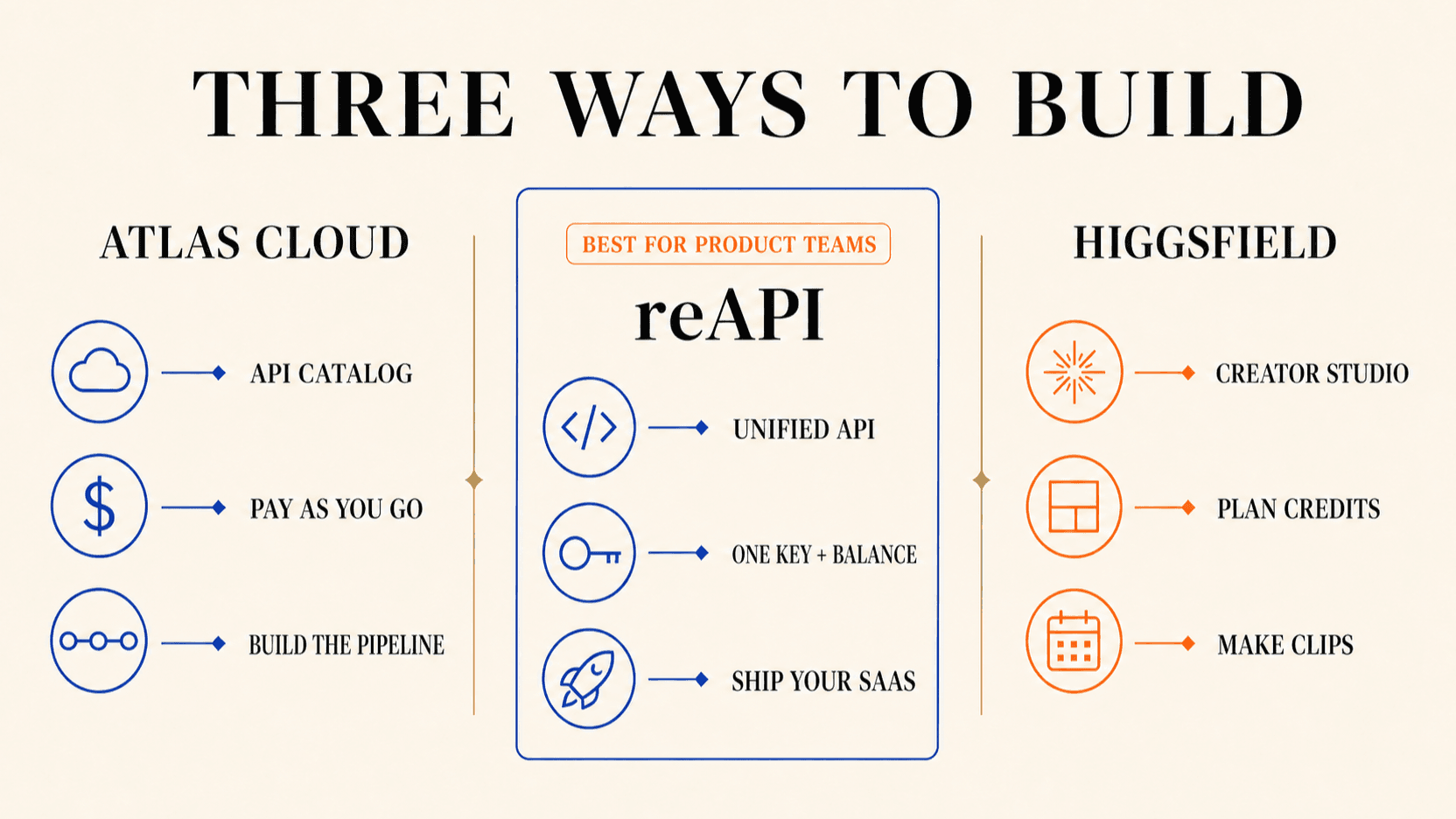
Choose reAPI when you are building a SaaS product and want a focused multi-model API, one media balance, and a documented asynchronous media workflow. Choose Higgsfield when a creator wants presets and a polished browser studio. Choose Atlas Cloud when maximum catalog breadth or raw GPU infrastructure is the deciding requirement.
That three-way distinction also explains the recent “Seedance 2.5 Higgsfield” and “Atlas Cloud Seedance 2.5” searches. A platform can publish a model page without proving that the model is callable. reAPI has since crossed that line with a live model ID, schema, and rates; the Atlas Cloud and Higgsfield statements below remain dated to the sources retrieved on August 2.
TL;DR
- reAPI: best fit for product teams that want a curated multi-model API, live model pages, pay-as-you-go credits, and the same submit-and-poll workflow across media.
- Atlas Cloud: best fit when a very broad catalog, GPU services, or enterprise infrastructure matters more than a focused integration path.[1]
- Higgsfield: best fit for people producing clips in a browser with presets, identity tools, and a visual project workflow.
- Seedance 2.5: reAPI now exposes
doubao-seedance-2.5-face; Atlas Cloud advertised early access and Higgsfield showed a coming-soon page in the August 2 source check.[2][3][7] - What to ship today: developers can run Seedance 2.5, Seedance 2.0, or MiniMax H3 through reAPI; creators should verify the current Higgsfield picker for account-level access.
Atlas Cloud vs Higgsfield at a glance
| Area | Atlas Cloud | Higgsfield | reAPI |
|---|---|---|---|
| Core product | Broad multi-model API and GPU cloud | AI video creator studio | Curated multi-model API gateway |
| Primary user | Infrastructure and enterprise teams | Creators, marketers, and agencies | SaaS and application developers |
| Main interface | Model pages, APIs, and GPU services | Browser generator, presets, and projects | Model playground, REST API, and task status |
| Model breadth | 400+ models advertised | Curated studio catalog | Curated catalog with live availability on model pages |
| Billing | Usage based; varies by model | Subscription tiers and credits | Pay-as-you-go credits; no monthly plan required |
| Seedance now | Seedance 2.0 API in the August 2 source check | Seedance 2.0 creator workflow in the August 2 source check | Seedance 2.0 API and Seedance 2.5 API |
| Seedance 2.5 | Early-access cohort in the August 2 source check | Coming-soon notification page in the August 2 source check | Live as doubao-seedance-2.5-face |
| Product work | You build UI, review, storage, and delivery | Studio supplies most creator workflow | You build the UI; reAPI supplies the model and task layer |
| Best outcome | Broad infrastructure platform | A finished clip made interactively | A programmable product pipeline |
This comparison is published by reAPI. reAPI competes with Atlas Cloud at the API layer, so its product claims point to live reAPI pages and the recommendations state where Atlas Cloud or Higgsfield is genuinely the better fit.
Atlas Cloud is an API platform
Atlas Cloud gives developers one account for a large model catalog spanning video, image, audio, and language generation. Its Seedance 2.0 endpoint follows a familiar asynchronous pattern: submit a job, retain the task identifier, then poll or otherwise retrieve the result when generation finishes.[1]
This is useful when your product already has its own user interface. A team can place model selection behind configuration, route workload by price or capability, and store outputs in its own system. The trade-off is ownership: Atlas Cloud does not become your review queue, brand workflow, customer permissions, or final delivery experience.
The breadth is useful when one account must cover an unusually wide set of models or when the same vendor also needs to supply GPU infrastructure. The trade-off is focus: every production decision should use the live model page and price table, not the size of the overall catalog.
Higgsfield is a creator studio
Higgsfield starts from the opposite end. A creator chooses a model within a web product, then combines it with platform-level tools such as camera presets, character or identity workflows, advertising formats, and project organization.
Higgsfield uses subscription tiers and credits, with exact offers varying by plan, promotion, and region.[4] It also documents a 30-day Seedance Unlimited promotion built on Enhanced Seedance 2.0 Fast. That promotion uses standard queues and 480p or 720p output; it is not unlimited Seedance 2.5 or unlimited 4K.[5]
The studio saves setup work for a human operator. It is less suitable as the invisible engine behind your own SaaS unless a specific API program covers the required workflow.
reAPI is the focused API alternative
reAPI sits between Atlas Cloud's broad infrastructure catalog and Higgsfield's finished creator studio. Selected image, video, and audio models use its media workspace; language models use a separate chat workspace. The two workspaces have separate keys and balances. Media jobs use a consistent asynchronous flow: submit a request, receive a task ID, then poll the task until it completes or fails.
The practical difference is what can be used now. Seedance 2.5 on reAPI is live as doubao-seedance-2.5-face for 480p/720p output, 4–30-second clips, and documented edit, extend, and mixed-reference workflows.[7][8] Seedance 2.0 remains available for 1080p/4K and cheaper tiers, while MiniMax H3 reaches up to 2K.
reAPI does not replace Higgsfield's full editing workspace, reusable-identity tools, or campaign presets. It also does not sell the raw GPU infrastructure that can make Atlas Cloud attractive. It is the narrower choice for teams that want to put generation inside their own product without maintaining a separate provider integration and billing relationship for every selected model.
Building a product? Try Seedance 2.5 on reAPI, review the API quickstart, or compare it with Seedance 2.0.
Seedance 2.5 availability: early access is not an endpoint
ByteDance demonstrated Seedance 2.5 with 30-second continuous output, expanded multimodal references, second-level control, and video editing.[6] reAPI now supplies the production pieces that were missing: model ID doubao-seedance-2.5-face, a public schema, 480p/720p output, and live pricing.[7][8]
Atlas Cloud's August 2 source described a Seedance 2.5 early-access cohort while its callable Seedance documentation remained on 2.0.[2] Higgsfield's page at that check was still a notification surface.[3] By contrast, reAPI now presents Seedance 2.5 as a live route with its own 2.5 contract.
Use the same test on any platform:
- Is
Seedance 2.5present in the signed-in live catalog? - Is there a real model ID or selectable generator option?
- Are duration, resolution, reference limits, and audio behavior stated?
- Is the actual charge visible before generation?
If any answer is missing, treat that particular platform surface as an announcement or waitlist, not a production dependency. The Seedance 2.5 on Higgsfield guide tracks that platform-specific distinction in more detail.
Pricing: three different bills
Atlas Cloud meters model calls. Higgsfield sells plan access and credits. reAPI meters completed API work against a pay-as-you-go credit balance and automatically refunds a media job that finishes in failure. Comparing the cheapest visible number produces a misleading winner because the three products include different work.
For Atlas Cloud, estimate:
- generated seconds by model and resolution;
- average failed or rejected generations;
- storage, delivery, moderation, and application hosting;
- engineering time for queue and error handling.
For Higgsfield, estimate:
- monthly plan and any add-ons;
- credits consumed per accepted clip;
- unused credits;
- creator time saved by presets, identity, and in-app workflows.
For reAPI, estimate:
- the live per-model rate for the chosen resolution and duration;
- any billable reference-video time documented by that model;
- accepted outputs after automatic failed-job refunds;
- the product work your team still owns: UI, review, storage, and delivery.
Then divide the total by accepted deliverables. Pay as you go usually fits variable API traffic. A subscription studio can be cheaper for a creator who uses its workflow every day. For reAPI, use the live Seedance 2.0 model page rather than copying a price from an article that may age.
Model choice and switching
Atlas Cloud's wider catalog makes switching easier at the account level, but models still have different request schemas and behaviors. Normalizing prompt, duration, and aspect_ratio does not make reference video, native audio, and safety errors identical.
Higgsfield deliberately narrows those differences behind a visual interface. That makes testing easier for a creator but automation harder for a product team. Its value is curation and workflow, not maximum backend portability.
reAPI narrows the operational differences at the media-job layer: one media credential, task status pattern, balance, and model directory. Model-specific fields still matter, so switching from Seedance to H3 is a controlled adapter change rather than a promise that every request body is identical.
If portability is the goal, define an internal job object and provider adapter. Store the upstream model ID with every result, maintain a fixed evaluation set, and never silently change the model behind an existing product label.
Which should you choose?
Choose Atlas Cloud when
- you are building a SaaS product or internal application;
- API calls, metered billing, and model breadth matter;
- your team can own job queues, storage, review, and delivery;
- you want the Seedance routes verified in Atlas Cloud's current live catalog plus access to other model families;
- you can treat Seedance 2.5 as early access until a live endpoint appears.
Choose Higgsfield when
- creators need to work in a browser with minimal setup;
- reusable identity, camera presets, and marketing tools save time;
- subscription credits match predictable monthly use;
- the final deliverable is a clip, not an API response;
- the Seedance models visible in your current account are sufficient.
Choose reAPI when
- you are adding AI video to your own SaaS or application;
- Seedance 2.5, Seedance 2.0, or MiniMax H3 needs to be callable now;
- one task workflow and credit balance are more useful than the widest possible catalog;
- live model pages and automatic failed-job refunds matter;
- you do not need a full browser editing studio or raw GPU rental.
Use Higgsfield with reAPI when
- a creative team explores and approves a visual language in Higgsfield;
- developers then automate approved, structured variants through reAPI;
- the cost of two tools is lower than forcing either platform to do the other's job.
Atlas Cloud and Higgsfield alternatives
None of the three will fit every team. fal and Replicate offer model-level developer access, Krea provides another creator workspace, and Dreamina is the official ByteDance consumer route. The best Higgsfield alternatives guide compares those platform categories directly.
FAQ
Is Atlas Cloud cheaper than Higgsfield?
Not universally. Atlas Cloud meters API usage, while Higgsfield sells subscriptions and credits that include creator tools. Compare cost per accepted deliverable for your workload.
Does Atlas Cloud have a Seedance API?
Yes, Atlas Cloud publicly documents Seedance 2.0 endpoints. Its Seedance 2.5 page describes early access; verify a live model ID before planning production.
Does Higgsfield offer an API?
Higgsfield's public product is primarily a creator studio. If an API is essential, confirm current developer access, supported models, and commercial terms directly rather than assuming the web model picker is programmable.
Which platform is better for MiniMax H3?
For a documented route on this platform, use MiniMax H3 on reAPI. Atlas Cloud remains relevant when its broader catalog or infrastructure is the reason for the account. Higgsfield should be evaluated through its current live model picker. See the H3 API guide for request modes and limits.
Which is better for a marketing team?
Higgsfield usually fits a hands-on marketing team because it provides creator workflows. reAPI fits a marketing software product that generates assets programmatically. Atlas Cloud becomes more relevant when that product also needs maximum catalog breadth or GPU infrastructure.
Is reAPI an Atlas Cloud alternative?
Yes, for teams buying model access through an API. reAPI is the more focused option for selected media and language models; Atlas Cloud is broader and also sells GPU infrastructure. Compare the exact live models your product needs rather than total catalog size.
Does reAPI have Seedance 2.5?
Yes. The reAPI Seedance 2.5 page is live, and the callable model ID is doubao-seedance-2.5-face.[7][8]
The verdict
Atlas Cloud wins on breadth and infrastructure. Higgsfield wins on interactive creator workflow. reAPI is the practical choice for teams that want to put Seedance and other selected media models inside their own product with a documented async API and live pay-as-you-go pricing. For Seedance 2.5, reAPI now has the concrete production route: doubao-seedance-2.5-face, with 480p/720p rates and documented billing.[7][8]
References
- Atlas Cloud. Model catalog and Seedance 2.0 API. Retrieved August 2, 2026. atlascloud.ai
- Atlas Cloud. Seedance 2.5 early access. Retrieved August 2, 2026. atlascloud.ai
- Higgsfield. Seedance 2.5 — coming-soon notification page. Retrieved August 2, 2026. higgsfield.ai
- Higgsfield. AI pricing and plans. Retrieved August 2, 2026. geo.higgsfield.ai
- Higgsfield. What Creators Really Get with Seedance Unlimited. Updated July 9, 2026. geo.higgsfield.ai
- ModelArk. Doubao Seedance 2.5 official promotion. Retrieved August 2, 2026. ark.volcengine.com
- reAPI. Seedance 2.5 — live production pricing. Retrieved August 17, 2026 from reapi.ai/models/seedance-2-5
- reAPI. doubao-seedance-2.5-face — model ID, supported resolutions, request schema, and billing. Retrieved August 17, 2026 from reapi.ai/docs/seedance-2-5
Further reading
- reAPI. Seedance 2.5 on Higgsfield. reapi.ai/blog/seedance-2-5-on-higgsfield
- reAPI. MiniMax H3 vs Seedance 2.5. reapi.ai/blog/minimax-h3-vs-seedance-2-5
- reAPI. Best Seedance 2.5 alternatives. reapi.ai/blog/best-seedance-2-5-alternatives
Author

Categories
More Posts
How to Control AI Video Camera Movement with Blender Previz
Build a simple Blender gray-box scene, animate a repeatable camera path, export a preview, and use it as motion guidance for AI video generation.

Best-Value Seedance 2.0 API in 2026: Prices Compared
A matched Seedance 2.0 API price comparison across reAPI, Atlas, Replicate, fal, and WaveSpeed, including billing rules and best-value picks.

FLUX 3 vs Seedance 2.5: Keyframes, Duration, and Cost
Choose FLUX 3 or Seedance 2.5 by maximum duration, ordered keyframes, references, editing, native audio, Draft workflow, resolution, and API cost.