Nano Banana API Free Tier: What Google Actually Charges
There is no Nano Banana API free tier: Google lists it as Not available on every model. Here are the real per-image rates, batch pricing, and what $0.02 buys.
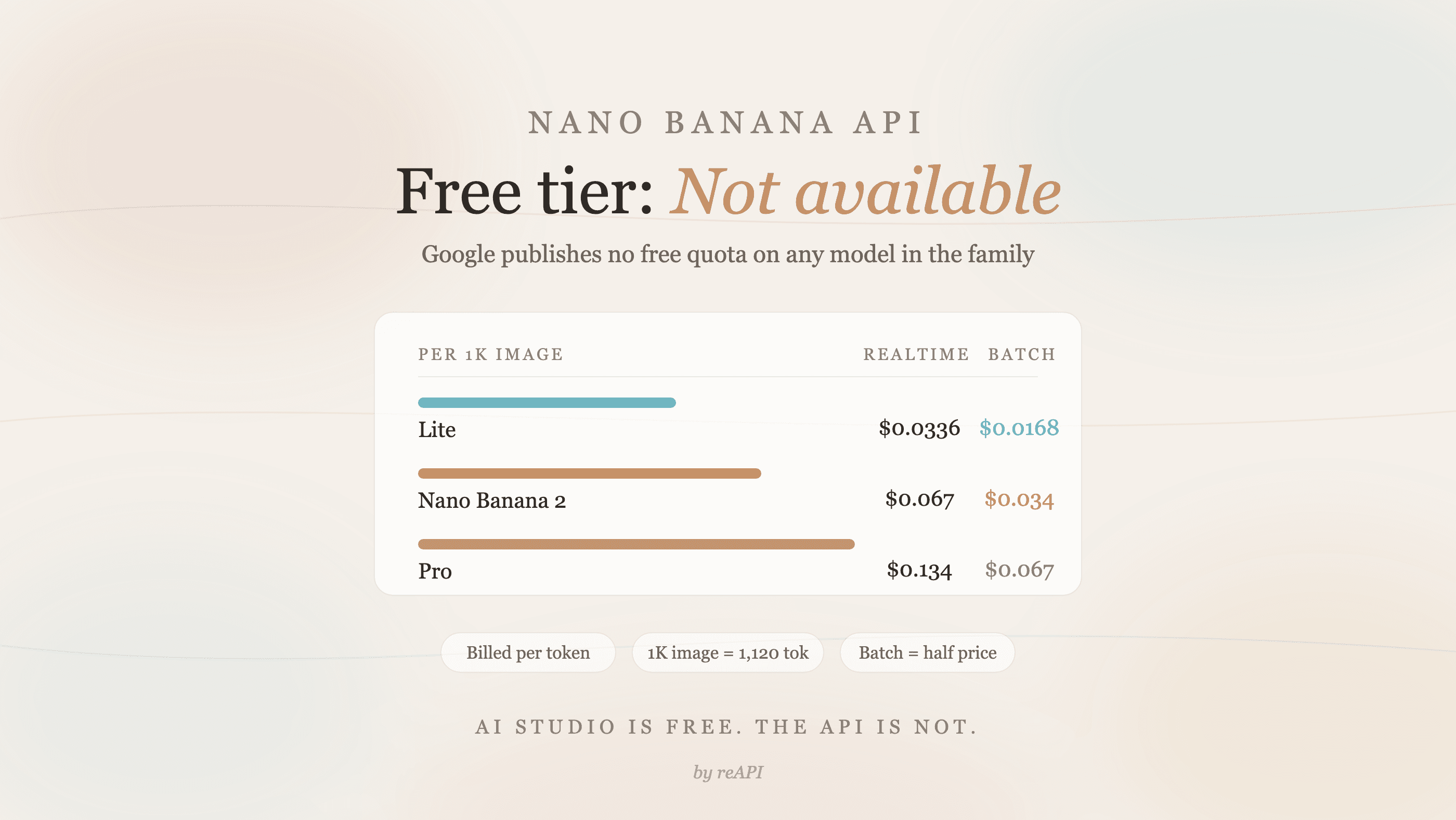
The short answer about a Nano Banana API free tier is that there isn't one. Google's published pricing lists the free tier for every Nano Banana image model as Not available[1]. Not rate-limited, not capped at some quota. Not offered.
That catches people off guard because Nano Banana genuinely is free inside Google AI Studio, and the two things get conflated constantly. Clicking around the model in a browser and calling the Nano Banana API from your own code are different products under different commercial terms, and only one of them meters you from the first request.
TL;DR
- No Nano Banana API free tier exists on any model in the family. Google lists free-tier input and output as "Not available" for Lite, 2, Pro, and the older 2.5 Flash Image[1].
- AI Studio is free; the API is not. That gap is where the confusion comes from.
- Billing is per token, not per picture. A 1K image consumes 1,120 output tokens[1].
- Batch mode is exactly half price and also has no free tier[1].
- Cheapest realtime route through Google is Lite at about $0.0336 per 1K image[1].
- On reAPI the same Lite model runs $0.02 per image, roughly 40% under Google's realtime rate.
- Signup credit is $0.10, about five Lite images. Enough to prove an integration works, not to run one.
What Google actually publishes
The pricing page splits every model into a free-tier column and a paid-tier column. Across the Nano Banana API family, the free column is empty[1].
| Model | API ID | Free tier | Paid, per image |
|---|---|---|---|
| Nano Banana 2 Lite | gemini-3.1-flash-lite-image | Not available | ~$0.0336 at 1K |
| Nano Banana 2 | gemini-3.1-flash-image | Not available | $0.045 at 0.5K, $0.067 at 1K, $0.101 at 2K, $0.151 at 4K |
| Nano Banana Pro | gemini-3-pro-image | Not available | $0.134 at 1K and 2K, $0.24 at 4K |
| Nano Banana | gemini-2.5-flash-image | Not available | $0.039 |
Read the Lite row against the Pro row. The spread is about 4x at 1K. That gap is why tier selection moves your bill more than prompt tuning ever will.
Why so many pages claim it is free
Three things drive the confusion, and each is partly true.
Google AI Studio costs nothing. You open the model in a browser, generate images, pay nothing. Real, and the origin of most "Nano Banana is free" claims. It is also not an API: no key, no programmatic calls, no terms that let you put it behind your own product.
Consumer Gemini apps bundle image generation. Also real, also not the Nano Banana API.
New cloud accounts get promotional credit. Promotional credit is not a free tier. It runs out, and the meter underneath is the paid rate.
None of that changes the answer. When a page quotes a specific "free tier limit" for the Nano Banana API, check it against Google's own table, because that table says the column is not available.
The per-token detail that breaks naive estimates
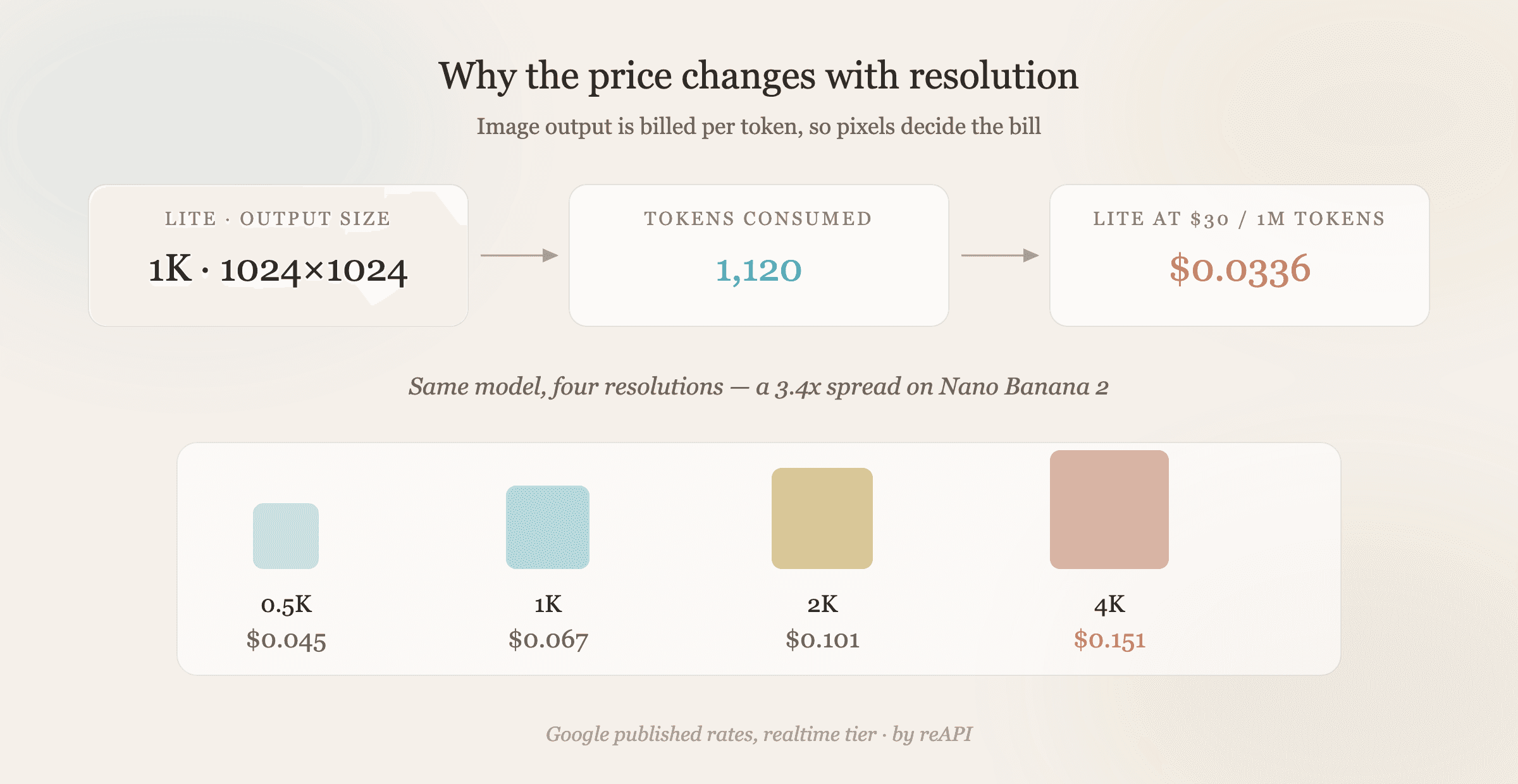
Google bills image output by token rather than by picture. Lite output runs $30 per 1M tokens, Nano Banana 2 runs $60, and Pro runs $120[1]. The per-image numbers above are Google's own conversions published beside those token rates.
The concrete conversion is worth internalizing: a 1K image at 1024×1024 consumes 1,120 output tokens, which is how $30 per 1M becomes $0.0336 per image[1].
Two consequences follow.
Resolution changes token count, so one model costs different amounts per image depending on output size. Nano Banana 2 ranges from $0.045 at 0.5K to $0.151 at 4K, a 3.4x spread on a single model[1].
Input bills separately. Lite input is $0.25 per 1M tokens for text, image, or video; Nano Banana 2 input is $0.50[1]. Editing pipelines that send a source image on every call carry input cost that a pure text-to-image estimate quietly ignores.
Budget from the token rates and your real resolution mix. Per-image shorthand is fine for rough comparison and misleading for planning.
Batch mode halves the rate
Every tier of the Nano Banana API also has a batch rate, and it is consistently half of the realtime rate[1].
| Model | Realtime per 1K image | Batch per 1K image |
|---|---|---|
| Nano Banana 2 Lite | $0.0336 | $0.0168 |
| Nano Banana 2 | $0.067 | $0.034 |
| Nano Banana Pro | $0.134 | $0.067 |
Batch has no free tier either, so this is not a way around the answer above. It is a way to cut the bill in half when latency does not matter: overnight asset generation, bulk catalog work, backfills.
The tradeoff is that batch jobs are queued rather than answered immediately, which rules them out for anything a user is waiting on. If your workload is genuinely offline, batch through Google directly is the cheapest route in this entire comparison.
What the Nano Banana API costs on reAPI
reAPI prices Nano Banana 2 Lite at $0.022 per image, flat, at 1K.
Against Google's realtime $0.0336 for the same model that is roughly 55% lower (checked October 22, 2026). Credits are the unit: 1 credit is $0.001, so a Lite image is 15 credits, and failed generations are refunded automatically, so the meter only moves on output you actually receive.
Set that honestly against batch. Google's batch rate of $0.0168 undercuts the $0.02 here. If your work is offline and you are willing to run the queue, that is the cheaper path. The $0.02 buys realtime response through the same unified endpoint as every other model on the platform, which is a different thing than being cheapest in absolute terms.
Two limits stated plainly. Lite is 1K only, so 2K and 4K need a different tier regardless of price. And there is no free tier here either. What exists is a $0.10 signup credit, roughly five Lite images. That covers confirming your integration end to end. It is not a trial you can build a product on, and describing it as one would be dishonest.
Choosing a tier
Across the Nano Banana API the useful question is not which model is best but which failures you can afford to pay for.
Lite handles ordinary generation and editing at 1K. At $0.02 the cost of regenerating a bad result is lower than the engineering time spent preventing one.
Nano Banana 2 buys resolution headroom to 4K and better handling of harder prompts.
Pro is the only tier positioned for reasoning-heavy work: dense compositions, many simultaneous constraints, in-image text that has to stay coherent. At $0.134 it is about 6.7x a Lite image, so it earns its slot only when the discard rate below it is high enough to close that gap.
A Nano Banana API routing rule that survives contact with production: draft at Lite, escalate only what fails. Most teams find the escalation rate is far below what they assumed.
Calling it
curl https://reapi.ai/api/v1/images/generations \
  -H "Authorization: Bearer YOUR_API_KEY" \
  -H "Content-Type: application/json" \
  -d '{
    "model": "nano-banana-2-lite",
    "prompt": "a ceramic mug on a walnut desk, morning light from the left"
  }'
Media inputs are public http(s) URLs only, with no base64 on any model, so reference images need hosting before the call. Live rates sit on reapi.ai/models/nano-banana-2-lite, and that table is canonical rather than any figure quoted here, because these numbers move.
FAQ
Is there a Nano Banana API free tier?
No. Google lists the free tier as "Not available" for every Nano Banana image model, Lite included[1].
Why do people say Nano Banana is free?
Because Google AI Studio is free in a browser. That is a playground, not API access: no key, no programmatic calls, no right to put it behind your own product.
What is the cheapest way to call the Nano Banana API?
Batch mode on Lite, at $0.0168 per 1K image, if you can tolerate queueing[1]. For realtime calls, Google publishes $0.0336 and reAPI runs the same model at $0.02.
How much does a Nano Banana Pro image cost?
$0.134 at 1K and 2K, and $0.24 at 4K on Google's published realtime rates[1].
Is the Nano Banana API billed per image or per token?
Per token. A 1K image consumes 1,120 output tokens, and image output runs $30 to $120 per 1M tokens by tier[1].
Do I get anything free on reAPI?
A $0.10 signup credit, roughly five Lite images. It covers verifying an integration, not running one.
Can Lite generate 2K or 4K images?
No. Lite is 1K only. Higher resolutions need Nano Banana 2 or Pro.
Does editing an existing image cost more than generating one?
Usually. On the Nano Banana API the source image counts as input tokens billed separately from output, at $0.25 per 1M for Lite[1].
Budgeting without a free tier
The honest framing is that a Nano Banana API free tier does not exist and should not be planned around. What exists instead is a cheap floor. Batch on Lite at $0.0168 is the absolute minimum if latency is irrelevant, and $0.022 realtime on reAPI is low enough that per-generation cost stops being the variable worth optimizing at all.
Start at Lite, measure how often output actually misses your bar, and escalate only that slice. Then check the live tables before committing a budget, because both sides of this comparison changed in the weeks before it was written, and the Nano Banana API pricing will keep moving.
References
- Google. Gemini API pricing — Nano Banana model family free tier, realtime and batch rates. Retrieved July 2026 from ai.google.dev/gemini-api/docs/pricing
Further reading
- reAPI. How to use Nano Banana 2 Lite. reapi.ai/blog/how-to-use-nano-banana-2-lite
- reAPI. Nano Banana Pro vs Nano Banana 2. reapi.ai/blog/nano-banana-pro-vs-nano-banana-2
- reAPI. Model catalog. reapi.ai/models
Author

Categories
More Posts
Seedream 5 Pro Content Filters: What They Block
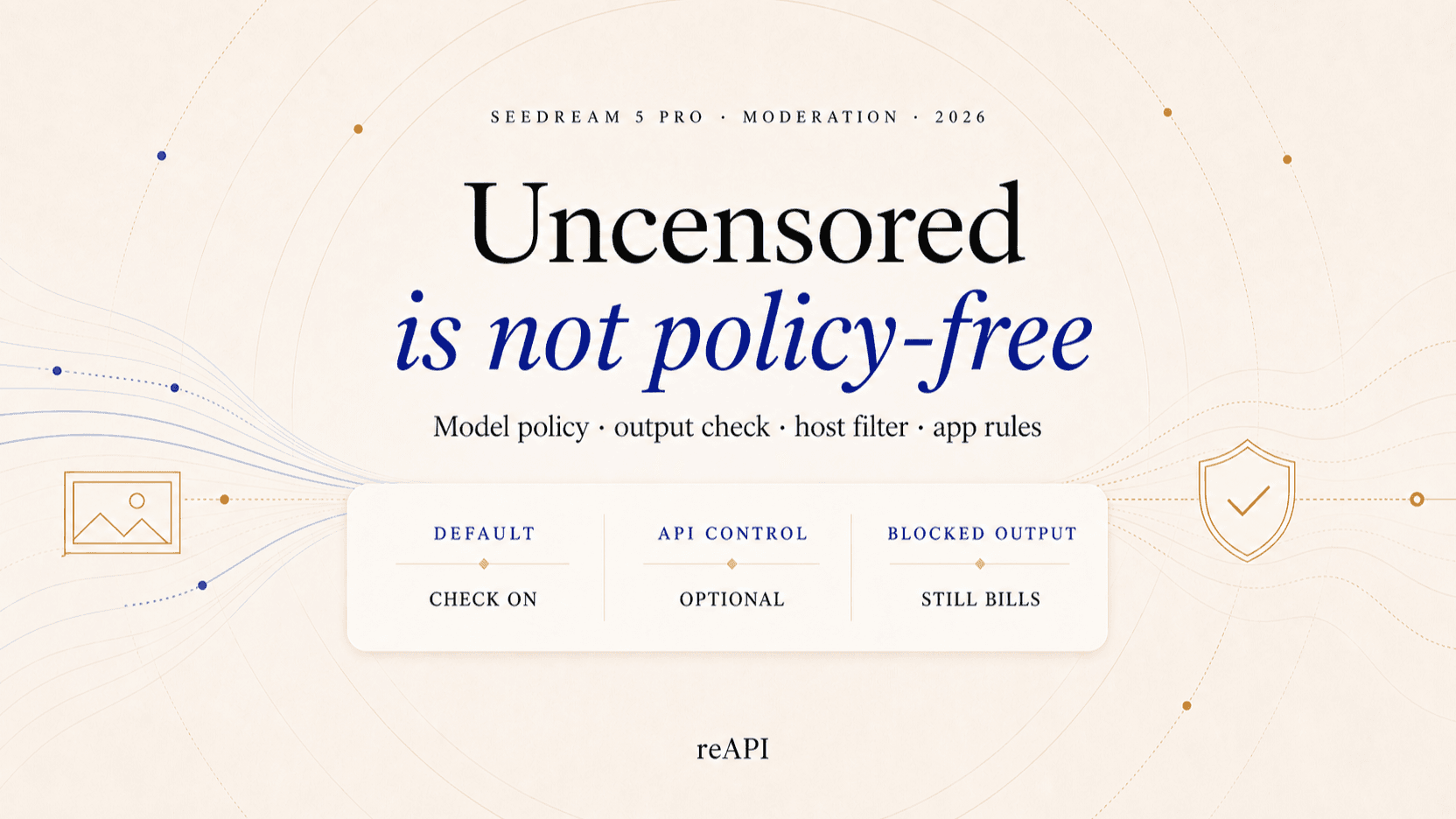
Seedream 5 Pro content filtering runs in several layers, and a refusal rarely says which one fired. What each layer blocks and which limits never move.
What Is the Context Window in Claude, and What Counts
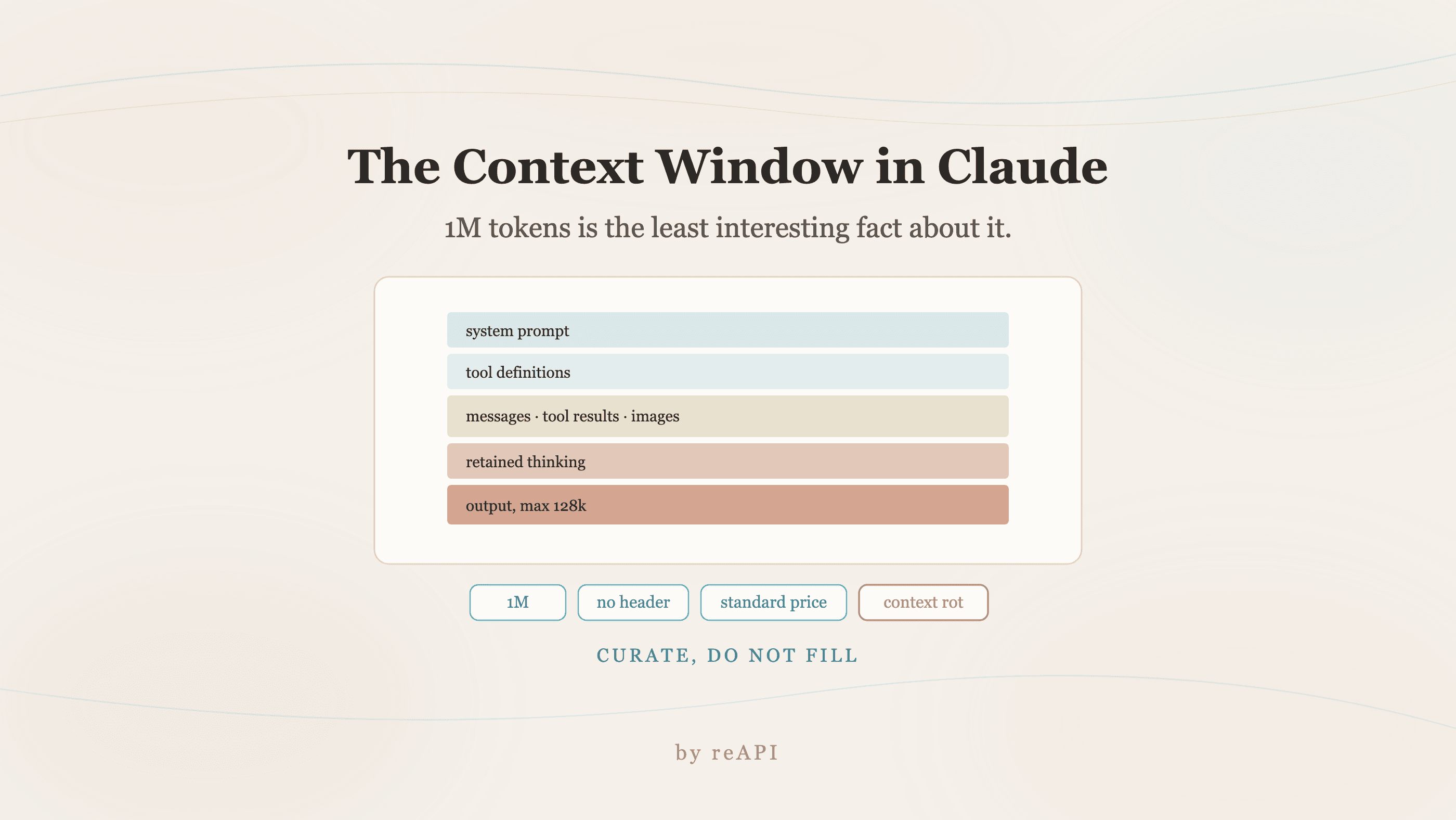
The context window in Claude is 1M tokens on current models, but tool definitions, retained thinking and cached input all consume it. More is not better.
Atlas Cloud vs Higgsfield: API Platform or Creator Studio?
Atlas Cloud vs Higgsfield vs reAPI for Seedance: compare API access, creator workflows, pricing, model breadth, and which platform fits your team.