Nano Banana Pro vs Nano Banana 2: Which Tier to Use
Nano Banana Pro vs Nano Banana 2: they run on different model lines, only Pro is rated high on reasoning, and the right routing rule is your discard rate.
The Nano Banana Pro vs Nano Banana 2 question usually gets asked as if the two were one engine with different stickers. That assumption is wrong, and the difference is not subtle: they run on different underlying model lines.
Nano Banana 2 is built on Gemini 3.1 Flash Image. Nano Banana Pro is built on Gemini 3 Pro Image, a separate and more capable line aimed at reasoning-heavy generation[1]. That is why the comparison is hierarchical rather than lateral, and why the routing rule between them is about what a frame has to survive, not about brand preference.
TL;DR
- Different model lines, not two configurations of one model. Pro sits on Gemini 3 Pro Image; 2 and Lite sit on Gemini 3.1 Flash[1].
- Pro is the only tier rated high on reasoning, which is what dense infographics and multi-constraint compositions actually need[1].
- Resolution is the hard divider. Lite caps at 1K. Pro reaches 4K[1].
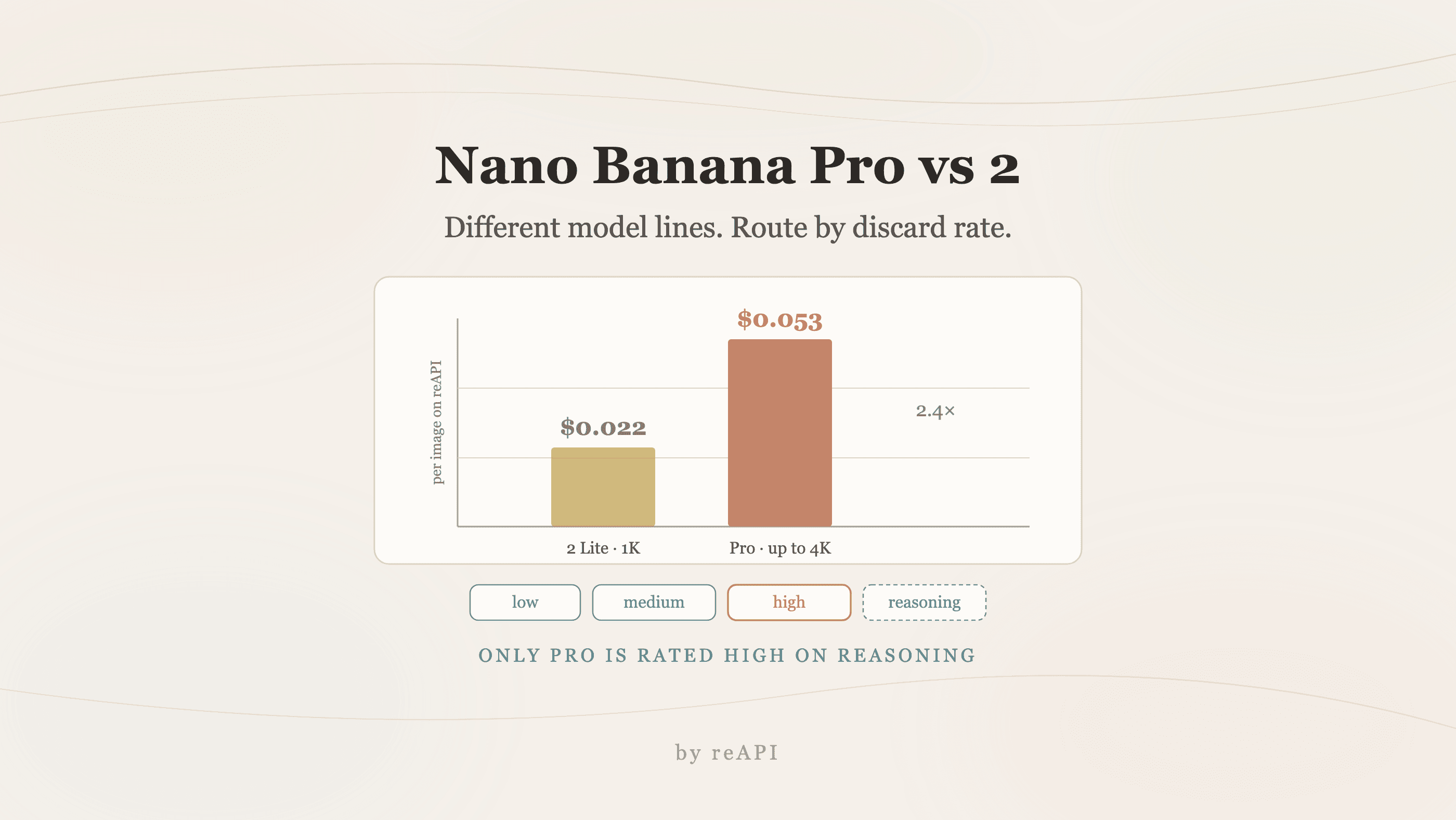
- On reAPI, Pro runs $0.028 per image at 1K and 2K, and $0.03 at 4K, against Google's published $0.1072 and $0.192.
- Lite runs $0.015 per image, 1K only.
- Base Nano Banana 2 is not on the reAPI gateway. The available tiers are Pro and Lite.
What each tier actually is
Google's own positioning table sorts the family on four axes[1].
| Tier | Underlying model | Latency | Visual quality | Reasoning |
|---|---|---|---|---|
| Nano Banana 2 Lite | Gemini 3.1 Flash-Lite Image | Low | Medium | Low |
| Nano Banana 2 | Gemini 3.1 Flash Image | Medium | High | Medium |
| Nano Banana Pro | Gemini 3 Pro Image | High | High | High |
The row that decides most real routing decisions is the last one. Lite and 2 differ mainly in speed and fidelity, and both are rated below Pro on reasoning. Pro is the only tier Google rates high there, and reasoning is what a model needs when a composition has to be correct rather than merely attractive: a labeled diagram, a periodic table, a packaging mockup with a compliant nutrition panel, a multi-constraint scene where four things must all be true at once.
The comparison that matters

| Dimension | Nano Banana Pro | Nano Banana 2 | Nano Banana 2 Lite |
|---|---|---|---|
| Model line | Gemini 3 Pro Image | Gemini 3.1 Flash Image | Gemini 3.1 Flash-Lite Image |
| Reasoning rating | High | Medium | Low |
| Max resolution | 4K | up to 4K | 1K ceiling |
| Typical latency | High | Medium (~20s at 1K) | Low (~4s at 1K) |
| On reAPI | Yes | No | Yes |
| reAPI rate per image | $0.028 at 1K/2K, $0.03 at 4K | n/a | $0.015 |
Two things fall out of that table.
The resolution ceiling is the cleanest disqualifier. If the deliverable needs to survive a large crop or print-adjacent review, Lite is out by definition at 1K. That decision needs no quality judgment at all.
The price gap is smaller than the tier language suggests. Pro at $0.028 is about 1.9 times Lite's $0.015 (rates checked October 22, 2026). That is a real multiple at volume, but it is not the order-of-magnitude gap the words "Pro" and "Lite" imply. For a hero frame, paying 2x for 4K plus high reasoning is rarely the wrong call.
When each one is right
Reach for Pro when the frame ships. Packaging art, campaign stills, marketplace assets, anything at 4K, and anything where the composition has to be factually correct rather than plausible. The high reasoning rating is doing the work here, not the resolution number.
Reach for Lite when you are iterating. At roughly four seconds and $0.015 an image, generating a dozen directions costs about 18 cents and takes under a minute. Draft there, then render the winner once on Pro.
The mixed route is the actual answer for most pipelines. Blind-and-discard variants go to Lite; finalists go to Pro. A team generating twenty candidates and shipping one pays $0.30 in drafts plus $0.030 for the final 4K frame, about $0.33 for the set. Running all twenty-one on Pro would cost about $0.59. Same output, a little over half the spend, and the saving grows with the discard ratio.
That routing rule is worth stating as a policy rather than a preference: the discard rate decides the tier, not the subject matter.
What Lite gives up
Worth being specific, because "good enough for volume" hides real constraints[1].
- 1K ceiling. No 2K, no 4K.
- Weaker editing. Lite's editing Elo trails base Nano Banana 2 by a real margin, so demanding edits belong higher up the family.
- Low reasoning rating. Complex multi-constraint scenes and dense factual infographics are exactly what it is not built for.
What it keeps is the part that matters for drafting: ten aspect ratios including 16:9 and 21:9, legible in-image text, character consistency, and multi-image composition.
Calling both on reAPI
Both tiers run on the same async task endpoint, so switching is a model-string change:
# Draft: fast and cheap
curl https://reapi.ai/api/v1/images/generations \
  -H "Authorization: Bearer YOUR_API_KEY" \
  -H "Content-Type: application/json" \
  -d '{
    "model": "nano-banana-2-lite",
    "prompt": "packaging concept for a matcha tea tin, soft studio light, 3:4",
    "aspect_ratio": "3:4"
  }'
# Final: 4K, high reasoning
curl https://reapi.ai/api/v1/images/generations \
-H "Authorization: Bearer YOUR_API_KEY" \
-H "Content-Type: application/json" \
-d '{
"model": "gemini-3-pro-image-preview",
"prompt": "packaging shot for a matcha tea tin with a compliant nutrition panel, studio light",
"resolution": "4k"
}'Three platform notes. Media inputs are public http(s) URLs only, with no base64 on any model. Resolution is a priced dimension on Pro, so it is a cost choice rather than a quality toggle. And live rates are on reapi.ai/models/gemini-3-pro-image-preview and reapi.ai/models/nano-banana-2-lite, which are canonical rather than any number quoted here.
FAQ
What is the difference between Nano Banana Pro and Nano Banana 2?
They run on different model lines. Pro is Gemini 3 Pro Image, rated high on reasoning; Nano Banana 2 is Gemini 3.1 Flash Image, rated medium. Pro is the higher-fidelity, higher-resolution path[1].
Is Nano Banana Pro worth the extra cost?
For frames that ship at high resolution or need factual correctness in the composition, yes. On reAPI the gap is $0.028 against $0.015, roughly 1.9x, which is easy to justify for a final asset and hard to justify for drafts.
Can Nano Banana 2 Lite produce 4K?
No. Lite caps at 1K. That is the cleanest reason to escalate[1].
Which tier is best for image editing?
Not Lite. Its editing quality trails base Nano Banana 2 by a real margin, so demanding edits belong on a higher tier[1].
Is base Nano Banana 2 available on reAPI?
No. The gateway carries Nano Banana Pro and Nano Banana 2 Lite. If your workflow specifically needs the middle tier, call it through Google directly.
How should I route between them?
By discard rate. Iterate on Lite where most candidates get thrown away, render finalists on Pro. A twenty-draft, one-final cycle costs about half of running everything on Pro.
Do they use the same API surface on reAPI?
Yes. Same async task endpoint, same auth, different model string and a resolution field on Pro.
Routing by discard rate, not by prestige
The Nano Banana Pro vs Nano Banana 2 question is usually asked as a quality comparison, and answered better as an economics one. Pro is a genuinely different model line with the only high reasoning rating in the family and the resolution headroom to match. Lite is fast and cheap enough that throwing away most of what it makes is the intended workflow.
So the decision rule is not which model is better. It is how many candidates you expect to discard before something ships. High discard rates belong on the cheap tier; the frame that survives belongs on Pro. Set that up once as a router and the blended cost lands far below an all-Pro pipeline while the shipped work is indistinguishable. Read Nano Banana Pro vs Nano Banana 2 as a routing question and it answers itself.
References
- Google. Gemini API — image generation models, tiers, and capabilities. Retrieved July 2026 from ai.google.dev/gemini-api/docs/image-generation
- Google. Gemini Developer API pricing. Retrieved July 2026 from ai.google.dev/gemini-api/docs/pricing
Further reading
- reAPI. How to use Nano Banana 2 Lite. reapi.ai/blog/how-to-use-nano-banana-2-lite
- reAPI. How to use GPT Image 2. reapi.ai/blog/how-to-use-gpt-image-2
- reAPI. Model catalog. reapi.ai/models
Author

Categories
More Posts
Where to Use Seedance 2.5: Official Apps and API Access
Find where to use Seedance 2.5 through official apps, BytePlus, Volcengine, reAPI, and Higgsfield, with account requirements and regional access limits today.

Cheapest Veo 3.1 API in 2026: Every Provider's Real Price
Veo 3.1 API prices run from $0.40/sec on Google direct to $0.046 per 8-second clip on reAPI. Full price comparison across five providers, May 2026.

Best Content Moderation API: Text, Image and Video Compared
Best content moderation API by use case: OpenAI, Azure, AWS, Google, Hive, Sightengine and Mistral compared on modality, categories, billing and self-hosting.