
Seedance 2.5 Unlimited Plans: Audit the Math
Audit a Seedance 2.5 unlimited plan from its published model, window, queue, concurrency, duration, and access terms, then compare metered cost.
Is Seedance 2.5 actually included in an unlimited plan, and what capacity does that plan buy? On August 9, Higgsfield's own pricing page listed no Seedance model in the unlimited column. The three models carrying an unlimited badge were Nano Banana 2, Nano Banana Pro, and Kling 3.0, each with a seven-day window.[1]
The published price sheet and help-center terms are the subject here. Below is the arithmetic, the disclosed limits that make an unlimited offer manageable, and the point where counting seconds becomes easier to audit than buying a label.
TL;DR
- No Seedance 2.5 unlimited plan appeared on Higgsfield's own pricing page on August 9, 2026.[1]
- "Unlimited" means seven days, not a month, on the two plans that have it at all.[1]
- An unlimited video bundle caps output at 15 seconds. Higgsfield's help centre lists video bundles as "1 generation at a time, up to 15 seconds"[2], on a model sold for its 30-second single pass.
- Their own credit allowance prices Ultra at roughly 133 Seedance videos for $99. A user generating one clip per ten minutes for an eight-hour day would do 1,440 in a month, about eleven times that allowance.[1]
- Latency is a disclosed control. The fine print says unlimited usage "may be subject to dynamic speed adjustments during high-traffic periods."[1]
- Unlimited does not reach the API. Higgsfield states it is available only on their website and "not accessible on MCP/CLI, Canvas or Supercomputer."[1]
The arithmetic behind an unlimited label
Take Higgsfield's Ultra plan at $99 a month billed annually. Their page tells you what they think that buys: 3,000 credits, which they translate as roughly 133 Seedance 2.0 videos.[1] That is the host's own estimate of a fair month, and it works out to about $0.74 per video.
Now price a user who takes "unlimited" literally. One clip every ten minutes, eight hours a day, thirty days, is 1,440 clips. Against the plan's own 133-video allowance that is 10.8 times the assumed load.
Convert it to money at a published pay-as-you-go rate rather than any host's internal cost. reAPI's Seedance 2.5 rate works as the yardstick because it is public, per-second, and checkable with a calculator:[3]
| 720p output | Per clip | 1,440 clips | Versus a $99 plan |
|---|---|---|---|
| 5 s | $1.335 | $1,922 | 19.4x |
| 15 s | $4.003 | $5,764 | 58.2x |
| 30 s | $8.005 | $11,527 | 116x |
Nineteen times the plan price at the shortest clip length the model supports, and that is before anyone asks for the 30-second takes Seedance 2.5 was built for. Metered rates across this market sit within a factor of two of each other, WaveSpeed for instance publishing $0.36 per second at the same resolution,[4] so picking a different host moves the multiplier and never the conclusion. A modest user doing five clips a day at 720p still lands at $200 of generation on a $99 plan.
This is a retail-equivalent scenario, not evidence of Higgsfield's internal cost or margin. It shows why “unlimited” is not enough information by itself: the model, access window, queue, concurrency, duration, and product surface all have to be read from the published terms.
What the people paying the model bills say
One operator published his own cost basis on 8 August, and the conflict of interest belongs at the top rather than in a footnote: Tibo, who runs the video tool Revid and says he spends more than $300,000 a month on AI models, sells a product that competes with the plans he is criticising.[5] Read him as an interested party whose numbers happen to be checkable.
His figure: "Seedance 2.5 costs about $0.10 per second of video, bare minimum. that's the price WE pay."[5] That puts a 30-second clip near $3 in raw model cost before storage, upscaling or retries.
Two things make it worth more than competitor noise. Published 480p retail rates for the model run from roughly $0.12 to $0.22 a second across the platforms I checked,[3][4] so his $0.10 floor sits just under the cheapest retail price rather than nowhere near it. And the argument cuts against his own commercial interest, since it concludes that nobody can sell the thing customers most want to buy.
The arithmetic above also leaves out completed clips that fail your own review. The rate does not predict an acceptance rate, so use a scenario and replace it with your measured attempts per keeper. At five attempts per keeper:[3]
| Usable output | One attempt | Five attempts |
|---|---|---|
| 5 s at 720p | $1.335 | $6.68 |
| 30 s at 720p | $8.005 | $40.03 |
At that illustrative retry rate, one and a half usable 30-second videos exhausts a $59 monthly plan. This does not predict creative success; it shows why cost per usable clip must include every completed attempt.
The narrower conclusion is enough: the retail-rate arithmetic does not close without limits, and the host's own terms disclose several of them.
The four places the cap actually lives
A Seedance 2.5 unlimited offer has to bleed the excess somewhere, and there are only four places to put it.
Model tier. The cheapest plan restricts its Seedance allowance to Seedance 2.0 Fast and 2.0 Mini, not the flagship.[1]
Latency. Higgsfield documents this lever outright: "Unlimited generations run in the standard queue, while credit-based generations always run in the priority queue."[2] Switching Unlimited off, the same page says, "deducts credits and runs in the priority queue at maximum speed."[2] The fee you avoided is the fee that buys the priority queue back. The terms do not publish a target wait time, so measure it on the workload you intend to run.
Concurrency, and the duration cap inside it. Starter allows up to 2 parallel videos, Ultra up to 8.[1] Unlimited bundles bought through the marketplace are tighter: video runs "1 generation at a time, up to 15 seconds."[2]
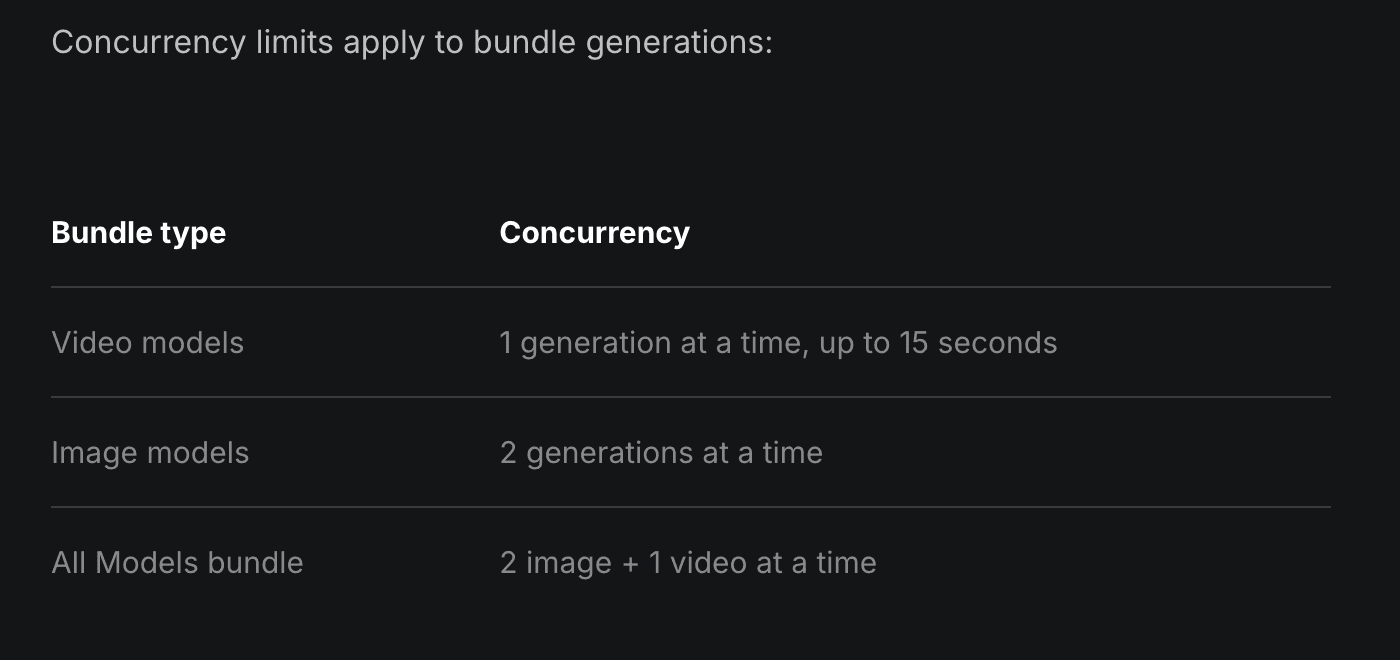
Higgsfield's own help centre, captured 9 August 2026.[2]
That second number is the one to sit with. Seedance 2.5 exists because it generates 30 seconds in a single pass. An unlimited Seedance 2.5 bundle that stops at 15 hands you the model without the reason you wanted it, and no offer headline says so.
Surface. The unlimited allocation runs on the website only. Higgsfield states plainly that unlimited models "are not accessible on MCP/CLI, Canvas or Supercomputer,"[1] and the help centre is blunter still: "Unlimited access applies only on higgsfield.ai: outside it, generations always deduct credits."[2] If you are building anything programmatic, the offer does not apply to you at all, and no amount of subscription tier changes that.
Stack those controls and a buyer can see what the allowance actually covers. The word “unlimited” does not override a named model tier, standard queue, duration ceiling, concurrency limit, or website-only scope.
The numbers that are never published
The reviewed Higgsfield pricing and help-center pages publish queue class, dynamic speed adjustment, concurrency, duration, and access-surface limits. They do not state a target queue time, define “high traffic,” quantify the throughput reduction, or promise which models will remain unlimited thirty days later.[1][2]
Without those figures, the page cannot tell you the throughput your workload will receive. Measure it instead: use the shortest recoverable purchase window, run a representative batch at the prompt length and resolution you need, record wall-clock time and accepted outputs, then divide plan cost by usable clips. Treat the result as a dated measurement, not a permanent plan feature.
Metered billing inverts that. The rate is published before you buy, and anyone can check the budget with a calculator.
Seedance 2.5 unlimited versus counting seconds
Per-second billing has an obvious disadvantage: the meter is always running and there is no psychological ceiling. It also has one property that no unlimited plan can match. What you buy is capacity, and the only thing rationing it is your own budget.
Concretely, on reAPI's published Seedance 2.5 rates:[3]
| Spend | 720p, 5 s clips | 480p, 5 s clips |
|---|---|---|
| $19 | 14 | 32 |
| $47 | 35 | 79 |
| $99 | 74 | 166 |
Set those against Higgsfield's own quoted counts of about 15, 53 and 133 Seedance videos at the same three price points.[1] The subscription counts look competitive, and at 480p the pay-as-you-go numbers are ahead. But the comparison is not decidable, because the page does not state the duration or resolution behind its video counts, and the plans that quote 53 and 133 are quoting Seedance 2.0 rather than 2.5.
That ambiguity is the point. A per-second rate is falsifiable. Somebody can divide $10 by it and check the answer. "About 133 videos" cannot be checked by anyone, which is precisely why it is the unit subscription pages prefer.
Metered access makes three dimensions explicit: the exact model ID, the API surface, and the per-second charge. Compare those with the model, queue, and surface named in an unlimited offer before treating the two as equivalent.
FAQ
Is there an unlimited Seedance 2.5 plan right now?
Not on Higgsfield's published pricing as of 9 August 2026. All three individual tiers show no unlimited access for Seedance; the unlimited badges sit on Nano Banana 2, Nano Banana Pro and Kling 3.0, each for seven days.[1]
Why do unlimited plans feel so slow?
Higgsfield discloses that unlimited usage may receive dynamic speed adjustments during high-traffic periods and that unlimited generations use the standard queue rather than the priority queue. It does not publish a target wait time.[1][2]
Do unlimited plans give the full model?
Check the named model rather than the word “unlimited.” The entry tier's published Seedance allowance names Seedance 2.0 Fast and 2.0 Mini.[1]
Can I use an unlimited plan through an API?
No. Higgsfield states unlimited models are not accessible on MCP/CLI, Canvas or Supercomputer.[1] Programmatic work needs metered access.
How many Seedance 2.5 clips does $99 buy on reAPI?
74 clips at 720p and 5 seconds, or 166 at 480p, at published rates and 1 credit = $0.001.[3]
Is unlimited ever the right choice?
If you work entirely in a browser, accept the named model and standard queue, and can use the stated seven-day window, the offer may fit. Programmatic or latency-sensitive work needs separately documented access and service terms.
Buying capacity instead of buying a promise
Run the numbers on any unlimited offer before you buy it. Take the host's own credit allowance, work out the per-video price it implies, then ask what you would actually generate in a month at the pace you work. Read the named model, resolution, clip length, queue, concurrency, and access surface beside that number. If the terms do not quantify throughput, measure a recoverable short window before committing to an annual purchase.
Metered per-second billing is less exciting but easier to audit. You can divide the current rate into your budget before submitting a task. Against a website-only allowance with a named model tier, standard queue, dynamic speed adjustments, and no queue-time SLA, paying for exactly the seconds you generate is the option with the clearer unit cost.
References
- Higgsfield. Pricing — individual plans, unlimited model list and terms. Retrieved 9 August 2026 from higgsfield.ai/pricing
- Higgsfield. What are Unlimited models, and which plans include them? — help centre: queue behaviour, bundle concurrency and access conditions. Updated 3 August 2026, retrieved 9 August 2026 from higgsfield.ai/creator-hub/help-center/credits-and-usage/what-are-unlimited-models-and-which-plans-include-them
- reAPI. Seedance 2.5 — model page, published per-second rate band. Retrieved 9 August 2026 from reapi.ai/models/seedance-2-5
- WaveSpeed. bytedance/seedance-2.5/text-to-video — pricing tables with and without reference videos. Retrieved 9 August 2026 from wavespeed.ai/models/bytedance/seedance-2.5/text-to-video
- Tibo (@tibo_maker), founder of Revid. Post on the unit cost of Seedance 2.5 and why unlimited plans cannot clear it. Posted 8 August 2026, retrieved August 2026 from x.com/tibo_maker/status/2085999680186450326
Further reading
- reAPI. Seedance 2.5 API Pricing: fal vs kie vs WaveSpeed vs reAPI. reapi.ai/blog/seedance-2-5-api-pricing-compared
- reAPI. Seedance 2.5 Content Filtering: Diagnosing a Refusal. reapi.ai/blog/seedance-2-5-content-filtering
More Posts
Author

Categories
More Posts

Best Replicate Alternatives in 2026: 5 Options Compared
Looking for Replicate alternatives in 2026? Compare fal.ai, Together AI, RunPod, Hugging Face, and reAPI on model range, pricing, speed, and API design.

Who Makes Seedance 2.5? ByteDance and Its App Brands
Who makes Seedance 2.5? Learn how ByteDance Seed, Doubao, BytePlus, Volcengine, Dreamina, and Jimeng relate, and find the official model and release sources.
Seedance 2.5 Content Filtering: Diagnosing a Refusal
Diagnose a Seedance 2.5 refusal from the submit response, task error, routing parameter, and settled usage instead of guessing which safety check fired.