Seedance 2.5 API Pricing: fal vs kie vs WaveSpeed vs reAPI
Real Seedance 2.5 API pricing on four platforms, pulled August 2026. Rates spread 1.8x, reference jobs bill on a different clock, and three worked examples.
Which Seedance 2.5 API host is cheapest, and what will a 720p 30-second clip actually cost? The answer depends on the resolution and whether the job includes a reference video.
Seedance 2.5 API pricing is not one number per platform. It is four numbers, and two of them are measured on a different clock than the others. Every host publishes a per-second rate that looks comparable, then bills reference-video jobs on a formula that is not. Below are the published rates on fal.ai, kie.ai, WaveSpeed and reAPI, pulled on 9 August 2026 with the 1080p tier re-read on 21 August, all converted to a unit you can divide.
TL;DR
- reAPI is the lowest of these four on every tier. Without a reference clip: $0.118589/s at 480p, $0.266824/s at 720p, $0.461856/s at 1080p. With one: $0.071153/s and $0.160094/s at the two lower tiers.[1]
- fal.ai is the highest on every tier. $0.4730/s at 720p without video input, 1.77x reAPI's rate for output from the same weights, and the gap widens to 2.46x at 1080p.[3]
- All four now run 1080p, and only WaveSpeed goes to 4K. At 1080p the four rates are $0.461856, $0.570, $0.90 and roughly $1.137 per second, in the same platform order.[1][3][4][5]
- All four discount reference-video jobs, then bill you for the source footage too. reAPI also applies a minimum clock:
max(output + ceil(source), ceil(5 / 3 × output)).[1] - A 720p job with a 10-second reference and a 5-second output costs $2.40 on reAPI, $2.85 on kie.ai, $3.30 on WaveSpeed and $4.26 on fal.ai.[1][3][4][5]
- One caveat against reAPI: a minimum-billing floor makes very short references against long outputs cost more than kie.ai's simpler formula. The threshold is worked out below.
What the four platforms actually charge
All four sell the same weights, but they no longer expose the same tiers. Durations of 4 to 30 seconds plus auto, up to 30 reference images and 10 reference videos are common to everyone[3], matching the envelope ByteDance described at launch[2]. Resolution is where they split: all four now run 1080p, and WaveSpeed alone also sells 4K, at $1.80 per second[5].
Seedance 2.5 API pricing starts with the simple case, where you send a prompt and maybe some reference images but no source clip:
| Platform | 480p | 720p | 1080p |
|---|---|---|---|
| reAPI | $0.118589 /s | $0.266824 /s | $0.461856 /s |
| kie.ai | $0.140 /s | $0.315 /s | $0.570 /s |
| WaveSpeed | $0.18 /s | $0.36 /s | $0.90 /s |
| fal.ai | $0.2205 /s | $0.4730 /s | ~$1.137 /s |
Sources: reAPI's model page[1], kie.ai's rate of 28, 63 and 114 credits per second at $0.005 per credit[4], WaveSpeed's published table[5], and fal's own pricing note[3]. The 480p and 720p rows were read on August 9, 2026; the 1080p column came from those same four pages on August 21.
One number in that table is derived rather than quoted. fal publishes a per-second figure for 480p and 720p but prices 1080p only as $0.0234 per 1,000 tokens, where tokens are width × height × duration × 24 / 1024[3]. At 1920 × 1080 that works out to 48,600 tokens per second of output, so roughly $1.137. Treat it as fal's own formula applied, not as a rate fal prints.
Spread from cheapest to dearest is 1.77x at 720p and 2.46x at 1080p. For a 30-second 720p clip that is $8.01 against $14.19, for output from the same weights.
Reference-video jobs bill on a different clock
Here is the part that makes single-number comparisons useless. Seedance 2.5's headline capability is reference-driven generation, and every platform discounts the per-second rate when you supply a source clip. None of them stops charging for the source.
kie.ai states the rule directly: "No video = Price × Output; With video = Price × (Input + Output)."[4] WaveSpeed says the same thing in its own words, pricing reference jobs on "the combined duration of reference video duration + output duration."[5] fal's token formula multiplies by "(input video duration + output video duration)."[3] reAPI first rounds total source-video duration up to a whole second, then uses the greater of source plus output or its minimum clock.[1]
| Platform | 480p reference rate | 720p reference rate | Billed over |
|---|---|---|---|
| reAPI | $0.071153 /s | $0.160094 /s | max(output + ceil(input), ceil(5/3 × output)) |
| kie.ai | $0.085 /s | $0.190 /s | input + output |
| WaveSpeed | $0.11 /s | $0.22 /s | input + output |
| fal.ai | ~$0.1323 /s | ~$0.2838 /s | input + output |
The practical consequence is that a long reference is expensive everywhere. Twenty seconds of source footage producing ten seconds of output bills thirty seconds on all four, not ten. On reAPI, a very short source can instead hit the minimum clock. Budget from counted seconds, not from output length.
The floor that works against us
One rule on reAPI deserves stating because it is the only place our rate stops being the lowest. Billable seconds on a reference job are max(output + ceil(total source-video duration), ceil(5 × output ÷ 3)). That floor mirrors the minimum-token table ByteDance publishes for the Seedance 2.5 series, so the underlying cost exists on every host reselling the model. reAPI's billing exposes it. The other three published formulas do not mention it either way.[1][3][4][5]
In practice: a 2-second reference against a 30-second output bills as 50 seconds on reAPI, not 32. At that shape kie.ai comes out ahead, $6.08 against $8.01.
Checked across output lengths from 4 to 30 seconds, the threshold is clean. If the rounded source duration is at least two-thirds of the target output, reAPI's minimum clock no longer adds billed seconds. Below that ratio, compare the floor-adjusted reAPI total with kie.ai rather than ranking on headline rate alone.
Most reference work sits comfortably above that line, because the point of supplying twenty seconds of footage is rarely to get four seconds back. But if your workflow is a two-second clip driving a thirty-second generation, price it on kie.ai first.
Seedance 2.5 API pricing for three real jobs
Rates are abstract. Here are three shapes people actually run, all 720p, priced on each platform's published formula.
A five-second clip from a prompt, no reference material.
| Platform | Cost |
|---|---|
| reAPI | $1.335 |
| kie.ai | $1.575 |
| WaveSpeed | $1.80 |
| fal.ai | $2.365 |
A ten-second reference clip restyled into a five-second output. Fifteen counted seconds on all four.
| Platform | Cost |
|---|---|
| reAPI | $2.402 |
| kie.ai | $2.850 |
| WaveSpeed | $3.30 |
| fal.ai | $4.257 |
A twenty-second reference cut down to ten seconds. Thirty counted seconds on all four.
| Platform | Cost |
|---|---|
| reAPI | $4.803 |
| kie.ai | $5.700 |
| WaveSpeed | $6.60 |
| fal.ai | $8.514 |
The gap between cheapest and dearest holds near 1.8x across all three shapes. On a hundred clips a month at the second shape, that is $240 against $426.
One caveat on credit packs
kie.ai's pricing note says high-tier top-ups carry a 10% bonus, which drops its effective rate roughly 10% below the listed price.[4] Applied to 720p without video input that is about $0.284/s against reAPI's $0.267/s, so the ranking holds and the gap narrows to roughly 6%. Anyone buying credits in bulk on kie.ai is paying less than its listed rates suggest, which is worth knowing before treating a list price as final. Neither WaveSpeed nor fal publishes a comparable volume bonus.
FAQ
Which platform has the cheapest Seedance 2.5 API pricing?
Of the four compared here, reAPI has the lowest listed rate on every tier: $0.266824/s at 720p without a reference clip and $0.160094/s with one.[1] For very short references against long outputs, calculate reAPI's minimum clock before choosing a provider.
Why is fal.ai nearly double reAPI for the same model?
fal publishes $0.4730/s for 720p against reAPI's $0.266824/s.[3][1] Both resell the same ByteDance weights with the same parameter surface, so the difference is margin and packaging, not capability.
How many credits is a 720p 30-second Seedance 2.5 clip on reAPI?
8,005 credits, which is $8.005 at 1 credit = $0.001, with no reference video.[1] At 480p the same clip is 3,558 credits.
Does turning off the safety checker change the price?
Not on reAPI. nsfw_checker selects where a task runs, not a rate tier, so the same request bills the same either way.[6]
Why does my reference job cost more than duration times rate?
Because all four platforms count input seconds as billable. A 20-second reference producing 10 seconds bills 30 seconds everywhere; reAPI can bill more than source plus output when its minimum clock is higher.[1][4][5][3]
Is 480p worth it to save money?
At 720p you pay roughly 2.2x the 480p rate on every platform here. ByteDance's parameter table listed only 480p and 720p for Seedance 2.5 at launch,[6] and reAPI added 1080p in August 2026 — so 480p remains a real saving rather than a downgrade from something better.
Do these prices include audio?
Yes on all four. Seedance 2.5 generates a synced audio track as part of the same job, and none of the four publishes a separate audio charge.[2]
What about failed generations?
reAPI refunds the reserve in full when a task fails, including moderation failures.[1] Refund behaviour on a failed job is worth checking wherever you buy, because at these rates a silent charge on a rejected prompt is a real line item.
Picking a platform by workload shape
For reference-driven work, reAPI has the lowest listed rate of these four at both resolutions. Its minimum clock stops adding seconds once the rounded source duration reaches two-thirds of output duration. For plain text-to-video and image-to-video it is also the lowest of the four, by 12% against kie.ai and 44% against fal.ai.
The one shape to price elsewhere is a very short reference driving a long generation, where reAPI's minimum-billing floor hands the win to kie.ai. Everything else lands the same way, and fal.ai does not win any shape measured here. Its published Seedance 2.5 API pricing is the highest on every tier in this comparison, at both resolutions, with and without reference video.
Full parameter reference and runnable examples are at reapi.ai/docs/seedance-2-5, and the live rate band is on reapi.ai/models/seedance-2-5.
References
- reAPI. Seedance 2.5 — model page, published per-second rate band and refund behaviour. Retrieved 9 August 2026, 1080p rate re-read 21 August 2026 from reapi.ai/models/seedance-2-5
- ByteDance Seed. One-take Creation, Flexible Referencing: Introducing Seedance 2.5. Published 31 July 2026, retrieved August 2026 from seed.bytedance.com/en/blog/one-take-creation-flexible-referencing-introducing-seedance-2-5
- fal.ai. Seedance 2.5 Reference to Video — pricing note and queue schema. Retrieved 9 August 2026, 1080p rate re-read 21 August 2026 from fal.ai/models/bytedance/seedance-2.5/reference-to-video
- kie.ai. Seedance 2.5 — credits-per-second pricing and video-input formula. Retrieved 9 August 2026, 1080p rate re-read 21 August 2026 from kie.ai/seedance-2-5
- WaveSpeed. bytedance/seedance-2.5/text-to-video — pricing tables with and without reference videos. Retrieved 9 August 2026, 1080p rate re-read 21 August 2026 from wavespeed.ai/models/bytedance/seedance-2.5/text-to-video
- reAPI. doubao-seedance-2.5-face — parameters, resolutions and billing dimensions. Retrieved August 2026 from reapi.ai/docs/seedance-2-5
Further reading
- reAPI. Seedance 2.5 Unlimited Plans: The Math That Can't Work. reapi.ai/blog/seedance-2-5-unlimited-plans-math
- reAPI. Seedance 2.5 Content Filtering: Diagnosing a Refusal. reapi.ai/blog/seedance-2-5-content-filtering
More Posts
Author

Categories
More Posts
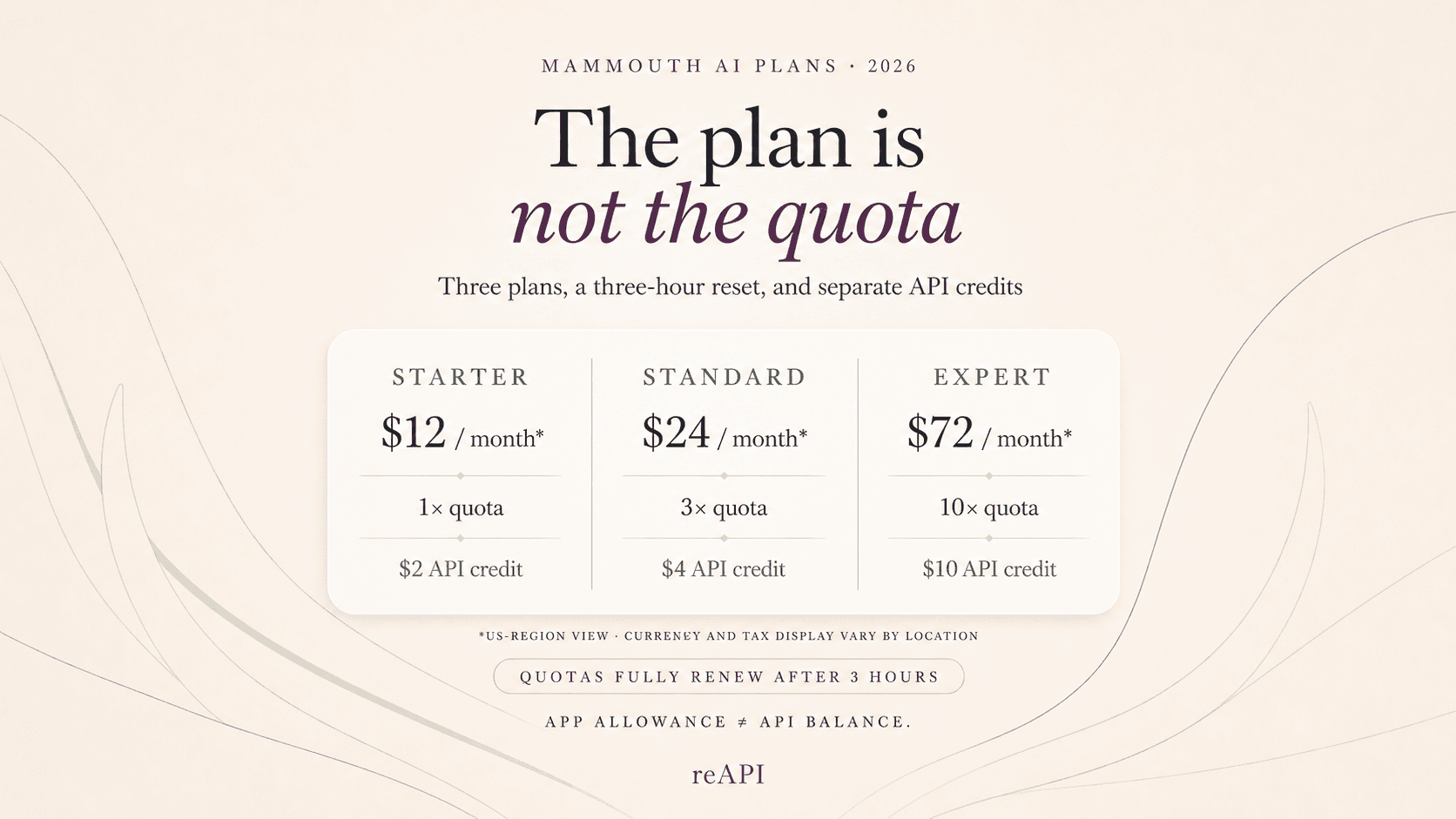
Mammouth AI Pricing: Plans, Limits, and API Access (2026)
Mammouth AI pricing explained: compare Starter, Standard, and Expert plans, three-hour quota resets, included API credits, PAYG access, and file limits.
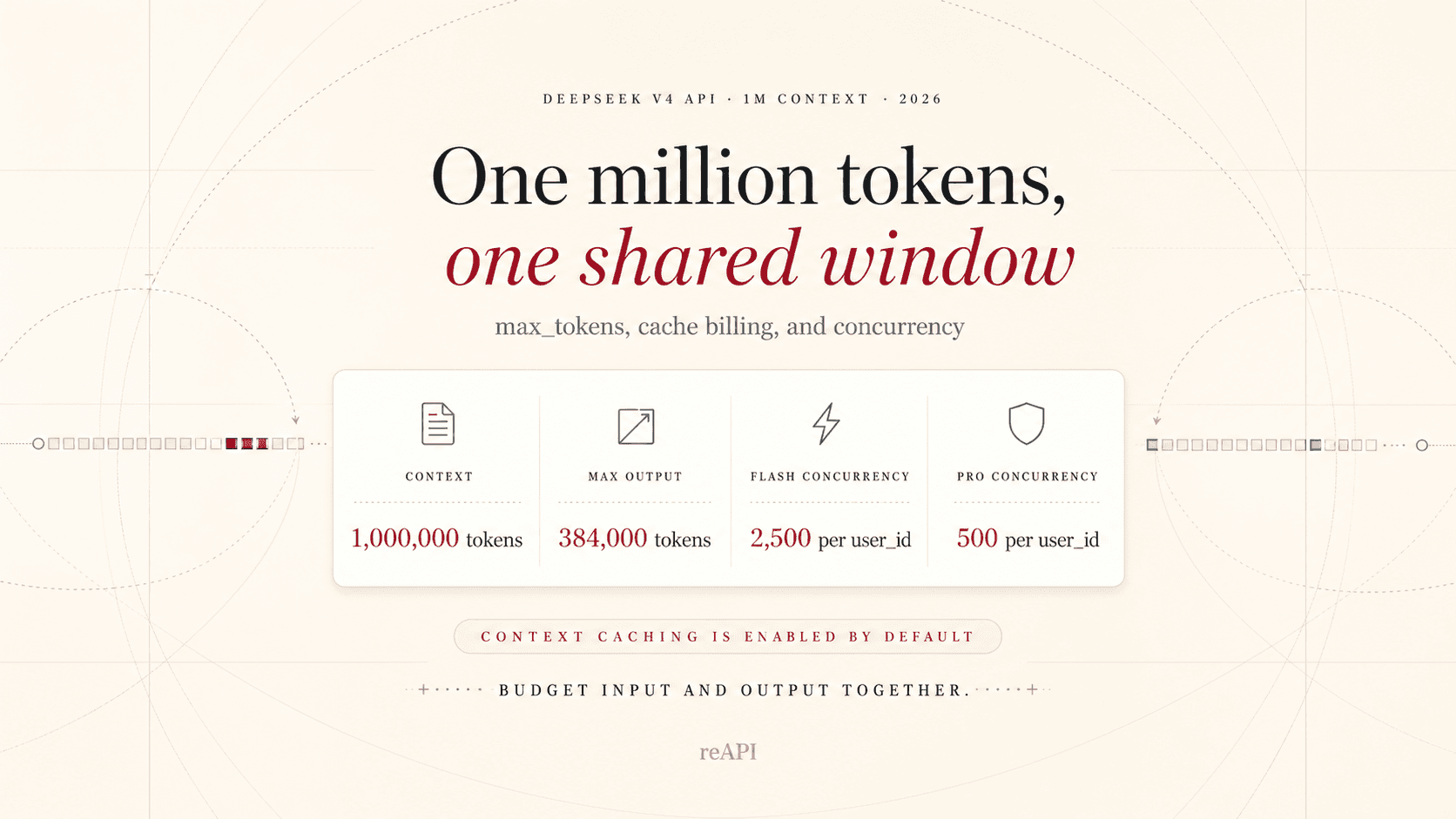
DeepSeek V4 1M Context: max_tokens, Billing, and Concurrency
DeepSeek V4 shares its 1M context between input and output, with a 384K maximum output. Learn max_tokens, cache billing, and concurrency limits.

Best Replicate Alternatives in 2026: 5 Options Compared
Looking for Replicate alternatives in 2026? Compare fal.ai, Together AI, RunPod, Hugging Face, and reAPI on model range, pricing, speed, and API design.