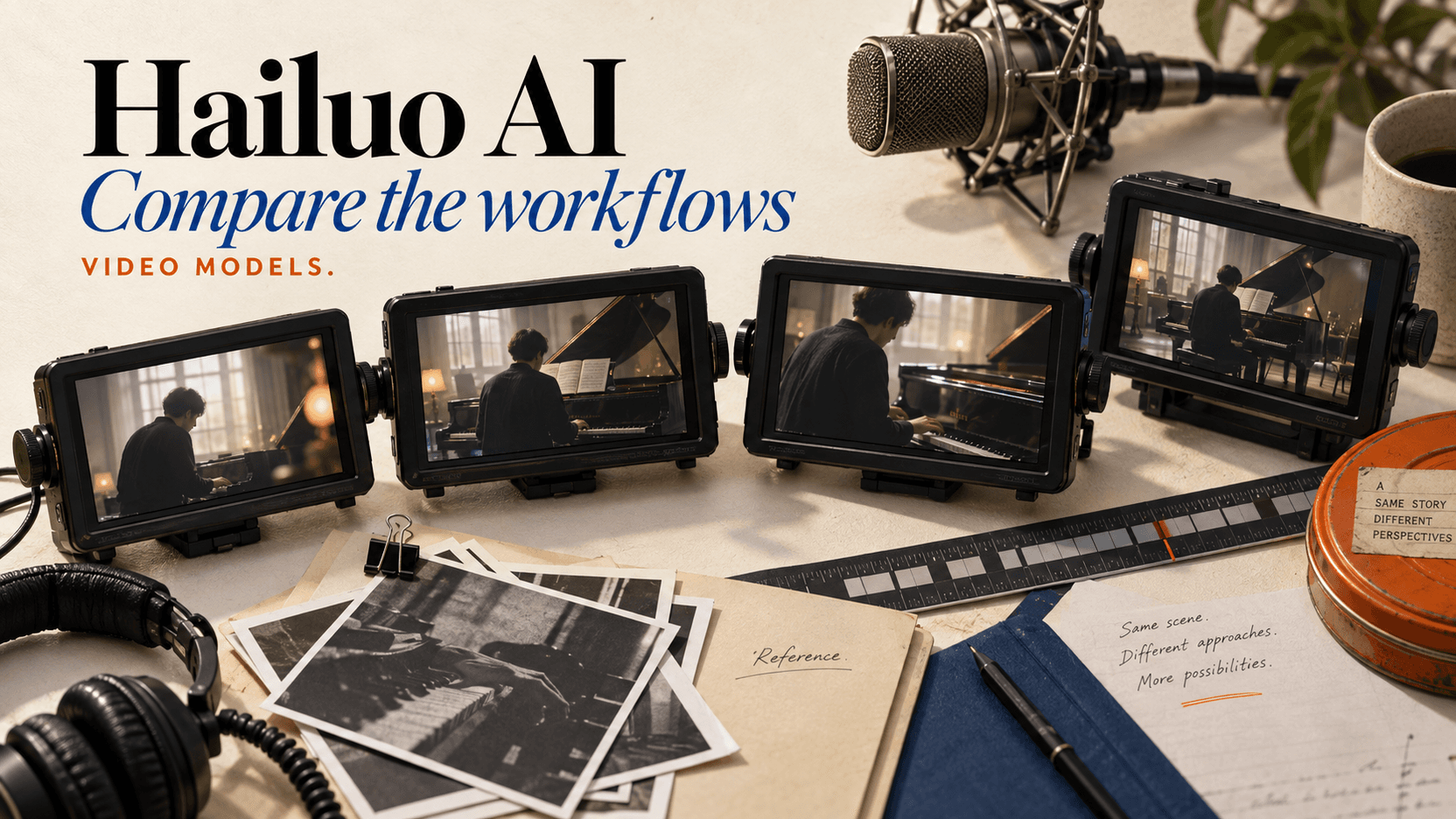
Hailuo AI Compared: Seedance 2.5, Kling 3.0, Veo 3.1 Prices
How does Hailuo AI compare to other AI video generators? MiniMax H3 vs Seedance 2.5, Kling 3.0, and Veo 3.1 on price per second, duration, audio, and refs.
How does Hailuo AI compare to other AI video generators? The short version: Hailuo AI's current model, MiniMax H3, is the only frontier video model in its class released with open weights, it accepts up to nine reference images plus reference audio, and it runs to 15 seconds per clip. Its rivals answer with different strengths. Seedance 2.5 generates up to 30 seconds in one pass, Kling 3.0 has the cheapest with-audio tier of the group, and Veo 3.1 bills flat per generation instead of per second.
This comparison puts all four on the same table: specs first, then what the same clip costs on each, using live per-second prices pulled from reAPI's model pages in August 2026. Prices below are the platform rates on reAPI, where all four models run behind one API key; first-party rates differ by vendor.
TL;DR
- Hailuo AI (MiniMax H3) is an open-weight, general-purpose, omni-modal generation model released in July 2026[1]. On reAPI it runs $0.1825/s with audio, native, at 4–15 seconds per clip[2].
- Seedance 2.5 goes longest: up to 30 seconds in a single generation, with up to 30 reference images and audio on by default; image-reference jobs start at $0.118589/s, while the lower $0.071153 rate requires a source video[3].
- Kling 3.0 is the budget with-audio pick at $0.11/s (standard tier, audio on), and the only one of the four with a listed 4K tier at $0.3685/s[4].
- Veo 3.1 is the predictable one: the Fast tier bills $0.161 per generation, so an eight-second clip costs the same as a four-second one[5].
- The differences that decide real projects are reference inputs and duration ceilings, and those spreads are wide: 2 reference images on Kling versus 30 on Seedance, 15-second clips on Hailuo versus 30 on Seedance.
Where Hailuo AI sits among AI video generators
MiniMax positions H3 as "an open-weight, general-purpose, omni-modal generation model", released July 2026 as the video flagship in its model family[1]. Open weights set it apart in this lineup. Seedance, Kling, and Veo are all closed models reachable only through their vendors' services or API platforms; H3 is the one whose weights exist outside the vendor's walls.
For most API users the license matters less than what the model takes as input. H3's surface is unusually wide: a text prompt, an optional first and last frame, up to nine reference images, and up to three reference audio files[2]. Reference audio is the rare one. None of the other three accepts an audio file as a style reference for the generated soundtrack at this parameter count, and it is the reason H3 prompt guides spend as much time on sound as on camera direction.
Spec comparison: duration, audio, and reference inputs
Numbers below come from each model's live schema on reAPI, retrieved August 2026[2][3][4][5].
| Hailuo AI (H3) | Seedance 2.5 | Kling 3.0 | Veo 3.1 | |
|---|---|---|---|---|
| Clip length | 4–15 s | 4–30 s | 3–15 s | per generation |
| Native audio | yes | yes, on by default | audio and no-audio tiers | audio and no-audio tiers |
| Reference images | up to 9 | up to 30 | up to 2 | model-dependent |
| Reference audio | up to 3 files | up to 10 files | no | no |
| First/last frame control | yes | via reference images | via reference images | yes |
| Aspect ratios | 21:9 to 9:16 + adaptive | presets + adaptive | 16:9, 9:16, 1:1 | 16:9 family |
| 4K tier | no | no (480p/720p) | yes, $0.3685/s | yes, on official tiers |
Two spreads deserve attention. Duration: Seedance's 30-second ceiling is double everyone else's, which changes what counts as one generation for narrative content. Reference density: Seedance takes 30 images and 10 audio files, Hailuo takes 9 and 3, Kling takes 2 and none. If your workflow builds characters or products from reference sets, that column picks your model before price does.
Price per clip: the same eight seconds on four models
Per-second rates only mean something at a fixed clip length, so here is eight seconds of 720p-class output with audio where available, at reAPI's listed rates in August 2026:
| Model, tier | Rate | 8-second clip |
|---|---|---|
| Veo 3.1, Fast | $0.161 per generation | $0.16[5] |
| Seedance 2.5, 480p with image ref | $0.118589/s | $0.949[3] |
| Kling 3.0, standard + audio | $0.11/s | $0.88[4] |
| Kling 3.0, pro + audio | $0.1485/s | $1.19[4] |
| Hailuo AI (H3), standard | $0.1825/s | $1.46[2] |
| Seedance 2.5, 720p from text | $0.266824/s | $2.13[3] |
Read the table with its footnotes in mind. Veo's flat $0.161 is the Fast tier; its per-second official tiers run $0.0736/s to $0.552/s depending on resolution, audio, and quality level[5]. Seedance image references stay on its base rate. Only a source video selects the lower rate, and the billing clock then includes source duration plus a minimum tied to output length[3]. Hailuo H3 charges one flat rate that always includes audio, plus $0.055 per reference image beyond the fifth[2].
On reAPI all four are prepaid at 1 credit = $0.001, and failed generations refund automatically, so the cost of an experiment is bounded by the clips that actually complete[2].
What each model is actually for
Choose Hailuo AI (H3) when sound and identity both matter: it holds a subject across a 15-second choreographed shot while taking audio references for the score. Music-driven content, dance, and dialogue scenes lean on exactly the inputs H3 has and others lack.
Choose Seedance 2.5 for length and reference-heavy pipelines. A 30-second single-pass generation avoids stitching two 15-second clips, and 30 reference images is enough to lock a product or character from every angle.
Choose Kling 3.0 when the budget is per-clip and audio is required. $0.88 for eight seconds with sound is the lowest with-audio number in the table, and the 4K tier exists when a client asks for it.
Choose Veo 3.1 when predictability beats tuning. Flat per-generation billing makes cost planning trivial, and the official per-second tiers scale up to 4K with audio when the Fast tier's ceiling shows.
If you want the deeper one-on-one against ByteDance's model, we ran that comparison separately in Hailuo H3 vs Seedance 2.5.
Calling all four through one endpoint
All four models take the same request shape on reAPI: POST to the videos endpoint with a model id, poll the task until it completes. Switching generators is a one-field change:
curl https://reapi.ai/api/v1/videos/generations \
  -H "Authorization: Bearer rk_live_..." \
  -H "Content-Type: application/json" \
  -d '{
    "model": "minimax-h3",
    "prompt": "A dancer in a rain-soaked courtyard, camera dollying slowly closer",
    "duration": 8,
    "aspect_ratio": "16:9"
  }'
Swap "minimax-h3" for the model id shown on the Seedance 2.5, Kling 3.0, or Veo 3.1 model page and the workflow stays identical, which is the practical way to A/B the four generators on your own prompts instead of trusting anyone's comparison table, including this one. Input images and audio must be public HTTPS URLs.
FAQ
How does Hailuo AI compare to other AI video generators?
It trades length for input richness. Hailuo's H3 caps clips at 15 seconds, shorter than Seedance 2.5's 30, but accepts nine reference images and three reference audio files, the widest audio-reference surface of the major generators[2]. It is also the only open-weight model among the four compared here[1].
Can Hailuo AI be used for professional video work?
Yes, within its format. Fifteen seconds of finished output with native audio covers ads, social clips, and music-driven scenes; it does not cover long-form. Teams that need one continuous 30-second take use Seedance 2.5 instead[3].
What does Hailuo AI cost per video?
At reAPI's listed rate of $0.1825/s, a six-second clip is $1.10 and the 15-second maximum is $2.74, audio included[2]. Reference images beyond the fifth add $0.055 each.
Which AI video generator is cheapest with audio included?
In this four-model lineup at eight seconds: Veo 3.1 Fast at $0.161 per generation, then Kling 3.0 standard with audio at $0.88, followed by Seedance 2.5's image-referenced 480p tier at $0.949[3][4][5]. Rates move; check the live model pages before budgeting.
Is Hailuo AI open source?
MiniMax describes H3 as open-weight[1], meaning the model weights are published; that is not the same as a fully open-source stack. API access remains the practical route for production workloads that need hosted inference, queuing, and billing.
Does Hailuo AI generate sound?
Yes. H3 output includes generated audio at the flat per-second rate, and up to three reference audio files can steer the soundtrack's style[2]. Kling and Veo price audio as separate tiers; Seedance ships audio on by default.
Picking a generator in practice
Start from the constraint, not the model. A 30-second continuous story points at Seedance 2.5 before price enters the picture. A soundtrack that must match a reference track points at Hailuo AI. A per-clip budget under a dollar with audio points at Kling 3.0 or Veo 3.1's Fast tier. Then run the same prompt through the finalists; at $0.16 to $1.46 per eight-second test, a four-way bake-off costs less than the coffee consumed while arguing about it. However the bake-off lands, the way Hailuo AI compares to other AI video generators comes down to whether its 15-second, audio-referenced format matches the work in front of you.
References
- MiniMax. MiniMax H3 — official model page. Retrieved August 2026 from minimax.io
- reAPI. MiniMax H3 — model page with live pricing and input schema. Retrieved August 2026 from reapi.ai/models/minimax-h3
- reAPI. Seedance 2.5 — model page with live pricing and input schema. Retrieved August 2026 from reapi.ai/models/seedance-2-5
- reAPI. Kling 3.0 — model page with live pricing and input schema. Retrieved August 2026 from reapi.ai/models/kling-3-0
- reAPI. Veo 3.1 — model page with live pricing and input schema. Retrieved August 2026 from reapi.ai/models/veo3-1
Further reading
- reAPI. Hailuo H3 / MiniMax H3 API guide. reapi.ai/blog/hailuo-h3-minimax-h3-api-guide
- reAPI. MiniMax H3 prompt guide: motion, camera, sound, and references. reapi.ai/blog/minimax-h3-prompt-guide
- reAPI. MiniMax H3 vs Seedance 2.5. reapi.ai/blog/minimax-h3-vs-seedance-2-5
Author

Categories
More Posts
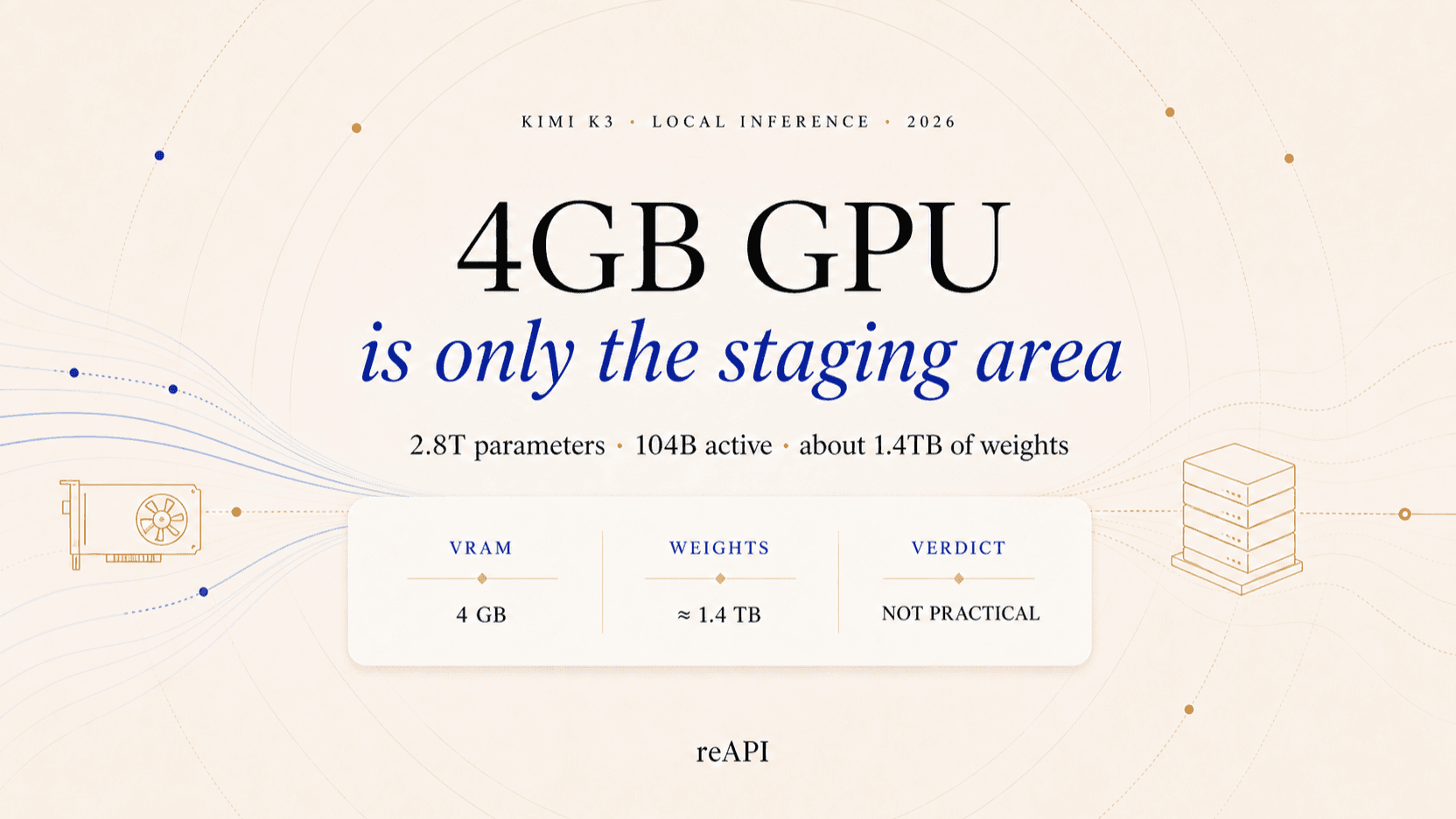
Unbelievable: Run Kimi K3 — 2.8 Trillion Parameters on a Single 4GB GPU
Can Kimi K3 really run on one 4GB GPU? Learn the 1.4TB weight math, what layer offloading changes, current tool support, and the practical API route today.
GLM-5.2 API Guide: 1M Context, Pricing, and Coding (2026)
Use the GLM-5.2 API with OpenAI-compatible code. Learn its 1M context, $1.40/$4.40 official pricing, reAPI rates, reasoning controls, and limits.

How Long Can Seedance Videos Be? 2.0 at 15s, 2.5 at 30s
Seedance 2.0 generates 4–15 seconds per request; Seedance 2.5 supports 4–30 seconds. See duration settings, current costs, and scene chaining.