
FLUX 3 Video API Pricing: Draft, HD, FHD, and Continuation
Calculate FLUX 3 video costs across Draft, HD, FHD, keyframe, and continuation modes, including the draft-to-final workflow and 5–20s totals.
FLUX 3 Video costs from $0.056 to $0.488 per second on reAPI, depending on whether the request is a Draft, a normal text/keyframe generation, or a video continuation at HD or FHD. A ten-second job can therefore cost $0.56, $1.57, $2.67, $3.78, or $4.88 even though every request carries the same model id.[1]
The mode is the price. Treating FLUX 3 as one per-second number produces bad estimates, particularly for continuation.
The six FLUX 3 rates
Public reAPI rates checked August 23, 2026:
| Request type | Resolution | Price per second | 10-second cost |
|---|---|---|---|
| Draft from text/keyframes | HD | $0.056 | $0.56 |
| Text or keyframes | HD | $0.157 | $1.57 |
| Text or keyframes | FHD | $0.267 | $2.67 |
| Continuation Draft | HD | $0.111 | $1.11 |
| Video continuation | HD | $0.378 | $3.78 |
| Video continuation | FHD | $0.488 | $4.88 |
FLUX 3 accepts integer durations from 5 to 20 seconds. The bill is simply the tier rate multiplied by requested duration.[2]
| Tier | 5 seconds | 10 seconds | 20 seconds |
|---|---|---|---|
| Draft | $0.28 | $0.56 | $1.12 |
| Text/keyframes HD | $0.79 | $1.57 | $3.14 |
| Text/keyframes FHD | $1.34 | $2.67 | $5.34 |
| Continuation Draft | $0.56 | $1.11 | $2.22 |
| Continuation HD | $1.89 | $3.78 | $7.56 |
| Continuation FHD | $2.44 | $4.88 | $9.76 |
Rounded table totals use the displayed public rate. The final credit charge follows the live rate card.
Why continuation costs more
A text request asks the model to create a clip from a prompt. A continuation request also has to read the source video's picture and audio, establish its state, and carry both forward. FLUX 3 places that job in a separate tier.[2]
At HD, continuation is about 2.4 times the standard text/keyframe rate. Starting from a video solely because it feels more controlled can therefore be expensive. Use continuation when the source contains motion, timing, or audio continuity that a still keyframe cannot express.
If only the initial composition matters, send one image as the first keyframe. It stays in the standard tier.
Keyframes do not add a surcharge
One to ten image_urls can guide a FLUX 3 generation. One image is the start frame; two are start and end; three or more become evenly spaced middle frames in array order. Keyframe jobs use the standard text/image tier rather than the continuation tier.[2]
That makes a ten-second FHD transition between two approved designs $2.67 at the current rate:
{
  "model": "flux-3-video",
  "prompt": "A clean mechanical transformation between the two product states",
  "image_urls": [
    "https://files.example.com/start.png",
    "https://files.example.com/end.png"
  ],
  "duration": 10,
  "resolution": "fhd",
  "audio": true
}
The order is semantic. Renaming the files or sorting the URLs later can change the intended timeline.
Draft-to-final is two bills, not one discounted final
draft: true renders a low-quality HD preview. If it works, submit a second request with draft_from_task_id to finalize that exact Draft at normal quality. The finalization is billed at the corresponding normal tier.[2]
For a ten-second text-to-video job:
Draft HD                  $0.56
Finalize same draft, HD   $1.57
Total                     $2.13
Going directly to HD would be $1.57, so Draft does not save money on a first-try success. It saves money when several bad ideas can be rejected before full rendering.
Suppose four concepts are tested and one is finalized:
4 Drafts × $0.56          $2.24
1 HD final                $1.57
Total                     $3.81

4 direct HD attempts      $6.28
The Draft loop saves $2.47 in that example. It works because three ideas die cheaply.
There is an API constraint worth designing around: finalization takes the completed Draft task id, and only resolution may change. Sending a new prompt, duration, or media with draft_from_task_id is rejected. If the prompt changes, it is a new generation rather than a finalization.
Silent video is not cheaper
FLUX 3 Video generates native audio by default. Setting audio: false returns a silent clip but does not select a lower rate.[2] Disable audio when the output should be silent or a separate sound mix is planned, not as a cost control.
A cost-aware routing rule
Use this order:
- Prompt only when no visual state has been approved.
- One or more keyframes when approved stills define the important moments.
- Continuation only when source motion or audio must carry into the new clip.
- Draft first when several concepts are likely to be discarded.
- Direct final when the prompt and references are already locked.
Break-even math for the Draft loop
Draft is worthwhile when the number of rejected ideas is high enough to cover its extra charge on the accepted idea.
For a ten-second HD job, let n be the number of concepts. One direct HD attempt is $1.57; one Draft is $0.56, and a single accepted concept still needs a $1.57 final.
direct workflow = n × $1.57
draft workflow  = n × $0.56 + $1.57
At one concept, direct costs $1.57 and Draft-to-final costs $2.13. At two, both routes are close: $3.14 direct versus $2.69 for two Drafts and one final. From two competing concepts onward, the Draft path is already cheaper if only one is finalized.
The math assumes a Draft reliably predicts whether the final composition and motion will work. It may not reveal small text, fine texture, or FHD-only defects. If those details determine acceptance, one early direct final should calibrate how much trust to place in Draft reviews.
Price a continuation before choosing it
Continuation should earn its higher rate by removing an edit or preserving something that cannot be captured in a still.
For a 20-second FHD continuation, the displayed total is $9.76. A new 20-second FHD text/keyframe generation is $5.34. The $4.42 difference buys access to the source clip's moving state and audio continuity.
Ask three questions before paying it:
- Does the first new frame need to match a moving source, or would the source's last frame be enough?
- Must the original soundtrack continue without a cut?
- Is the source motion actually useful, or is it merely being attached as a visual reference?
If the last still plus a prompt can define the next shot, keyframe generation stays on the standard tier. If a person is mid-action or the audio phrase must continue naturally, continuation has information the still cannot carry.
Production preflight
Before submitting a batch, validate the same fields used by billing:
| Check | Why it matters |
|---|---|
| Duration is an integer 5–20 | Invalid values fail; omitted duration becomes 5 |
| Draft uses HD | Draft does not have an FHD tier |
| Keyframe array order is intentional | Reordering changes the timeline |
| Video field is present only for continuation | It selects the expensive tier |
| Finalization contains no new prompt/media | A completed Draft is finalized as-is |
| Audio choice is creative, not financial | Silent output receives no discount |
Store the resolved tier beside the task id. When a user disputes a continuation bill, the application should be able to show which input selected that tier rather than reconstructing the payload from memory.
The FLUX 3 model page carries the live six-tier rate card. The FLUX 3 API documentation covers the request modes, keyframe order, Draft finalization, and polling.
References
- reAPI FLUX 3 model and pricing page, accessed August 23, 2026.
- reAPI FLUX 3 API documentation, accessed August 23, 2026.
- Black Forest Labs, “FLUX 3 Video”, August 4, 2026.
Author

Categories
More Posts
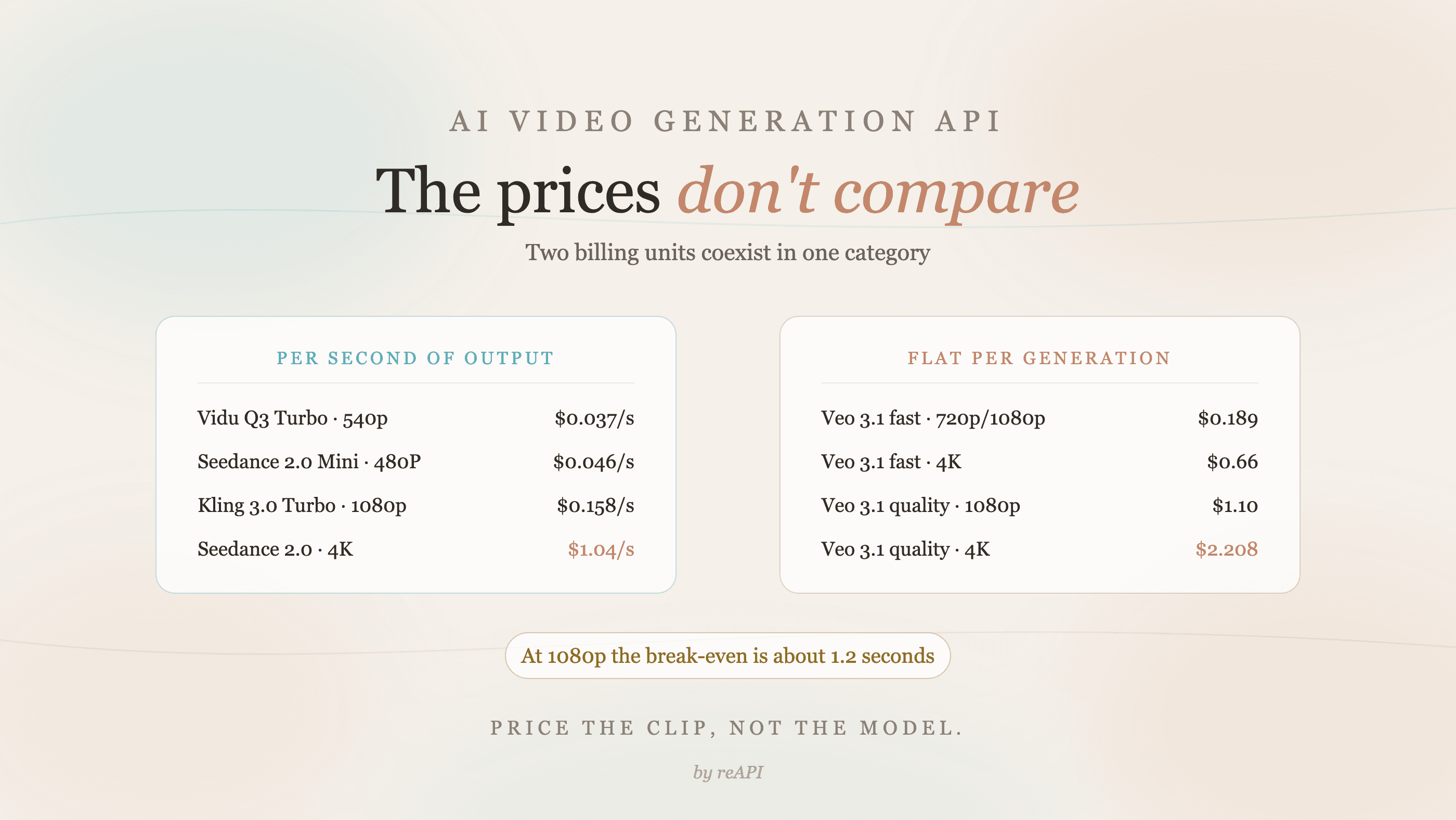
AI Video Generation API: Why the Prices Don't Compare
AI video generation API rates use two incompatible billing units: per second and flat per generation. Where the break-even sits and how to price a real clip.
Claude Fable 5.1 vs GPT-6 Astra: Choose by Workload
Compare Claude Fable 5.1 and GPT-6 Astra by context, tools, caching, retention, and task fit—then run a fair evaluation on your own workload.
Best Seedance 2.5 Alternatives: H3, Veo, Sora and More
Compare the best Seedance 2.5 alternatives for video generation, including MiniMax H3, Seedance 2.0, Veo 3.1, Sora 2, Runway, and Kling 3.