· reAPI Team
Seedance 2.5 vs Seedance 2.5 Flash: Pricing, Speed, and Workflow Guide
Compare Seedance 2.5 vs Seedance 2.5 Flash on resolution (4K vs 720p), reference caps (50 vs 20), Draft mode, per-second API pricing, and when to switch.
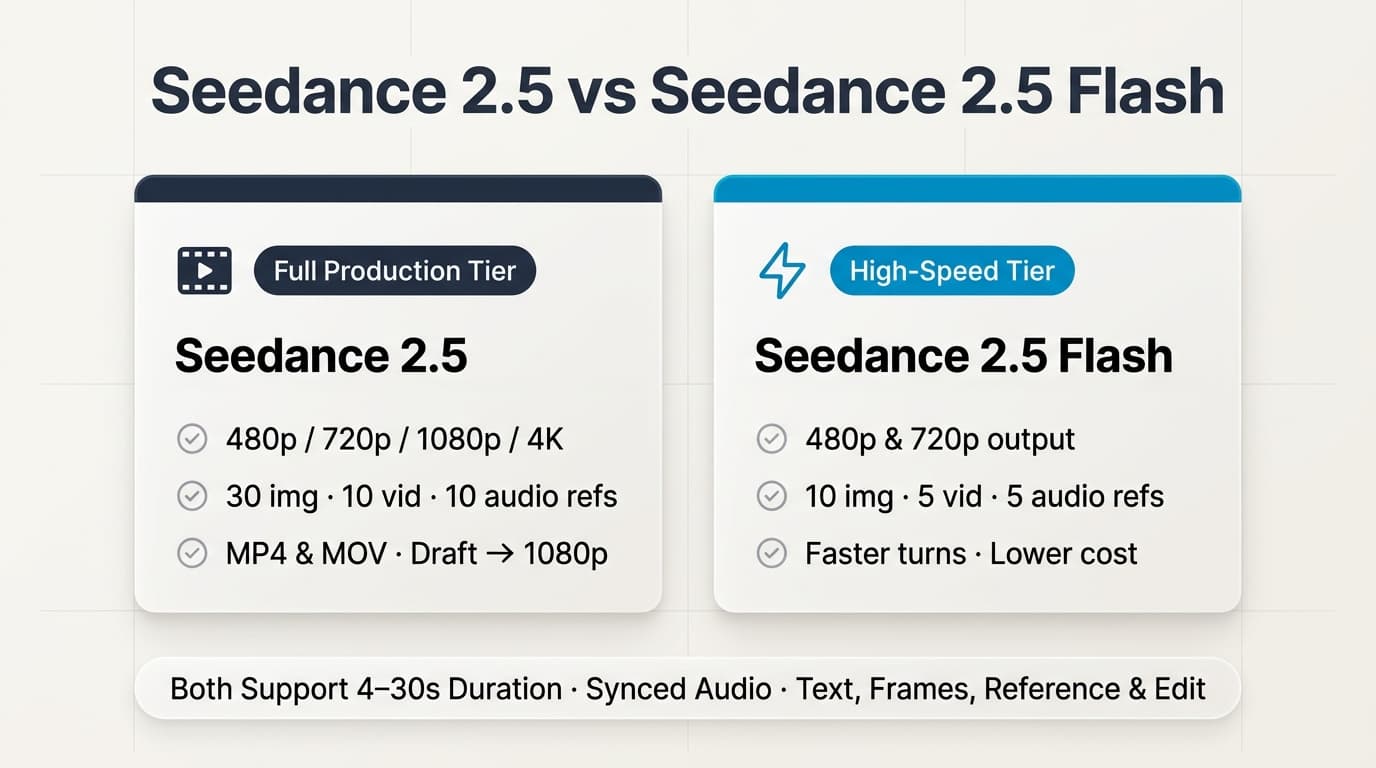
Choose Seedance 2.5 Flash when you need fast, lower-cost 480p or 720p video generation for social clips, creative iteration, and high-volume testing. Choose Seedance 2.5 when you need native 1080p or 4K delivery, more than 20 reference files, MOV export, scene chaining, or Draft-to-1080p Final mode.[1][2]
ByteDance launched Seedance 2.5 Flash on November 12, 2026 (opening the developer API on November 15) as a speed-and-cost tier of the same 2.5 generation, not a separate model family.[3] Both tiers generate 4 to 30 second clips with native synced audio, first/last-frame control, multimodal references, and prompt-driven video editing. On Volcengine Ark and BytePlus, Flash trims official video-token list prices by roughly 34% (46 vs 70 RMB per million standard tokens; 28 vs 42 RMB per million with video references) and cuts compute time roughly in half.[2][4] The catch is that Flash caps output at 720p, halves the reference budget, and omits standard 2.5's Draft-to-Final lock.
Video Walkthrough: Seedance 2.5 vs Seedance 2.5 Flash
Watch the side-by-side breakdown below before reviewing the full specification table, pricing math, and API request differences:
Specifications Side by Side
Most confusion between Seedance 2.5 vs Seedance 2.5 Flash happens when teams assume Flash is just "2.5 with a speed toggle." Five concrete specification boundaries separate the two routes on reAPI and upstream:[1][2]
| Specification | Seedance 2.5 (doubao-seedance-2.5-face) | Seedance 2.5 Flash (seedance-2-5-flash) |
|---|---|---|
| Release timeline | Official Ark channel Aug 2026 (4K added Nov 17) | Released Nov 12, 2026 (API opened Nov 15) |
| Supported resolutions | 480p, 720p, 1080p, 4K | 480p, 720p only |
| Clip duration | 4–30 seconds (plus -1 auto / edit) | 4–30 seconds (plus -1 auto / edit) |
| Reference asset cap | 50 total (30 images, 10 videos, 10 audios) | 20 total (10 images, 5 videos, 5 audios) |
Synced audio (generate_audio) | Yes (speech, SFX, BGM) | Yes (speech, SFX, BGM) |
| Generation modes | Text, image, first/last frames, reference, edit, extend | Text, first/last frames, reference, edit |
| Draft-to-1080p Final mode | Yes (draft: true -> draft_task_id) | No |
| Output container | MP4 and MOV (output_format) | MP4 |
| Extra production controls | return_last_frame, bitrate_mode, seed, tools (web search), watermark | Streamlined surface (resolution, duration, ratio, generate_audio) |
| Official Ark token list (no ref / with video ref) | 70 / 42 RMB per 1M tokens | 46 / 28 RMB per 1M tokens (~34% lower) |
Three of those rows change how you design a real pipeline:
- Resolution is a delivery requirement, not a sharpness slider. If a client brief or YouTube channel requires native 1080p or 4K footage, Flash cannot deliver it directly. You either render the final on standard Seedance 2.5 or pair a 720p Flash output with a cloud upscaler like Topaz Video Upscaler ($0.044/s at 2x, which turns 720p into 1440p).
- 20 reference assets covers a character sheet; 50 covers a multi-character scene. Flash's cap of 10 images, 5 videos, and 5 audio clips is plenty for a single product reveal, talking-head ad, or two-character dialogue. Large commercial storyboards with wardrobe refs, props, lighting sheets, and multi-angle motion clips hit Flash's ceiling quickly and belong on standard 2.5.[4]
- Draft mode is the one feature Flash cannot replace. On standard Seedance 2.5, setting
draft: truerenders a fast 480p preview whose exact composition and motion you can later lock and re-render at 1080p usingdraft_task_id.[1] Flash has nodraft_task_idbridge. If you love a 720p Flash take and want a 1080p master, switching the prompt to standard 2.5 produces a brand-new generation rather than upgrading that exact take.[4]
Pricing Comparison: Per-Second Rates and Batch Math
Both models bill per second of generated video on reAPI (with a lower per-second rate whenever you include a reference video, because upstream bills combined video tokens at the lower reference-video unit price).[1][2]
Here are the seeded per-second USD rates across reAPI's live channels (check the Seedance 2.5 and Seedance 2.5 Flash model pages for current live snapshots):
| Model & Channel on reAPI | 480p (No Video Ref / With Video Ref) | 720p (No Video Ref / With Video Ref) | 1080p (No Video Ref / With Video Ref) | 4K (No Video Ref / With Video Ref) |
|---|---|---|---|---|
Seedance 2.5 Flash PR (seedance-2-5-flash-pr) | $0.067 / $0.041 | $0.151 / $0.093 | Not supported | Not supported |
Seedance 2.5 Flash Standard (seedance-2-5-flash) | $0.120 / $0.075 | $0.240 / $0.150 | Not supported | Not supported |
Seedance 2.5 Standard (doubao-seedance-2.5-face) | $0.119 / $0.071 | $0.267 / $0.160 | $0.462 / $0.276 | $1.023 / $0.631 |
Seedance 2.5 also exposes Economy (doubao-seedance-2.5-eco) and PR (seedance-2.5-pr) channels on its model page for teams comparing per-token vs per-second routing.[1]
What 5s, 10s, 30s, and 50-Clip Batches Actually Cost
Multiply those per-second rates across realistic production runs (standard text/image-to-video, no video reference):
| Workload | Seedance 2.5 Flash PR (720p) | Seedance 2.5 Standard (720p) | Seedance 2.5 Standard (1080p) | Savings (Flash PR vs 2.5 720p) |
|---|---|---|---|---|
| Single 5-second shot | $0.76 | $1.34 | $2.31 | 43% less ($0.58 saved) |
| Single 10-second ad clip | $1.51 | $2.67 | $4.62 | 43% less ($1.16 saved) |
| Full 30-second continuous take | $4.53 | $8.01 | $13.86 | 43% less ($3.48 saved) |
| Batch of 50 ten-second social variants | $75.50 | $133.50 | $231.00 | Save $58.00 per batch |
The Retry Break-Even Trap
Cheap per-second rates only save money when the clips pass review. Look at the simple break-even formula:
Cost per approved clip = (Total attempts x Per-clip price) / Approved clipsIf seedance-2-5-flash-pr at 720p costs $1.51 per 10-second clip versus $2.67 on standard Seedance 2.5, Flash stays cheaper as long as it needs fewer than 1.77 attempts for every single approved standard 2.5 take.[5] The moment a physically demanding shot (fast hand-object contact, dense crowd motion, or readable product typography) forces three retries on Flash while standard 2.5 nails it on attempt one ($4.53 vs $2.67), Flash ends up costing 70% more plus extra editor review minutes.[4]
Speed and Visual Quality: What Independent Tests Show
ByteDance announced Seedance 2.5 Flash as roughly "twice the generation speed" of standard Seedance 2.5 without publishing official seconds-per-clip tables.[6] Independent side-by-side tests published in mid-November 2026 largely back up the compute speedup, with one important operational caveat:[4][5][6]
- Measured generation speed: Matched 10-second 720p runs on Segmind averaged 82 seconds on Flash vs 171 seconds on standard 2.5 (roughly 2.1x faster). Across 11 shared prompts reported by Renoise, median render time dropped from 283 seconds on standard 2.5 to 147 seconds on Flash (roughly 1.9x faster).[4]
- Queue time still counts: As SceneMixer notes, total wall-clock wait equals queue wait + GPU compute time.[6] During peak traffic hours, shared queue latency can narrow the perceived gap. Submitting shots concurrently through the async API avoids serial waiting on either tier.
- Where Flash matches standard 2.5: Talking-head clips, mobile-first social portraits, simple product orbits, atmospheric establishing shots, and reference-image continuity on clean scenes hold up very closely to standard 2.5 at 720p.[5]
- Where standard 2.5 pulls ahead: Complex physical interactions (liquid pours, sports contact, multi-object collisions), fine background atmospheric depth in dense crowds, small on-screen text/logos, and long multi-shot sequences that rely on
return_last_framechaining ormovcolor precision for post-production grading.[4][5]
Two-Tier Production Workflow: Iterate on Flash, Deliver on 2.5
Instead of forcing an entire studio or SaaS backend onto one tier, split your pipeline into an iteration lane and a delivery lane:
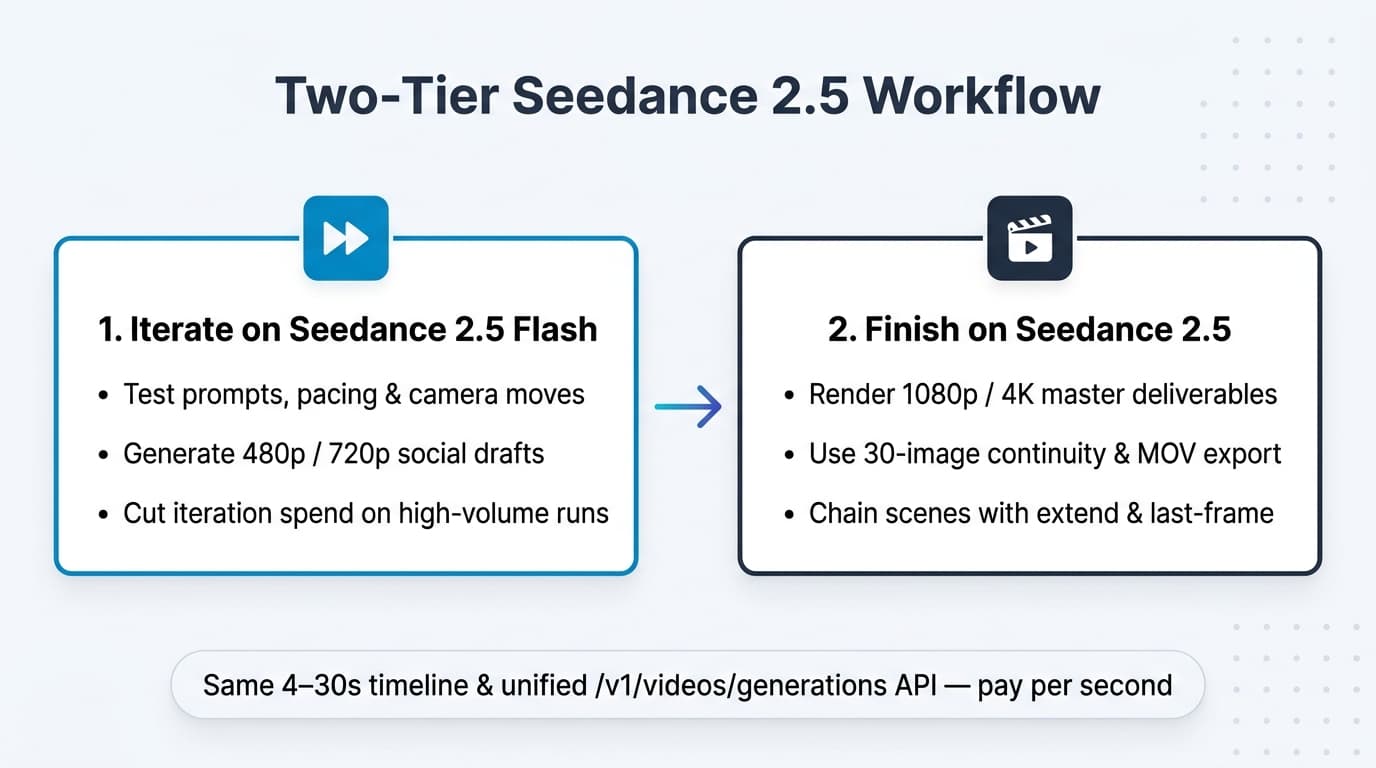
- Use Seedance 2.5 Flash for discovery and mobile feeds: Test five camera angles, pacing variations, and dialogue timing at 480p (
$0.067/son Flash PR, or$0.34per 5-second test) or 720p ($0.151/s). For TikTok, Reels, Shorts, and user-facing consumer apps where mobile compression erases fine 4K detail anyway, ship the approved 720p Flash clip directly. - Use Seedance 2.5 for master deliverables and complex continuity: Once your prompt structure and reference kit are locked, move hero commercials, 1080p/4K deliverables, and 25+ asset character campaigns to standard Seedance 2.5. If you want locked composition from cheap preview to 1080p final, skip Flash for that specific shot and use standard 2.5's native
draft: true->draft_task_idworkflow instead.
API Payload Differences on reAPI
Both models use POST https://api.reapi.ai/v1/videos/generations with the same REAPI_API_KEY, but notice the request-body shape difference before swapping model IDs in code:[1][2]
- Seedance 2.5 Flash (
seedance-2-5-flashorseedance-2-5-flash-pr) uses nativecontent[]blocks andratio:curl -X POST https://api.reapi.ai/v1/videos/generations \ -H "Authorization: Bearer $REAPI_API_KEY" \ -H "Content-Type: application/json" \ -d '{ "model": "seedance-2-5-flash-pr", "content": [ { "type": "text", "text": "A ceramic coffee cup slowly rotates on a wooden table under warm studio lighting, static camera." } ], "resolution": "720p", "ratio": "16:9", "duration": 5, "generate_audio": true }' - Seedance 2.5 Standard (
doubao-seedance-2.5-faceorseedance-2.5-pr) uses flat fields (prompt,size, optionaldraft/output_format/return_last_frame):curl -X POST https://api.reapi.ai/v1/videos/generations \ -H "Authorization: Bearer $REAPI_API_KEY" \ -H "Content-Type: application/json" \ -d '{ "model": "doubao-seedance-2.5-face", "prompt": "A ceramic coffee cup slowly rotates on a wooden table under warm studio lighting, static camera.", "size": "16:9", "resolution": "1080p", "output_format": "mp4", "duration": 5, "generate_audio": true }'
Consult the Seedance 2.5 API docs and Seedance 2.5 Flash API docs for full multimodal reference arrays (image_urls, video_urls, audio_urls) and polling schemas.
Frequently Asked Questions
Is Seedance 2.5 Flash the same as Seedance 2.5 Draft mode?
No. Seedance 2.5 Flash is a standalone fast model outputting 480p or 720p clips. Draft mode (draft: true) is a workflow inside standard Seedance 2.5 that produces a 480p preview linked to a draft_task_id, allowing you to re-render that exact shot at 1080p later. You cannot pass a Flash task ID into standard 2.5's Final render step.[1][3]
Can Seedance 2.5 Flash render 1080p or 4K video?
No. Seedance 2.5 Flash is capped at 480p and 720p. If you need native 1080p or 4K output (or MOV containers), use standard Seedance 2.5. If you already generated a great 720p clip on Flash and want higher resolution without regenerating the motion, run it through Topaz Video Upscaler API.
Is Seedance 2.5 Flash really twice as fast?
In matched 720p tests, yes: independent timings show roughly 1.9x to 2.1x faster compute time (for example, 82s vs 171s on 10-second clips). Real end-to-end wait time still depends on queue load, so batching requests asynchronously in parallel matters just as much as model speed.[4][6]
How much cheaper is Seedance 2.5 Flash than Seedance 2.5?
Official ByteDance video-token prices are roughly 34% lower on Flash (46 vs 70 RMB per million standard tokens). On reAPI, seedance-2-5-flash-pr at 720p ($0.151/s) costs 43% less per second than doubao-seedance-2.5-face at 720p ($0.267/s), and 67% less than standard 2.5 at 1080p ($0.462/s).
Does Seedance 2.5 Flash support audio and video editing?
Yes. Like standard Seedance 2.5, Flash supports native synced audio (generate_audio: true), 4–30 second takes, first/last-frame guidance, multimodal references (up to 10 images, 5 videos, 5 audios), and prompt-driven video editing (edit mode with duration: -1 and ratio: "adaptive").[2]
Where can I try both models side by side?
You can test both in the browser playground or via API with one balance on the Seedance 2.5 and Seedance 2.5 Flash model pages, or see our Seedance 2.5 Flash web access guide for Jimeng and Dreamina rollout details.
References
- reAPI. Seedance 2.5 model page, live pricing, channels, and Draft-to-Final specification. reapi.ai/models/seedance-2-5
- reAPI. Seedance 2.5 Flash model page, live pricing, and native
content[]API schema. reapi.ai/models/seedance-2-5-flash - reAPI. Where to Use Seedance 2.5 Flash: Web Access and Downloads (Nov 12 launch & Nov 15 API schedule). reapi.ai/resources/seedance-2-5-flash-access
- Pixmax AI. Seedance 2.5 Flash vs Seedance 2.5: 846 vs 345 Credits, Tested (Segmind & Renoise speed runs, Draft mode vs Flash). Checked November 23, 2026. pixmax.ai/blog/seedance-2-5-vs-seedance-2-5-flash.html
- LinkModel AI. Seedance 2.5 Flash vs 2.5: Save 38% or Upgrade? (batch math and retry break-even analysis). Checked November 23, 2026. linkmodel.ai/blog/seedance-2-5-flash-vs-seedance-2-5
- SceneMixer. Is Seedance 2.5 Flash really twice as fast? (BytePlus announcement & queue-time breakdown). Checked November 23, 2026. scenemixer.com/guides/is-seedance-2-5-flash-really-twice-as-fast