· reAPI Team
Seedance 2.5 vs Kling 4.0 vs Wan 3.0: Real Cost & Speed
Seedance 2.5 vs Kling 4.0 vs Wan 3.0: same image, same prompt. Compare real 8-second results, actual API costs and measured waiting times on reAPI.
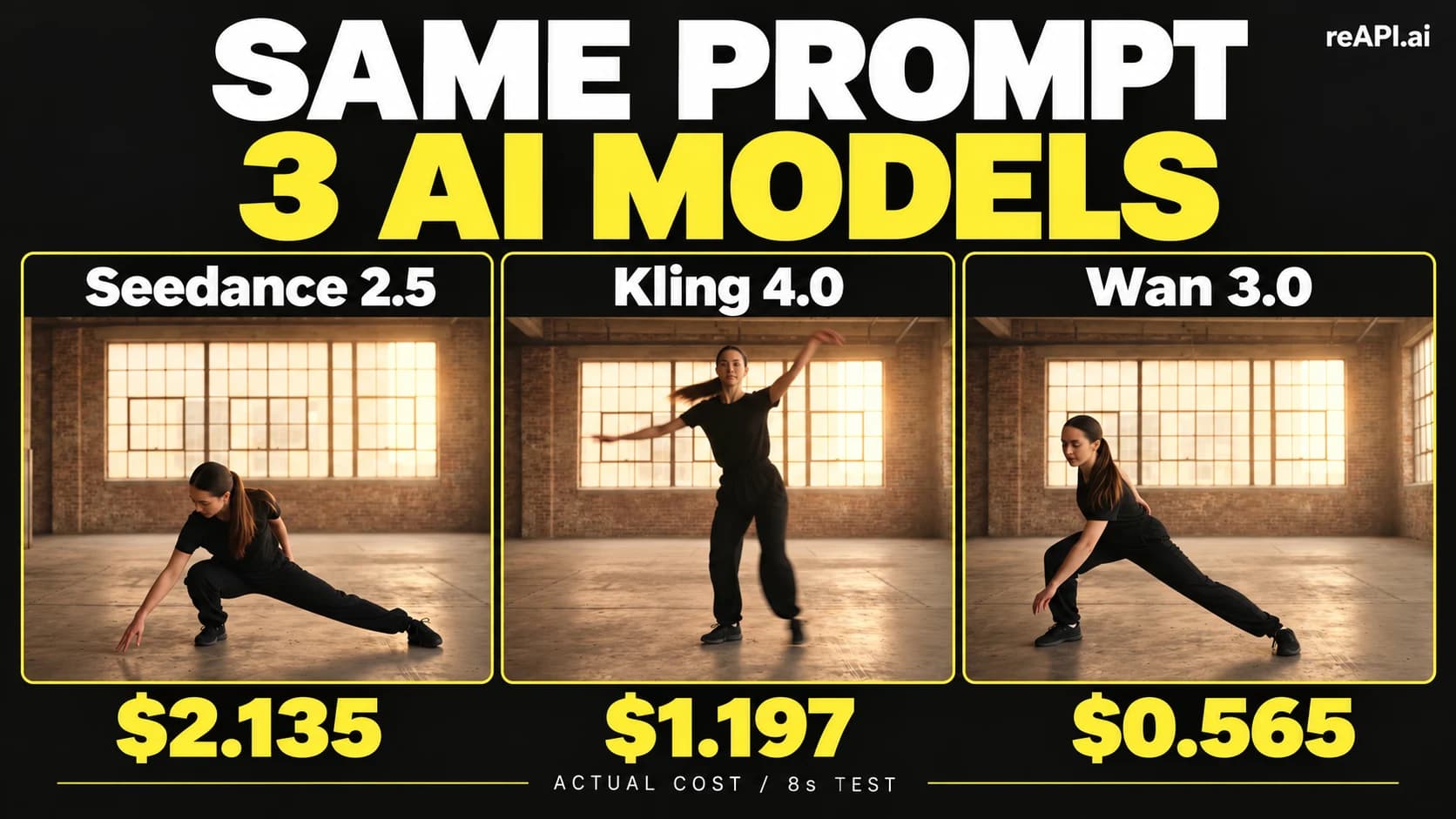
Same prompt. Same starting image. Three AI video models.
For this Seedance 2.5 vs Kling 4.0 vs Wan 3.0 comparison, we ran one image-to-video request per model on reAPI. Every request asked for eight seconds at 720p, using the identical opening image and motion prompt.
Wan 3.0 had the lowest generation charge at $0.565. Seedance 2.5 returned first, in approximately 3 minutes 21 seconds. Kling 4.0 cost $1.197 and reached its low dance pose later in the clip.
The three videos and shared reference image cost $3.925 in total. For creators and developers choosing an image-to-video API, these results show how output, price and waiting time can point toward different choices.
Seedance 2.5 vs Kling 4.0 vs Wan 3.0: the results
| Model | Requested output | Actual video charge | Observed waiting time |
|---|---|---|---|
| Seedance 2.5 | 8 seconds, 720p | $2.135 | 3m 21s |
| Kling 4.0 | 8 seconds, 720p | $1.197 | 4m 39s |
| Wan 3.0 | 8 seconds, 720p | $0.565 | 4m 22s |
Source: our completed reAPI tasks on October 29, 2026. Charges are the settled amounts for these requests, in USD. Waiting time runs from submission to the first completed status observed, including queuing, processing and polling delay.
In the comparison video, Seedance 2.5 is on top, Kling 4.0 is in the middle, and Wan 3.0 is at the bottom. Each result also receives a larger individual playback so the dancer’s feet, turn and low pose are easier to inspect[1].
This is one completed generation per model. It shows what these requests produced, rather than establishing a general quality or speed ranking.
What we kept the same
The starting image shows an adult dancer wearing black in a sunlit industrial room. We generated that image once and supplied the same image URL as the first frame to all three models.
The motion brief asks the dancer to complete a short sequence: side steps, an arm sweep, a turn, a deep side lunge and a return to standing. Keeping the camera fixed makes differences in the movement easier to see.
| Test condition | Configuration |
|---|---|
| Starting image | Identical image, supplied as the first frame |
| Prompt | Identical text |
| Requested duration | 8 seconds |
| Requested resolution | 720p |
| Reference videos or audio | None |
| Attempts | One per model |
| Generated audio | Enabled |
| Comparison playback | Normal speed, generated audio muted |
We used doubao-seedance-2.5-face, kling-4-0 and wan3.0-video, without substituting Eco, Flash or Prime variants.
The requested resolution tier was the same, although the returned files had slightly different dimensions: 1284 × 716 for Seedance, 1280 × 716 for Kling, and 1280 × 720 for Wan. The comparison preserves their aspect ratios and keeps the full dancer visible.
Audio was enabled across the requests because Kling 4.0 generates sound without an off switch[2]. We muted the generated tracks in the comparison to focus on the pictures. This test therefore makes no judgment about soundtrack quality.
The exact prompt
We submitted the following text unchanged to all three models:
Use the supplied image as the exact opening frame. One continuous eight-second wide shot of the same adult dancer in the same room. The camera stays completely locked and the whole body remains visible. She takes two quick side steps to her right, sweeps both arms outward, makes one controlled full-body turn, lowers into a deep side lunge with one hand reaching toward the floor, then rises to a balanced upright pose. Keep her identity, black clothing and ponytail consistent. Natural weight shifts, planted feet, believable joints and fingers, realistic fabric and hair movement. Keep the windows, walls, floor lines and sunlight stable. Natural quiet room ambience and footfalls only, no music, no speech, no captions, no logos, no cuts, no camera movement, no slow motion.
The sequence gives us specific actions to compare: when the turn happens, when the dancer reaches the low pose, and how she returns toward standing.
What changed between the three videos?
The clearest difference is how each model distributes the movement across the eight seconds. The observations below describe the takes in our comparison video[1].
Seedance 2.5: an earlier turn and low pose
In the Seedance result, the turn happens early. By approximately four seconds, the dancer is already in a low side lunge, with one hand reaching toward the floor and the opposite leg extended.
Later frames show the transition back toward standing. For an edit that needs the low pose near the middle of the shot, this particular take places the action there.
Kling 4.0: more time upright before the lunge
Kling uses more of the middle of the clip for upright movement and arm gestures. At four seconds, the dancer remains standing with her arms extended, while Seedance and Wan have already moved into low poses.
Kling reaches its low pose later, around the six-second mark. That creates a different rhythm: more time in the upright sequence, followed by a later drop and recovery.
Wan 3.0: movement across the frame before lowering
Wan’s dancer travels across the frame before lowering into the lunge. At approximately four seconds, she is already low; later frames show a deeper pose followed by a return to an upright position.
The black outfit, warm light, brick walls and large windows remain recognizable across all three results. Those shared elements make the differences in action timing easier to compare.
A few frames cannot establish smoothness by themselves. Watch the full clips to assess the transitions, particularly the planted foot during the turn, contact with the floor, and the rise from the lowest pose.
What did each eight-second video actually cost?
The completed tasks charged 2,135 credits for Seedance 2.5, 1,197 credits for Kling 4.0, and 565 credits for Wan 3.0.
For this test, that puts Wan’s video charge approximately 73.5% below Seedance’s and 52.8% below Kling’s, calculated as (higher charge − Wan charge) ÷ higher charge × 100 and rounded to one decimal place.
The per-second figures below divide the settled clip charges by the requested eight seconds, rounded to four decimal places. They describe these requests, rather than a quote for every configuration.
| Model | Actual charge per clip | Effective cost per requested second |
|---|---|---|
| Seedance 2.5 | $2.135 | ~$0.2669 |
| Kling 4.0 | $1.197 | ~$0.1496 |
| Wan 3.0 | $0.565 | ~$0.0706 |
The complete test budget was:
| Item | Actual charge |
|---|---|
| Three generated videos | $3.897 |
| Shared reference image | $0.028 |
| Total | $3.925 |
All three requests completed on their first attempt, keeping the test below its $5 generation budget.
For production work, the next question is how much you spend obtaining a take you can use. This experiment records the cost of one completed output per model; it does not measure how many additional attempts a particular brief might require.
Which model generated the video fastest?
Seedance 2.5 had the shortest observed waiting time in this run.
The underlying measurements were 200.650 seconds for Seedance, 262.102 seconds for Wan, and 278.922 seconds for Kling. Rounded to the nearest second, those are the times shown in the video.
| Completion order | Model | Observed waiting time |
|---|---|---|
| 1 | Seedance 2.5 | 3m 21s |
| 2 | Wan 3.0 | 4m 22s |
| 3 | Kling 4.0 | 4m 39s |
Seedance returned approximately 61 seconds before Wan and 78 seconds before Kling.
These are submission-to-ready measurements, including time spent waiting in a queue and the delay between status checks. A different queue, request or run can change the order. The useful observation here is that the least expensive request and the first completed request were different models.
Which result would we choose?
For this shot, the choice depends on the constraint.
For the lowest generation charge, Wan 3.0 came out ahead in this test. Its $0.565 output gives a budget-conscious creator a concrete sample to judge before committing to more generations.
For the shortest observed wait, Seedance 2.5 came first. Its earlier turn and lunge also give this take a different pacing from Kling’s output.
For a longer upright sequence before the low pose, the Kling 4.0 take is worth comparing closely. Its price falls between the other two, and the later lunge may fit an edit that needs more movement before the drop.
We would review the moving result against the intended shot before choosing. The same opening image and prompt gave us three different interpretations, so the decision is more specific than picking a model name from a ranking.
FAQ
Which is cheaper: Seedance 2.5, Kling 4.0 or Wan 3.0?
Wan 3.0 was cheapest in our eight-second, 720p image-to-video test on reAPI. It cost $0.565, compared with $1.197 for Kling 4.0 and $2.135 for Seedance 2.5. These are actual charges from the completed requests on October 29, 2026.
How long did the three models take?
Seedance 2.5 was ready in approximately 3 minutes 21 seconds, Wan 3.0 in 4 minutes 22 seconds, and Kling 4.0 in 4 minutes 39 seconds. The measurements include queuing, processing and polling delay. They are observations from this run, not guaranteed completion times.
Does the same prompt produce the same video?
No. In this test, the same image and motion prompt produced different action timing. At four seconds, Seedance and Wan were already in low poses, while Kling remained upright with extended arms. Matching the inputs makes those differences easier to examine.
Can I compare all three models through reAPI?
Yes. We submitted all three requests through reAPI using each model’s documented fields. The shared image and prompt can remain consistent, but model-specific parameters still need to follow the relevant Seedance 2.5, Kling 4.0 and Wan 3.0 API documentation.
Compare the shot you actually need
In this Seedance 2.5 vs Kling 4.0 vs Wan 3.0 test, Wan cost least, Seedance returned first, and the three outputs timed the dance differently. The complete experiment cost $3.925, including the shared starting image.
Bring one image and a specific motion brief, then compare the result alongside its actual charge and waiting time. That gives you a practical basis for choosing the model for your next shot.
Explore video models on reAPI.
References
- reAPI. Seedance 2.5 vs Kling 4.0 vs Wan 3.0: Same Prompt, Cost & Speed. Video accompanying the October 29, 2026 test. Watch on YouTube.
- reAPI. Kling 4.0 API documentation. Sound behavior checked October 29, 2026. reapi.ai/docs/kling-4-0.