· reAPI Team
Kling 4.0 vs Seedance 2.5: What Two Flying-Car Ads Reveal
Kling 4.0 vs Seedance 2.5 through two flying-car ads: compare environmental reactions, comic storytelling, and product consistency in the creator examples.
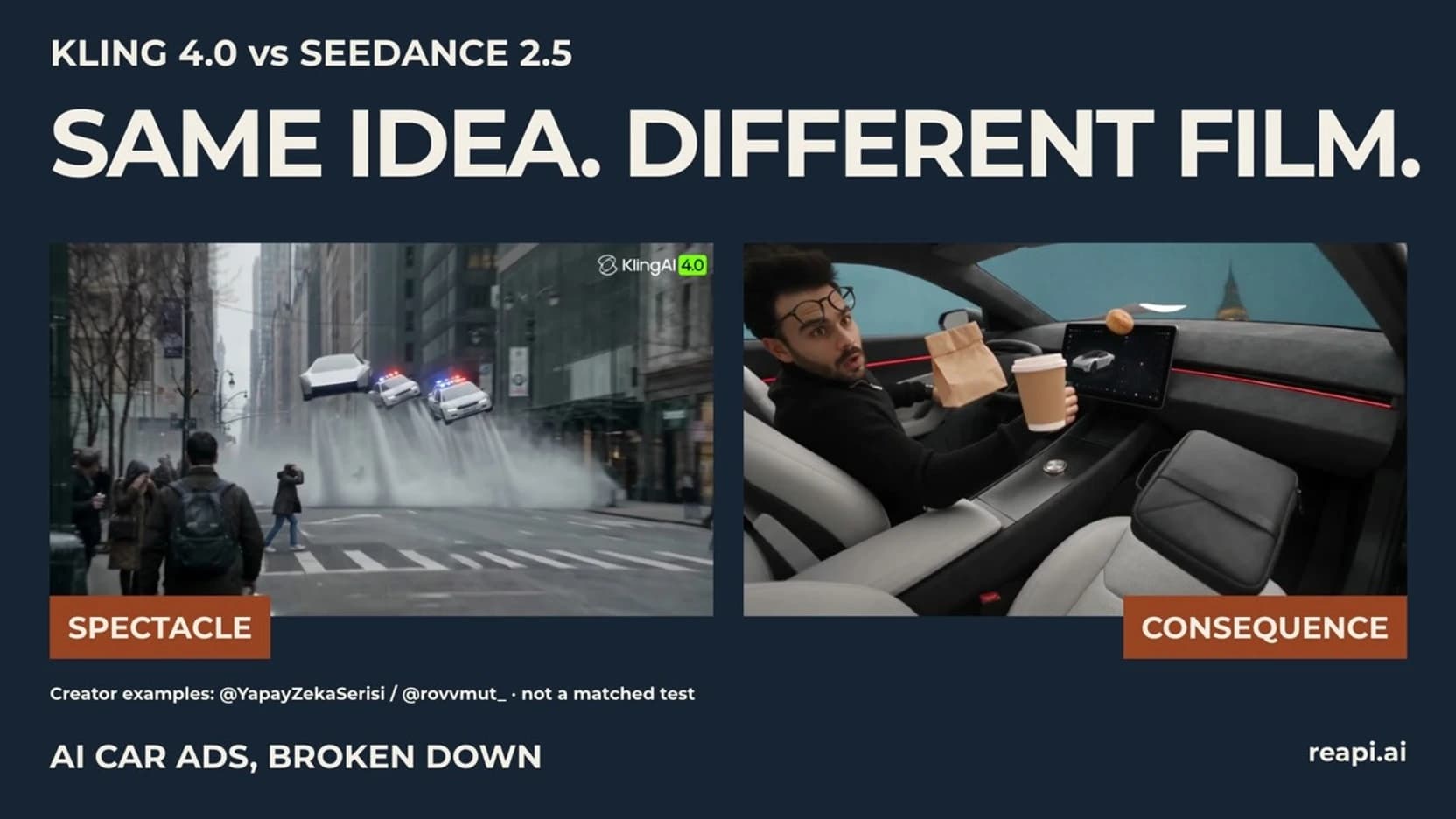
One flying car gets tangled in overhead cables. Another turns an escape from traffic into a coffee disaster. Our Kling 4.0 vs Seedance 2.5 video looks at two creator-made car ads that share a premise and pursue different payoffs: a city reacting to an impossible vehicle, and a driver's decision coming back to punish him[1].
The useful comparison is between these finished films. Their model labels come from their creators, and they do not form a controlled test with the same prompt and production process. For an editor, though, they offer specific things to study: how a scene makes flight feel consequential, how a joke survives a sequence of shots, and whether the advertised car stays recognizable.
Watch the two flying-car ads
The 1-minute, 54-second breakdown starts the Kling example at 0:17, the Seedance example at 0:39, and the discussion of motion versus product consistency at 0:59. The cover is the video's own thumbnail.
TL;DR
- The example attributed to Kling 4.0 uses a flying car's interaction with its surroundings as the spectacle. The original post is by @YapayZekaSerisi[2].
- @rovvmut_'s Seedance 2.5 example builds a comic sequence around escaping traffic and the consequences inside the car[3].
- The Seedance creator also published a shot-by-shot prompt. That gives us useful production context, but it is not a shared prompt used by both creators[4].
- Neither a convincing collision nor a successful joke establishes general model superiority. Review motion, narrative continuity and product identity separately.
- These are creator examples, not official Tesla campaigns or a new benchmark conducted by reAPI[1].
What Kling 4.0 vs Seedance 2.5 shows in these examples
The two ads give the flying-car idea different jobs. In our reading, the Kling example asks you to watch the world react. The Seedance example asks you to follow a person whose solution creates a new problem. That is a comparison of direction and execution in these clips, rather than a claim that either model is restricted to one style.
| What to inspect | Kling-attributed example | Seedance-attributed example |
|---|---|---|
| Main attraction | Flight and its effect on the surrounding street | The driver's choice and its comic consequences |
| Important relationship | Vehicle, obstacles and environment | Driver, vehicle and objects inside the cabin |
| Narrative emphasis | An impossible event becomes a physical situation | Escaping one inconvenience leads to another |
| Useful review question | Do contact and reaction make the action readable? | Can you follow the setup, decision and payoff across cuts? |
| What the clip cannot establish | Typical output quality or success rate for Kling 4.0 | Typical output quality or success rate for Seedance 2.5 |
The scene descriptions come from the published examples and our accompanying analysis[1][2][3]. The review questions are editorial criteria, not scores from an experiment.
Kling's flying car has a world to push against
The original post is a montage of several situations, rather than one continuous street scene[2]. The street and cable encounters are examples within that montage.
The overhead cables give the Kling example a useful complication. A vehicle floating through an empty sky can be visually striking, but there is little around it to explain its movement. Put obstacles in its path and the viewer has something to track: approach, contact and consequence[1].
That is why the environment deserves attention alongside the car. Watch where contact seems to happen, when the surrounding objects react, and whether the vehicle's next movement follows from that encounter. Those relationships can make an impossible premise easier to read without making it physically realistic.
For a car-ad brief, this suggests a concrete creative choice. If the point is the scale or audacity of the vehicle, give the viewer a setting that expresses it. A street, an obstacle and a reaction can communicate more than an instruction to make the shot “cinematic.” This is a lesson we draw from the scene, not a guarantee that a particular prompt will reproduce it.
A separate check still matters: inspect the car itself. A strong environmental reaction can attract enough attention that you miss a changing outline or inconsistent detail. Motion and product identity need their own review passes.
Seedance turns a shortcut into a story
The Seedance example gives the flying car a motivation: the driver wants to get out of traffic. The comic consequence is personal. Coffee becomes part of the problem, so the spectacle has a payoff tied to the person inside the vehicle[1][3].
There is more context here than the finished clip alone. In a follow-up post, @rovvmut_ publishes a ten-shot prompt for a rainy blue-hour sequence in London around Westminster Bridge. It specifies car and character references, objects floating inside the cabin, coffee hitting the driver's face, and a final encounter with a black taxi. It also asks for no music[4].
Those are instructions in the published prompt. They should not all be treated as independently confirmed properties of every generated frame or of the final audio. Their value for this analysis is that they reveal a planned chain of events. The scene has a setup, an attempted solution and a consequence, with props carrying part of the joke.
The cup matters because it links the action across moments. When reviewing a sequence like this, track who holds it, where it moves, and when the driver notices the result. A cut can preserve that relationship or make it hard to follow. Judge the finished sequence at normal speed before inspecting individual frames.
The published prompt makes the example more useful to learn from. It does not reveal a complete record of retries, discarded outputs or editing decisions, and it does not tell us how Kling would respond to the same instructions.
Convincing motion and product consistency are separate checks
A flying car can be entertaining while still needing work as a product film. The impossible movement is the premise. The vehicle's identity is what the audience needs to retain.
For that reason, review the footage twice. On the first pass, follow the action without pausing. Can you tell what the car is doing, what changes because of it, and why the next shot follows? On the second, compare the details that identify the product. The following is a proposed checklist, not a list of defects proven in these two ads.
| Review area | What to compare |
|---|---|
| Exterior identity | Body silhouette, proportions, windows, lights and wheel placement across shots |
| Interior continuity | Dashboard layout, seating, steering wheel and the positions of important props |
| Human action | Hand placement, eyeline and whether the driver's reaction follows the event |
| Contact | The apparent point of contact, the timing of the reaction and what happens immediately afterward |
| Edit continuity | Whether changes in angle preserve the action the viewer is following |
| Sound | Whether the delivered sound supports the action and the intended brief |
Passing one row does not resolve the others. A good joke does not establish stable car geometry. A consistent dashboard does not make an unclear sequence understandable. Keep notes specific enough that a revision has an identifiable target.
Turn the comparison into a shot brief
Before choosing a model, decide what your ad must communicate. Use the two examples as references for different intentions: an environment reacting to an extraordinary vehicle, or a person dealing with the consequences of using it.
A compact brief can record four decisions:
- Product: which visible features must remain consistent, and which reference images define them?
- Action: what single event should the viewer understand in this shot?
- Consequence: what changes in the environment or for the character because of that event?
- Acceptance: what would make the shot usable, and what specific change would make it unsuitable?
For example, an original concept could ask for an unbranded car to rise above stationary traffic while a loose object inside the cabin reacts to the ascent. The review would check that the car keeps its identity, the object stays trackable and the driver's reaction makes sense. This is an illustrative brief, not either creator's prompt or a test we ran.
If you then compare models, keep the intended shot, references and acceptance criteria aligned. Record the settings, attempts and editing work for each result. Save the rejected outputs too: a selected final clip cannot tell another creator how much work it took to obtain.
Use the Kling 4.0 model page and Seedance 2.5 model page to check their respective reAPI pages before planning an implementation. This article does not establish API access, current prices or identical controls for the two models.
FAQ
Which looks better for AI car ads, Kling 4.0 or Seedance 2.5?
These examples support a preference between two films, not a general model ranking. Choose the environmental interaction or character-driven payoff that fits your brief, then evaluate the relevant shots under comparable conditions.
Were the two ads made with the same prompt?
They are not presented as a matched-prompt comparison. The Seedance creator published a detailed prompt, but there is no verified common production protocol connecting the two examples[1][4].
Can I read the Seedance flying-car prompt?
Yes. The creator's follow-up post contains the shot plan and reference instructions. Read it alongside the finished example; instructions alone do not establish that every requested detail survived generation and editing[4].
Are these official Tesla advertisements?
They are presented here as creator-made concepts. Our video explicitly does not identify either as an official Tesla campaign[1].
Does realistic-looking flight prove accurate physics?
No. You can assess whether the motion and reactions look convincing in a clip. Establishing physical accuracy would require defined criteria and a separate evaluation, which this comparison does not provide.
Did reAPI generate or benchmark these two ads?
No. This article accompanies reAPI's analysis of published creator examples. We did not run a new matched generation test, measure success rates or reconstruct the creators' complete production histories[1].
Choose the shot before the model
The useful takeaway from Kling 4.0 vs Seedance 2.5 here is a choice of emphasis. One example makes flight interesting through the surrounding world; the other gives it a character and a comic consequence. Pick the relationship your ad needs to show, then check that the car, the action and the edit hold together. The video breakdown brings those choices back to the footage.
References
-
reAPI. Kling 4.0 vs Seedance 2.5: Two Flying Cars, Two Very Different Ads. Published and retrieved October 19, 2026. youtu.be/jaT_f2opb1Y
-
@YapayZekaSerisi. Creator post attributing a flying-car film to Kling 4.0. Retrieved October 19, 2026. x.com/YapayZekaSerisi/status/2111489781200761061
-
@rovvmut_. Seedance 2.5 flying-car concept. Retrieved October 19, 2026. x.com/rovvmut_/status/2111322341246681200
-
@rovvmut_. Published shot-by-shot prompt for the flying-car sequence. Retrieved October 19, 2026. x.com/rovvmut_/status/2111322887282184249