GPT Image 2.5 is live — OpenAI's newest image model, targeted edits that leave the rest of the frame alone

MAGI-2 — 480B Native Audio-Video Generation Model

Generate up to 30 seconds of 1080p, 25 fps video with synchronized speech, foley and music in one pass. MAGI-2 pairs omni-reference control across 20 assets with precision shot timing and targeted video editing.

MAGI-2 is released by Sand.ai. API access and live billing are not yet available on reAPI.

Native audio-videoOmni-reference (20)Timeline cut controlVideo editing
Highlights
480B MoE (~28B active) · 30s 1080p 25 fps · 20 references
Best for
Long-take native audio-video, multi-asset storytelling and commercial shots
Input
Text prompts + up to 10 images, 5 videos, 5 audio clips
Output
1080p 25 fps video with synced native audio · 6 aspect ratios

What is MAGI-2?

MAGI-2 is Sand.ai's flagship frontier video generation model, released on November 24, 2026 as the full-scale successor to the 114B Preview checkpoint. Built on a single-stream Transformer with Multi-Head Latent MoE, it scales to 480 billion total parameters (~28B active) trained on 4 trillion tokens. MAGI-2 outputs up to 30 seconds of 1080p, 25 fps video with synchronized dialogue, sound effects, ambience and music in one pass, while supporting up to 20 multimodal references, shot-cut timing and targeted video edits. The model is released by Sand.ai, and API integration on reAPI is not yet available.

What you can build with this model

Real-world workflows and production use cases you can build and ship with this model.

MAGI-2 native audio-video workflow poster showing a glass cinema frame strip and amber acoustic wave.

Generate 30-second native audio-video with MAGI-2

Create continuous 30-second scenes without stitching short clips or dubbing soundtracks afterward. The single-stream backbone produces picture, lip-synced speech, foley and ambient room tone together, keeping lighting and motion stable across long takes.

Check MAGI-2 availability
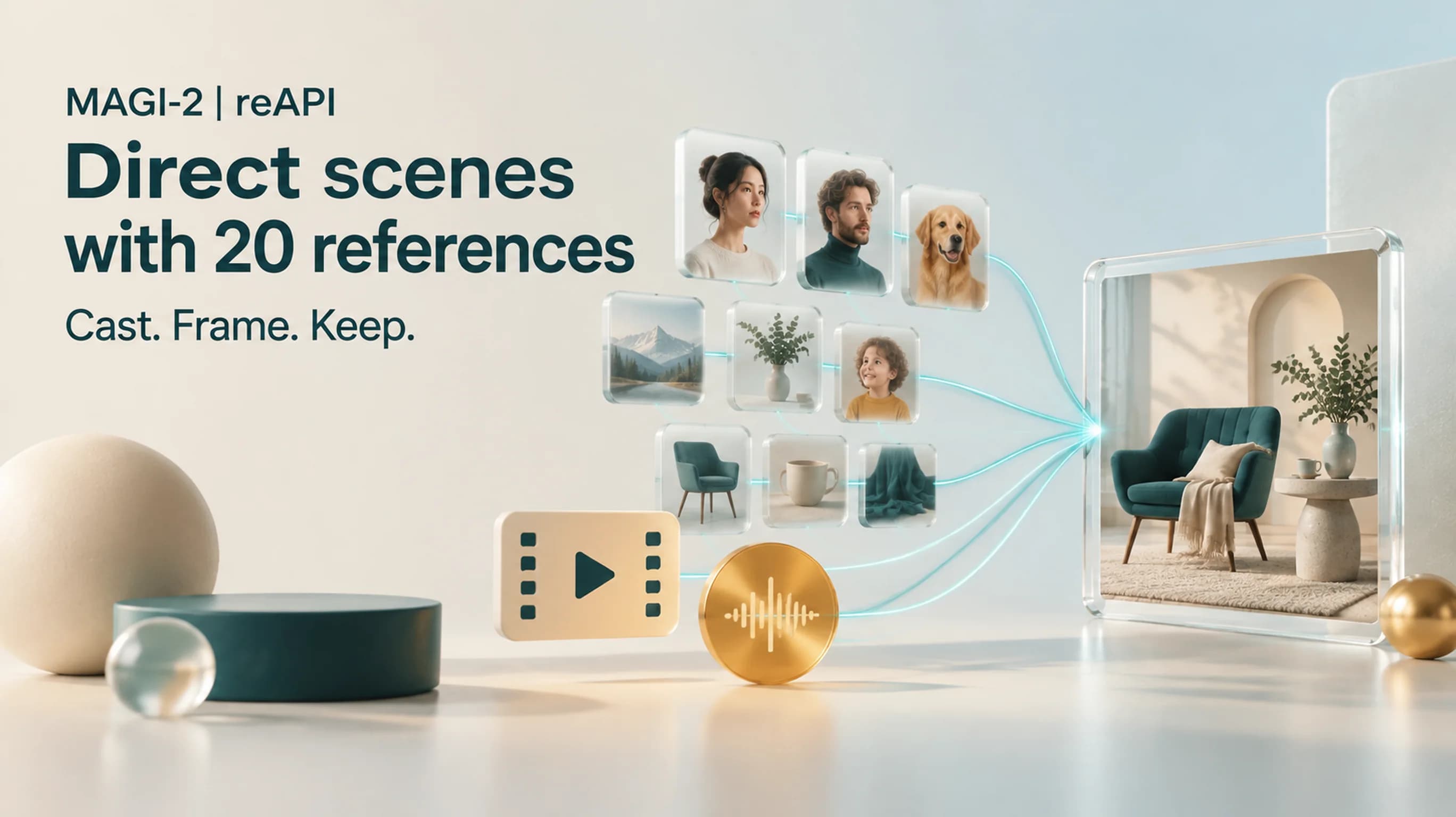
MAGI-2 omni-reference workflow poster showing portrait, film and sound tiles converging into a master frame.

Direct scenes with 20 references in MAGI-2

Supply up to 10 images, 5 videos and 5 audio clips in one native request to anchor characters, props, visual style and voices. During 1080p upscaling, MAGI-2 re-injects original reference images so small faces and on-screen text stay legible across long shots.

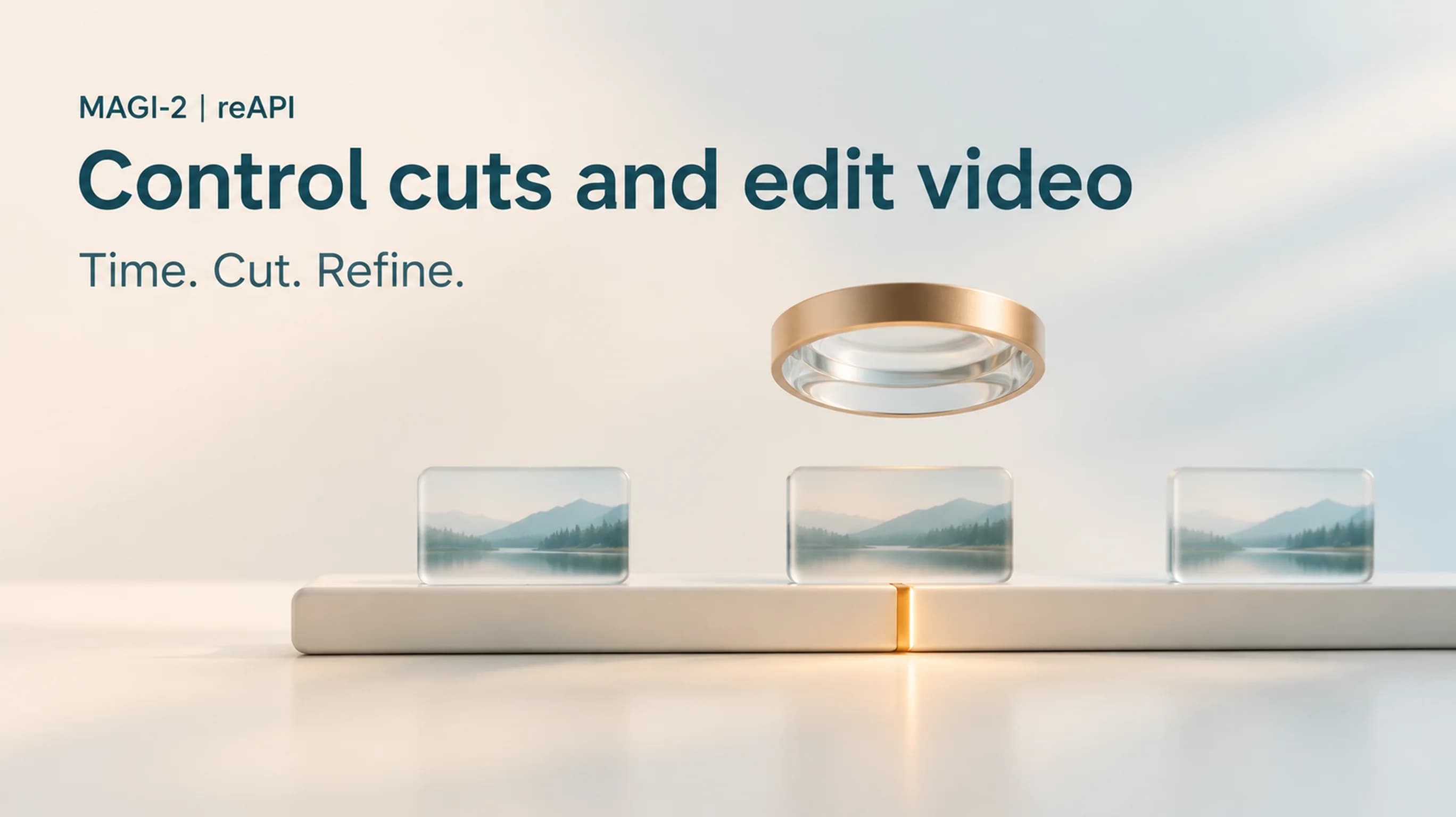
MAGI-2 timeline and editing workflow poster showing a ceramic timeline rail with shot markers and optical loupe.

Control cuts and edit video with MAGI-2

Specify exact beat timing, shot cuts and camera progression, or let the model plan framing and transitions from brief story beats. Production teams can also apply targeted edits to existing footage while preserving surrounding scene continuity.

Why teams evaluate MAGI-2

480B sparse scale without dense overhead

MAGI-2 activates roughly 28 billion parameters per token out of 480 billion total via Multi-Head Latent MoE and Head Parallelism. Scaling capacity 4x and data 3x over the August Preview raised its Artificial Analysis Video Arena v2.1 four-task average by +151.8 Elo to 1150.3.

Reference re-injection for sharp 1080p upscaling

Instead of stretching soft base frames, the latent spatiotemporal upscaler draws directly on raw reference images during reconstruction. That design keeps small facial identity, fine textures and text readable over full 30-second sequences.

Generation, timing and editing in one model

Rather than splitting text-to-video, reference conditioning and footage edits across separate tools, MAGI-2 handles all three inside a single pipeline. Creators get six aspect ratios, 20-asset omni-reference and precision cut control in one workflow.

How to evaluate MAGI-2 for your pipeline

  1. step 01

    Review MAGI-2 specs and limits

    Check whether the output envelope fits your delivery target: up to 30 seconds, 1080p at 25 fps, six aspect ratios and 20 multimodal references. Factor in Sand.ai's stated caveats on extreme high-speed motion and fine 2D animation.

    Open
  2. step 02

    Compare MAGI-2 against live alternatives

    Weigh MAGI-2 against Seedance 2.5 on resolution ceiling, reference caps and current API readiness. If you need 4K output or immediate production API calls today, compare both options side by side below.

    Open
  3. step 03

    Explore live video models on reAPI

    MAGI-2 is not yet callable through reAPI. While integration is pending, browse active video generation models in the reAPI catalog to run multi-reference and native-audio workflows immediately.

    Open

Capabilities

Unified audio-video backbone

MAGI-2 processes text, video and audio tokens inside one single-stream Transformer so lip-sync, foley, ambient acoustics and music evolve together from the start.

30-second 1080p output at 25 fps

Generates continuous clips up to 30 seconds at 1080p and 25 fps across six aspect ratios, backed by RL post-training and latent spatiotemporal upscaling.

20-item omni-reference control

Each native request accepts up to 20 media references—up to 10 images, 5 videos and 5 audio clips—to lock character identity, motion and sound.

Timeline and shot-cut control

Direct exact cut timestamps and camera choreography, or provide high-level story beats for autonomous camera planning and shot transitions.

Targeted video editing

Apply directed edits to existing video footage inside MAGI-2 without rebuilding the entire sequence from scratch.

Video Arena v2.1 benchmark jump

Sand.ai reports a 1150.3 four-task average Elo for MAGI-2 on Artificial Analysis Video Arena v2.1 (I2V, I2V-Silent, T2V-Silent, T2V), up from 998.5 on Preview.

MAGI-2 vs Seedance 2.5

Both models target 30-second native audio-video production with multi-asset references and video editing. The table below compares publicly documented capabilities from Sand.ai's announcement and reAPI's live Seedance 2.5 specification.

Capability
MAGI-2
Seedance 2.5
Max clip length
Up to 30 seconds in a single pass
4–30 seconds (plus auto length in edit mode)
Resolution & frame rate
1080p at 25 fps across 6 aspect ratios
480p, 720p, 1080p and 4K (4K requires content filter off)
Native audio
Synchronized dialogue, foley, ambience and music
Synchronized speech, SFX and music (toggleable)
Multimodal references
Up to 20 items (10 images, 5 videos, 5 audio clips)
Up to 30 images, 10 videos and 10 audio clips + first/last frame
Open weights status
114B Preview open; 480B open weights announced as upcoming
Proprietary hosted model
reAPI availability
Model released by Sand.ai; reAPI API not yet available
Live on reAPI with playground and API docs

Sources: Sand.ai MAGI-2 release blog (November 24, 2026) and reAPI's live Seedance 2.5 configuration, checked November 25, 2026. Visual quality depends on prompt, references and output settings.

Frequently asked questions

Common questions about this model.

MAGI-2 is Sand.ai's flagship 480B-parameter video generation model released on November 24, 2026. Built on a single-stream Transformer with Multi-Head Latent MoE (~28B active parameters) and trained on 4 trillion tokens, it generates up to 30 seconds of 1080p, 25 fps video with native synchronized audio.

MAGI-2 is not currently available for billing or API calls on reAPI, so no reAPI rate applies yet. Sand.ai has stated it plans to open-source the flagship weights and publish a technical report following the November 2026 launch, while hosted commercial access is offered through partner platforms.

No reAPI subscription or credit spend is required because MAGI-2 is not yet integrated on reAPI. Live video models on reAPI run pay-as-you-go with no monthly subscription; access terms on external platforms are set by those providers.

API access for MAGI-2 is not yet live on reAPI, so reAPI keys cannot call it today. You can monitor Sand.ai's official API Platform or explore live video models already available on reAPI while integration is pending.

MAGI-2 Preview (released August 5, 2026) was a ~114B total / ~6B active open-source research checkpoint. Flagship MAGI-2 scales parameters more than 4x to 480B total (~28B active), expands pre-training data roughly 3x to 4T tokens, adds RL post-training and 1080p reference-re-injected upscaling, and raises Artificial Analysis Video Arena v2.1 four-task average Elo from 998.5 to 1150.3.

According to Sand.ai's release announcement, MAGI-2 generates up to 30 seconds of continuous video in a single pass at 1080p resolution and 25 fps across six aspect ratios, with native synchronized audio included.

Sand.ai documents omni-reference support for up to 20 media items per native request, combining up to 10 images, 5 videos and 5 audio clips to guide characters, style, motion and sound.

Not yet for the full 480B flagship checkpoint. As of the November 24, 2026 announcement, the 114B Preview is already open-sourced on GitHub and Hugging Face, while Sand.ai states that open-source weights and a detailed technical report for flagship MAGI-2 will follow soon.

Yes. Because it uses a single-stream architecture over text, video and audio tokens, it generates lip-synced dialogue, foley, ambient room tone and music natively alongside the video frames rather than layering audio afterward.

Sand.ai's release post notes four active limitations: extreme high-speed motion can occasionally show trajectory or continuity artifacts, medium- and wide-shot 2D animation can look overly smooth in fine local motion, complex soundscapes need richer physical layering, and aesthetics-focused post-training narrows some pre-trained reasoning and cross-lingual generalization.

Both models generate up to 30-second native audio-video clips with multimodal references and video editing. MAGI-2 focuses on 1080p at 25 fps with a 480B MoE architecture and announced upcoming open weights, whereas Seedance 2.5 is live on reAPI today, supports up to 4K resolution and accepts up to 30 images, 10 videos and 10 audio clips.

Not yet. This page is a factual guide to Sand.ai's release. Once reAPI adds API integration for MAGI-2, live pricing, playground controls and endpoint documentation will be published here.
MAGI-2

Track MAGI-2 or start building with live video models

API access for MAGI-2 is not yet live on reAPI. Read the FAQ for verified specs and open-weight status, or browse active video models ready to call today.