Seedance Credits and Quotas: Why the Balance Runs Out
How many clips a credit balance buys depends on resolution, duration and input mode at once. Per-second billing answers the same question with multiplication.
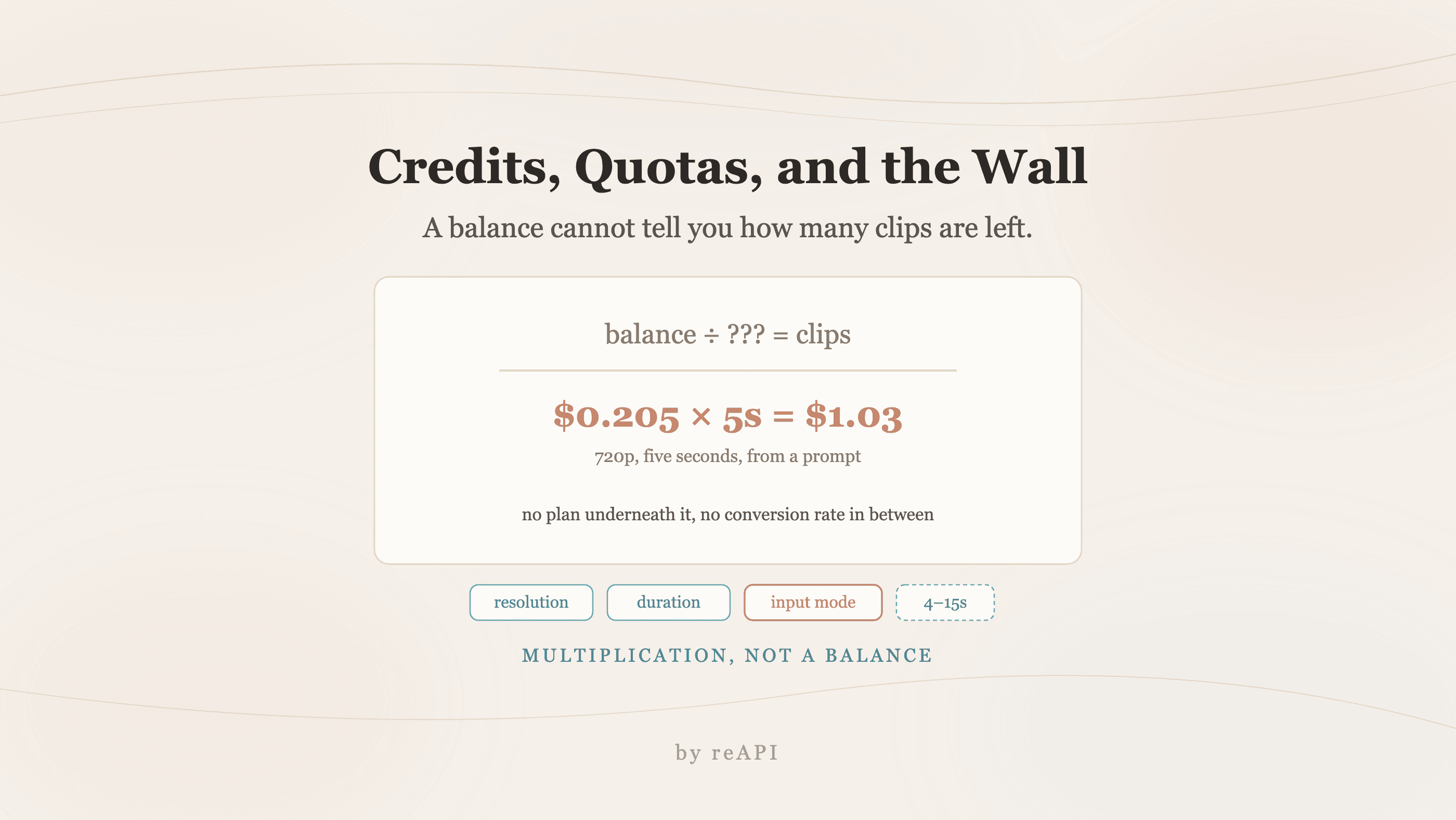
"How many clips does my plan get me" is a question with no stable answer, and that is the actual problem. Credits convert to clips at a rate that changes with resolution, duration, and settings you may not be watching, so the number of videos left in a subscription is never a number you were told.
Per-second billing answers the same question with arithmetic instead.
TL;DR
- Credits hide the exchange rate. The same balance buys a different number of clips depending on resolution, length, and input mode.
- Per-second billing makes the conversion explicit:
ceil(rate × billable seconds × 1,000)credits. - A 5-second 720p Face clip is $0.769 without source video. With a 5-second source video, it is $0.938[1].
- Resolution is the steepest lever, roughly 11x from 480p to 4K.
- Duration must be 4–15 seconds; out-of-range requests are rejected rather than clamped.
- There is no "unlimited" on any per-second model. What there is, is a rate you can multiply.
Why credit balances never answer the question
A credit is a unit the platform defines, and a clip consumes a variable number of them. Three things move the conversion, usually at once:
Resolution. A 1080p clip does not cost twice a 480p one; on the underlying per-second rates it is closer to five times.
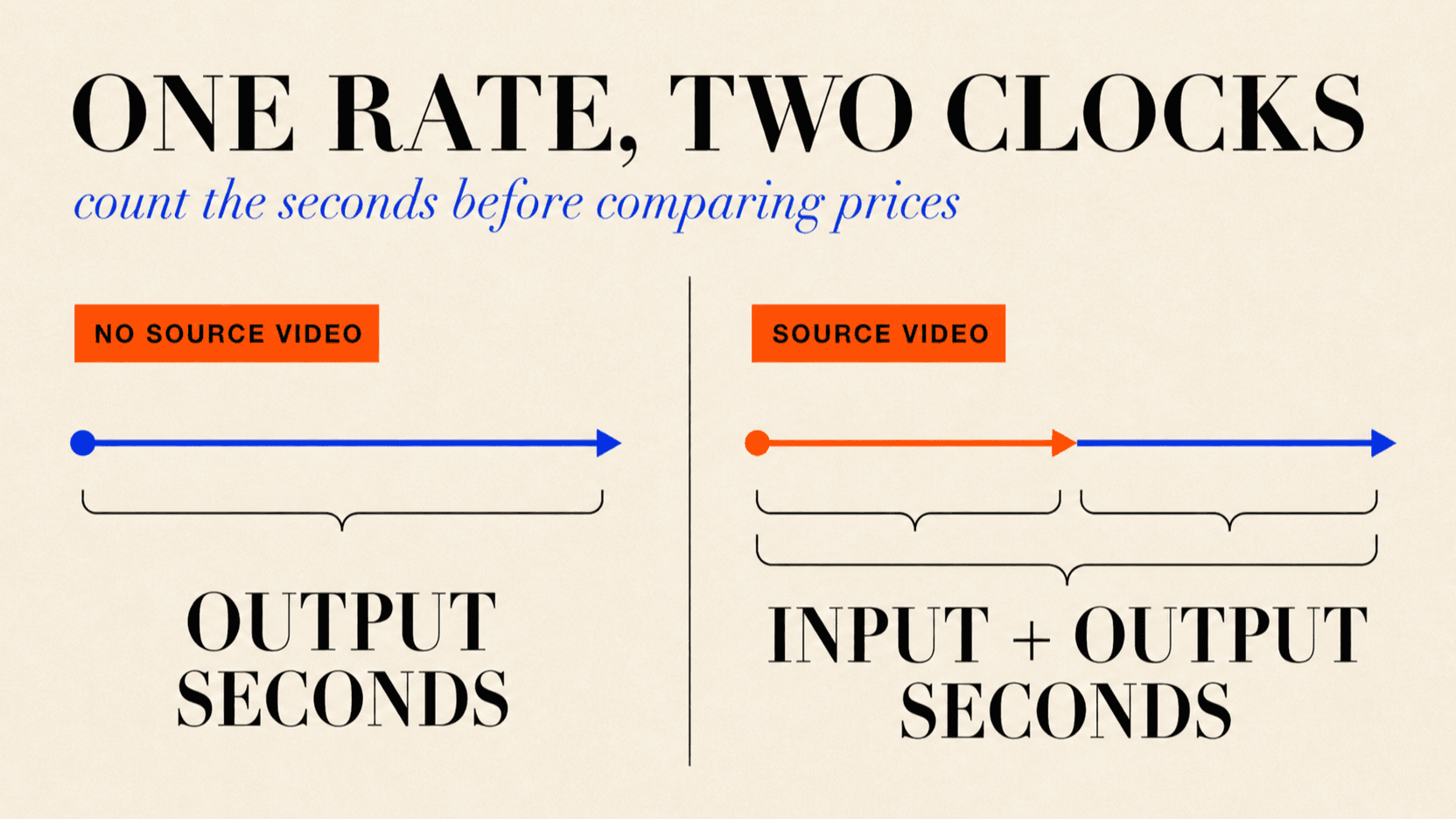
Duration. Without source video, billing follows output duration. When video_urls is present, the rounded-up total source-video duration is added to the output duration.
Input mode. On Seedance, supplying an uploaded source video moves the request onto a lower rate and a longer billing clock. Supplying an image does neither.
Multiply those together and "how many videos do I have left" has no single answer, which is why the question keeps getting asked and never gets a satisfying reply.
What per-second billing looks like
Rates per billed second on the public Face route[1]:
| Resolution | From a text prompt | With an uploaded video |
|---|---|---|
| 480p | $0.07125 | $0.043125 |
| 720p | $0.15375 | $0.09375 |
| 1080p | $0.3825 | $0.2325 |
| 4K | $0.780 | $0.480 |
Fast Face runs lower still at 480p and 720p: $0.086 and $0.182 without source video, $0.05 and $0.11 with one. Mini is listed separately at $0.05 and $0.108 without source video, $0.032 and $0.066 with one.
Now the same question, answered:
| What you want | Cost |
|---|---|
| One 5-second 720p Face clip, no source video | $0.769 |
| One 10-second 1080p Face clip, no source video | $3.825 |
| 100 five-second 720p Face clips, no source video | $76.90 |
| 1,000 five-second 480p drafts on Fast Face | $310 |
No balance to track, no conversion rate, no wall that arrives mid-project.
The formula
billable seconds = output seconds + ceil(total source-video seconds)
credits = ceil(per-second rate × billable seconds × 1,000)
cost = credits × $0.001
For a mixed workload, sum the seconds per configuration and multiply each by its own rate. That is the whole model.
Two constraints attached to it[1]:
Duration must be an integer from 4 to 15 seconds. Out-of-range requests are rejected rather than rounded or billed. Longer pieces are assembled from multiple generations, each billed separately.
The lower rate needs an uploaded video specifically. Image inputs and first/last-frame references stay on the base rate. A source-video request also bills the output duration plus the rounded-up total source-video duration. Details are in Seedance 2.0 cost per second.
About "unlimited"
There is no unlimited tier on a per-second model, and it is worth being direct about why rather than pretending otherwise.
Generating video costs compute that scales with output length and resolution. Any plan advertising unlimited generation is either rate-limiting you somewhere you cannot see, degrading quality or queue priority under load, or reserving the right to change the terms. The cost does not disappear; it moves somewhere less visible than a line item.
Per-second pricing is the opposite trade. You give up the comfort of a flat monthly number and get an invoice you can predict to the cent before you run anything.
Controlling spend without a quota
Draft cheap, render once. 480p on Fast Face is $0.086 per second, so a 5-second iteration costs about 28 cents. Iterate there, then render the approved shot at delivery resolution. The Face route's 480p-to-4K spread is roughly 11x.
Count both clocks before feeding video. The source-video rate is about 39% lower at 720p Face, but the source duration becomes billable. Compare the full request total rather than the rate alone.
Cap duration deliberately. Every second bills. A 15-second clip where 8 would do is nearly double the cost for the same shot.
Forecast before you build. Multiply expected seconds by rate for each configuration and you have a monthly number before writing the integration.
curl https://reapi.ai/api/v1/videos/generations \
  -H "Authorization: Bearer YOUR_API_KEY" \
  -H "Content-Type: application/json" \
  -d '{
    "model": "doubao-seedance-2.0-face",
    "prompt": "product hero on a stone counter, soft window light, slow orbit",
    "resolution": "480p",
    "duration": 5
  }'
That request costs $0.357 after credit rounding. The same prompt at 1080p costs $1.913. Live rates are on reapi.ai/models/seedance-2-0.
Image generation works the same way
Per-image rather than per-second, same principle of a knowable unit[2]:
| Model | Per image |
|---|---|
| Nano Banana 2 Lite | $0.022 |
| Seedream 5.0 Pro (1K) | $0.045 |
| Nano Banana Pro (1K/2K) | $0.053 |
Twenty drafts on Lite plus one final on Pro is about $0.33 for the set at October 22, 2026 rates. There is no plan underneath that number either.
FAQ
How many videos can I generate before credits run out?
On a per-second model the question does not apply: each completed request consumes its calculated credits. At $0.769 for a 5-second 720p Face clip without source video, a $100 budget covers 130 complete clips[1].
How much does one Seedance 2.0 video cost?
A 5-second 720p Face clip without source video is $0.769. With a 5-second source video, it is $0.938 because both source and output duration are billed[1].
Is there an unlimited Seedance plan?
Not on per-second billing. Any unlimited offer is limiting somewhere less visible, because output length and resolution consume compute that scales.
Why did my costs jump when I switched to 1080p?
Because resolution is the steepest lever. 1080p is roughly five times 480p per second, and 4K is roughly eleven times[1].
Does a failed or short generation still cost?
Failed tasks are refunded automatically. Successful requests follow whole-request credit rounding; requests outside the 4–15-second duration range are rejected.
How do I cut cost without cutting quality?
Draft at 480p on Fast Face and render only the approved shot at delivery resolution. If the pipeline sends source video, include its duration in the forecast.
Do image models bill the same way?
Per image rather than per second, but with the same property: one knowable unit, no conversion rate[2].
How do I forecast a monthly bill?
Calculate each request from its rate and billable seconds, apply whole-request credit rounding, and sum the credits.
Trading a comfortable number for a knowable one
Credit systems feel simpler because they produce one figure a month. They are harder to plan with, because the figure that matters, cost per finished clip, is derived from a conversion rate that moves with three variables at once.
Per-second billing inverts that. There is no monthly comfort number, and there is no wall arriving in week three either. What there is, is a rate table and multiplication, which is enough to answer "what will this campaign cost" before anyone approves it. For anyone who arrived here because a credit balance ran out mid-project, that is the actual difference.
References
- reAPI. Seedance 2.0 and Seedance 2.0 Mini model pages — live rates by resolution, variant, and source-video mode. Retrieved August 17, 2026 from reapi.ai/models/seedance-2-0 and reapi.ai/models/seedance-2-0-mini
- reAPI. Model catalog — per-image rates for the image models. reapi.ai/models
Further reading
- reAPI. Seedance 2.0 cost per second. reapi.ai/blog/seedance-2-0-cost-per-second
- reAPI. Where to use Seedance 2.0. reapi.ai/blog/where-to-use-seedance-2-0
- reAPI. Nano Banana Pro vs Nano Banana 2. reapi.ai/blog/nano-banana-pro-vs-nano-banana-2
Author

Categories
More Posts

Seedance 2.5 vs Seedance 2.0: Which Fits Your Workload?
Seedance 2.5 vs Seedance 2.0 compared with live per-second prices: 30s takes and video edits on 2.5, 1080p/4K and cheaper tiers on 2.0. Pick by workload.

Hailuo AI Compared: Seedance 2.5, Kling 3.0, Veo 3.1 Prices
How does Hailuo AI compare to other AI video generators? MiniMax H3 vs Seedance 2.5, Kling 3.0, and Veo 3.1 on price per second, duration, audio, and refs.
How to Use Claude Sonnet 5: Effort, Cost, and Limits
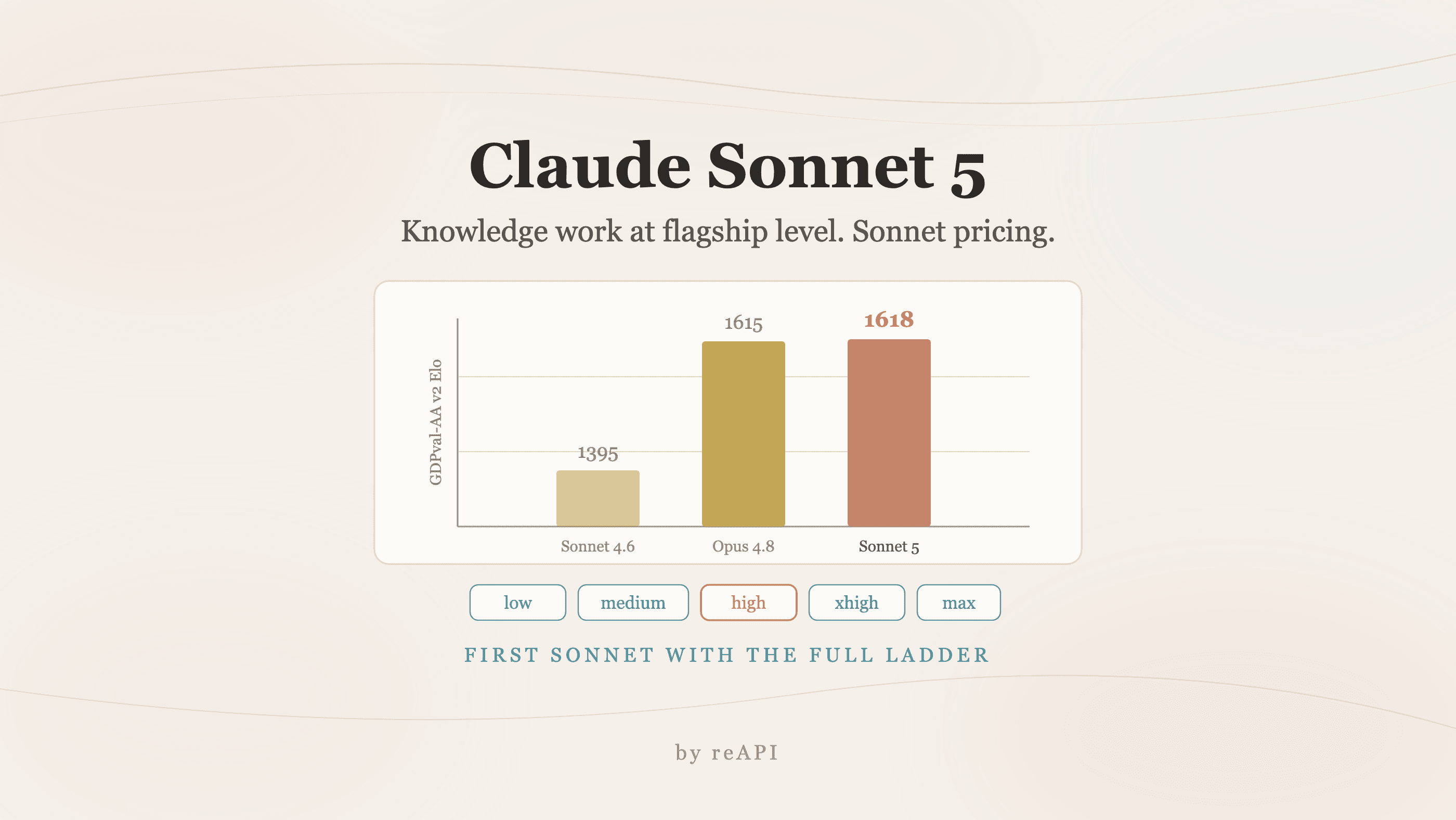
How to use Claude Sonnet 5: benchmarks against Opus 4.8, the effort ladder that drives cost, the denser tokenizer that inflates bills, and migration steps.