Seedance 2.5 vs Seedance 2.0: Which Fits Your Workload?
Seedance 2.5 vs Seedance 2.0 compared with live per-second prices: 30s takes and video edits on 2.5, 1080p/4K and cheaper tiers on 2.0. Pick by workload.
Seedance 2.5 vs Seedance 2.0 is not an "old model vs new model" question. The two generations sit on the same API, share the same per-second billing, and as of August 2026 both are fully live — but they solve different problems. Seedance 2.5 stretches a single take to 30 seconds, accepts up to 50 reference assets, and adds a prompt-driven video-edit mode. Seedance 2.0 still owns everything 2.5 gave up to get there: 1080p, 4K, and the two cheapest tiers in the family.
I maintain both integrations, so this comparison uses the live prices and request schemas straight from the model pages, not marketing copy. Here is where each one actually wins.
TL;DR
- Seedance 2.5 generates 4–30 second clips (or picks the length itself with
duration: -1); Seedance 2.0 tops out at 15 seconds[1]. - Seedance 2.5 accepts 30 reference images + 10 videos + 10 audio tracks per request, and audio can be the only input. Seedance 2.0 caps at 9 + 3 + 3[3].
- Seedance 2.0 is the only one of the two that outputs 1080p and 4K. Seedance 2.5 serves 480p and 720p, full stop[1].
- On the same 720p text-to-video job, Seedance 2.0 Face costs about 42% less per second ($0.15375/s vs $0.267/s)[1][2].
- Video editing ("replace the outfit", "remove the background music") is a 2.5-only task type and requires
duration: -1[3]. - Real-person reference images work on both generations through the same automated review flow.
What actually changed between Seedance 2.0 and Seedance 2.5
Three limits moved, and each one unlocks a workflow rather than a spec-sheet bragging point.
Single takes doubled. Seedance 2.0 generates 4 to 15 seconds per request. Seedance 2.5 goes to 30, and it can also decide the length itself: pass duration: -1 and the model picks the best cut within the window. Billing for auto duration reserves at the 30-second cap and settles to the actual output length once the clip renders, so you never pay for seconds that were not generated[4]. For dialogue scenes and UGC-style ads, 16–30 seconds in one take means no stitching and no continuity drift between segments.
Reference capacity tripled or better. A 2.5 request carries up to 30 images, 10 video clips, and 10 audio tracks, and you can address them in the prompt ("use the composition of @video1, @audio1 as the soundtrack"). A pure audio reference now works with no image or video attached, which 2.0 rejects. If your pipeline builds videos from a brand-asset folder rather than a single still, this is the difference between one request and a pre-processing step.
Editing became a task type. Seedance 2.5 classifies each request as text-to-video, reference-to-video, video edit, video extend, or first/last-frame — based on which fields you send and what the prompt asks for. Write "replace the dancer's dress with a red one" against a source clip and the model performs an edit whose output keeps the source's aspect ratio and length (within about 0.4 seconds)[3]. Seedance 2.0 has no equivalent; the nearest workaround is regenerating the whole scene and hoping.
Where Seedance 2.0 still wins: 1080p, 4K, and the cheap tiers
The honest half of the Seedance 2.5 vs Seedance 2.0 decision is that 2.5 removed things.
Resolution. Seedance 2.0 outputs 480p, 720p, 1080p, and 4K. Seedance 2.5 outputs 480p and 720p only — the request validator rejects anything higher before it ever reaches the model[4]. If the deliverable is a hero asset for a landing page or anything a client will view full-screen on a monitor, 2.0 remains the only option in the family.
Price per second. At the same resolution, 2.0 undercuts 2.5 at every tier. The Face 720p text-to-video rate is $0.15375/s on 2.0 against $0.267/s on 2.5. And 2.0 has Fast Face below that ($0.132/s at 720p) plus a separately listed Mini tier below Fast Face for bulk drafting[2]. High-volume pipelines that iterate dozens of drafts per final cut feel this difference immediately.
Maturity. Two generations of prompt guides, community examples, and internal tooling exist for 2.0. If a workflow already hits its quality bar on 2.0, the upgrade question is not "is 2.5 better" but "does anything on this list justify a 42% higher per-second rate". Often the answer is no.
Per-second pricing compared: what a 5-second clip really costs
Both generations bill output duration at the base rate. An actual source video selects a lower rate but changes the billing clock; 2.5 also enforces a minimum of ceil(5 / 3 × output). Live rates from the model pages, August 2026[1][2]:
| Tier (per second) | Seedance 2.5 | Seedance 2.0 Face | Seedance 2.0 Fast Face |
|---|---|---|---|
| 480p, text-to-video | $0.119 | $0.07125 | $0.062 |
| 480p, with source video | $0.071 | $0.043125 | $0.036 |
| 720p, text-to-video | $0.267 | $0.15375 | $0.132 |
| 720p, with source video | $0.160 | $0.09375 | $0.080 |
| 1080p, text-to-video | not available | $0.3825 | not available |
| 4K, text-to-video | not available | $0.780 | not available |
Concrete jobs:
- A 5-second 720p text-to-video draft: $0.769 on 2.0 Face, about $1.33 on 2.5.
- A 30-second 720p dialogue scene in one take: $8.00 on 2.5 — and simply impossible as a single generation on 2.0 (two 15-second takes cost $4.61 but need stitching and won't hold continuity).
- A 5-second 4K product hero: $3.90 on 2.0, no 2.5 equivalent at any price.
One billing note that applies to both: on reference jobs the input video's seconds bill on top of the output seconds, so a 10-second source plus a 5-second output is billed as 15 reference-tier seconds. The full formula, including 2.5's minimum-billing floor, is in the API docs[4].
Video editing and auto duration: the 2.5-only workflow
This pair of features is the strongest reason to move, so it deserves the fine print.
The edit/extend classification is decided by the model from your prompt wording. Phrases like "edit the video", "add", "remove", "replace", or "change X" against reference material trigger the video-edit task type — and that task type accepts only duration: -1 and an adaptive aspect ratio. Send a fixed duration with an edit-style prompt and the task fails asynchronously with a parameter error (fully refunded, but you lose the round trip)[3].
In practice this means two things for integration code. First, expose -1 as a first-class value, not an error case. Second, if users type free-form prompts, expect the occasional reclassification: a prompt that merely mentions "removing the background" of a scene can flip a reference job into an edit job. The model page's task-type table documents the trigger words worth avoiding in plain generation prompts[4].
Auto duration also changes cost behavior in your favor. A -1 request reserves at the 30-second maximum, then settles to what was actually produced — an edit of a 6-second source settles at roughly 6 seconds, not 30. Budget alerts that key off the reserve amount will over-report until the settle lands.
How to run the comparison on your own footage
Model choice arguments end quickly when you run the same brief through both. The procedure that gives clean numbers:
- Pick one representative brief per workload (product ad, dialogue scene, image-to-video post).
- Generate on 2.0 Face at your target resolution, then on 2.5 at 720p, same prompt and references.
- Count usable shots per 10 generations, not aesthetic scores. A model that lands 6/10 usable at $1.33 beats one that lands 3/10 at $0.77.
- For anything involving source-video edits or 16+ second takes, 2.0 cannot enter the comparison — that work routes to 2.5 by default.
Both models sit behind the same endpoint with the same auth and task polling, so an A/B harness is a one-line model-id swap.
FAQ
Is Seedance 2.5 a drop-in replacement for Seedance 2.0?
Mostly. Both use the same async endpoint and task polling. The request shape differs in limits (duration range, reference counts) and 2.5 rejects 1080p/4k resolution values that 2.0 accepts, so validation-level code needs the per-model ranges.
Can Seedance 2.5 generate 1080p or 4K video?
No. Seedance 2.5 serves 480p and 720p only. For 1080p and 4K output, use Seedance 2.0 Face, which offers both.
Which is cheaper, Seedance 2.5 or Seedance 2.0?
Seedance 2.0, at every shared resolution. Its Face 720p text rate is $0.15375/s against $0.267/s for 2.5, and its Fast Face and Mini tiers go lower still. Choose 2.5 when the capability gap (length, references, editing) saves you more than the rate difference costs.
How long can a Seedance 2.5 video be compared to 2.0?
Seedance 2.5 generates 4–30 seconds per request, or picks a length itself with duration: -1. Seedance 2.0 generates 4–15 seconds. Both can chain longer sequences by passing the returned last frame into the next request.
Do both models support real-person reference images?
Yes. Both generations accept real-person reference images and videos; reference material passes an automated review before generation, and rejected material fails with a clear moderation error and a full refund.
What happens if I send a fixed duration with an edit prompt on Seedance 2.5?
The model classifies the request as a video edit, which requires duration: -1, and the task fails asynchronously with a parameter error. The reserve is fully refunded. Remove the edit phrasing or switch to -1.
Does Seedance 2.0 get the video-edit mode?
No. Video edit and video extend are Seedance 2.5 task types. On 2.0 the closest option is regenerating the scene with adjusted prompts or references.
Picking a generation in practice
Route by workload, not by version number. Send to Seedance 2.5 when the job needs takes longer than 15 seconds, more than a handful of references, audio-only conditioning, or any edit/extend operation on existing footage. Send to Seedance 2.0 when the deliverable is 1080p or 4K, when the shot fits in 15 seconds, or when volume economics matter more than the new capabilities — its Fast tier produces 720p drafts at less than half the 2.5 rate.
The two share billing, auth, and task lifecycle, so most production setups end up using both: 2.0 Fast for iteration and high-res finals, 2.5 for long takes and edits. That split, rather than a wholesale migration, is the practical answer to Seedance 2.5 vs Seedance 2.0 in 2026.
References
- reAPI. Seedance 2.5 — model page with live per-second pricing. Retrieved August 2026 from reapi.ai/models/seedance-2-5
- reAPI. Seedance 2.0 Face, Fast Face, and Mini — model pages with live pricing and source-video billing. Retrieved August 17, 2026 from reapi.ai/models/seedance-2-0 and reapi.ai/models/seedance-2-0-mini
- ByteDance Volcano Engine. Doubao Seedance 2.5 tutorial — task types, duration and aspect-ratio constraints. Retrieved August 2026 from docs.volcengine.com/docs/82379/2607688
- reAPI. Seedance 2.5 API reference — request schema, task types, and billing notes. Retrieved August 2026 from reapi.ai/docs/seedance-2-5
Author

Categories
More Posts

AI Image Generation Cost vs Video: 2-9x More Per Frame
AI image generation cost per megapixel runs 2 to 9 times a frame of generated video. The per-frame math across eight video tiers and seven image models.

What Is reAPI? Models, Pricing, and How to Use It in 2026
reAPI provides chat and media APIs for 200+ image, video, audio, and language models. Here is what it does, what it costs, and how to make your first call.
How to Use Claude Code: Anthropic's Terminal Coding Agent
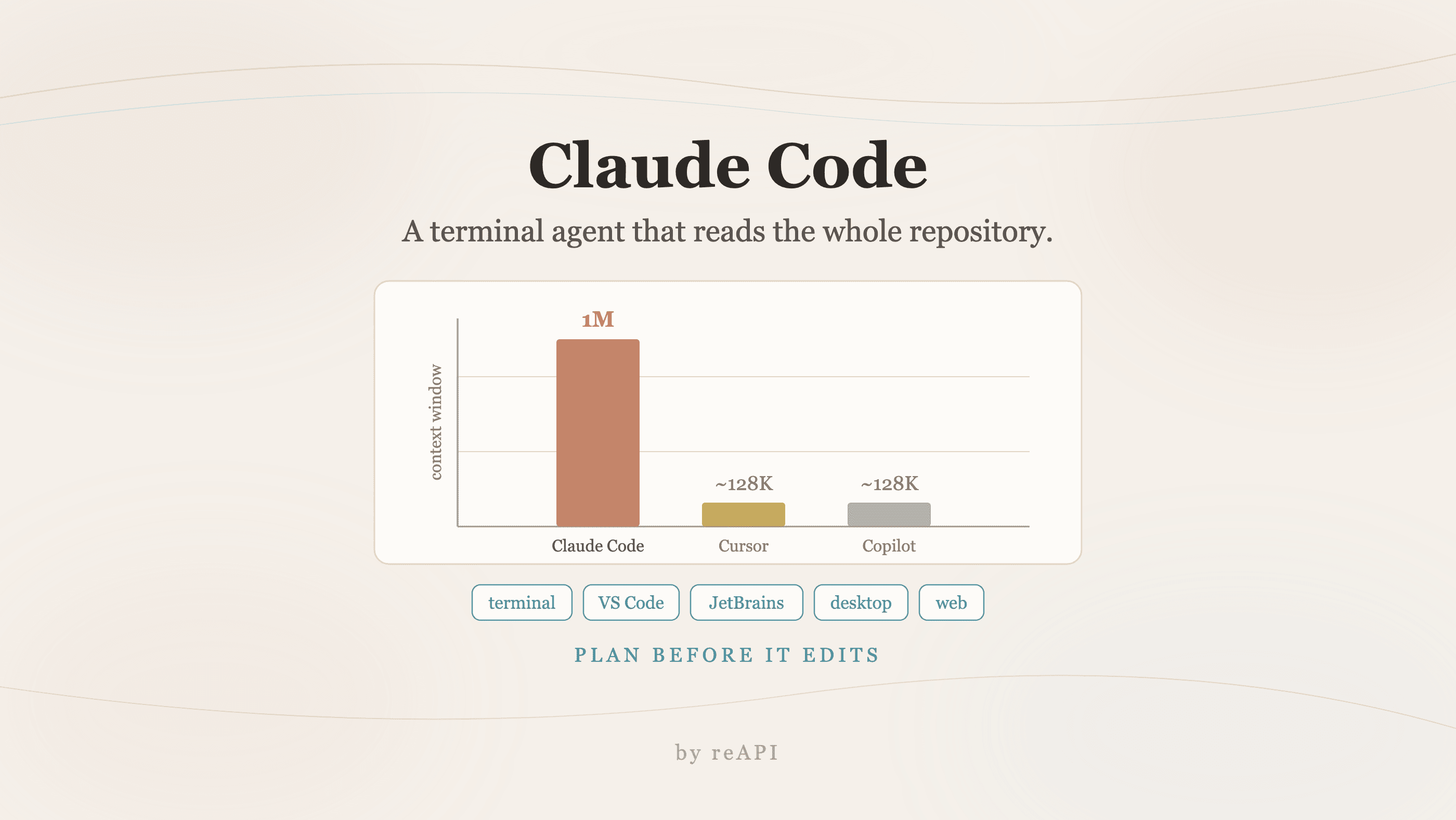
How to use Claude Code: the 1M token context window, 80.8% SWE-bench score, Plan Mode, every surface it runs on, installation, and how it compares to Cursor.