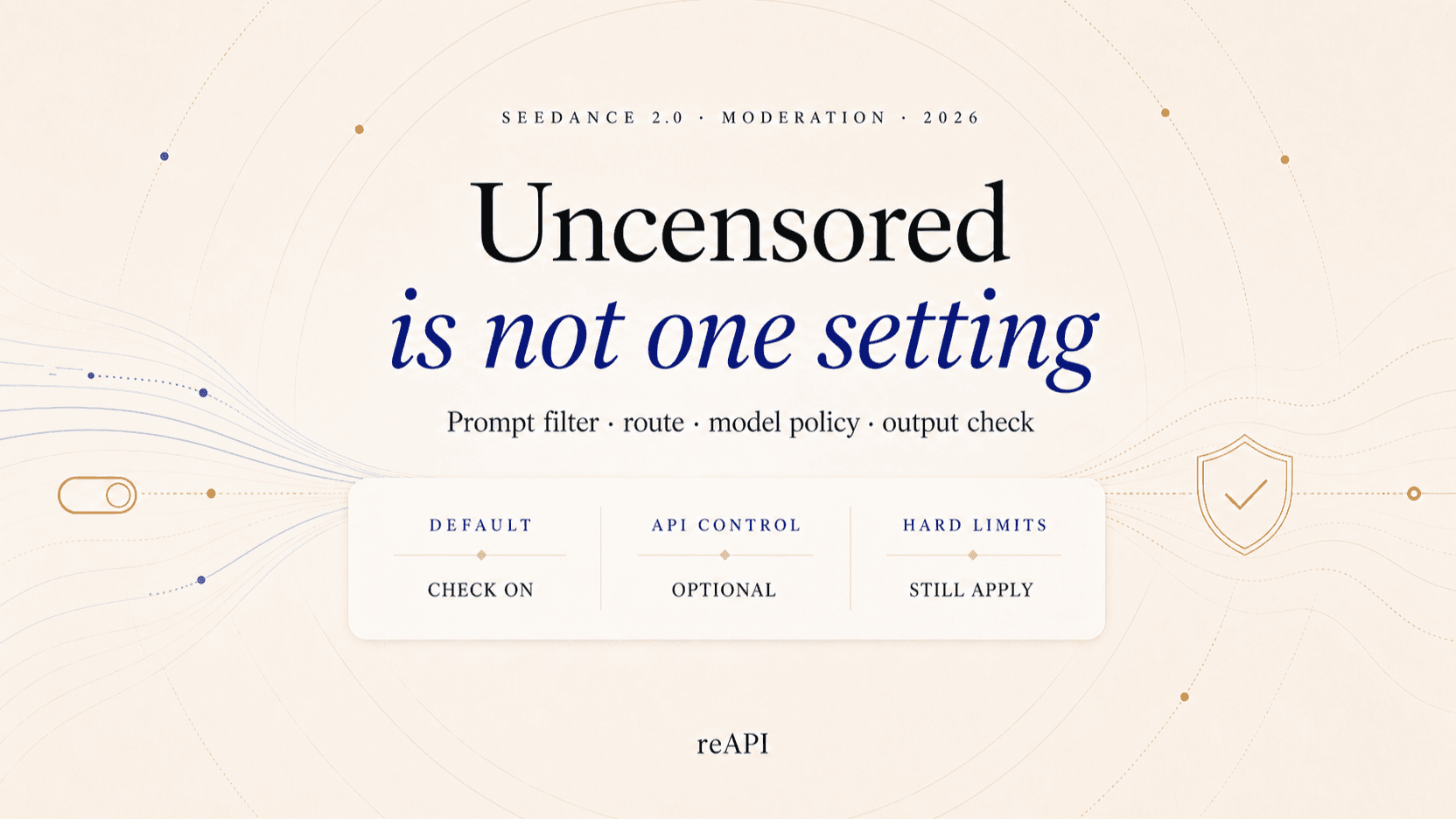
Seedance 2.0 Safety Filters: What They Block and Why
Seedance 2.0 safety filtering runs in several layers, and a refusal rarely says which one fired. What each layer blocks and which limits never move.
Seedance 2.0 is not literally uncensored. Hosted routes differ in how much filtering they add in front of the model, but no route removes every content, model, rights, or platform rule. The safer description is less restricted Seedance 2.0, not a rule-free video model.
That distinction matters because “Seedance 2.0 uncensored” is used online to mean several different things: no extra prompt filter, fewer output blocks, support for real-person references, or no moderation at all. Those are not the same product. This guide defines the terms, separates the layers that can refuse a request, and explains which safety boundaries remain everywhere.
TL;DR
- Moderation is the default everywhere. No mainstream route ships with it off.
- The API offers an explicit control. Compatible Standard model requests may expose a moderation setting; consumer surfaces generally keep it locked on.
- A permissive route is not immunity. Where a host offers one, it changes which path runs the job. Model-level checks stay in place either way.
- Official is different. The Official model IDs do not expose this switch, and the direct official channel does not accept real-person reference uploads.[1]
- Some rejections still happen. Model-level or output-policy failures can remain terminal even after an optional checker is disabled.
- Rights still apply. Consent, copyright, acceptable-use rules, and your own application's moderation obligations do not disappear.
What “Seedance 2.0 uncensored” can mean
There is no industry-standard definition of “uncensored AI video.” Treat it as a marketing label until a provider states which layer is actually changed.
| Phrase people use | What it may actually mean | What it does not prove |
|---|---|---|
| No extra prompt filter | The host does not add a pre-generation keyword gate | The model will accept every prompt |
| NSFW checker off | One host-side check or route choice is disabled | All provider and output checks are gone |
| Real-person support | A designated model/channel accepts authorized face inputs | Consent is optional |
| Relaxed moderation | Fewer borderline, non-explicit prompts are rejected | Prohibited content is allowed |
| Fully uncensored | Supposedly no checks or rules at any layer | A credible commercial API rarely makes this promise |
The precise claim worth making is simple: some hosted surfaces expose a moderation setting, and it selects a route rather than removing checks. Where such a setting exists it is on by default, and turning it off asks for a less filtered path when the request and channel support one.
That is useful control for legitimate production teams dealing with false positives in editorial fashion, stylized performance, fictional characters, historical drama, or other lawful material that a broad safety classifier may misread. It is not a prompt-obfuscation feature and should not be used to evade law, consent, copyright, or the service's acceptable-use terms.
Seedance 2.0 censorship is a stack, not one switch

A generated video can be stopped at multiple points. Turning off one optional checker does not remove the others.
1. Client or product-layer checks
A consumer app may screen the prompt before it ever reaches Seedance. It can also block uploads, certain words, or categories based on its own audience and app-store obligations. Two sites using the same model can therefore feel very different.
This is why a prompt rejected in one interface may be accepted through an API without any change to the underlying model. The difference can be the host's extra filter rather than the model itself.
2. Route-level moderation
An API host can send a request through a Standard, Flexible, face-enabled, or official route. Where a host exposes a moderation setting, it participates in that routing decision rather than disabling the model's own checks.
This is the layer most people mean when they search for an “uncensored Seedance 2.0 API.” More accurately, they are looking for an API without an additional conservative host check.
3. Model and provider policy
The generation model still has learned and enforced boundaries. The upstream provider can reject an input, refuse to render a scene, or return a policy error. A routing flag cannot promise that every requested frame will be generated.
BytePlus publishes separate ModelArk acceptable-use terms for its generative AI services, and its official Seedance documentation describes input restrictions for real-person reference media.[1][2]
4. Output review
A prompt can pass and the rendered result can still fail a final output check. This is not contradictory: generative models are probabilistic, so a harmless brief can sometimes produce an image that crosses a policy threshold.
A content-policy failure is different from a provider submission or infrastructure failure, and should be treated as terminal rather than retried in a loop.
Why safe Seedance prompts still get censored
A rejection does not automatically mean the prompt was malicious. Broad classifiers trade precision for coverage, and that creates false positives. Common causes include:
- a fictional or synthetic face that looks like a real person;
- theatrical makeup, skin-toned materials, or close crops that lose context;
- an original design that resembles protected character or brand imagery;
- a neutral prompt paired with a reference asset carrying metadata or visual details the classifier flags;
- a valid prompt whose probabilistic output, rather than input, crosses a threshold.
Do not respond by hiding keywords or repeatedly resubmitting the same rejected request. Instead, identify which layer rejected it.
For a lawful false positive, a good diagnostic sequence is:
- Confirm the prompt and all references are original, licensed, or used with documented consent.
- Run the same benign request once with moderation on and once with
falseon a compatible Standard model. - Record whether the failure occurred before submission, during provider generation, or at final output review.
- Check the task's structured error code and avoid automatic retry on a content-policy result.
- If the issue is a real-person input, move to a face-enabled workflow rather than trying to disguise the subject.
This A/B test tells you whether the optional host check was the cause. It does not attempt to defeat a model-level decision.
What a less-restricted API still requires from SaaS teams
If you are integrating Seedance into a product, moderation becomes a product design responsibility rather than a box to remove.
BytePlus's rules for platform customers call for end-user identity controls, traceability from generated content to user accounts, warnings, content takedowns, account restrictions, audit logs, incident response, and rights records for trusted or real-person assets.[3] Your exact obligations depend on your service and jurisdiction, but the engineering pattern is broadly useful:
- keep a durable task-to-user mapping;
- log the model ID, route choice, input asset IDs, and policy outcome;
- rate-limit repeated failures and suspicious bursts;
- require a rights attestation for real-person or branded references;
- provide reporting, takedown, and account-enforcement tools;
- separate internal creative testing from public user-generated output;
- review the destination platform's rules before publishing.
This is the practical meaning of responsible API control. A more permissive route can reduce false positives for trusted creators while your application keeps the safeguards appropriate to its users and distribution channel.
FAQ
Is Seedance 2.0 uncensored?
No, not in the literal sense of having no rules. Hosts vary in how much filtering they add, but model, provider, output, rights, and platform policies can still reject or prohibit content on any route.
Does Seedance 2.0 support NSFW content?
Such a setting is commonly named for the checker itself, but it should not be read as blanket approval for any content category. It controls an optional checking and routing layer. The acceptable-use policy and model/output decisions remain in force.[2]
Does a less-filtered route guarantee my video will generate?
No. A compatible Flexible route may still return a model or output-policy failure. If a compatible route is unavailable, the task may use Standard safety behavior instead. Treat the flag as a route preference, not a success guarantee.
Can I use a real person's face?
Use a face-enabled model only when you have the subject's authorization and the necessary rights. The Official direct channel does not accept real-person reference uploads. Other surfaces accept reference material and run their own review over it.
The accurate label is “less restricted,” not “no rules”
The useful part of this topic is not the word “uncensored.” It is knowing that filtering happens in distinct layers, that a refusal names only one of them, and that several of those layers never move regardless of which surface you use.
That distinction lets a team reduce avoidable false positives without pretending the rest of the safety stack has vanished. Assume the default is moderated, retain rights and consent records for any reference material, and treat a content-policy failure as final rather than something to retry around.
“Uncensored” is discussed here as a search and marketing term, not as a description of how any route actually behaves.
References
- BytePlus ModelArk. Dreamina Seedance 2.0 series tutorial. Updated July 31, 2026. docs.byteplus.com/api/docs/ModelArk/2291680
- BytePlus. GenAI Acceptable Use Policy. Updated July 11, 2026. docs.byteplus.com/en/docs/legal/acceptable_use_policy_byteplus_genai
- BytePlus ModelArk. Platform Customer Code of Conduct and Default Handling Rules. Updated June 16, 2026. docs.byteplus.com/en/docs/ModelArk/2353368
Further reading
- What Is Seedance 2.0 and How to Use It. reapi.ai/blog/what-is-seedance-2-0-and-how-to-use-it
- Seedance 2.0 Character Consistency Guide. reapi.ai/blog/seedance-2-0-character-consistency-guide
- How Long Can Seedance Videos Be? reapi.ai/blog/how-long-can-seedance-videos-be
Author

Categories
More Posts
Wan 3.0 ComfyUI: API Workflows and Setup Requirements
Set up Wan 3.0 ComfyUI with official templates or a custom reAPI adapter. Compare account requirements, media inputs, task polling and dated cost estimates.
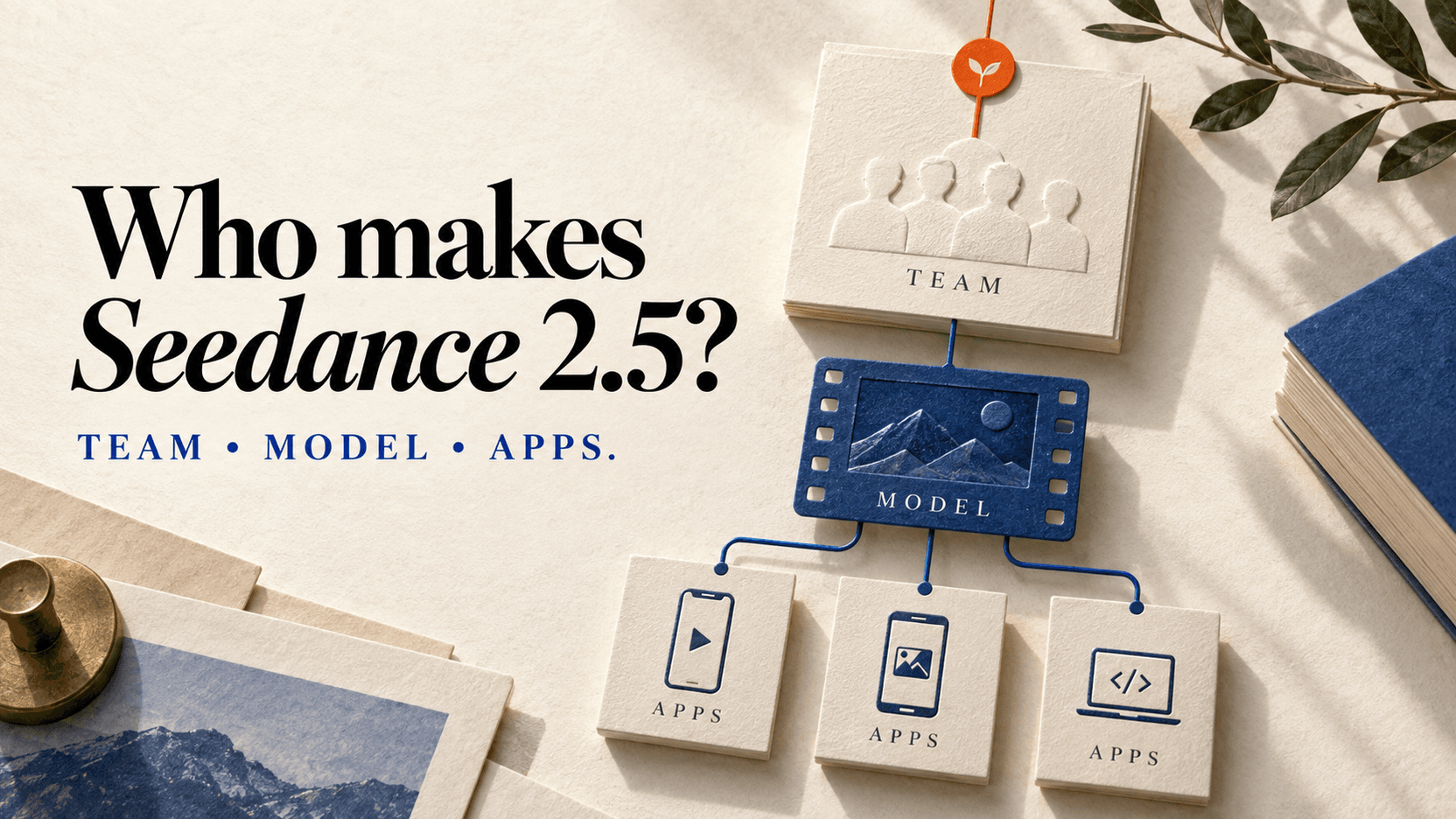
Who Makes Seedance 2.5? ByteDance and Its App Brands
Who makes Seedance 2.5? Learn how ByteDance Seed, Doubao, BytePlus, Volcengine, Dreamina, and Jimeng relate, and find the official model and release sources.
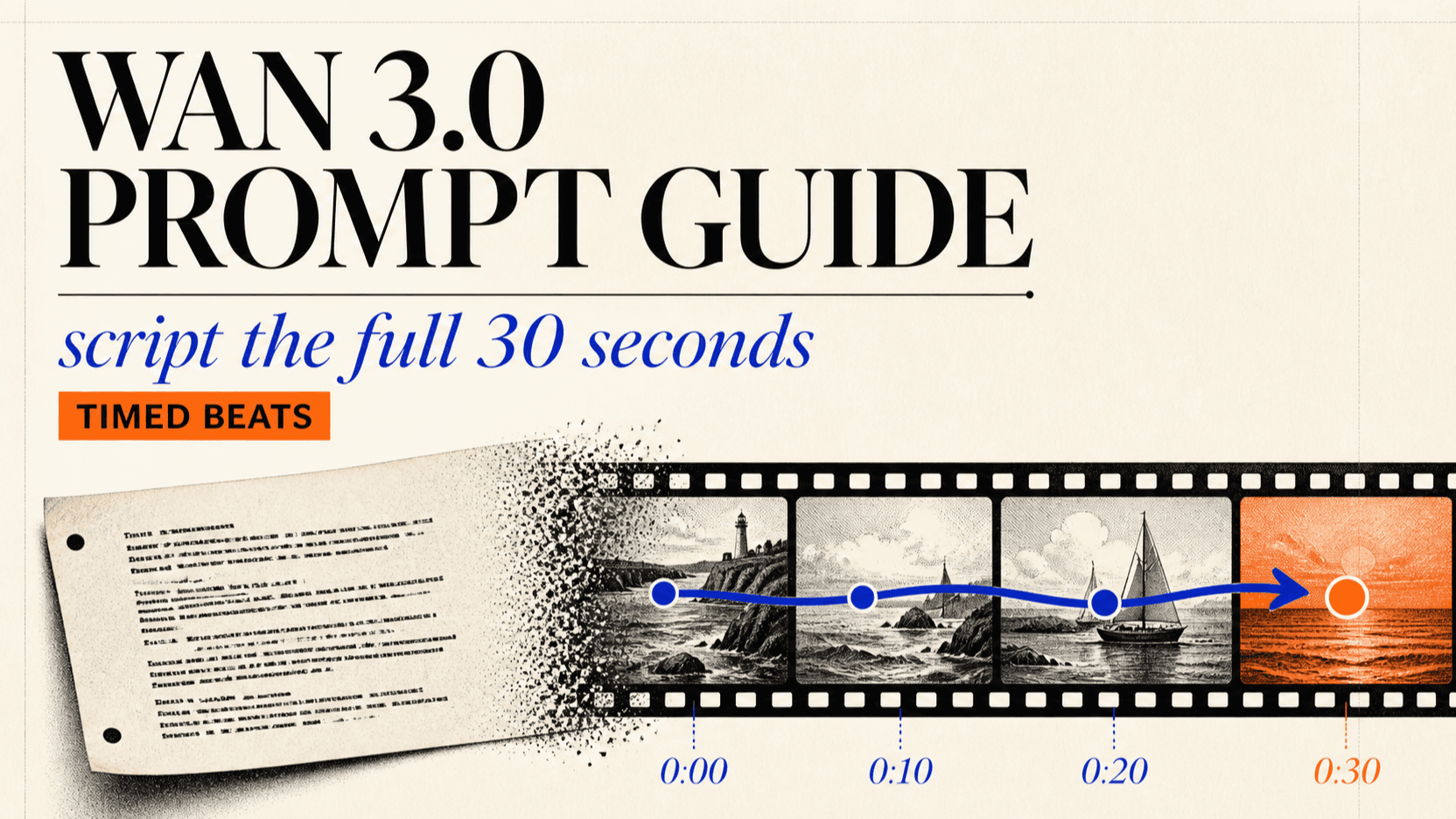
Wan 3.0 Prompt Guide: Write Coherent 30-Second Video Scripts
Learn a practical Wan 3.0 prompt structure for coherent 30-second video: timed beats, camera direction, reference roles, audio, examples, and fixes.