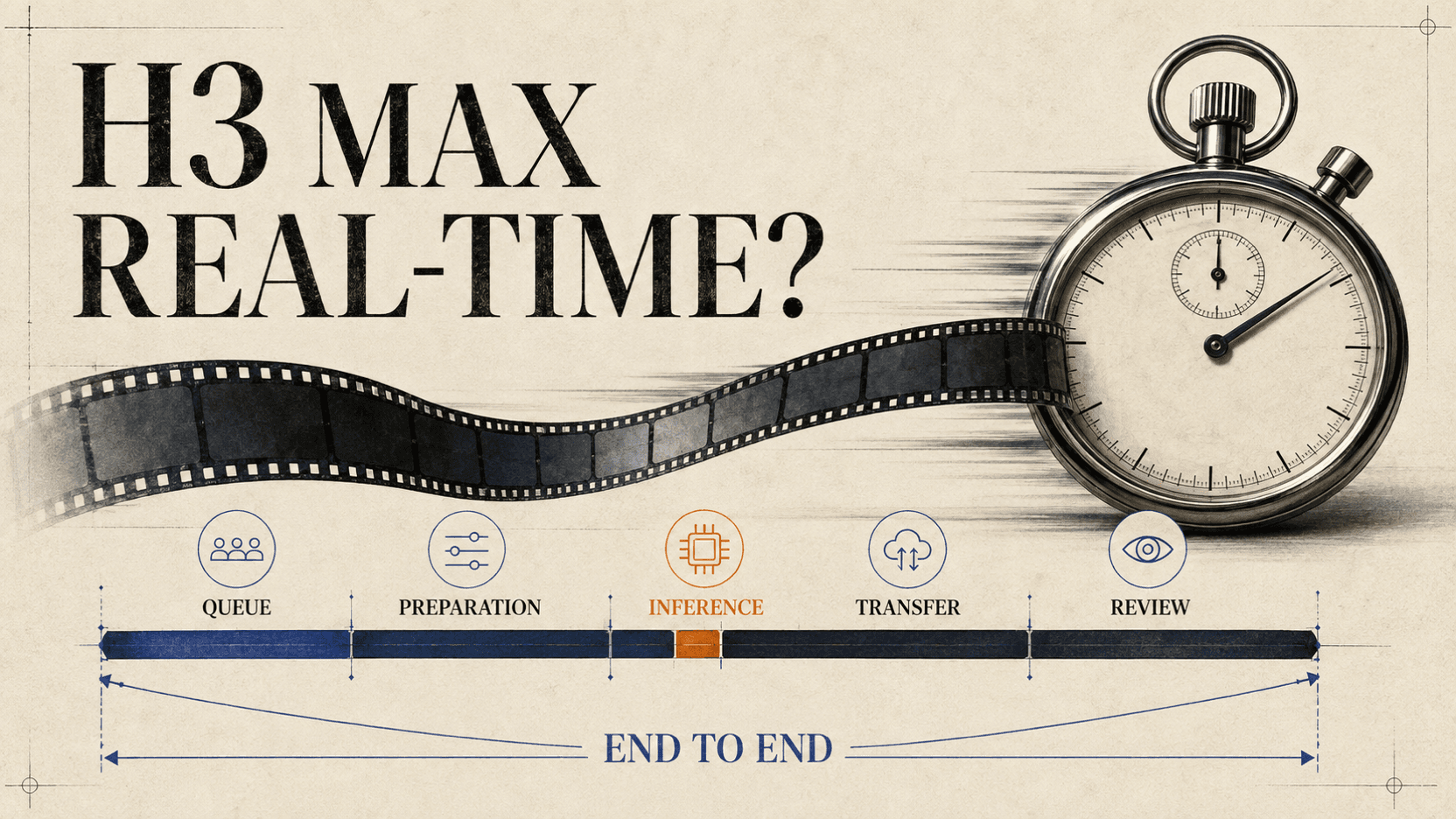
Is MiniMax H3 Max Real Time? Measure App Latency
Learn what MiniMax H3 Max real-time speed claims measure, why published times differ, and how to benchmark queue, inference, polling, and download.
MiniMax H3 Max can be faster than real time under a specific definition: fal reports generating a five-second clip in under three seconds on its optimized serving stack. That does not mean every five-second request reaches a user's screen in three seconds, nor does it mean the model streams finished frames continuously. Queueing, prompt expansion, output processing, polling, and download all sit outside a narrow inference measurement.[1]
The distinction is visible in first-party numbers. MiniMax Design says a five-second H3 Max video takes about 15 seconds there and a 15-second video about 40 seconds, with actual time varying by settings and service conditions.[2] Both statements can be true. They describe different systems and measurement boundaries.
Quick answer
- “Faster than real time” means generation finishes before the clip would finish playing; it does not mean live frame streaming.
- fal's sub-three-second result measures its own optimized H3 Max stack, not a universal API promise.[1]
- MiniMax Design estimates a longer wait on its surface, which is why an app must measure queue, generation, transfer, and download separately.[2]
- Report time per accepted clip. A fast rejected result adds no usable throughput.
What “real time” means for a generated video
Use a ratio before using the label. The standard practical calculation is:
real-time factor (RTF) = generation time / output playback durationFor a five-second output:
| Measured generation time | RTF | Plain-language reading |
|---|---|---|
| 2.5 seconds | 0.5 | Faster than real time under this clock |
| 5 seconds | 1.0 | Equal to playback duration |
| 15 seconds | 3.0 | Three times slower than playback |
The formula is simple; the numerator is not. “Generation time” might mean GPU inference, provider wall time, time from POST to completed task, or time until a player has the entire MP4. Label the numerator every time you publish an RTF.
These are four different measurements:
- Inference RTF: model execution divided by output duration.
- Provider RTF: provider admission through finalized output, if the provider publishes that boundary.
- Observed API RTF: client POST through the first terminal response.
- Playback-ready RTF: client POST through a successfully downloaded or buffered file.
Only the last two describe the wait in your application. Inference RTF is still useful for comparing serving work, but it cannot account for a queue the client cannot see.
Faster-than-real-time generation is not the same as streaming
The common H3 Max API pattern is asynchronous: submit a job, receive an ID, then wait for a completed MP4. A clip can finish faster than its own duration without delivering frame one early. That is fast batch generation, not proof of incremental video streaming.
A continuous playback system can instead generate upcoming clips while an approved clip is playing and maintain a queue ahead. That is a buffered pipeline. It can feel continuous even when every generation arrives as a complete file.
Why fal and MiniMax Design publish different H3 Max times
fal developed the post-trained H3 Max variant and optimized its inference system alongside it. Its launch announcement reports a five-second clip in under three seconds of wall time and roughly 35 times the throughput of the official MiniMax H3 endpoint in fal's evaluation.[1] The result belongs to fal's model-and-serving combination.
MiniMax Design gives a user-facing estimate for a different surface: about 15 seconds for five seconds of output and 40 seconds for 15 seconds of output. Its page explicitly warns that actual time varies with settings and service conditions.[2]
The gap can contain several stages:
POST sent
  -> authentication and validation
  -> queue admission
  -> optional prompt processing
  -> model inference
  -> encoding and safety checks
  -> storage and result publication
  -> next client poll
  -> MP4 download or player buffering
Different providers can also run different hardware, batching rules, concurrency limits, prompt expansion, and endpoint implementations. Even inside one provider, 480P and 768P need not have the same latency distribution. There is no sound way to convert one launch number into a promise for another route.
Measure MiniMax H3 Max end to end on the route you will ship
A useful latency test starts before the POST and ends when the output is actually usable. Keep the prompt, duration, resolution, source asset, account, and region fixed while measuring a baseline. Change one variable at a time after that.
Record these timestamps:
| Timestamp | Event | What it captures |
|---|---|---|
t0 | Client starts POST | Beginning of the user-visible wait |
t1 | Submission response parsed | Network, validation, admission, and task creation |
t2 | Last observed processing state | Lower bound before completion |
t3 | First observed terminal state | Upper bound on task completion plus polling delay |
t4 | Output download completes | Playback-ready wait for a full-file workflow |
Polling means the exact completion moment falls between t2 and t3. Do not
report t3 - t0 to millisecond precision as if the server exposed a precise
finish timestamp. If you poll every three seconds, the observation can arrive
almost three seconds after the state changed; caching can widen that
uncertainty.
The reAPI Tasks API recommends a two-to-three-second polling cadence and notes that in-flight task responses are cached for five seconds. Polling faster increases request pressure without making the video finish sooner.[4]
A Node.js timing harness for reAPI
The script below submits one paid five-second 480P job, measures client-visible time, and downloads the returned file into memory. It does not claim to measure fal's inference kernel. Check the live model page and your account before running it.[5]
const API_BASE = 'https://reapi.ai/api/v1';
const API_KEY = process.env.REAPI_API_KEY;

if (!API_KEY) throw new Error('Set REAPI_API_KEY');

const headers = {
  Authorization: `Bearer ${API_KEY}`,
  'Content-Type': 'application/json',
};

const sleep = (ms) => new Promise((resolve) => setTimeout(resolve, ms));

async function readJson(response) {
  const body = await response.json().catch(() => ({}));
  if (!response.ok) {
    const message = body.error?.message ?? response.statusText;
    throw new Error(`HTTP ${response.status}: ${message}`);
  }
  return body;
}

const t0 = performance.now();

// Submit once. Do not automatically repeat this POST after an ambiguous
// network failure: the first request may already have created a paid task.
const submission = await readJson(
  await fetch(`${API_BASE}/videos/generations`, {
    method: 'POST',
    headers,
    body: JSON.stringify({
      model: 'minimax-h3-max',
      prompt:
        'One continuous shot of a red paper boat moving through a shallow rain gutter while the camera tracks beside it; natural rain and street ambience, no dialogue.',
      aspect_ratio: '16:9',
      duration: 5,
      resolution: '480P',
    }),
  }),
);

const t1 = performance.now();
let lastProcessingAt = t1;
let task;
const deadline = Date.now() + 30 * 60 * 1000;

while (Date.now() < deadline) {
  await sleep(3000);
  task = await readJson(
    await fetch(`${API_BASE}/tasks/${submission.id}`, {
      headers: { Authorization: `Bearer ${API_KEY}` },
    }),
  );

  const observedAt = performance.now();

  if (task.status === 'processing') {
    lastProcessingAt = observedAt;
    continue;
  }

  if (task.status === 'failed') {
    throw new Error(
      `${task.error?.code ?? 'FAILED'}: ${task.error?.message ?? 'Unknown error'}`,
    );
  }

  if (task.status === 'completed') {
    const t3 = observedAt;
    const videoUrl = task.output?.video_urls?.[0];
    if (!videoUrl) throw new Error('Completed task has no video URL');

    const download = await fetch(videoUrl);
    if (!download.ok) {
      throw new Error(`Download failed: HTTP ${download.status}`);
    }
    const bytes = (await download.arrayBuffer()).byteLength;
    const t4 = performance.now();

    console.table({
      task_id: submission.id,
      output_seconds: 5,
      submit_round_trip_ms: Math.round(t1 - t0),
      completion_after_ms_lower_bound: Math.round(lastProcessingAt - t0),
      completion_after_ms_upper_bound: Math.round(t3 - t0),
      playback_ready_ms: Math.round(t4 - t0),
      observed_api_rtf: Number(((t3 - t0) / 5000).toFixed(2)),
      playback_ready_rtf: Number(((t4 - t0) / 5000).toFixed(2)),
      downloaded_bytes: bytes,
    });
    break;
  }
}

if (!task || task.status === 'processing') {
  throw new Error(
    `Local polling deadline reached for ${submission.id}; resume GET requests instead of submitting again.`,
  );
}
Run the same harness across separate time windows rather than firing a large burst that changes the queue you are trying to observe. Save every result, including failures. A small pilot can report median and range; reserve a tail percentile such as p95 for a sample large enough to support it.
Compare latency without accidentally changing the job
Matched settings are necessary but not sufficient. Use the same source URL, prompt bytes, aspect ratio, duration, and resolution. If one provider expands the prompt and another does not, record that difference rather than pretending the requests were identical internally.
For each run, retain:
- model ID, provider, endpoint, account region, and observation date;
- T2V or I2V mode and a hash of each input asset;
- duration and resolution;
- submission round trip, completion bounds, and download time;
- terminal status and error code;
- whether the clip passed the creative acceptance check.
Do not mix a five-second 480P H3 Max draft with a 15-second 768P base H3 clip and call the difference a model benchmark. Likewise, a fal inference time and a MiniMax Design UI time do not belong in one “winner” column unless the table labels their measurement boundaries.
Throughput, concurrency, and accepted clips are separate numbers
Latency is the wait for one job. Throughput is how much work a system finishes over time. A provider can have excellent single-job inference and still limit concurrent requests; another can take longer per job while finishing more jobs in parallel.
For a buffered channel that must play one clip after another, a rough worker estimate is:
required concurrent workers ~= ceil(
  tail end-to-end seconds
  / (clip seconds × creative acceptance rate)
)
This is a planning approximation, not a capacity guarantee. If a 10-second clip takes 20 seconds at the chosen tail latency and only half of outputs pass, one worker supplies 0.5 accepted clips every 20 seconds. Keeping a ten-second playback slot filled would need about four workers before adding safety margin, moderation failures, or editorial review.
The buffer matters too. Generate several approved clips before playback starts, then keep producing the next slots while viewers watch the current one. If the buffer reaches zero, the stream stalls regardless of an impressive median.
A stopwatch cannot grade the sound or the story
H3 Max retains H3's joint audio-video generation according to fal's launch announcement.[1] That makes acceptance review part of any real-time claim. A completed clip is not usable if the wrong character speaks, dialogue crosses between voices, a sound cue lands on the wrong action, or the next shot forgets the previous setting.
Grade each clip on the requirements that matter to the application:
| Check | Pass condition |
|---|---|
| Prompt events | Required beats appear in the correct order |
| Character continuity | Face, outfit, and role remain identifiable |
| Speaker assignment | Each line belongs to the intended voice |
| Audio timing | Speech and effects align with visible actions |
| Transition | First and last frames connect plausibly when supplied |
| Safety/review | The clip is acceptable for the destination |
Then report both raw completion throughput and accepted completion throughput. The latter is the number that can keep an application alive.
FAQ
Is MiniMax H3 Max faster than real time?
fal reports a five-second video in under three seconds on its optimized stack, which is faster than real time for that measurement. Test the route you intend to use; the figure does not guarantee end-to-end latency elsewhere.
Why does MiniMax Design say about 15 seconds for a five-second clip?
It is a different delivery surface and a user-facing estimate. MiniMax says the time varies with settings and service conditions. Queueing and processing outside model inference can also be part of the observed wait.
Does real-time H3 Max generate a live stream frame by frame?
Not on the basis of the standard asynchronous endpoints. They return completed video files. A continuous experience can be built by generating later clips while earlier clips play and maintaining a buffer.
Does resolution affect MiniMax H3 Max speed?
It can affect the work performed, but no single multiplier should be assumed. Benchmark both 480P and 768P on the chosen endpoint if both matter. The current MiniMax direct and reAPI H3 Max contracts do not offer 2K.[3]
Can I compare the fal timings.inference value with my reAPI stopwatch?
Only if the table labels them as different metrics. One is a backend inference field on fal; the other is a client-observed path that can include admission, queueing, polling, storage, and network time.
How many tests are enough?
There is no universal count. Run enough to cover the prompts, modes, settings, and time windows you will ship. With a small pilot, publish the median and full range rather than an unstable p95, and keep creative rejects in the record.
Publish the wait your user actually feels
“MiniMax H3 Max real time” is defensible only with a named clock. fal's result shows what its co-optimized stack can do. MiniMax Design's estimate shows that a different product surface can expose a longer wait. Your application needs its own POST-to-playback number, measured on its own route and paired with an acceptance rate.
Keep inference RTF, observed API RTF, playback-ready RTF, and accepted clips per hour as separate fields. Then a speed claim becomes a reproducible operating number instead of a phrase borrowed from a launch post.
References
- fal. Introducing H3 Max by fal. Published August 26, 2026. fal.ai
- MiniMax Design. MiniMax H3 Max—Fast AI Video Generator. Retrieved September 7, 2026. design.minimax.io
- MiniMax API. Create Video Generation Task V2. Retrieved September 7, 2026. platform.minimax.io
- reAPI. Tasks API: polling, status, and output. Retrieved September 7, 2026. reapi.ai
- reAPI. MiniMax H3 Max model page and request controls. Retrieved September 7, 2026. reapi.ai
Further reading
Author

Categories
timings.inference value with my reAPI stopwatch?How many tests are enough?Publish the wait your user actually feelsReferencesFurther readingMore Posts
Seedance Credits and Quotas: Why the Balance Runs Out
How many clips a credit balance buys depends on resolution, duration and input mode at once. Per-second billing answers the same question with multiplication.

Higgsfield AI Pricing: Plans, API Costs and Is It Free?
Higgsfield AI pricing explained: subscription plans, credit costs per model, the new pay-as-you-go API, whether Higgsfield is free, and where reAPI costs less.

Best WaveSpeed Alternatives in 2026: 5 Options Compared
Looking for WaveSpeed alternatives in 2026? Compare fal.ai, Replicate, Together AI, RunPod, and reAPI on model range, pricing, speed, and API design.