GPT Image 2 vs Nano Banana Pro: Editing, 4K, API, and Price
Compare GPT Image 2 and Nano Banana Pro for editing, references, 4K output, grounding, transparency, API controls, and current reAPI pricing.
Choose GPT Image 2 when editing is part of the product: masks, transparent backgrounds, output formats, and controlled revisions. Choose Nano Banana Pro when the difficult part is understanding the brief: many reference images, search-grounded context, complex layouts, and inexpensive 4K output.
That is the useful answer to GPT Image 2 vs Nano Banana Pro. Neither model wins every image task, and a single leaderboard score cannot settle a workflow question. On reAPI, both are available through the same image endpoint, so the lowest-risk setup is to route each job to the model whose controls match it.
TL;DR
- GPT Image 2 is the stronger API surface for masks, transparency, JPEG, PNG or WebP control, and batch output through reAPI's stable channel.
- Nano Banana Pro accepts up to 14 reference images, supports 1K, 2K and 4K across ten aspect ratios, and brings Google's search grounding and visual reasoning to complex briefs.
- For current reAPI routes, GPT Image 2 starts at $0.03 on the basic channel; Nano Banana Pro starts at $0.033. Those entry prices are not feature-equivalent.
- If you only compare the cheapest row, you will miss the expensive part: retries, manual cutouts, and rebuilding a composition that the first model misunderstood.
GPT Image 2 vs Nano Banana Pro at a glance
| Decision point | GPT Image 2 on reAPI | Nano Banana Pro on reAPI |
|---|---|---|
| Best fit | Precise generation and edit pipelines | Reasoning-heavy, reference-heavy visual work |
| Model ID | gpt-image-2 basic; gpt-image-2-official stable | gemini-3-pro-image-preview |
| Reference images | Up to 16 on the basic channel | Up to 14 |
| Output count | 1 basic; up to 4 stable | Up to 4 |
| Resolution | 1K, 2K, and selected 4K output | 1K, 2K, and 4K |
| Aspect ratios | 14 basic-channel ratios | 10 ratios |
| Masked editing | Stable channel | Not exposed as a mask field |
| Transparent output | Stable channel | Not exposed as an API control |
| Search grounding | No | Google direct API supports it; current reAPI schema has no explicit field |
| Starting reAPI price | $0.03 basic at 1K | $0.033 at 1K or 2K |
Prices in this article were checked on August 13, 2026. They are the live reAPI rates, not claims that OpenAI or Google changed their direct prices. Use the GPT Image 2 model page and Nano Banana Pro model page for the current rate before shipping a billing estimate.[3][4]
The real difference is the shape of the job
OpenAI describes GPT Image 2 as its most advanced image generation model, with high-fidelity inputs and support for both generation and editing endpoints. Google positions Nano Banana Pro, the Gemini 3 Pro Image model, for professional assets, complex instructions, 4K output, grounding, and deliberate reasoning before rendering.[1][2] The current reAPI route does not expose a search-grounding switch, so treat grounding here as a Google-direct capability, not a promised reAPI request field.
Those descriptions overlap until a product requirement becomes concrete.
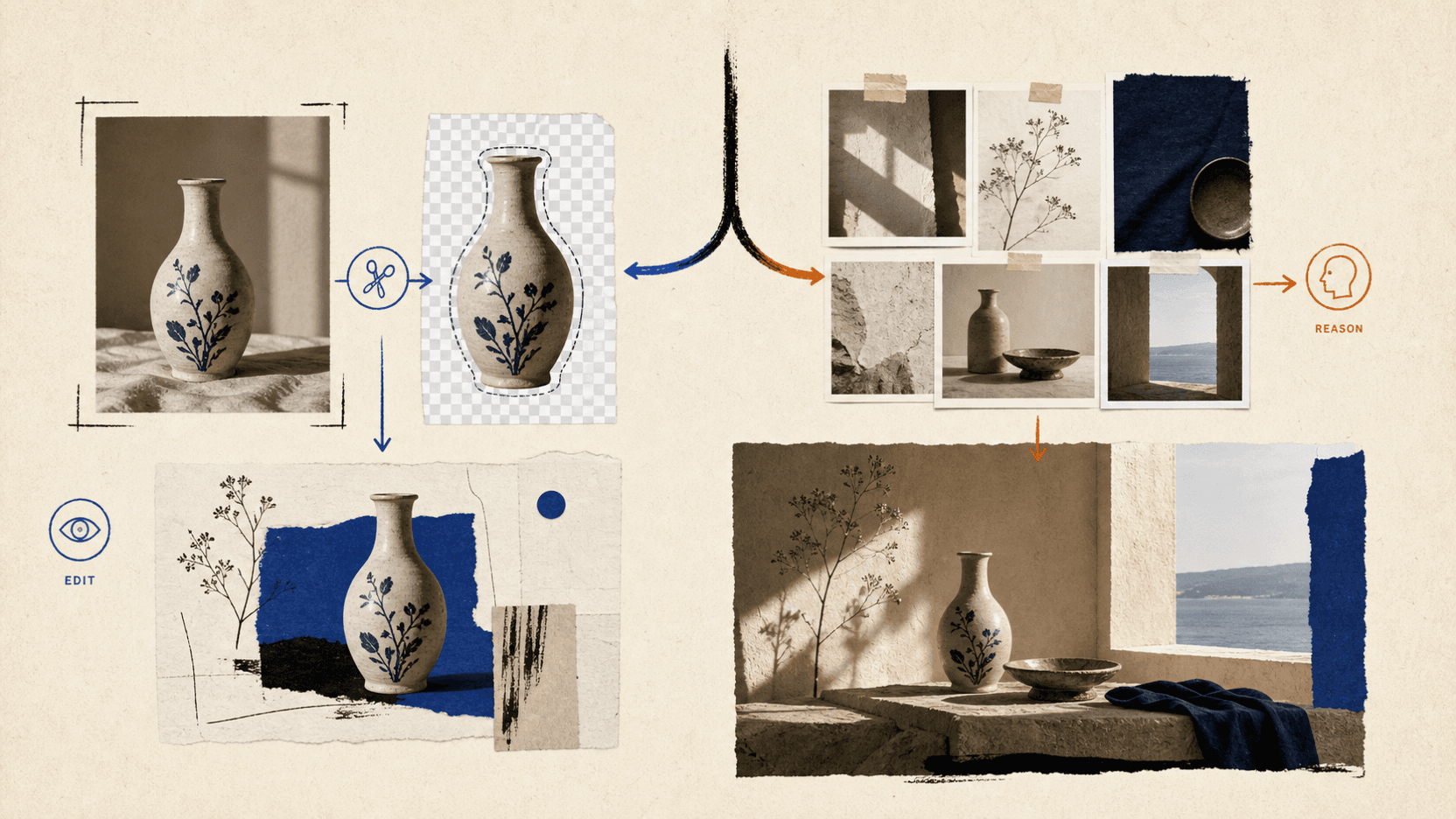
Suppose a merchandising tool must remove a background, preserve the product, replace one region, and return a transparent PNG. That is not merely “make a good picture.” It is an editing contract. GPT Image 2's stable reAPI channel exposes the controls needed to implement it.
Now suppose a research team provides a dozen reference images and asks for a 4K visual that reconciles objects, locations, written notes, and current-world context. The problem is understanding and composition before it is pixel editing. Nano Banana Pro is built for that sort of brief.
Where GPT Image 2 earns its place
GPT Image 2 has two reAPI routes under separate model IDs. gpt-image-2 is a
fast, flat-priced generation and editing path with one output.
gpt-image-2-official adds OpenAI-style quality, background,
output_format, compression, mask, and n controls.[3]
That distinction matters in four common products.
Product cutouts and compositing
A transparent background is a production primitive. If an e-commerce tool needs a clean object for a catalog layout, an explicit alpha-background option is more dependable than asking for “a transparent-looking background” in prose. The latter can still produce a checkerboard painted into the image.
Local revisions
Mask-based editing lets the application identify the region allowed to change. It does not make every edit perfect, but it narrows the contract. The approved parts of the image are no longer fair game for a full regeneration.
Output-sensitive delivery
JPEG, PNG and WebP are not artistic choices once an image enters a product. They affect alpha support, payload size, browser delivery, and downstream tools. GPT Image 2's stable route exposes those choices directly.
Several deliverables from one request
The stable route accepts n up to four. That is useful when the application
needs several candidates with the same quality and format settings. The basic
route deliberately keeps a smaller contract: one image, no mask, and no
quality or output-format selector.
Where Nano Banana Pro is the better fit
Nano Banana Pro's advantage is not a hidden Photoshop tool. It is the amount of visual context the model can organize before it renders.
Many references with named roles
The reAPI route accepts up to 14 reference images. That capacity only helps if the prompt separates their jobs. “Use these images” invites an uncontrolled blend. A better instruction reads like an art-direction note:
Image 1 is the product: preserve its silhouette and label.
Images 2–5 define the room and material palette.
Images 6–8 define camera height and lighting only.
Create a 16:9 launch image with the product centered on the left third.
Leave clean negative space on the right for copy. Do not invent a logo.
Search-grounded context
Google documents search grounding for the underlying Gemini image model. On Google's direct API, that can help when a visual brief depends on current or factual context. reAPI's current Nano Banana Pro schema does not expose an equivalent field. Either way, generated text, maps, dates, and factual graphics still need human verification before publication.[2]
4K without a special composition class
Nano Banana Pro exposes 1K, 2K and 4K across its supported ratios. The current reAPI rate card lists 4K only slightly above its 1K and 2K bands. GPT Image 2 can also produce 4K, but its basic channel limits that output to selected wide formats, while the stable high-quality 4K tier is priced for a different class of job.
Complex visual briefs
Google's model documentation emphasizes professional asset production and complex instructions. That is the right reason to test Nano Banana Pro for storyboards, information-dense layouts, campaign systems, and multi-reference composites. It is still a vendor claim until it survives your own prompt set.
Price comparison without the misleading shortcut
The lowest visible numbers are close, but the products do not line up row for row.
| Route | Current price | What that row buys |
|---|---|---|
| GPT Image 2 basic, 1K | $0.03/image | One image, flat resolution price, up to 16 references |
| GPT Image 2 basic, 2K | $0.05/image | One image at the higher resolution tier |
| GPT Image 2 basic, 4K | $0.08/image | One image in supported 4K widescreen output |
| GPT Image 2 stable, low | $0.022/image | OpenAI-style control surface at low quality |
| Nano Banana Pro, 1K or 2K | $0.033/image | Up to four outputs, up to 14 references |
| Nano Banana Pro, 4K | $0.035/image | 4K output in the same API family |
GPT Image 2 stable pricing rises with quality and size; its high-quality 4K row is far above the entry tier. That is not evidence that Nano Banana Pro is universally cheaper. It means “4K image” is too vague for a useful comparison. A transparent product cutout, a search-grounded infographic, and a cinematic wallpaper are three different units of work.
Measure cost per accepted asset. Count retries, manual masking, copy repairs, and the extra model call needed when a workflow starts on the wrong control surface.
One endpoint makes routing practical
Both models submit to the same asynchronous image endpoint on reAPI. The model ID and model-specific fields change; authentication and task polling do not.
curl https://reapi.ai/api/v1/images/generations \
  -H "Authorization: Bearer $REAPI_API_KEY" \
  -H "Content-Type: application/json" \
  -d '{
    "model": "gemini-3-pro-image-preview",
    "prompt": "Create a restrained 16:9 editorial product photograph. Preserve the object in Image 1 and use Images 2–4 only for material and lighting references.",
    "image_urls": [
      "https://example.com/product.png",
      "https://example.com/material-1.jpg",
      "https://example.com/material-2.jpg",
      "https://example.com/light.jpg"
    ],
    "aspect_ratio": "16:9",
    "resolution": "4k",
    "n": 1
  }'
For a masked GPT Image 2 job, keep the endpoint and switch to the stable channel fields documented in the GPT Image 2 API reference. Poll the returned task through the shared task endpoint until it completes.
The routing rule can stay readable:
mask, alpha, or explicit output format -> GPT Image 2 official
many references or broad 4K layout -> Nano Banana Pro
search-grounded image brief -> Google direct API, then verify the facts
simple generation -> run a fixed quality-and-cost test on both
What neither model removes from the workflow
Both models can miss exact small text. Both can distort a protected product detail. Both can make a plausible but incorrect factual graphic. More reference images can introduce contradictions rather than reduce them.
The review checklist should be written before the prompt:
- Which object or person must remain unchanged?
- Which words must be exact?
- Which region may change?
- Which facts require a source check?
- What file format, dimensions, and alpha behavior must the application receive?
That turns model evaluation into acceptance testing. It also stops a striking demo from winning over an image that actually meets the contract.
FAQ
Is Nano Banana Pro better than GPT Image 2?
Not across every task. Nano Banana Pro is the better fit for reference-heavy, grounded, and complex 4K composition work. GPT Image 2 is the better fit when masks, transparency, output formats, and controlled edits are part of the API requirement.
Which model accepts more reference images?
On current reAPI routes, GPT Image 2's basic channel accepts up to 16 reference images; Nano Banana Pro accepts up to 14. Capacity alone does not guarantee consistency. Assign each reference a specific role in the prompt.
Which model is cheaper for 4K images?
Nano Banana Pro currently has the lower broadly available 4K rate on reAPI. GPT Image 2 pricing varies sharply by channel, quality, and size, so compare the specific output contract rather than the “4K” label alone.
Can Nano Banana Pro generate transparent PNGs?
The current reAPI Nano Banana Pro schema does not expose an explicit transparent background control. GPT Image 2's stable channel does.
Can I switch between them without changing providers?
Yes. Both are available through reAPI's image generation endpoint. You still need to validate model-specific fields because the schemas are not identical.
The decision
Pick GPT Image 2 for an image editor. Pick Nano Banana Pro for a visual reasoner. If the application does both, routing is more defensible than declaring one permanent winner.
Start with the requirement that would make an otherwise attractive image unusable: missing transparency, a failed mask, contradictory references, weak 4K coverage, or misunderstood context. That failure tells you which model to try first. The image model catalog and both live model pages let you test the same brief without building two provider integrations.
Disclosure: reAPI publishes this comparison and operates the routed API described above. Vendor capabilities come from OpenAI and Google documentation; reAPI limits and prices come from the live model pages. No independent quality benchmark is claimed here.
References
- OpenAI. GPT Image 2 model documentation. Retrieved August 13, 2026. developers.openai.com/api/docs/models/gpt-image-2
- Google AI for Developers. Image generation with Gemini — Nano Banana model comparison and capabilities. Retrieved August 13, 2026. ai.google.dev/gemini-api/docs/image-generation
- reAPI. GPT Image 2 API reference. Retrieved August 13, 2026. reapi.ai/docs/gpt-image-2
- reAPI. Nano Banana Pro API reference. Retrieved August 13, 2026. reapi.ai/docs/gemini-3-pro-image-preview
Further reading
Author

Categories
More Posts
Which Claude Model Is Best for Coding and for Writing
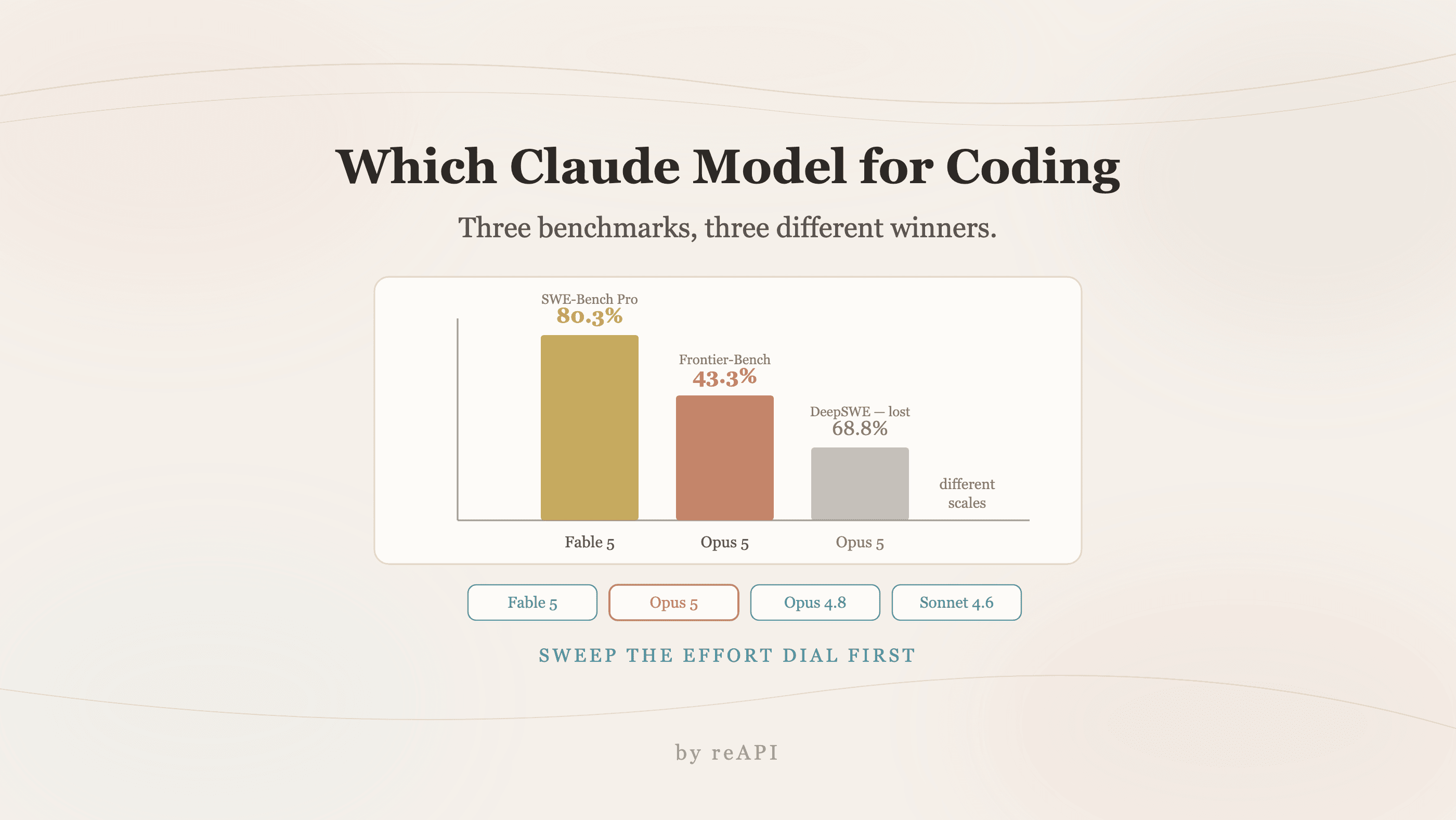
Which Claude model is best for coding depends on the benchmark: Fable 5 tops SWE-Bench Pro, Opus 5 wins agentic terminal work and costs a third as much.
Seedance 2.5 Features: 30-Second Clips and 50 References
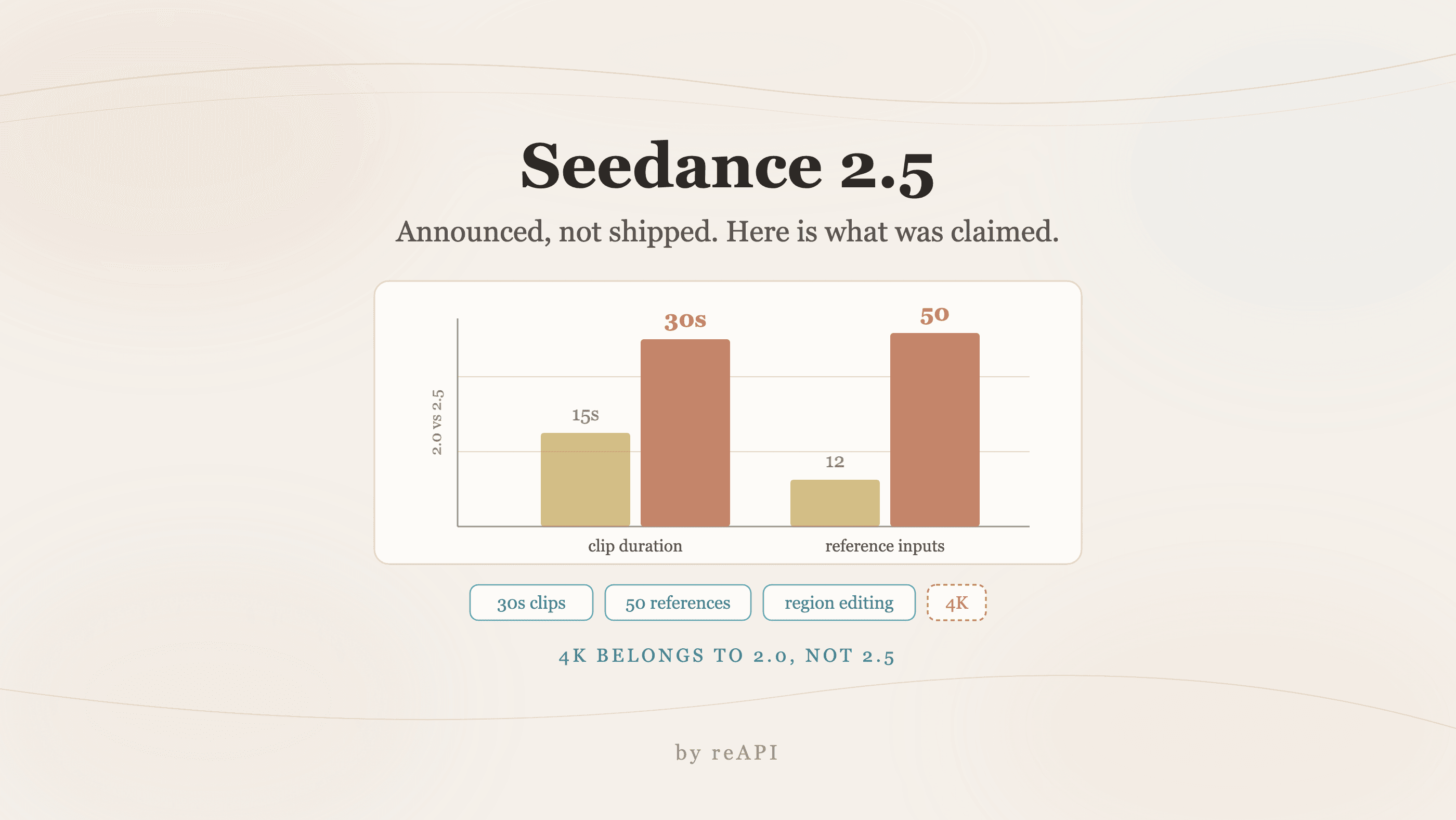
The Seedance 2.5 features ByteDance announced: 30-second single clips, 50 multimodal references, region editing, and why native 4K belongs to Seedance 2.0.

MiniMax H3 License: Territory, Revenue, and Commercial Use
MiniMax H3 is open-weight but not Apache or MIT. Read the territory exclusions, $20M revenue threshold, attribution rule, and self-hosting checklist.