Does Nano Banana Have a Watermark? SynthID Explained
A visible badge and SynthID are different things. One is a product tier you can change, the other is provenance embedded in the content. How to tell them apart.
"Does Nano Banana have a watermark" gets asked as one question but describes two completely different things, and conflating them is why the answers online contradict each other.
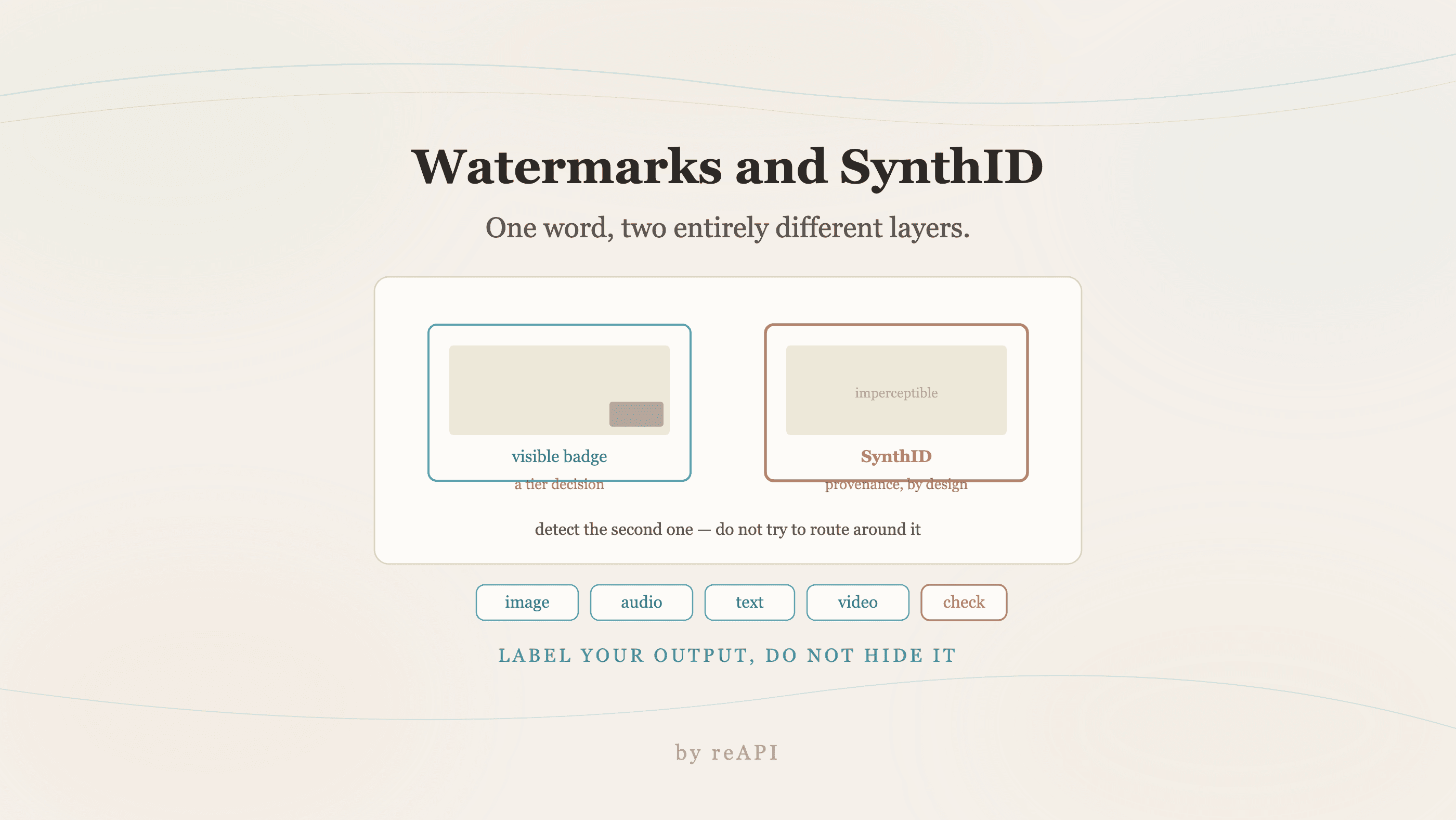
One is a visible badge in a corner, added by a product tier. The other is SynthID, an imperceptible provenance marker embedded by Google across its generative AI products[1]. They have different causes, and only one of them is a product-tier question.
TL;DR
- Visible badges come from the surface, not the model. They are a consumer-tier feature, and API output does not carry them.
- SynthID is different: a digital watermark embedded directly into AI-generated images, audio, text, and video, imperceptible to humans[1].
- SynthID is embedded across Google's generative AI consumer products[1].
- You can check for it by uploading the file to Gemini and asking whether it was created or altered by Google AI[1].
- A SynthID Detector portal exists, currently in testing with journalists and media professionals[1].
- Provenance marking is not a bug to route around. This article covers detection, not removal.
The two things people mean
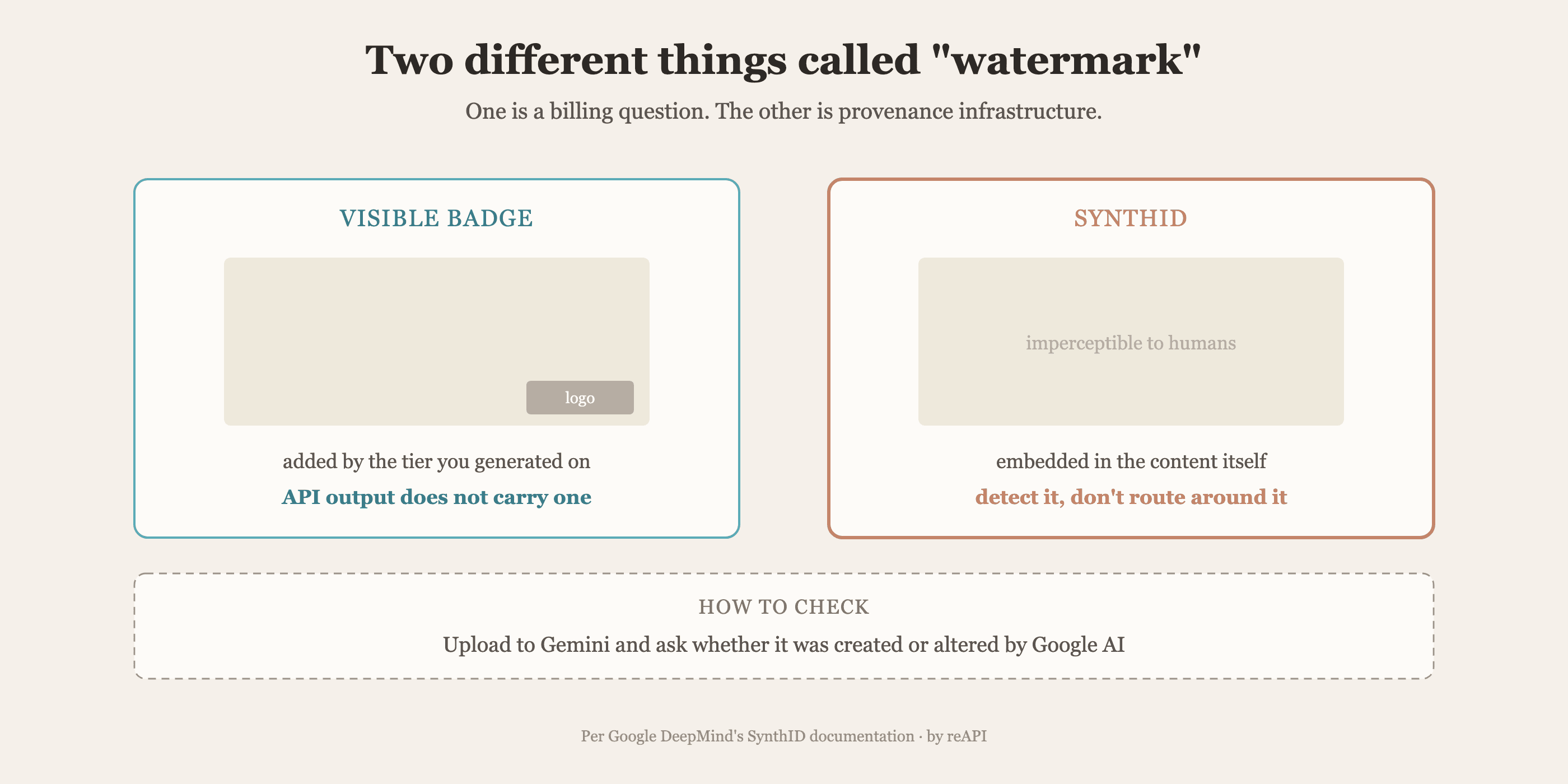
A visible watermark is a logo or badge composited onto the output. It exists because a free or entry tier is subsidised, and the badge is part of what you are trading for the free generation. It is a product-packaging decision made by whichever surface you used.
SynthID is a watermarking tool designed specifically for AI-generated content. Google describes it as embedding digital watermarks directly into AI-generated images, audio, text, or video, imperceptible to humans but detectable by SynthID's technology[1]. Its purpose is to let people identify AI-generated or altered content, which is transparency infrastructure rather than a limitation on your account.
Most people searching for watermark removal are looking at the first one and assuming it is the second. If a badge is visibly sitting in the corner of your image, that is a tier question.
If it is a visible badge
The badge comes from the surface you generated on, so the fix is the surface, not the file.
API output does not carry a consumer-tier badge. When you generate through an image API you get the image the model produced. On reAPI that means Nano Banana 2 Lite at $0.022 per image or Nano Banana Pro at $0.053, with no badge and no plan attached[2].
curl https://reapi.ai/api/v1/images/generations \
  -H "Authorization: Bearer YOUR_API_KEY" \
  -H "Content-Type: application/json" \
  -d '{
    "model": "nano-banana-2-lite",
    "prompt": "product hero on a stone counter, soft window light",
    "aspect_ratio": "16:9"
  }'
That is the entire answer to the visible-badge version of the question: it is a property of the tier you generated on, and the paid API tier does not add one.
If it is SynthID
This one is not a tier feature and should not be treated as one.
SynthID watermarks are embedded across Google's generative AI consumer products, and they are designed to survive as a provenance signal rather than to inconvenience you[1]. The marker exists so that an image can later be identified as AI-generated or AI-altered, which is increasingly what platforms, publishers, and regulators expect to be able to check.
How to check whether content carries it[1]:
- Ask Gemini. Upload the image, video, or audio clip to a chat and ask whether it was created or altered by Google AI. Gemini checks for a SynthID watermark and reports what it finds.
- SynthID Detector, a verification portal for uploading an image, video, or audio file. Google is currently collaborating with journalists and media professionals to test it, with an early-tester waitlist.
That detection path is worth knowing in both directions: for verifying content you received, and for understanding what is knowable about content you produced.
What this means if you are building something
Disclose rather than obscure. If your product generates images for users, the useful posture is telling them the output is AI-generated. Provenance signals are moving toward being expected, and a product that labels its own output ages better than one that gets identified later.
Do not build removal into a pipeline. Beyond the practical problem that these markers are designed to be robust, stripping provenance from AI-generated media is the behavior that platform policies and emerging disclosure rules are specifically aimed at. It is not a technical corner worth optimizing.
Know which marker you are dealing with. A visible badge is a billing question. An invisible provenance marker is a compliance and transparency question. They have nothing to do with each other, and treating the second like the first is how teams end up with a policy problem they did not intend.
Check what you receive. If you accept user-uploaded images into a workflow where provenance matters, the Gemini check is a one-step way to find out whether something was AI-generated or edited[1].
FAQ
Does Nano Banana add a watermark?
Two different things get called that. A visible badge is a consumer-tier feature and is not added to API output. SynthID is an imperceptible provenance marker Google embeds across its generative AI consumer products[1].
How do I get images without a visible badge?
Generate through an API tier rather than a free consumer tier. On reAPI that is $0.022 per image on Nano Banana 2 Lite and $0.053 on Nano Banana Pro[2].
What is SynthID?
Google DeepMind's watermarking tool for AI-generated content, embedding digital watermarks into images, audio, text, and video that are imperceptible to humans but detectable by SynthID's technology[1].
How do I check if an image has a SynthID watermark?
Upload it to Gemini and ask whether it was created or altered by Google AI. A separate SynthID Detector portal is in testing with journalists and media professionals[1].
Does SynthID apply to video and audio too?
Yes. Google describes SynthID as covering images, audio, text, and video[1].
Can SynthID be removed?
That is not something this guide covers. These markers are provenance infrastructure, and stripping them from AI-generated media is what disclosure rules and platform policies are aimed at.
Is a visible badge the same as SynthID?
No. A badge is composited onto the picture by a product tier. SynthID is an imperceptible signal embedded in the content itself[1].
Should my product label AI-generated images?
Increasingly that is the expectation. Labelling your own output is cheaper than being identified later by someone else's detector.
Two questions wearing one word
The reason "does Nano Banana have a watermark" produces contradictory answers is that half the people answering are talking about a corner badge and the other half are talking about provenance infrastructure.
If a logo is visibly on your image, that is a tier you generated on, and an API tier does not add one. If the question is whether the content carries an identifiable signal that it came from a generative model, the answer is that Google embeds SynthID across its generative AI products, it is imperceptible by design, and there is a detection path in Gemini for checking it. Those are different facts about different layers, and only the first is a watermark you should be trying to change.
References
- Google DeepMind. SynthID — watermarking and identifying AI-generated content, and how to detect it. Retrieved July 2026 from deepmind.google/technologies/synthid
- reAPI. Model catalog — per-image rates for the image models. reapi.ai/models
Further reading
- reAPI. Nano Banana Pro vs Nano Banana 2. reapi.ai/blog/nano-banana-pro-vs-nano-banana-2
- reAPI. How to use Nano Banana 2 Lite. reapi.ai/blog/how-to-use-nano-banana-2-lite
- reAPI. Where to use Seedance 2.0. reapi.ai/blog/where-to-use-seedance-2-0
Author

Categories
More Posts
GPT-6 Astra Context Window: Why Codex May Show 258K
Understand GPT-6 Astra's 1.05M API context window, why a Codex session may show a smaller budget, and how to measure compaction without guessing.
Qwen Image 3.0 API Pricing: Pro vs Standard Cost per Image
Qwen Image 3.0 API pricing explained: Alibaba's per-image rates for Standard and Pro at 1K and 2K, how reference images are billed, and when Pro is worth it.

Seedance 2.1 and Seedance 2.0 Mini: What's Actually Coming
Seedance 2.1 reportedly brings a 20% quality bump and Seedance 2.0 Mini a lower price tier. What's sourced, what ByteDance denies, and how to prepare.