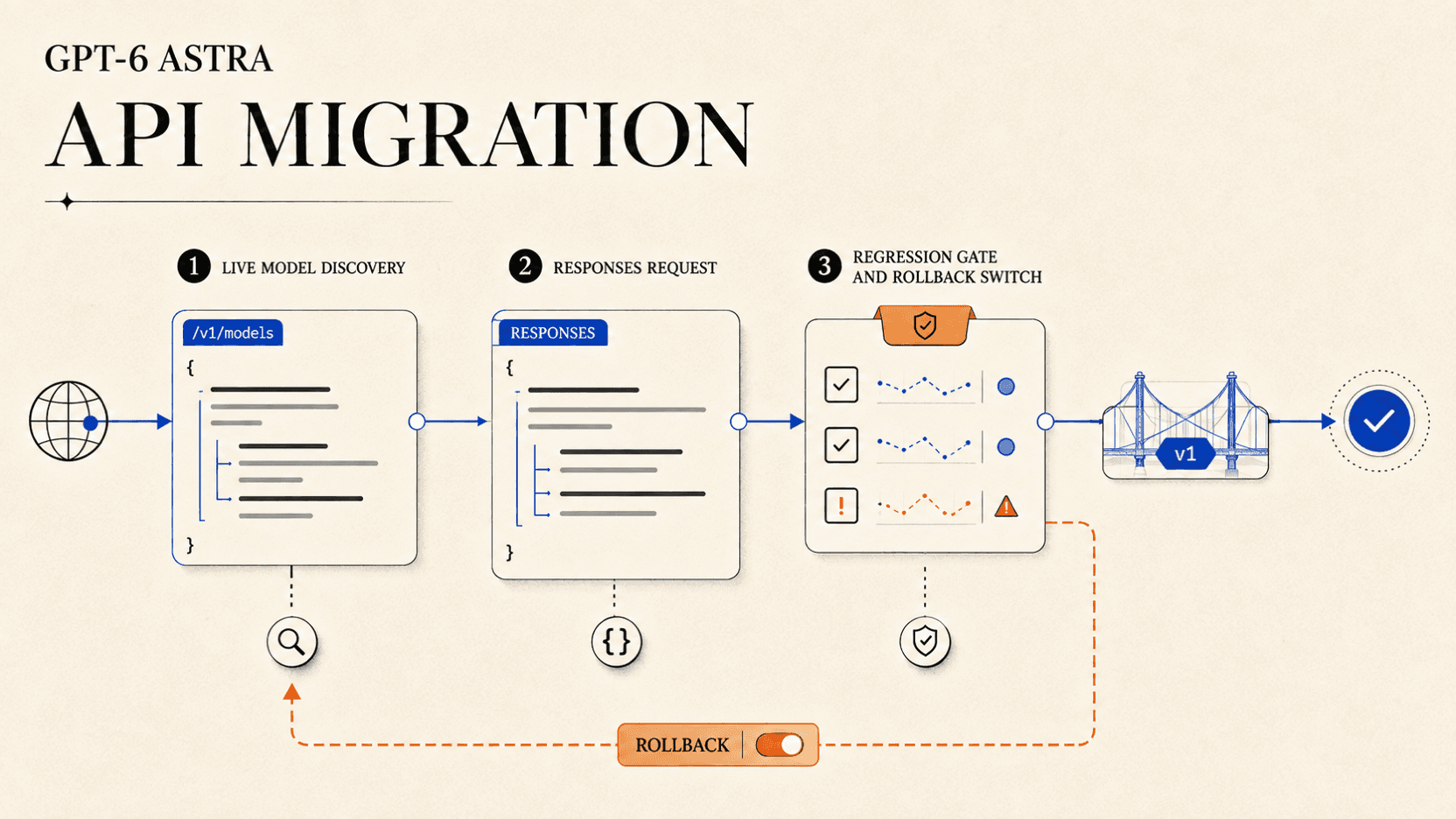
GPT-6 Astra API Migration: Responses, Tools, and Rollback
Migrate to GPT-6 Astra with model discovery, a Responses API request, reasoning controls, tool checks, acceptance gates, and a rollback plan.
The safest GPT-6 Astra API migration is a reversible configuration change,
not a search-and-replace on the model name. Confirm that the production API key
returns gpt-6-astra from /v1/models, move tool-using requests to the
Responses API, start at the lowest reasoning effort that passes your checks,
remove parameters the model rejects, and keep the previous route ready until a
canary set meets its acceptance criteria.[1][2]
This guide uses OpenAI's direct API contract for the migration examples. An OpenAI-compatible gateway may expose a different subset of endpoints and parameters even when the wire model ID is the same. Check that gateway's live catalog and documentation separately.
Quick answer
- Confirm that the production key can discover
gpt-6-astra; an announcement is not an entitlement check. - Move tool calls to the Responses API and map old
noneorminimalreasoning tolow.[1][2] - Remove unsupported sampling and log-probability fields before the first request.[2]
- Ship behind a reversible model switch, then compare correctness, side effects, latency, tokens, and cost on your own fixtures.
Step 1: prove that the production key can see the model
Use model discovery before editing a request. The official ID is
gpt-6-astra, but access is still attached to an API account and key. A model
shown in documentation may not yet be returned to every credential at the same
moment during a rollout.[1]
Keep the key in an environment variable and filter the response locally:
test -n "$OPENAI_API_KEY" || {
  echo "OPENAI_API_KEY is not set" >&2
  exit 1
}

curl --fail-with-body --silent \
  https://api.openai.com/v1/models \
  -H "Authorization: Bearer $OPENAI_API_KEY" \
  | jq -e '.data[] | select(.id == "gpt-6-astra") | .id'
Do not add set -x, print the environment, paste a real key into the command,
or put it in frontend code. A CI job can run the same check with a secret
injected by its credential store.
Treat discovery as a gate:
| Result | Meaning | Migration action |
|---|---|---|
| Exact ID returned | The key can discover gpt-6-astra | Continue to a one-request smoke test |
| HTTP 401 or 403 | Authentication or permission problem | Fix the credential or project; do not change application traffic |
| Valid response, ID absent | Model is not currently discoverable to that key | Keep the old model and recheck later |
| Network or 5xx error | Availability is unknown | Retry the read with bounded backoff; do not treat it as absence |
Discovery is necessary, but it is not a full readiness test. Quotas, request shape, regional settings, or tool policy can still reject a later call. Save the discovery time and key identifier, never the key value.
If the model appears in documentation but an application still cannot call it, the live catalog is the useful evidence. Check the credential and environment rather than inferring access from an announcement or a screenshot.
Step 2: inventory the request you have now
Capture the current behavior before changing endpoints. For each production request class, record:
- current model and endpoint;
- system or developer instructions and prompt version;
- input types and typical context size;
- tools, tool schemas, approval rules, and allowed side effects;
- sampling, reasoning, output, cache, and service-tier parameters;
- success criteria, latency deadline, and fallback behavior;
- the fields your parser reads from the response;
- logs used to reconcile tokens and cost.
This inventory separates three migrations that are often mixed together:
- changing the model to
gpt-6-astra; - moving from Chat Completions to Responses;
- changing prompt or tool behavior to exploit new capabilities.
Ship the first two with the smallest compatible prompt change. Prompt redesign can follow after the transport and parser pass. If all three move together, a failed canary will not tell you whether the model, endpoint, prompt, or tool loop caused the regression.
Step 3: establish a plain Responses API request
Start without tools, streaming, or a long context. The first request should prove authentication, model selection, response parsing, and usage logging.
import OpenAI from 'openai';

const apiKey = process.env.OPENAI_API_KEY;
if (!apiKey) throw new Error('Set OPENAI_API_KEY in your secret store');

const client = new OpenAI({ apiKey });

const response = await client.responses.create({
  model: 'gpt-6-astra',
  reasoning: { effort: 'low' },
  input: [
    {
      role: 'user',
      content: [
        {
          type: 'input_text',
          text: 'Return a three-item rollback checklist for a database index change.',
        },
      ],
    },
  ],
});

console.log(response.output_text);
console.log(response.usage);
OpenAI's model page lists Responses and Chat Completions as supported endpoints. The migration guide recommends Responses for Astra and specifically requires it when tools are involved.[1][2] Keep the initial prompt deterministic enough to review by eye, but do not claim a successful run until your own key has completed it.
If you call Astra through reAPI, use its route-specific GPT-6 Astra documentation. That current contract is OpenAI-compatible Chat Completions and exposes its own supported parameter set. Do not send the direct OpenAI Responses body above to a route whose documentation names a different endpoint.
Step 4: choose a reasoning effort with an escalation rule
OpenAI documents low, medium, high, xhigh, and max for GPT-6 Astra.
It also states that none is unsupported. The migration guide says an existing
none or minimal setting should move to low; otherwise, begin by
preserving the application's effective reasoning level.[1][2]
| Effort | Start here when | Promote only when |
|---|---|---|
low | Classification, extraction, simple planning, or the first transport smoke test | A defined correctness or tool-use gate fails |
medium | The task needs more planning or judgment and low misses a known requirement | The same fixture still fails after prompt defects are removed |
high | Complex debugging, review, or decisions where a miss has a high correction cost | A smaller representative set shows a measurable gain from more effort |
xhigh | Long, difficult work whose value can justify additional latency and tokens | Your evaluation shows it beats high on the target acceptance metric |
max | The hardest bounded cases after all lower levels are measured | Never as an unmeasured global default |
These “start here” entries are deployment advice, not vendor performance claims. Your application decides the thresholds. A useful policy can be written without guessing how much thought a prompt needs:
run at low
if a machine-checkable acceptance gate fails without a transport error:
    retry once at medium
if the task is explicitly high value and medium fails:
    route to human review or a separately approved higher-effort queue
Avoid retrying a tool action at higher effort after it may have changed external state. Reconcile the action first. An effort escalation is safe for a read-only analysis; it is not automatically safe for “send”, “purchase”, “delete”, or “deploy”.
Step 5: move tool calls to Responses deliberately
OpenAI says GPT-6 Astra tool calling requires the Responses API. Chat Completions remains listed for the model, but a Chat Completions request with tools is not the migration path OpenAI documents.[2]
A function definition in a Responses request can look like this:
const tools = [
  {
    type: 'function',
    name: 'read_change_ticket',
    description: 'Read one change ticket by its approved identifier.',
    parameters: {
      type: 'object',
      properties: {
        ticket_id: { type: 'string' },
      },
      required: ['ticket_id'],
      additionalProperties: false,
    },
    strict: true,
  },
];

const response = await client.responses.create({
  model: 'gpt-6-astra',
  reasoning: { effort: 'medium' },
  input: 'Read change ticket CHG-1042 and list its stated rollback steps.',
  tools,
});
The model can request the function; your application still validates the arguments, executes the allowed operation, and returns the tool result in the continuation. Preserve the original call ID. Do not let a model name change bypass your authorization, confirmation, or idempotency controls.
Build separate fixtures for:
- choosing the correct tool rather than answering from memory;
- producing arguments that pass the schema;
- refusing to invent a ticket ID when none was supplied;
- handling a tool error without repeating a side effect;
- combining multiple read results without dropping source distinctions;
- pausing for approval before an irreversible action.
OpenAI also documents async tool calling and mid-turn steering for Astra. Adopt them after the synchronous loop is correct; they add states that need their own timeout, cancellation, and continuation tests.[2]
Step 6: remove incompatible parameters before the canary
Do not wait for production traffic to discover a stale request option. OpenAI's migration guide lists the fields to remove.[2]
| Existing field or value | GPT-6 Astra migration |
|---|---|
temperature | Remove |
top_p | Remove |
top_logprobs | Remove |
Chat Completions logprobs | Remove |
Responses include: ["message.output_text.logprobs"] | Remove that entry |
Reasoning none or minimal | Start with low |
Responses reasoning_effort | Rename to nested reasoning: { effort: "..." } |
| Chat Completions with tools | Move the tool-using path to Responses |
Pre-GPT-5.6 prompt_cache_retention | Review migration to prompt_cache_options.ttl: "30m" |
The last cache change applies when migrating from GPT-5.5 or earlier; it is not required merely because the target is Astra. Service-tier compatibility also depends on data residency. OpenAI says GPT-6 Astra Fast and Priority are unavailable with EU data residency, so keep Standard processing there unless the official compatibility guidance changes.[2]
Search request builders, shared SDK wrappers, defaults, and observability middleware. A removed field may be injected far from the call site. Log a sanitized representation of the final request keys during the canary—never headers, secrets, full personal data, or confidential prompt bodies.
Step 7: define acceptance before sending traffic
A migration passes when the application result passes, not when the endpoint returns HTTP 200. Use fixtures drawn from production-shaped work and score the same inputs on the old and new routes.
| Gate | What to record | Example pass rule |
|---|---|---|
| Correctness | Required facts or assertions | All must-pass assertions succeed |
| Format | Schema parse and required keys | No repair pass needed |
| Tool use | Tool choice and argument validation | No unauthorized or invented call |
| Side effects | Idempotency and approval behavior | No action before required approval |
| Completion | Task reaches an accepted result | No abandoned or looping run |
| Latency | End-to-end and first useful output | Within the route's product deadline |
| Usage | Input, cached input, reasoning/output, tool calls | Stored for every attempt |
| Cost | Settled API cost | Within the per-task budget |
The useful cost equation includes rejected work:
cost per accepted task = total settled API cost / accepted tasksRun the old route and Astra on the same frozen fixtures. Keep tool data, permissions, timeouts, and graders identical. If the Astra prompt must change, version it and report the comparison as a model-plus-prompt migration rather than a model-only result.
OpenAI publishes extensive launch evaluations, but it also notes that research or API harnesses can differ from production ChatGPT behavior.[3] Your acceptance set answers the narrower question that matters: does this application improve without breaking its contract?
Step 8: canary, observe, and keep rollback one switch away
Deploy the new route behind configuration such as:
PRIMARY_MODEL=current-production-model-id
ASTRA_CANARY_MODEL=gpt-6-astra
ASTRA_CANARY_PERCENT=1
The names are examples; use identifiers actually returned to your key. Begin with internal traffic or replayed read-only fixtures. Then expose a small live percentage only after the offline gates pass.
Store enough data to explain a rollback:
- route and exact model ID;
- prompt and tool-schema version;
- reasoning effort;
- request ID and timestamps;
- sanitized error class;
- input, output, and cached-token usage;
- tool calls and approvals;
- acceptance decision and rejection reason.
Rollback conditions should be written before the canary. Examples include a must-pass correctness regression, schema failure, unauthorized tool attempt, budget breach, sustained latency breach, or model disappearance from discovery. When one triggers, set the primary model back to the previous route, stop new Astra work, and let already-started side-effecting tasks reconcile rather than blindly resubmitting them.
Do not delete the old request builder during the first release. Remove it only after the new route has passed the planned observation period and the rollback decision has been reviewed.
Troubleshooting the first GPT-6 Astra request
The API returns model not found
Run /v1/models again with the same key, project, and base URL. If the exact ID
is absent, keep the previous model. If it is present, check whether the request
is using a different credential or environment.
The request fails after changing only the model
Inspect the final serialized body for temperature, top_p, log-probability
fields, or an unsupported reasoning value. Shared defaults are a common source
of fields that are invisible at the call site.
A tool request fails on Chat Completions
Move that request class to Responses. Do not remove tools merely to make the request return text if the application depends on verified external data or actions.
The output is cut off or never reaches the required format
Check the output-token limit, reasoning effort, and response usage. The model page lists a 128,000-token maximum output, but a smaller application cap still applies when you set one.[1] Do not raise the ceiling before checking for loops or an unnecessarily broad prompt.
Higher effort costs more without improving acceptance
Return that request class to the lower passing effort. The five levels are
controls, not a ranking that says every task should run at max.
FAQ
Is the GPT-6 Astra API available under the ID gpt-6?
The official model ID is gpt-6-astra. Use the exact ID returned by
/v1/models; do not invent a shorter alias.[1]
Can I keep using Chat Completions?
OpenAI lists Chat Completions for GPT-6 Astra, but tool calling requires Responses. A text-only request may remain on Chat Completions; a tool-using agent should migrate to Responses.[1][2]
Which reasoning effort should I use first?
Use low for the transport smoke test and simple tasks. Preserve an existing
effective effort when it already maps cleanly, then promote individual request
classes only when a fixed evaluation shows a benefit.
Does GPT-6 Astra accept temperature?
OpenAI's migration guide says to remove temperature, along with top_p and
top_logprobs.[2]
Should an API error automatically fall back to the old model?
Only when the request is safe to replay and the fallback preserves the product contract. Reconcile any uncertain tool side effect first. Automatic replay can duplicate an email, charge, deletion, or deployment.
Can I use the direct OpenAI Responses code with reAPI?
Not against the Chat Completions route documented today. Follow the reAPI
GPT-6 Astra request contract, query its live /v1/models
catalog, and send only the endpoint and fields that route supports.
Ship the migration as a reversible change
A GPT-6 Astra API migration is ready when discovery, request parsing, tools, acceptance scoring, observability, and rollback have all been exercised. Keep the first release small. One explicit model switch and a clean set of canary records are more valuable than a broad rewrite that leaves no way to identify the failure.
After the route is stable, tune reasoning and prompts one request class at a time. The GPT-6 Astra context-window guide covers long-input planning, while the model page carries current reAPI pricing for teams evaluating that separate route.
References
- OpenAI API, “GPT-6 Astra Model”, accessed September 7, 2026.
- OpenAI API, “Model guidance: Using GPT-6 Astra”, accessed September 7, 2026.
- OpenAI, “GPT-6 Astra: A new generation of intelligence”, released September 3, 2026; accessed September 7, 2026.
Author

Categories
gpt-6?Can I keep using Chat Completions?Which reasoning effort should I use first?Does GPT-6 Astra accept temperature?Should an API error automatically fall back to the old model?Can I use the direct OpenAI Responses code with reAPI?Ship the migration as a reversible changeReferencesMore Posts

Pollo AI Pricing: Plans, Free Credits and a Cheaper API Alternative
Pollo AI pricing explained: subscription plans, free and daily credits, the Pollo API's $80 minimum top-up, whether Pollo AI is legit, and where reAPI costs less.

AI Music Video Generator API: Full Songs, Photos, and Lyrics
Turn a 10-second to 5-minute song and 1–7 reference images into a complete music video, with API examples, subtitle options, and exact cost tables.
Is GPT-5.6 Out Yet? Yes — and Here Is What Shipped
GPT-5.6 is released. It shipped as three tiers, the rollout was gated for weeks which is why answers conflict, and Terra is the one worth migrating to.