DeepSeek V4 Flash Official Release: 0731 Agent and Codex Upgrades
DeepSeek V4 Flash 0731 is live in API public beta with stronger agent benchmarks, native Responses API support, Codex integration, and the same model ID today.
DeepSeek V4 Flash 0731 is now the official Flash model served by DeepSeek's API. The July 31, 2026 update replaces the April preview behind the existing deepseek-v4-flash model ID, adds native Responses API support, and substantially retunes the model for coding agents and tool-driven work. DeepSeek calls the release official, but the API service is still labeled public beta.[1]
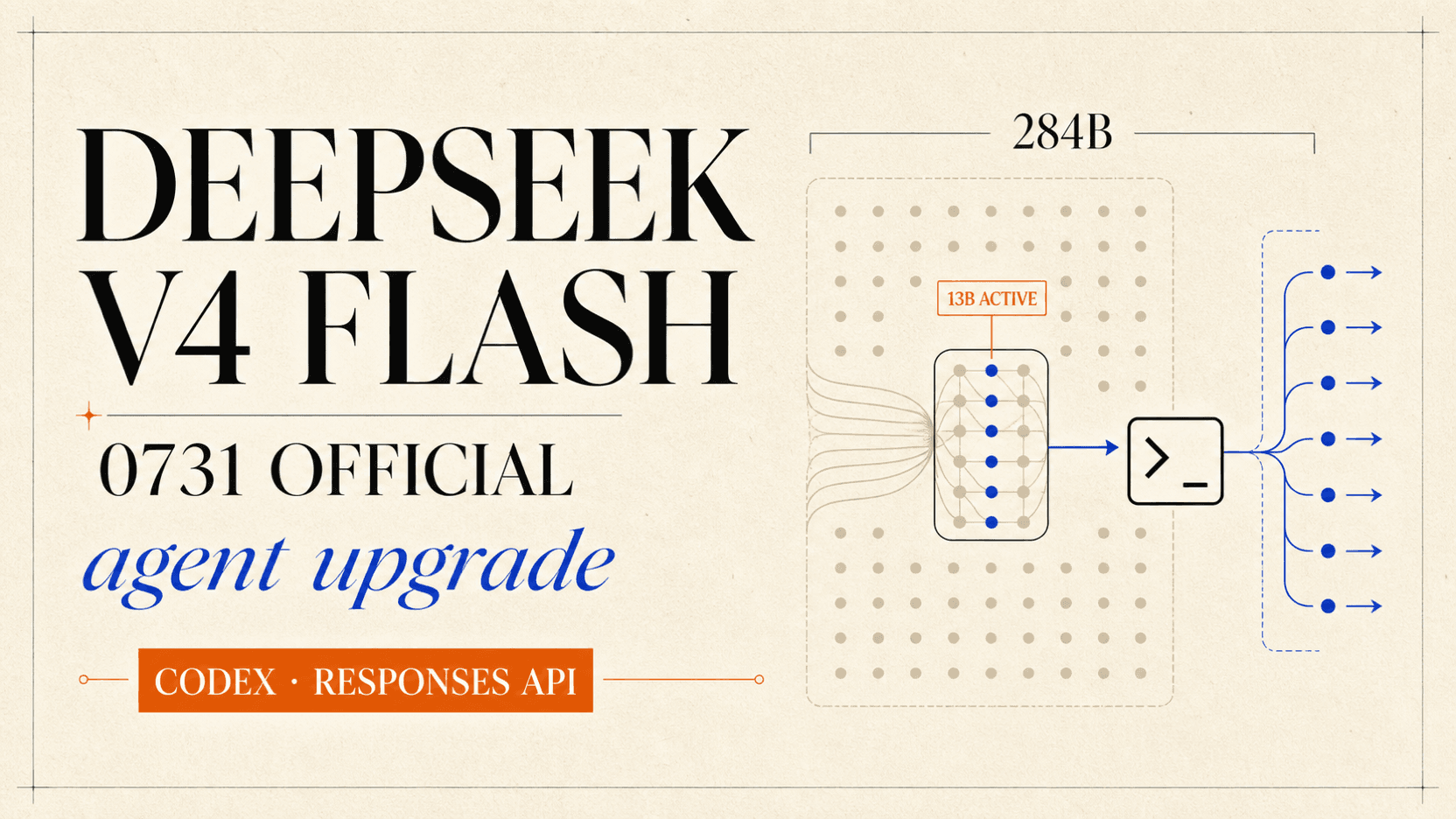
This is an API-only rollout. DeepSeek V4 Pro, the DeepSeek app, and the web chat were not upgraded as part of the 0731 release. The architecture also did not change: Flash remains a 284B-parameter mixture-of-experts model with 13B active parameters and a one-million-token context window.[1][2]
TL;DR
- The official model is
DeepSeek-V4-Flash-0731. Existing API calls keep usingdeepseek-v4-flash; no model-name migration is required.[1] - This is a post-training upgrade, not a new architecture. Total parameters, active parameters, and the 1M context window remain unchanged.[1][2]
- Agent performance is the headline. DeepSeek reports 82.7 on Terminal Bench 2.1, 54.4 on DeepSWE, and 70.3 on Toolathlon Verified, using its unreleased minimal harness and maximum reasoning effort.[1]
- Responses API support is native. Flash can now back Codex without the protocol-conversion proxy that the preview required.[3][4]
- The compatibility layer is not complete OpenAI parity. The API is stateless, accepts text rather than image/file inputs, and ignores or rejects several Responses API fields.[3]
- Pro and consumer chat did not change. DeepSeek says the official V4 Pro release will follow separately.[1]
DeepSeek V4 Flash 0731 specifications
| Item | Official release status |
|---|---|
| Release date | July 31, 2026 |
| Service status | Official API release in public beta |
| API model ID | deepseek-v4-flash |
| Checkpoint name | DeepSeek-V4-Flash-0731 |
| Architecture | Mixture of experts, unchanged from preview |
| Parameters | 284B total, 13B activated |
| Context window | 1M tokens |
| Maximum output | 384K tokens |
| Reasoning modes | Non-thinking, Think High, Think Max |
| API formats | Chat Completions, Anthropic-compatible, Responses API |
| Input on Responses API | Text; image and file inputs are not supported |
| Open weights | MIT-licensed model weights available |
The distinction between the model ID and checkpoint name is deliberate. DeepSeek-V4-Flash-0731 identifies the updated weights, while deepseek-v4-flash is the stable service name applications send to the API.[5] This lets DeepSeek update the backend without forcing every developer to change production configuration.
What changed from DeepSeek V4 Flash Preview
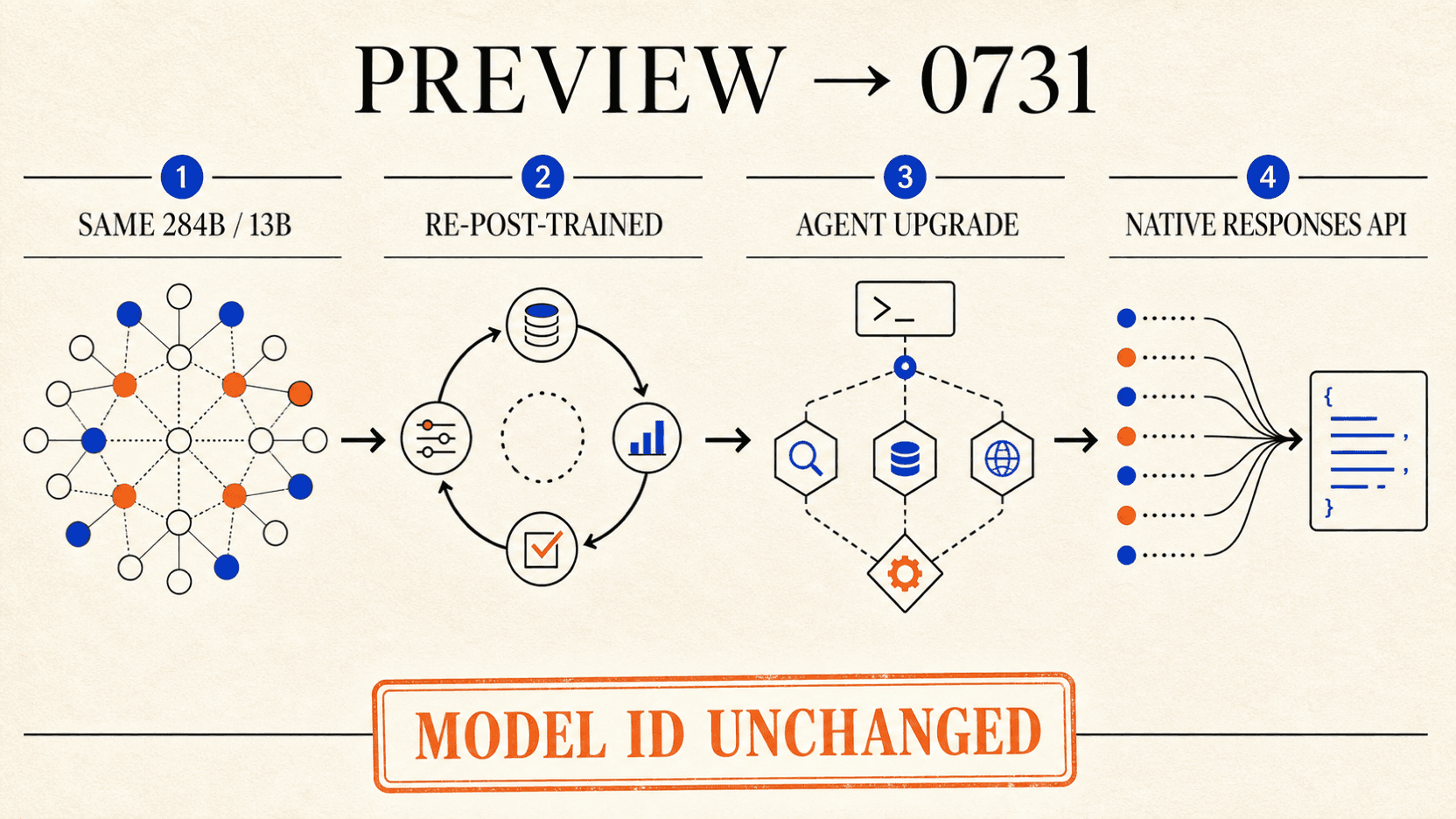
The 0731 release changes behavior and integration more than raw model scale.
| Area | April preview | 0731 official Flash |
|---|---|---|
| Architecture | 284B total / 13B active MoE | Unchanged |
| Context | 1M tokens | Unchanged |
| Model ID | deepseek-v4-flash | Unchanged |
| Training stage | Preview post-training | Re-post-trained for the official release |
| Agent capability | Strong general agent baseline | Major coding-agent and tool-use retuning |
| Responses API | No native endpoint | Native support |
| Codex integration | Required an adapter or another compatible route | Officially documented direct configuration |
| Rollout scope | Flash and Pro preview APIs | Flash API only |
DeepSeek says 0731 “was only re-post-trained.”[1] That phrase is easy to undersell. For agent models, post-training controls whether the model plans effectively, calls the right tool, reads the result, recovers from failure, and continues until the task is complete. Architecture sets the capacity; post-training determines how reliably that capacity appears inside a working agent.
The release therefore does not make the model larger. It makes the existing Flash model more useful for repository work, terminal tasks, patch generation, search, and multi-step automation.
DeepSeek's new agent benchmarks—and how to read them
DeepSeek published nine scores for the official release:[1]
| Benchmark | DeepSeek V4 Flash 0731 |
|---|---|
| Terminal Bench 2.1 | 82.7 |
| NL2Repo | 54.2 |
| CyberGym | 76.7 |
| DeepSWE | 54.4 |
| Toolathlon Verified | 70.3 |
| Agent Last Exam | 25.2 |
| Automation Bench Public | 25.1 |
| DSBench FullStack | 68.7 |
| DSBench Hard | 59.6 |
These figures support the claim that agent work was the focus of the update. They do not establish a universal ranking.
DeepSeek used its own “Harness minimal mode,” which the company says will be released later, with maximum reasoning effort, top_p: 0.95, and temperature: 1.0. Two of the reported datasets—DSBench FullStack and DSBench Hard—are internal.[1] Until the harness and internal tasks are available, those results cannot be independently reproduced end to end.
For a production evaluation, keep the same repository set, tool permissions, timeout, retry policy, reasoning effort, and token budget across models. Measure completed tasks and accepted patches, not just whether an agent produced a plausible-looking diff.
Native Responses API is the most important developer change
DeepSeek V4 Flash now accepts the Responses API format at the standard DeepSeek base URL. That removes a significant integration gap for Codex and other clients built around /v1/responses rather than Chat Completions.[3]
A minimal direct call uses the OpenAI SDK:
from openai import OpenAI

client = OpenAI(
    api_key="YOUR_DEEPSEEK_API_KEY",
    base_url="https://api.deepseek.com",
)

response = client.responses.create(
    model="deepseek-v4-flash",
    instructions="Review code conservatively and explain every proposed edit.",
    input="Find the race condition in this queue worker.",
    reasoning={"effort": "high"},
    max_output_tokens=8_192,
)

print(response.output_text)
Streaming returns semantic events such as response.output_text.delta, response.function_call_arguments.delta, and response.completed. Unlike the familiar Chat Completions stream, it does not end with data: [DONE].[3]
Native support matters because an adapter no longer has to translate tool calls, reasoning events, and output items between two wire formats. Fewer translation layers mean fewer places for tool-call IDs, streaming state, or reasoning history to break.
Responses API compatibility has important limits
“Native Responses API” does not mean that every OpenAI Responses feature works. DeepSeek documents the compatibility boundary in detail.[3]
Supported features include:
- text input and developer/system instructions;
- streaming;
- function tools and server-side web search;
- required or specific tool choice;
- reasoning effort;
- structured text formats;
- the
apply_patchcustom tool used for Codex compatibility.
Important limitations include:
previous_response_idandconversationare not supported, so the API is stateless;store, background mode, metadata, prompt templates, and service tiers are not supported;- image and file input items are replaced with placeholder text rather than processed;
- MCP, computer use, code interpreter, and file search tools are ignored;
parallel_tool_callsis ignored because parallel tool use is always enabled;- requests that exceed the context window return HTTP 400 instead of being automatically truncated.
Some unsupported parameters are silently ignored. That makes initial connection easier, but it also means a request can return successfully without honoring every control your application sent. Integration tests should verify behavior, not only HTTP status.
How to use DeepSeek V4 Flash 0731 with Codex
DeepSeek now publishes a dedicated Codex configuration guide. As of August 2, only Flash is supported; V4 Pro support is expected separately.[4]
The official setup creates a DeepSeek provider in ~/.codex/config.toml and a model catalog in ~/.codex/models.json. The important runtime values are:
model = "deepseek-v4-flash"
model_provider = "deepseek"

[model_providers.deepseek]
name = "DeepSeek"
base_url = "https://api.deepseek.com"
wire_api = "responses"
env_key = "DEEPSEEK_API_KEY"
DeepSeek's catalog gives Flash a 1,048,576-token maximum context, enables parallel tool calls, and exposes low, high, and max reasoning levels.[4] Keep the API key in an environment variable rather than writing it into a shared configuration file.
For repository work, begin with high reasoning. Move to max only for tasks that justify extra latency and output tokens, such as a cross-service migration or a difficult intermittent bug.
Pricing and context limits did not receive a new release tier
The current DeepSeek Direct price sheet lists Flash at:[6]
| Token category | Price per 1M tokens |
|---|---|
| Cached input | $0.0028 |
| Uncached input | $0.14 |
| Output | $0.28 |
Flash retains a 1M shared context window, a 384K maximum output, and an account-level concurrency limit of 2,500.[6][7] The low headline token price does not make maximum-context agent runs free: tool schemas, repository files, reasoning tokens, retries, and long outputs all contribute to usage.
For a detailed explanation of context budgeting and cache behavior, see DeepSeek V4 1M Context: max_tokens, Billing, and Concurrency.
These are DeepSeek Direct rates. reAPI has its own product contract and live rate card on the DeepSeek V4 model page. Do not copy a vendor price into a gateway cost calculator without checking the route you are actually using.
Calling DeepSeek V4 Flash through reAPI
The existing reAPI integration uses the same stable model name through an OpenAI-compatible Chat Completions endpoint:
curl https://api.reapi.ai/v1/chat/completions \
  -H "Authorization: Bearer $REAPI_API_KEY" \
  -H "Content-Type: application/json" \
  -d '{
    "model": "deepseek-v4-flash",
    "messages": [
      {
        "role": "system",
        "content": "Work through the repository methodically. Return a minimal patch."
      },
      {
        "role": "user",
        "content": "Trace this authentication failure and identify the smallest safe fix."
      }
    ],
    "max_tokens": 8192,
    "reasoning_effort": "high"
  }'
See the DeepSeek V4 API documentation for the current reAPI request contract. Gateway rollout and vendor-direct rollout are separate operational events, so confirm the active route and model discovery response when an application depends on the exact 0731 revision.
Who should switch to the official Flash release?
Existing DeepSeek Direct API users do not need to switch model IDs; the stable Flash name already selects the latest version. They should rerun evaluations because behavior changed even though configuration did not.
The release is particularly relevant for:
- coding-agent teams using terminal, search, and patch tools;
- developers who previously maintained a Chat Completions-to-Responses proxy;
- high-volume workloads that need a smaller active parameter footprint than V4 Pro;
- long-context agents that can benefit from automatic prefix caching;
- Codex users willing to operate within DeepSeek's documented compatibility limits.
Wait before treating it as a drop-in replacement when your workflow requires image understanding, durable Responses conversations, background jobs, code interpreter, MCP through the API, or exact OpenAI feature parity. Those features are absent or handled outside the model endpoint today.[3]
Production migration checklist
- Keep
deepseek-v4-flash; do not invent adeepseek-v4-flash-0731API ID unless a provider explicitly exposes it. - Rerun agent evaluations because the backend behavior changed under the stable name.
- Pin the harness, tool definitions, reasoning effort, token budget, and timeout when comparing results.
- Test every Responses API field your application relies on; several unsupported fields are silently ignored.
- Preserve conversation history client-side because
previous_response_idis not supported. - Reject or pre-process image and file inputs rather than assuming the model can inspect them.
- Track cached and uncached input separately in cost telemetry.
- Roll out behind a feature flag and keep the previous production route available until acceptance tests pass.
Frequently asked questions
Is DeepSeek V4 Flash 0731 the official version?
Yes. DeepSeek calls it the official V4 Flash release, served through an API public beta from July 31, 2026.[1] “Official release” describes the model revision; “public beta” describes the current service stage.
Do I need to change the API model name?
No. DeepSeek Direct continues to use deepseek-v4-flash, which now routes to DeepSeek-V4-Flash-0731.[5]
Is DeepSeek V4 Flash 0731 a larger model?
No. It keeps the preview architecture and size: 284B total parameters and 13B activated. The update comes from additional post-training.[1]
Does the official Flash release support the Responses API?
Yes. DeepSeek provides a native Responses API surface for Flash and documents direct Codex integration.[3][4]
Can DeepSeek V4 Flash process images through Responses API?
No. The official compatibility table says image and file input parts are replaced with placeholder text. Treat the endpoint as text input.[3]
Was DeepSeek V4 Pro upgraded too?
No. DeepSeek says the 0731 update applies only to the Flash API. The Pro API and App/Web models were unchanged, with the official Pro release planned separately.[1]
What this release actually means
The DeepSeek V4 Flash official release is a focused agent upgrade. It keeps the efficient Flash architecture and stable API name, then changes the part developers feel most: tool use, terminal work, coding behavior, and integration with Responses-based clients.
The practical headline is not merely that benchmark numbers rose. deepseek-v4-flash can now plug directly into Codex through a documented native protocol. Teams should still test the compatibility gaps, reproduce performance on their own repositories, and remember that the service is in public beta. That is a substantial release, but it is not yet the full DeepSeek V4 product-line rollout.
References
- DeepSeek. Change Log — DeepSeek-V4-Flash Update. July 31, 2026. api-docs.deepseek.com/updates
- DeepSeek. DeepSeek-V4-Flash model card — architecture, parameters, context, reasoning modes, and license. Retrieved August 2, 2026 from huggingface.co/deepseek-ai/DeepSeek-V4-Flash
- DeepSeek. Using the Responses API — supported fields, tools, streaming, and compatibility limits. Retrieved August 2, 2026 from api-docs.deepseek.com/guides/responses_api
- DeepSeek. Integrate with Codex — official provider and model configuration. Retrieved August 2, 2026 from api-docs.deepseek.com/quick_start/agent_integrations/codex
- DeepSeek. Your First API Call —
deepseek-v4-flashnow routes to the 0731 model. Retrieved August 2, 2026 from api-docs.deepseek.com/guides/function_calling - DeepSeek. Models & Pricing — Flash token rates, context, maximum output, and features. Retrieved August 2, 2026 from api-docs.deepseek.com/quick_start/pricing
- DeepSeek. Rate Limit & Isolation — account-level Flash concurrency. Retrieved August 2, 2026 from api-docs.deepseek.com/quick_start/rate_limit
Further reading
- reAPI. DeepSeek V4 model page and live gateway pricing. reapi.ai/models/deepseek-v4
- reAPI. DeepSeek V4 API reference. reapi.ai/docs/deepseek-v4
- reAPI. MiniMax M3 API: 1M Context, Pricing, and Coding Guide. reapi.ai/blog/minimax-m3-api-guide
Author

Categories
More Posts
Mammouth AI Pricing: Plans, Limits, and API Access (2026)
Mammouth AI pricing explained: compare Starter, Standard, and Expert plans, three-hour quota resets, included API credits, PAYG access, and file limits.
AI Image Generation for Games: Cut Cost With Caching
Build a cache-first game image pipeline with semantic keys, single-flight requests, async polling, budget caps, durable storage, and acceptance-cost math.

Can You Tell If a Writer Used ChatGPT? Patterns, Not Proof
Can you tell if a writer used ChatGPT? Learn the recurring style signals, why no phrase proves AI authorship, and a fairer way to review suspicious text.