· reAPI Team
GPT-6.1 Sol vs GPT-6 Sol: What Actually Changed for Coding, Caching & API Migration
GPT-6.1 Sol vs GPT-6 Sol side by side: same $2/$10 list rates, 50% cheaper cache reads, +10.4 intelligence jump, Ultrafast tier, and the breaking reasoning_effort change to check before migrating.
OpenAI shipped GPT-6 Sol on September 22, 2026, and replaced it seven days later with GPT-6.1 Sol on September 29, 2026[1][2]. On paper, both models share the exact same headline Standard price—$2.00 per million input tokens and $10.00 per million output tokens—and the same 272K long-context threshold. Yet switching from gpt-6-sol to gpt-6.1-sol is neither a trivial cosmetic bump nor a blind drop-in swap.
Three real changes separate the two models in production:
- Higher capability at the same list price: Independent testing on the Artificial Analysis Intelligence Index puts GPT-6.1 Sol 10.4 points ahead of GPT-6 Sol (54.6 vs 44.2), with OpenAI positioning 6.1 Sol as "near-Astra performance for complex work at a lower cost"[2][3].
- Half-price prompt cache reads and a new speed tier: Cached input drops from 10% ($0.20/1M) on GPT-6 Sol to 5% ($0.10/1M) on GPT-6.1 Sol, and GPT-6.1 Sol adds both 12-hour cache writes and a 6×
Ultrafasttier in the Responses API[1][2]. - A breaking parameter change: GPT-6.1 Sol drops
reasoning_effort: "none"(its minimum setting islow, withmediumas default) and changes how tool calling behaves across endpoints[2][4].
If your pipeline sends reasoning_effort: "none" for fast, non-reasoning extraction, swapping the model string without updating your request payload will break in production. Below is the complete side-by-side breakdown, worked dollar math for cache-heavy agent loops, and a concrete migration checklist.
GPT-6.1 Sol vs GPT-6 Sol at a glance
| Dimension | GPT-6 Sol (gpt-6-sol) | GPT-6.1 Sol (gpt-6.1-sol) | Practical impact |
|---|---|---|---|
| Release date | September 22, 2026 | September 29, 2026 | OpenAI's GPT-6 Sol docs now direct new work to 6.1 Sol[1] |
| Standard input (≤272K) | $2.00 / 1M | $2.00 / 1M | Identical uncached input cost[1] |
| Standard output (≤272K) | $10.00 / 1M | $10.00 / 1M | Identical output & reasoning token rate[1] |
| Cached input read (≤272K) | $0.20 / 1M (10% of input) | $0.10 / 1M (5% of input) | 50% cheaper cache reads on multi-turn agents[4] |
| Cache write (30-min) | $2.50 / 1M (1.25× input) | $2.50 / 1M (1.25× input) | Same 30-minute write multiplier[1] |
| Cache write (12-hour) | Not listed | $5.00 / 1M (≤272K) / $10.00 (>272K) | Available via Responses API for long-lived sessions[4] |
| Long-context cliff (>272K) | $4.00 in / $0.40 cached / $15.00 out | $4.00 in / $0.20 cached / $15.00 out | Full request re-prices above 272K on both models[1] |
| Speed tiers | Batch/Flex (0.5×), Standard (1×), Fast (2×) | Batch/Flex (0.5×), Standard (1×), Fast (2×), Ultrafast (6×) | Ultrafast ($12/$60) available in Responses API since Oct 8, 2026[2] |
| Reasoning effort levels | none, low, medium (default), high, xhigh, max | low, medium (default), high, xhigh, max (no none) | Breaking change if you explicitly send none[2] |
| Artificial Analysis Intelligence Index | 44.2 | 54.6 | +10.4-point gain at the same base list price[3] |
Why the 5% vs 10% cache-read cut matters—and when it doesn't
A common mistake when reading rate cards is assuming "cached input is half price" means your overall bill drops by 50%. It does not. Output tokens (which include hidden reasoning tokens) still bill at $10.00 per million on both models—50× to 100× more expensive than a cached input token.
Whether GPT-6.1 Sol actually lowers your invoice depends on the ratio of cached context to generated output. Compare two realistic engineering workloads using OpenAI's Standard short-context rates:
Scenario 1: Single-turn API classification or short code review (no cache reuse)
- Workload: 2,500 uncached input tokens, 600 output tokens (including reasoning), 10,000 requests.
- GPT-6 Sol:
(2,500 × $2 + 600 × $10) / 1M = $0.011/req→ $110.00 total. - GPT-6.1 Sol:
(2,500 × $2 + 600 × $10) / 1M = $0.011/req→ $110.00 total.
Here, the token bill is identical down to the cent—assuming both models spend the same number of reasoning tokens. The only financial upside on single-turn jobs is fewer retries: if GPT-6.1 Sol solves a bug on attempt 1 instead of attempt 2, your cost per accepted result drops in half even though the per-token rate did not move.
Scenario 2: 40-turn coding agent session with a 60K shared repo prefix
- Workload: 1 cache write of 60,000 tokens, followed by 39 cache reads of 60,000 tokens, plus 2,000 fresh input tokens and 1,000 output tokens per turn (40 turns total, staying under the 272K cliff).
| Cost component | GPT-6 Sol (10% cache read) | GPT-6.1 Sol (5% cache read) | Difference |
|---|---|---|---|
| 1× Cache write (60K @ $2.50/1M) | $0.150 | $0.150 | $0.000 |
| 39× Cache reads (2.34M tokens) | $0.468 (@ $0.20) | $0.234 (@ $0.10) | -$0.234 (-50%) |
| 40× New uncached input (80K @ $2.00/1M) | $0.160 | $0.160 | $0.000 |
| 40× Output + reasoning (40K @ $10.00/1M) | $0.400 | $0.400 | $0.000 |
| Total per 40-turn session | $1.178 | $0.944 | -$0.234 (-19.9%) |
Across 1,000 agent sessions a month, that single cache-read line item saves $234/month while also giving you the stronger 6.1 reasoning engine. For full tier-by-tier formulas and Batch/Flex/Fast/Ultrafast tables, see our GPT-6.1 Sol pricing guide and GPT-6 Sol pricing breakdown.
The hidden cost variable: reasoning tokens and losing none effort
Because OpenAI bills reasoning tokens at the $10.00/1M output rate, your reasoning_effort configuration moves the bill far more than input pricing does[5].
Here is the catch teams hit during migration:
- GPT-6 Sol lets you pass
reasoning_effort: "none"for deterministic formatting, JSON extraction, or fast UI completions where you do not want to pay for an internal thinking pass. - GPT-6.1 Sol removes
none. The lowest allowed value islow, and the default if omitted ismedium.
That creates two failure modes when migrating blindly:
- Hard HTTP 400 errors on endpoints that explicitly pass
"reasoning_effort": "none". - Silent latency and spend inflation on high-volume low-complexity routes: if a route previously ran at
nonewith 150 output tokens ($0.0015) and you switch it to GPT-6.1 Sol atlowormediumwhere it emits 800 hidden reasoning tokens + 150 visible tokens ($0.0095), output cost jumps 6.3× on that route.
The engineering fix is straightforward: do not force one model onto every route. Move complex coding, debugging, and agent planning to gpt-6.1-sol, and route pure formatting or non-reasoning extraction either to a cheaper sibling like GPT-6.1 Terra ($1/$5 per 1M) or gpt-6-luna ($0.10/$0.50 per 1M).
Processing tiers: where Ultrafast and 12-hour caching fit
Both models share Batch (0.5×), Flex (0.5×), Standard (1×), and Fast (2×). GPT-6.1 Sol adds two operational levers that GPT-6 Sol does not offer:
- 12-hour cache write lifetime ($5.00/1M ≤272K, $10.00/1M >272K in Responses API): Standard 30-minute caches expire when a developer steps away for lunch or a meeting. If your IDE agent or document review app keeps a 100K-token system context warm across an entire workday, paying 2× once for a 12-hour write avoids paying repeated 30-minute write penalties every hour[4].
- Ultrafast mode (
service_tier: "ultrafast", 6× Standard = $12 input / $60 output): Designed strictly for latency-critical interactive loops where wall-clock time beats token budget. Note that at $60/1M output, GPT-6.1 Sol Ultrafast costs more per output token than GPT-6 Astra at Standard ($50/1M)—so reserve it for short-output interactive steps, never for long code generation[1].
How to migrate from gpt-6-sol to gpt-6.1-sol safely
1. Update the model ID and audit reasoning_effort
Before:
curl -sS https://api.reapi.ai/v1/chat/completions \
  -H "Authorization: Bearer $REAPI_API_KEY" \
  -H "Content-Type: application/json" \
  -d '{
    "model": "gpt-6-sol",
    "reasoning_effort": "none",
    "messages": [{"role": "user", "content": "Extract all error codes as JSON."}]
  }'
After (migrated to gpt-6.1-sol on reAPI—same endpoint, same API key, single balance):
curl -sS https://api.reapi.ai/v1/chat/completions \
  -H "Authorization: Bearer $REAPI_API_KEY" \
  -H "Content-Type: application/json" \
  -d '{
    "model": "gpt-6.1-sol",
    "reasoning_effort": "low",
    "messages": [{"role": "user", "content": "Refactor this retry loop to respect context deadlines."}]
  }'
2. Run a paired 20-task pilot before flipping production traffic
Rather than trusting aggregate leaderboards, replay 20 recent production traces through both gpt-6-sol and gpt-6.1-sol and compare four columns:
- First-pass acceptance rate (did unit tests pass or did the human accept the diff without follow-up?).
- Reasoning + completion tokens per task (check whether
mediumon 6.1 Sol uses fewer or more total tokens thanhighon 6.0 Sol). - Cache hit ratio (
cached_tokens / prompt_tokens)—visible per request on reAPI's/usage-logsand/activitiesdashboards. - P95 time-to-final-token, especially if your prompts sit near the 272K long-context cliff (trimming a 280K prompt down to 265K cuts total cost by more than half on both models).
When to upgrade vs when to keep GPT-6 Sol (or choose another sibling)
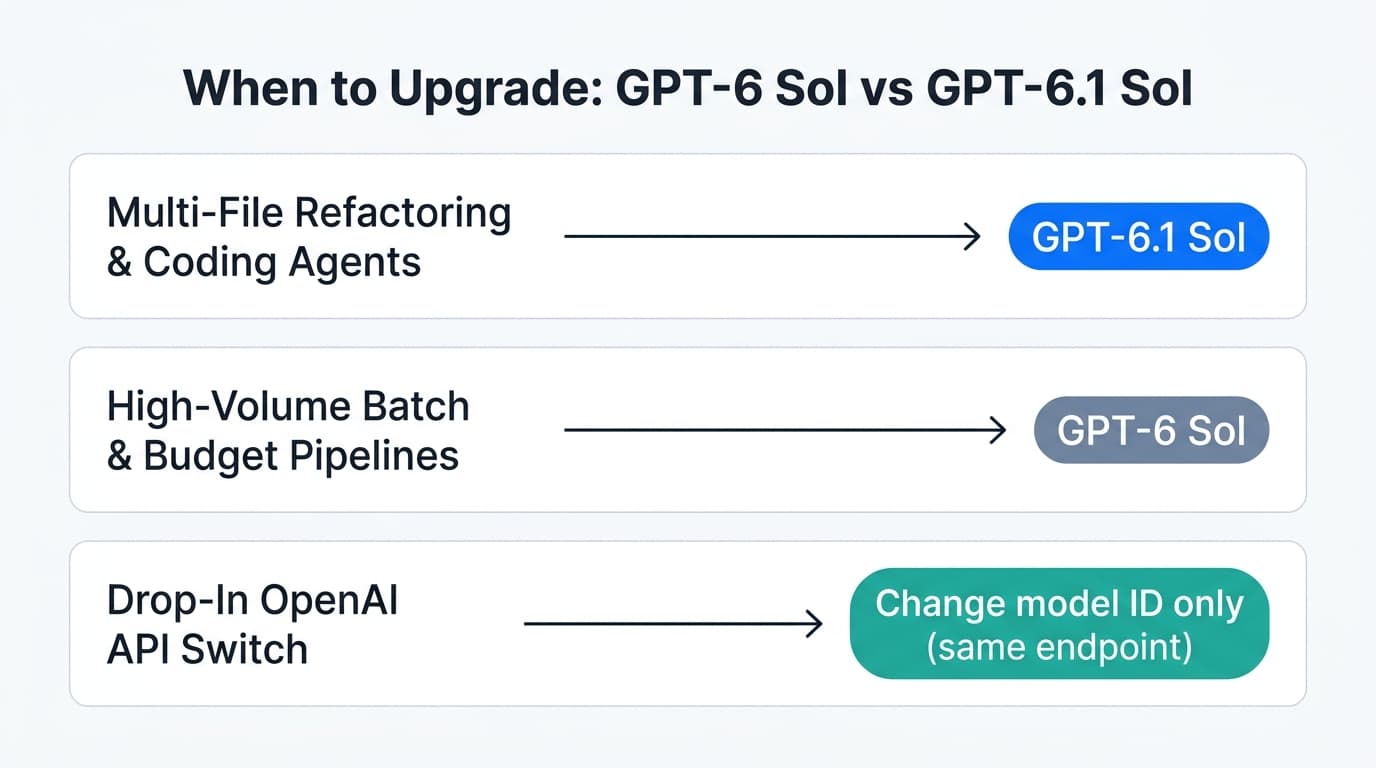
- Upgrade to GPT-6.1 Sol immediately for multi-file coding agents, repository refactoring, root-cause debugging, long-document synthesis, and any cache-heavy workflow where 5% cache reads compound across turns.
- Keep GPT-6 Sol temporarily only if a legacy service depends on
reasoning_effort: "none"or a strict Chat Completions tool-calling contract that you have not yet re-tested against 6.1 Sol. - Step down to GPT-6.1 Terra when tasks are routine, high-volume, or visual and you want half the per-token price ($1/$5)—see GPT-6.1 Terra vs GPT-6.1 Sol.
- Step up to GPT-6 Astra only on the hardest 5% of architectural or mathematical problems where 5× token spend is cheaper than an engineer's hour—see GPT-6.1 Sol vs GPT-6 Astra.
Frequently asked questions
Is GPT-6.1 Sol cheaper than GPT-6 Sol?
Uncached input ($2/1M), output ($10/1M), and 30-minute cache writes ($2.50/1M) are identical. GPT-6.1 Sol is cheaper specifically on cached input reads ($0.10/1M vs $0.20/1M—a 50% reduction) and on cost per accepted task when higher accuracy eliminates retry loops[1].
Can I upgrade from GPT-6 Sol to GPT-6.1 Sol by changing only the model ID?
Only if your requests do not pass reasoning_effort: "none" and your tool-calling integration passes smoke tests on the new model. If you currently send none, change it to low (or route that lightweight endpoint to a non-reasoning model) before switching[2].
Does GPT-6.1 Sol have a larger context window than GPT-6 Sol?
Both models share the same 272K short-context pricing boundary, above which the entire request moves to long-context rates ($4 input / $15 output per 1M). On both models, keeping prompts below 272K is the single largest cost optimization you can make[1].
How does GPT-6.1 Sol compare to GPT-6 Astra on price?
GPT-6.1 Sol costs one fifth of GPT-6 Astra on Standard input and output ($2/$10 vs $10/$50 per 1M) and one tenth on cached input reads ($0.10 vs $1.00 per 1M), while closing much of the practical coding gap[1].
References
- OpenAI, API Pricing — Standard, Batch, Flex, Fast and Ultrafast Tables,
https://openai.com/api/pricing/(reviewed 2026-10-28 & 2026-11-23). - OpenAI, GPT-6.1 Sol & GPT-6 Sol Model Documentation and Changelog,
https://platform.openai.com/docs/models(September 22–October 8, 2026). - Artificial Analysis, GPT-6.1 Sol vs GPT-6 Sol Intelligence Index Comparison (54.6 vs 44.2, reviewed 2026-11-23).
- OpenAI, Prompt Caching Guide (5% cache read rate on GPT-6.1 Sol & 12-hour write option),
https://platform.openai.com/docs/guides/prompt-caching. - OpenAI, Reasoning Models Guide — Reasoning Token Billing,
https://platform.openai.com/docs/guides/reasoning.