Qwen Image 2 API: Pricing, Text Rendering, and Editing (2026)
Use the Qwen Image 2 API for generation and image editing. Learn current pricing, supported ratios, prompt limits, reAPI parameters, safety, and code.
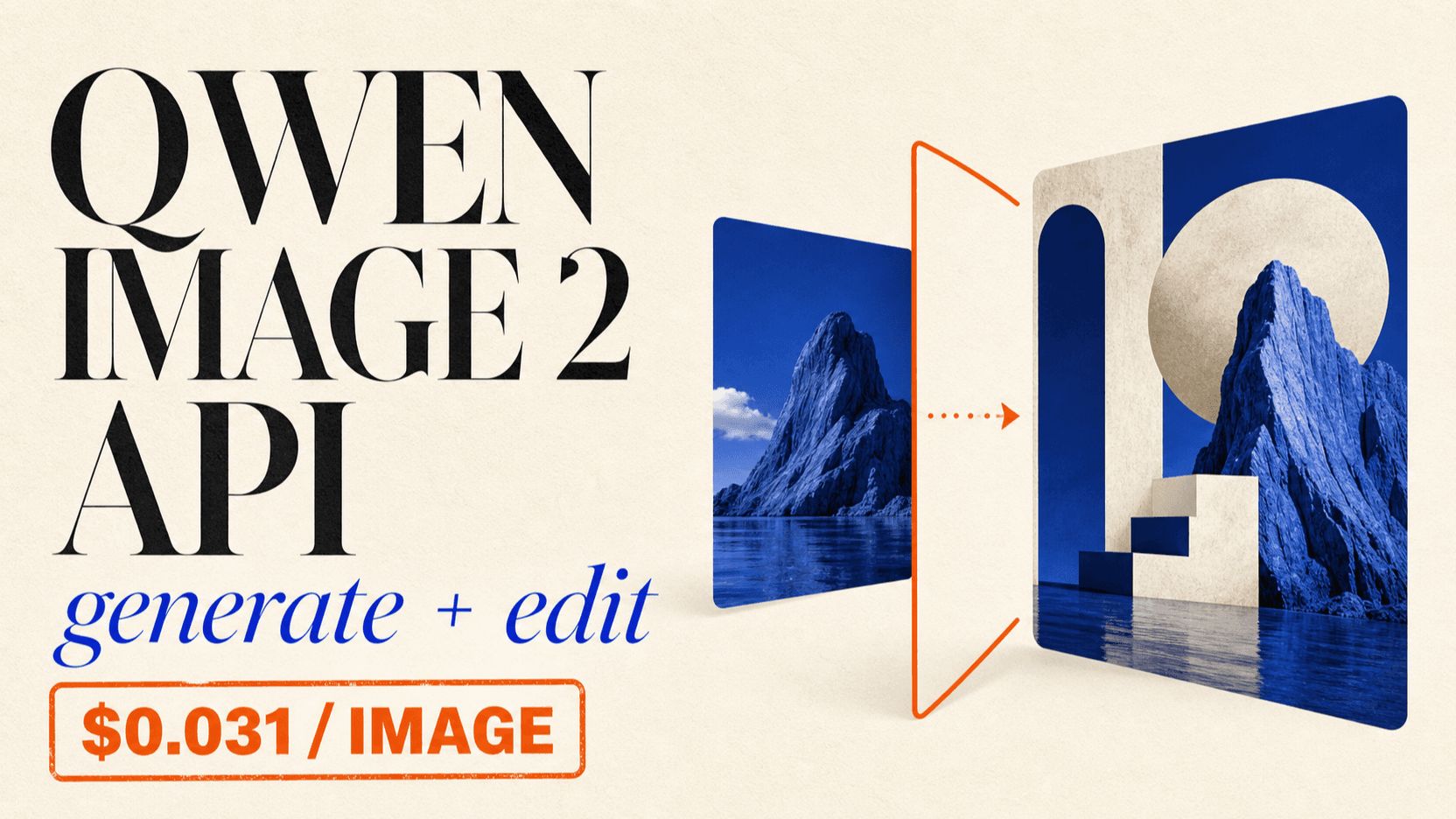
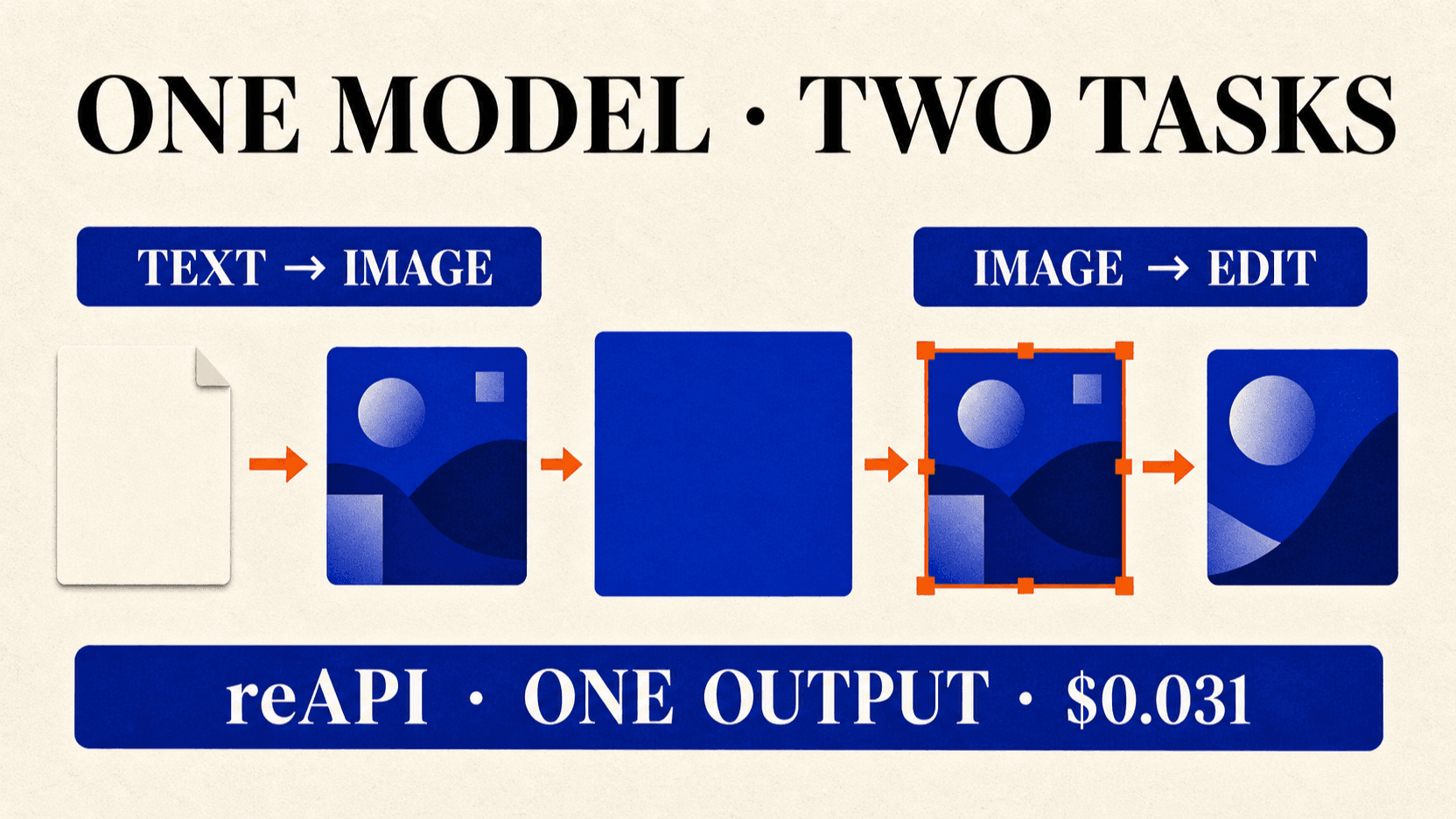
The Qwen Image 2 API combines text-to-image and image editing in one model. Send only a prompt to generate a new image; add one source image to edit it. QwenCloud lists the accelerated model at $0.035 per image, while reAPI's current route charges $0.031 for one output.
The model is especially relevant when prompts contain exact copy, structured layouts, or detailed scene constraints. It is not a universal replacement for every image model, but its flat price and shared generation/editing request shape make it easy to budget.
TL;DR
- Qwen Image 2 handles both image generation and image editing.
- QwenCloud advertises improved text rendering and prompts up to 1,000 tokens.[1]
- Official QwenCloud pricing is $0.035 per image; reAPI currently charges $0.031 per image.
- The reAPI route returns one image per request and accepts one public source image URL for editing.
nsfw_checkercontrols an additional reAPI output check. It is not a promise that upstream model or platform policies disappear.
Qwen Image 2 API specifications
| Specification | reAPI Qwen Image 2 route |
|---|---|
| Model ID | qwen-image-2 |
| Tasks | Text-to-image, single-image editing |
| Output count | One image per request |
| Output formats | PNG, JPEG |
| Text-to-image ratios | 1:1, 3:4, 4:3, 9:16, 16:9 |
| Additional editing ratios | 2:3, 3:2, 21:9 |
| Source image | One public HTTP(S) URL |
| Deterministic control | Optional seed |
| Current reAPI price | $0.031 per image |
Alibaba also offers Qwen Image 2 through Model Studio. That official surface supports up to six outputs per call and resolutions up to 2048×2048, while the QwenCloud marketplace describes a 120 RPM limit.[2] Those details do not automatically carry across providers. A gateway can expose a narrower, simpler schema even when the underlying family supports more modes.
Qwen Image 2 API pricing
| Provider surface | Price | Billing unit |
|---|---|---|
| QwenCloud list price | $0.035 | One generated image |
| reAPI current price | $0.031 | One generated image |
Both generation and editing use the same reAPI price. Aspect ratio does not
change the charge, and the current route has no n field. To produce four
variants, submit four requests and track their seeds rather than pretending one
request contains a batch.
At 10,000 outputs per month, the simple headline comparison is:
QwenCloud list price: 10,000 × $0.035 = $350
reAPI current price:  10,000 × $0.031 = $310
That estimate excludes failed requests, application storage, retries, and any post-processing pipeline. Save the rate-card date in production budgets because gateway and vendor prices can change independently.
How to generate an image with Qwen Image 2
The generation request needs a prompt and model ID. The remaining fields are optional.
curl https://reapi.ai/api/v1/images/generations \
  -H "Authorization: Bearer $REAPI_API_KEY" \
  -H "Content-Type: application/json" \
  -d '{
    "model": "qwen-image-2",
    "prompt": "Editorial poster for a typography workshop. Warm ivory paper, black serif headline reading TYPOGRAPHY LAB, cobalt italic annotation, one orange registration stamp.",
    "image_size": "16:9",
    "output_format": "png",
    "seed": 4281,
    "nsfw_checker": true
  }'
Use a public, durable location for the returned image after generation. Image APIs often return task assets from temporary storage, and an accessible URL is not the same as permanent object storage.
The Qwen Image 2 model page exposes the current controls, while the Qwen Image 2 API docs should be treated as the wire-format source of truth.
How to edit an image
Editing uses the same endpoint and model. Add image_url; the model infers the
task from the request shape.
curl https://reapi.ai/api/v1/images/generations \
  -H "Authorization: Bearer $REAPI_API_KEY" \
  -H "Content-Type: application/json" \
  -d '{
    "model": "qwen-image-2",
    "prompt": "Keep the product and camera angle unchanged. Replace the gray background with warm ivory paper and add a soft cobalt shadow.",
    "image_url": "https://example.com/product-source.png",
    "image_size": "3:2",
    "output_format": "png",
    "nsfw_checker": true
  }'
Editing prompts work better when they separate the change from the invariants. State what must change, then name what must remain fixed: subject identity, camera angle, product proportions, text, lighting direction, or background. That structure is more reliable than asking the model to “improve everything.”
Writing prompts for text rendering
QwenCloud positions text rendering as a core strength, but legibility still depends on prompt complexity and layout density. Use these practical rules:
- Quote the exact visible copy.
- Specify where the text sits and which line is largest.
- Keep the first attempt to one or two short phrases.
- Name the typography class—serif, sans-serif, condensed, monospaced—rather than a copyrighted typeface.
- Generate the visual, then verify every character before publishing.
For example:
Create a 16:9 conference poster.
Exact headline: “BUILD WITH IMAGES”.
Place the headline in two large black serif lines on the left.
Add a small cobalt italic note: “generation + editing”.
No other text, logos, badges, or interface elements.
Long prompts are useful for composition, but adding more words does not always improve exact typography. Treat the official 1,000-token support as an input capacity, not a recommendation to fill the full allowance.
Safety controls and nsfw_checker
The reAPI playground keeps nsfw_checker enabled. Direct callers can set it to
false, which skips an additional output-classification layer on the reAPI
route. It does not override Alibaba policies, model alignment, upstream request
inspection, or applicable law.
This distinction matters for benign edge cases such as swimwear, medical illustration, anatomy education, and some fine-art prompts. If a legitimate workflow is blocked, log the stage and error code before changing a control. Repeatedly rephrasing prompts without knowing whether the rejection happened at the gateway, provider, or model layer makes debugging slower.
For the broader policy model, see how uncensored image API claims actually work.
When to choose Qwen Image 2
Choose Qwen Image 2 when you need flat per-image billing, a shared generation and edit endpoint, aspect-ratio control, and prompts that contain structured copy. It is a good fit for posters, product variations, editorial graphics, and single-source edits.
Choose another route when you need multi-reference editing, native 4K output, or multiple images returned by one gateway request. The GPT Image 2 guide covers a different high-control editing workflow, while Nano Banana Pro vs Nano Banana 2 explains Google's professional and value tiers.
Common Qwen Image 2 API mistakes
Passing multiple source images
The current reAPI schema accepts one image_url, not an array. Use a model that
explicitly supports multi-reference input when several sources are essential.
Using edit-only ratios for text-to-image
2:3, 3:2, and 21:9 are available on the edit surface but rejected for
plain text-to-image through the current route. Pick one of the five generation
ratios for a new image.
Treating a seed as a byte-for-byte guarantee
A seed improves reproducibility, but infrastructure, model revisions, and backend changes can still alter the result. Store the prompt, source asset, model ID, seed, and generation date together.
FAQ
How much does the Qwen Image 2 API cost?
QwenCloud lists $0.035 per image. reAPI currently charges $0.031 per output for
its qwen-image-2 route.
Can Qwen Image 2 edit an existing image?
Yes. Add one public image_url and an edit instruction to the same generation
endpoint.
Does Qwen Image 2 generate readable text?
Text rendering is an advertised capability and often works best with short, explicit copy. Always verify spelling before production use.
Can I generate several images in one reAPI request?
No. The current route returns one image per request. Submit separate jobs for variants.
Is Qwen Image 2 uncensored?
No API should be described as unconditionally uncensored. reAPI exposes an optional additional NSFW checker, but upstream rules and safety systems remain.
Conclusion
The Qwen Image 2 API offers a compact workflow: one model for generation and editing, flat pricing, useful aspect-ratio control, and a strong emphasis on text-heavy compositions. Keep provider-specific parameters separate, verify rendered copy, and treat optional gateway moderation as one layer rather than the entire safety system.
References
- QwenCloud. Qwen-Image-2.0 model overview, pricing, and limits. qwencloud.com/models/qwen-image-2.0
- Alibaba Cloud Model Studio. Image generation and editing model comparison. alibabacloud.com/help/en/model-studio/image-model
- Qwen Team. Qwen-Image-2.0 Technical Report. arxiv.org/abs/2605.10730
Author

Categories
nsfw_checkerWhen to choose Qwen Image 2Common Qwen Image 2 API mistakesPassing multiple source imagesUsing edit-only ratios for text-to-imageTreating a seed as a byte-for-byte guaranteeFAQHow much does the Qwen Image 2 API cost?Can Qwen Image 2 edit an existing image?Does Qwen Image 2 generate readable text?Can I generate several images in one reAPI request?Is Qwen Image 2 uncensored?ConclusionReferencesMore Posts

How to Restore Old Video with AI (and What It Costs)
Restore old video with AI: the old_film scene preset, field-by-field request, real archive costs from $2.46 a reel, and where automated restoration stops.

Best Venice.ai Alternatives in 2026: 5 Options Compared
Looking for Venice.ai alternatives in 2026? Compare OpenRouter, Together AI, DeepInfra, local Ollama, and reAPI on models, privacy, pricing, and API design.
GLM-5.2 API Guide: 1M Context, Pricing, and Coding (2026)
Use the GLM-5.2 API with OpenAI-compatible code. Learn its 1M context, $1.40/$4.40 official pricing, reAPI rates, reasoning controls, and limits.