Free AI API tiers in 2026: what each one actually limits
Google's free AI API tier excludes every image, video and music model. Here is what each provider's free tier actually allows, with official 2026 prices.
A free AI API can mean a recurring model allowance, a limited trial, or a one-time credit. As checked on October 23, 2026, Google offers free access to selected Gemini models, Replicate offers limited runs of selected models, and eligible new reAPI accounts receive 100 credits ($0.10) once. These are different offers; none establishes unlimited generation.[1][7][13]
| Service | What is available without an inference charge | Amount and reset | Important condition |
|---|---|---|---|
| Google Gemini API | Selected models, including Gemini 3.6 Flash and Gemini 2.5 Flash Preview TTS on Standard | Active RPM/TPM/RPD depend on model and project; RPD resets at midnight Pacific | Check the model’s Free Tier column and your AI Studio limits |
| OpenAI API | Quickstart describes a free test request | No universal credit amount or recurring reset specified in that guide | A tutorial statement is not an ongoing allowance for every key |
| Replicate | Limited runs from its Try for Free collection, including image and video models | Run count and reset not published on the inspected pages | Account required; add billing and buy credit after the limit |
| fal.ai | No standard signup amount or recurring API allowance published on its pricing page | Promotional credit, if granted, expires after 90 days under its terms | Do not assume every account receives a promotion |
| reAPI | One-time registration credit for eligible new accounts | 100 credits = $0.10; no recurring reset | Check the actual credit balance in your dashboard |
This table describes public offers and their limits, not a promise that an account or API request will qualify. The provider sections below link the supporting sources and distinguish API access from a website trial.
TL;DR
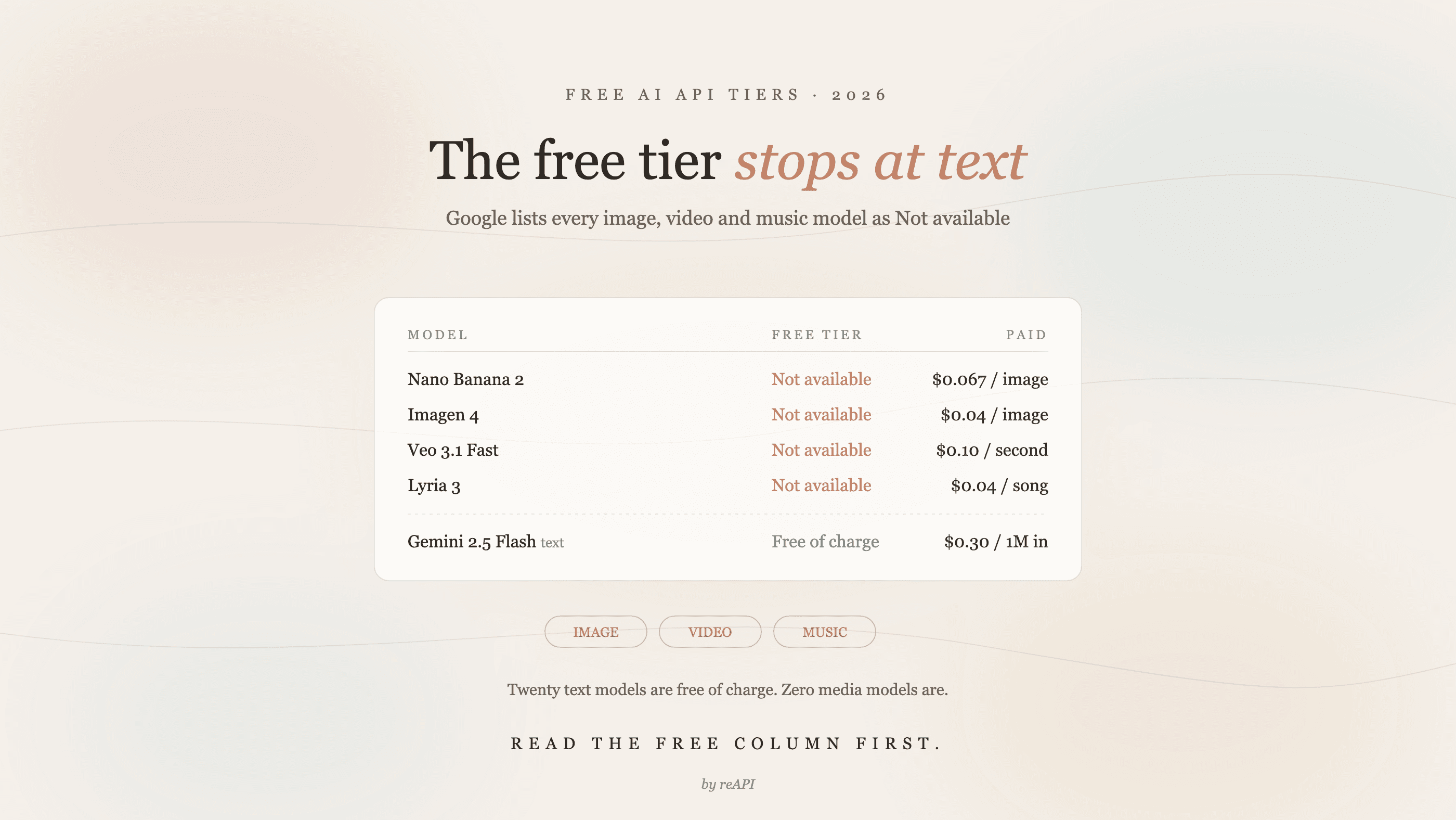
- Google’s free tier includes more than text. Selected speech and embedding models have free Standard rates; the image, video, and music-generation models listed below have no Google free tier.[1]
- Google’s data terms depend on region and service status. Its Unpaid Services terms permit product and machine-learning improvement; EEA, Swiss, and UK users receive the Paid Services data treatment even for unpaid use.[9]
- Check active Gemini limits per project and model. RPM, TPM, and RPD are separate constraints; a new key does not create a new project allowance.[2]
- OpenAI documents a free test request, not a standing credit grant. No repeatable request count or recurring allowance is specified in the quickstart.[8]
- Replicate publishes a trial-model collection; fal may issue promotions. Neither inspected offer provides a universal recurring API budget.[10][11]
- reAPI’s eligible signup gift is $0.10 once. A low paid rate can stretch a small test budget, but it is not an unlimited free tier.[13]
What Google's free AI API tier actually covers
Google’s pricing page distinguishes models and service modes. On October 23, 2026, examples with free Standard input and output include Gemini 3.6 Flash, Gemini 2.5 Flash, and Gemini 2.5 Flash Preview TTS; Gemini Embedding 2 also has free input rates. TTS produces audio, so this is not a text-only offer. Do not transfer a Standard free rate to Batch, Flex, Priority, or a different model version.[1]
The listed image, video, and music-generation models have no Google free tier. The paid figures in this table are retained from this guide’s July 2026 comparison; use Google’s current model-and-mode table for a new paid quote.
| Model | Free Tier | Paid Tier |
|---|---|---|
| Nano Banana (Gemini 2.5 Flash Image) | Not available | $0.039 per image |
| Nano Banana 2 Lite (3.1 Flash Lite Image) | Not available | $0.0336 per 1K image |
| Nano Banana 2 (3.1 Flash Image) | Not available | $0.067 per 1K image |
| Nano Banana Pro (Gemini 3 Pro Image) | Not available | $0.134 per 1K/2K image |
| Imagen 4 Fast / Standard / Ultra | Not available | $0.02 / $0.04 / $0.06 per image |
| Veo 3.1 Lite | Not available | $0.05 per second (720p) |
| Veo 3.1 Fast | Not available | $0.10 per second (720p) |
| Veo 3.1 Standard | Not available | $0.40 per second (720p and 1080p) |
| Veo 2 | Not available | $0.35 per second |
| Lyria 3 Clip / Pro | Not available | $0.04 / $0.08 per song |
Google is explicit about it in prose too. The Veo 3.1 description reads "available to developers on the paid tier of the Gemini API"[1].
For the four Nano Banana variants in this table, Google does not offer free-tier image generation. That describes Google’s own API, not every reseller’s trial or promotional credit. Check input, output, and any grounding feature separately rather than treating an image model as a single all-inclusive free allowance.[1]
The row nobody reads
Google’s pricing page labels a row “Used to improve our products,” but its API terms provide the fuller explanation. For Unpaid Services, Google says inputs and generated responses may be used to improve products and machine-learning technologies, and human reviewers may process them.[9]
There are material exceptions: if you are in the EEA, Switzerland, or the UK, the Paid Services data provisions apply even to unpaid use. For Gemini API requests, a project linked to an active billing account qualifies as Paid Services. Those terms say prompts and responses are not used to improve Google’s products; they still allow limited logging for abuse detection and applicable legal obligations.[9]
Choose the service and account configuration with those conditions in mind before sending client material, internal documents, or user-submitted content. A paid data-use policy is not the same promise as zero retention, and a Free Tier pricing label alone does not resolve the regional exception.
gemini api free tier limits
Google measures rate limits using requests per minute (RPM), input tokens per minute (TPM), and requests per day (RPD), with additional limits for some models. They apply per project, not per API key. RPD resets at midnight Pacific time. The active numbers depend on the model, usage tier, and account status; view them in Google AI Studio. Google warns that capacity can vary and the specified rates are not guaranteed.[2]
The Free tier requires an active project or free trial. Paid Tier 1 requires an active linked billing account; the documented billing-tier cap is $250. Tier 2 requires $100 paid plus 3 days from the first successful payment, and Tier 3 requires $1,000 plus 30 days. These paid-tier qualification thresholds and spending caps are not free API credits.[2]
A published model-specific example is Google Search grounding on Gemini 2.5 Flash: up to 500 RPD free, shared with Flash-Lite. That is a grounding allowance for those models, not 500 free calls to every Gemini model. Gemini 3.6 Flash’s free-tier Search grounding is unavailable, even though its Standard model inference is free.[1]
For capacity planning, record the exact model ID, project tier, RPM, TPM, RPD, and reset window shown for your account. Public model or tool allowances can help you compare options, but they do not replace your active project limits. Moving to a paid tier requires the corresponding billing-account setup.
What the other providers mean by free
Outside Google, separate a trial from a recurring inference allowance. The inspected providers publish different conditions and leave some quantities unspecified.
OpenAI. The current quickstart describes its walkthrough as a free test API request, then directs developers to billing. It does not specify a universal number of free requests, a credit amount for every new key, or a reset schedule.[8] The pricing page’s free file-search and ChatKit storage quantities are storage allowances, not free model inference. Do not treat a usage-tier spending ceiling as a credit grant.[3]
fal.ai. Its pricing page describes pay-per-use billing without publishing a standard signup-credit amount or recurring API quota. That does not mean promotions cannot exist: its terms say that free or promotional credits, if received, expire after 90 days. Check an actual offer’s conditions rather than assuming that signup guarantees a balance.[4][10]
Replicate. Its billing page links an actual Try for Free model collection. The collection includes image and video options such as google/imagen-4 and minimax/video-01, requires an account, and permits only a limited number of runs before billing and purchased credit are required. The inspected pages do not publish a fixed run count or recurring reset. The collection describes trying models on the site; it does not establish a guaranteed ongoing quota for every API key.[7][11]
These offers can help with an initial experiment. If you need repeatable API traffic, confirm that the offer covers the API, the selected model, and your account, then plan what happens when its allowance ends. A limited media trial can exist without being a permanent free media API.
freellmapi
FreeLLMAPI is a specific MIT-licensed local or self-hosted router, not a provider handing every user a new unlimited inference allowance. You add your own provider keys, and it routes requests across those providers’ available free quotas. Each provider’s eligibility, rate limits, terms, and remaining balance still apply.[12]
Its repository describes personal experimentation rather than production use. Treat its aggregated catalog totals as a view of possible provider allowances, not a guaranteed budget for your account. Running the router does not create new upstream credits or remove account limits.
What a fraction of a cent actually buys
When a free offer excludes the model you need or runs out, compare the smallest paid test you can make. Keep the trial balance, per-generation price, and recurring cost separate.
The reAPI examples below retain this guide’s dated prices and existing dynamic model-price fields. Static GPT Image 2 Stable Low was checked October 22, 2026; the static Seedance Face figures come from August 17, 2026. They are not a fresh all-model quote. On reAPI, 1 credit is $0.001; the Seedance rows are base rates without source video.[6]
| Model and tier | Price |
|---|---|
| GPT Image 2, Stable Low | $0.0045 per image |
| Nano Banana 2 Lite, 1K | $0.022 per image |
| GPT Image 2, Self 1K | $0.032 per image |
| GPT Image 2, Self 4K | $0.084 per image |
| Seedance 2.0 Mini, 480p | $0.05 per output second |
| Seedance 2.0 Fast Face, 480p | $0.086 per output second |
| Seedance 2.0 Face, 480p | $0.07125 per output second |
| Seedance 2.0 Mini, 720p | $0.108 per output second |
| Seedance 2.0 Fast Face, 720p | $0.182 per output second |
| Seedance 2.0 Face, 720p | $0.15375 per output second |
Text models bill per token rather than per generation. Compare model access, active quotas, data terms, and the full input/output bill. The Kimi K3 row below retains a July 2026 historical price, including its $12 output figure; use the model page for the current output quote. The GPT-5.6 Sol fields display model-specific prices.
| Model | Input | Output |
|---|---|---|
| Kimi K3 | $2.50 per 1M tokens | $12 per 1M tokens |
| GPT-5.6 Sol | $0 per 1M tokens | $0 per 1M tokens |
Nano Banana 2 Lite’s dynamic price of $0.022 per 1K image can be checked against Google’s matching model, resolution, and service mode; the $0.0336 Google figure in this guide is its Standard 1K comparison rate. At the dated $0.0045 GPT Image 2 Stable Low rate, twenty images would cost $0.09. That arithmetic describes that price and output count, not a guarantee that every model test fits a signup gift.[1][6]
Eligible new reAPI accounts receive 100 starter credits ($0.10), once, with no card required for the signup gift. Check your dashboard for the actual credited balance; it is not a daily or monthly free allowance. Use the quickstart for setup and the selected model’s price to estimate a test before submitting it. The pricing page links the wider model catalog.[13] Google’s free quota does not transfer to reAPI: the Gemini 3.6 Flash API on reAPI is billed at the model’s reAPI prices.
One more constraint that has nothing to do with price: Google embeds a SynthID watermark in image output from its models. If your use case involves resale or downstream editing, read up on what SynthID does to Nano Banana output before you commit to a pipeline.
FAQ
Can I get an AI API for free?
Yes, depending on the model and offer. Google has free Standard access to selected text, speech, and embedding models. Replicate offers limited trial runs for selected image and video models; eligible reAPI accounts receive a one-time $0.10 gift. None of those facts establishes unlimited generation or an identical allowance for every account.[1][11][13]
Does Nano Banana have a free API?
Google’s API free tier is unavailable for the four Nano Banana variants listed in this guide. A third-party trial may be a separate offer with its own limits. The retained paid comparison ranges from $0.0336 per 1K image on 2 Lite to $0.24 per 4K image on Pro; check current mode-specific pricing before budgeting.[1]
Is there a free Veo 3.1 API?
No. Google describes Veo 3.1 as "available to developers on the paid tier of the Gemini API" and lists Free Tier as "Not available" for the Standard, Fast and Lite variants[1].
Does Google train on my free-tier API requests?
Google’s Unpaid Services terms permit using inputs and responses to improve products and machine-learning technologies, with possible human review. EEA, Swiss, and UK users receive the Paid Services data provisions even for unpaid use. Paid Services do not use prompts and responses for product improvement, but limited logging can still occur; do not equate that policy with zero retention.[9]
What are the Gemini free-tier rate limits?
They depend on the model, project, and usage tier. Check active RPM, TPM, and RPD in AI Studio; limits apply per project and RPD resets at midnight Pacific. One public example is Gemini 2.5 Flash Search grounding at up to 500 RPD, shared with Flash-Lite. It is not a universal Gemini request allowance or a guarantee of available capacity.[1][2]
Do OpenAI API keys come with free credits?
OpenAI’s quickstart describes a free test request, but does not promise a universal signup-credit amount or recurring free inference allowance. Free storage quantities on the pricing page are not a model-token budget. Check the balance and conditions actually available to your account.[8][3]
Is Replicate free to start?
Replicate lets account holders try selected models from its public Try for Free collection for a limited number of runs. After that, billing and purchased credit are required. The inspected pages do not state a universal run count or reset window, so this is an evaluation option rather than a production-capacity commitment.[7][11]
What is the cheapest way to test an image model?
Start with a verified trial for the exact model, or calculate a small paid test. At the GPT Image 2 Stable Low snapshot of $0.0045 per image, checked October 22, 2026, twenty images cost $0.09. Recheck the model’s current rate and the account’s actual credits before generating; this is a dated example, not a claim that it is always the cheapest option.[6]
Picking a tier without getting stuck
For a model covered by Google’s free tier, check the active project quota and applicable data terms before testing. Speech and embedding support can matter just as much as text. If the model is not covered, a trial elsewhere may still help, but its quota and account conditions need separate verification.
For images, video, or music, first check whether a limited trial covers the exact model and API route. If it does not, estimate a small paid request from the published price. A signup gift, a website trial, and a recurring free API allowance are different ways to start; choose the one whose limits match your actual task.
References
- Google. Gemini Developer API pricing — Free Tier and Paid Tier rates by model. Rechecked October 23, 2026 from ai.google.dev/gemini-api/docs/pricing
- Google. Gemini API rate limits — usage tiers and tier qualification. Rechecked October 23, 2026 from ai.google.dev/gemini-api/docs/rate-limits
- OpenAI. API pricing. Rechecked October 23, 2026 from developers.openai.com/api/docs/pricing
- fal.ai. GenAI API pricing — pay-per-use. Rechecked October 23, 2026 from fal.ai/pricing
- Replicate. Pricing. Retrieved July 2026 from replicate.com/pricing
- reAPI. Model pricing — GPT Image 2, Nano Banana 2 Lite, Seedance 2.0 Face, Fast Face, and Mini. Seedance rates retrieved August 17, 2026 from reapi.ai/models
- Replicate. Billing — free limits. Rechecked October 23, 2026 from replicate.com/docs/topics/billing
- OpenAI. API quickstart. Rechecked October 23, 2026 from developers.openai.com/api/docs/quickstart
- Google. Gemini API additional terms: Unpaid and Paid Services data use. Checked October 23, 2026. https://ai.google.dev/gemini-api/terms
- fal.ai. Terms of Service: promotional credit expiry. Checked October 23, 2026. fal.ai/legal/terms-of-service
- Replicate. Try for Free model collection and trial conditions. Checked October 23, 2026. replicate.com/collections/try-for-free
- FreeLLMAPI. Official repository: provider keys, quota routing, license, and limitations. Checked October 23, 2026. github.com/tashfeenahmed/freellmapi ; freellmapi.co
- reAPI. Registration test credit and API quickstart. Checked October 23, 2026: 100 credits at 1,000 credits per USD, awarded once subject to registration eligibility. Quickstart.
Further reading
- reAPI. Nano Banana API free tier. reapi.ai/blog/nano-banana-api-free-tier
- reAPI. What SynthID does to Nano Banana output. reapi.ai/blog/nano-banana-watermark-synthid
Author

Categories
More Posts

MiniMax H3 License: Territory, Revenue, and Commercial Use
MiniMax H3 is open-weight but not Apache or MIT. Read the territory exclusions, $20M revenue threshold, attribution rule, and self-hosting checklist.
Gemini 4 Argon vs GPT-6 Astra vs Claude Opus 5.5: Benchmarks
Gemini 4 Argon vs GPT-6 Astra vs Claude Opus 5.5 across Google's 19 launch benchmarks. Compare task results, context limits and access before choosing a model.
FLUX 3 Image Release Date: Launch, Access, and Weights
FLUX 3 Image launched October 1, 2026. See how its release differs from the July family announcement, the Video launch, and public model-weight availability.