
Background Removal API Pricing: Cost per Usable Image
Calculate background removal API pricing from a live 88-credit rate, then add rejected outputs, retries, storage, and review to find your usable-image cost.
The current background removal API pricing for mj-v7-remove-bg is 88
credits, or $0.088 per completed request, when checked on September 3,
2026. That is the right starting number for a request budget. It is not
automatically the cost of one usable cutout.
A completed image can still have a halo, lose a handle opening, flatten a shadow, or arrive in a format that the next service cannot accept. This guide shows how to call the route, poll it safely, inspect the settled charge, and calculate cost per image that actually passes review.
TL;DR
- The live estimator returned 88 credits ($0.088) per completed
mj-v7-remove-bgrequest on September 3, 2026. One credit is $0.001.[1] - The request takes exactly one public HTTP(S) URL. It does not take a prompt, resolution, speed, or parent task ID.[2]
- The operation is asynchronous: submit once, save the returned task ID, and poll the task endpoint. Polling does not consume credits.[3]
- Budget with
total settled cost / accepted outputs, not the number of files submitted. At an 80% acceptance rate, an $0.088 request becomes $0.11 per usable image. - A failed task with
usage.credits: 0was refunded. A completed result that your team rejects for poor edges was still completed work, so include it in your accepted-image calculation.[3] - Run a small test set drawn from your own catalog before committing volume. One clean product photo says little about hair, glass, low contrast, or objects with holes.
Why the quoted price is rarely the useful number
If your app removes backgrounds from thousands of uploaded images, how do you compare services when price, edge quality, response time, resolution, and file handoff all affect the result? A sticker price alone cannot answer that question. The useful calculation is narrower:
cost per usable image = total settled API cost / images that pass reviewThat denominator changes the decision. A cheap endpoint that damages fine edges can cost more than a higher-priced one once reruns and manual cleanup are included.
What the current background removal API price buys
The live Midjourney V7 model page lists Remove BG as a lightweight edit. The current request estimate settles in whole credits, and the live estimate for the required payload is 88 credits.[1] Because one credit equals $0.001, use $0.088 in a budget.
| Requests | API subtotal at 88 credits | What the number assumes |
|---|---|---|
| 1 | $0.088 | One completed removal request |
| 10 | $0.88 | Ten completed requests, before acceptance review |
| 100 | $8.80 | No completed output rejected |
| 1,000 | $88.00 | No storage, review, or transformation cost |
| 10,000 | $880.00 | Same rate and a 100% accepted-output rate |
You may see the operation displayed as $0.0873 in a detailed price label. Do not use that fractional figure to reconcile a credit balance. The public pricing table and estimator show the payable unit as 88 whole credits, or $0.088. Check the live model page again before a large run because pricing can change.
The API subtotal excludes the work around the call:
- hosting the source at a URL the service can fetch;
- downloading and storing the result;
- validating transparency, dimensions, and file compatibility;
- human review or automated quality checks;
- completed outputs that fail your acceptance rules;
- resizing, color correction, shadow reconstruction, or later compositing.
For a prototype, those costs may be negligible. At catalog scale, they belong in the same spreadsheet as the API line item.
One source URL, no prompt and no parent task
mj-v7-remove-bg is simpler than the other Midjourney V7 edit operations. It
does not chain from a previous generation. Send the image you already have in
image_urls.[2]
| Field | Required | Accepted value |
|---|---|---|
model | yes | mj-v7-remove-bg |
image_urls | yes | An array containing exactly one public HTTP(S) image URL |
prompt | not accepted | Do not send it |
model_params | not accepted | No speed, task ID, or edit options |
size / resolution | not accepted | The route exposes no output-size control |
The schema is strict. Adding fields copied from another image model is not a
harmless no-op; it makes the request invalid. Base64 strings, data: URLs,
local paths, and authenticated browser-only links are also the wrong input.
Upload the source to storage you control and confirm that it loads without a
cookie or login.
Here is the complete cURL request:
curl https://reapi.ai/api/v1/images/generations \
  -H "Authorization: Bearer $REAPI_API_KEY" \
  -H "Content-Type: application/json" \
  -d '{
    "model": "mj-v7-remove-bg",
    "image_urls": [
      "https://your-cdn.example/catalog/source-product.png"
    ]
  }'
A valid submission returns a task record in processing state. Save its id.
The final image does not arrive in the POST response.
Submit once, then poll with a deadline
The safest beginner implementation has two separate actions: one POST that creates the job, followed by bounded GET requests that read its state. Do not put the POST inside the polling loop.
This Node.js example polls every 2.5 seconds and uses a 15-minute local deadline. The task reference recommends a two-to-three-second cadence and explains that in-flight task reads are cached, so faster polling adds request pressure without making the image finish sooner.[3]
const API_BASE = 'https://reapi.ai/api/v1';
const API_KEY = process.env.REAPI_API_KEY;
const sourceUrl = process.argv[2];

if (!API_KEY) throw new Error('Set REAPI_API_KEY');
if (!sourceUrl) throw new Error('Pass one public source image URL');

const headers = {
  Authorization: `Bearer ${API_KEY}`,
  'Content-Type': 'application/json',
};

async function readJson(response) {
  const body = await response.json();
  if (!response.ok) {
    const code = body.error?.code ?? response.status;
    const message = body.error?.message ?? 'Request failed';
    throw new Error(`${code}: ${message}`);
  }
  return body;
}

const sleep = (ms) => new Promise((resolve) => setTimeout(resolve, ms));

async function getTask(taskId) {
  for (let attempt = 0; attempt < 4; attempt += 1) {
    let response;
    try {
      response = await fetch(`${API_BASE}/tasks/${taskId}`, {
        headers: { Authorization: `Bearer ${API_KEY}` },
        signal: AbortSignal.timeout(15_000),
      });
    } catch (error) {
      if (attempt === 3) throw error;
      await sleep(1000 * 2 ** attempt);
      continue;
    }

    if (response.status === 429) {
      const seconds = Number(response.headers.get('retry-after'));
      await response.body?.cancel();
      await sleep(Number.isFinite(seconds) ? seconds * 1000 : 5000);
      continue;
    }

    if ([502, 503, 504].includes(response.status)) {
      await response.body?.cancel();
      await sleep(1000 * 2 ** attempt);
      continue;
    }

    return readJson(response);
  }

  throw new Error(`Task ${taskId} could not be read after transient errors`);
}

async function removeBackground(imageUrl) {
  const submitted = await readJson(
    await fetch(`${API_BASE}/images/generations`, {
      method: 'POST',
      headers,
      body: JSON.stringify({
        model: 'mj-v7-remove-bg',
        image_urls: [imageUrl],
      }),
      signal: AbortSignal.timeout(30_000),
    })
  );

  const deadline = Date.now() + 15 * 60 * 1000;

  while (Date.now() < deadline) {
    await sleep(2500);
    const task = await getTask(submitted.id);

    if (task.status === 'completed') {
      const urls = task.output?.image_urls ?? [];
      if (urls.length === 0) {
        throw new Error('Task completed without an image URL');
      }
      return {
        taskId: task.id,
        imageUrls: urls,
        credits: task.usage?.credits,
      };
    }

    if (task.status === 'failed') {
      const code = task.error?.code ?? 'UNKNOWN_TASK_ERROR';
      const message = task.error?.message ?? 'Background removal failed';
      const credits = task.usage?.credits ?? 'unknown';
      throw new Error(
        `${code}: ${message}; task=${task.id}; settled_credits=${credits}`
      );
    }
  }

  throw new Error(`Polling deadline reached for task ${submitted.id}`);
}

removeBackground(sourceUrl)
  .then(console.log)
  .catch((error) => {
    console.error(error.message);
    process.exitCode = 1;
  });
Run it with:
REAPI_API_KEY=rk_live_xxx node remove-background.mjs \
  https://your-cdn.example/catalog/source-product.png
In production, write the task ID to your database before returning from the submit handler. A worker can then resume polling after a process restart. Keep the API key on the server; never place it in browser JavaScript or a mobile app bundle.
What one failed live request actually cost
We submitted one mj-v7-remove-bg request while checking this guide on
September 3, 2026, using an owned mug photo.
The API accepted the strict payload as task
task_01a065b32dbe771eb5babd28de9b38d9, but it later ended in failed state
with error code 80003 and the
message Service authentication failed. It returned no output and
usage.credits: 0, so its settled cost was
$0, not $0.088.
We did not resubmit the unchanged request just to manufacture a successful example. This single run confirms the task and refund path; it says nothing about cutout quality, file type, dimensions, alpha support, or normal completion time. The 88-credit figure above remains the live estimate for a request that completes. Always read the terminal task instead of multiplying submission count by the advertised rate.[3]
Turn request price into cost per usable image
Start with an acceptance rule, not a percentage you hope to achieve. Then measure the percentage on a sample from the workload you intend to ship.
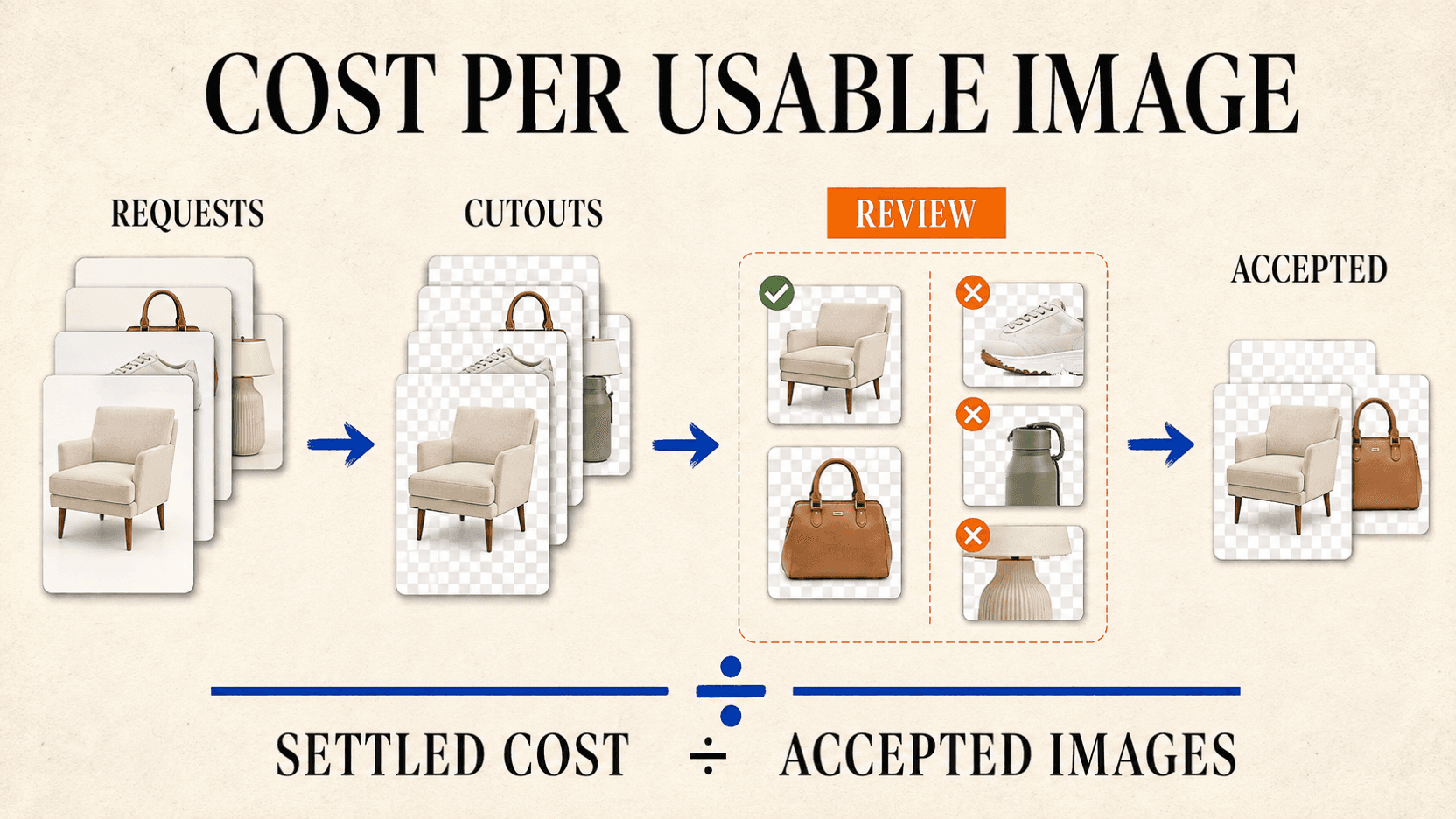
If each completed request produces one candidate, the planning equation is:
usable-image cost = $0.088 / acceptance rateThe table below contains scenarios, not measured model quality:
| Assumed acceptance rate | Requests for 1,000 accepted images | API subtotal | Cost per usable image |
|---|---|---|---|
| 100% | 1,000 | $88.000 | $0.0880 |
| 95% | 1,053 | $92.664 | $0.0927 |
| 90% | 1,112 | $97.856 | $0.0979 |
| 80% | 1,250 | $110.000 | $0.1100 |
| 50% | 2,000 | $176.000 | $0.1760 |
Use settled task data for the numerator. The task response exposes
usage.credits in every state. processing plus zero means billing has not
settled. completed shows the charged credits. failed plus zero means the
reservation was refunded; a positive value means a documented charge was
retained.[3]
This distinction prevents two accounting errors. Do not count a refunded provider failure as paid output, and do not erase a completed but ugly cutout from spend. It still consumed a paid request.
Decide what “usable” means before the test
A visual glance is too vague for a repeatable benchmark. Write a short rubric before submitting the sample, then apply the same checks to every result.
Transparency and edge integrity
Open the downloaded file in a tool that shows an alpha checkerboard. A white background is not transparency. Inspect the full silhouette at 100% and 400% zoom for white or dark halos, missing pixels, and chunks of the old background.
Holes, fine detail, and difficult materials
Include examples with handle openings, straps, spokes, loose hair, fur, and foliage. Add glass, translucent packaging, glossy metal, and low-contrast subject edges if those appear in your real catalog. A model that passes a dark mug on white may still fail a clear bottle or pale object on beige.
Product details and shadows
Confirm that labels, printed text, thin attachments, and the product outline did not change. Decide whether a contact shadow should be kept, softened, or removed. Different destinations need different answers, so “shadow removed” is not automatically a pass.
File contract
Record MIME type, extension, width, height, byte size, alpha presence, and the
number of returned URLs. The public contract returns output.image_urls, but
it does not promise a specific extension or pixel size for this operation.
Test the real file against the next API, design tool, or marketplace importer
in your pipeline.
A useful pilot is large enough to represent the hard cases, not just the easy ones. Ten to thirty owned images can expose obvious incompatibilities. A final procurement benchmark should follow the distribution of your actual catalog.
Retry failures without creating a cost loop
Retry rules should use the error, not frustration. The public error reference separates invalid input, authentication, insufficient balance, rate limits, capacity failures, and terminal workflow failures.[4]
| Result | What to do |
|---|---|
| HTTP 400, 401, 402, or 404 | Fix the request, credentials, balance, or task ID. Do not repeat unchanged. |
| HTTP 429 | Wait for Retry-After, then retry the same read or safe operation. |
| HTTP 502, 503, or 504 | Back off exponentially and cap attempts. |
Task failed | Read error.code and usage.credits before deciding whether to resubmit. |
Task completed, QA failed | Change the source or route the image to manual cleanup; cap paid reruns. |
Keep the submit action outside automatic polling retries. Once a POST returns a task ID, every later check should be a GET for that task. For a completed image that fails your rubric, a second identical request may reproduce the same edge problem. Changing the input crop, contrast, or preprocessing is more useful than an unbounded rerun.
Download accepted files to your own storage as soon as the task completes. The task documentation says output URLs are rehosted on the CDN but does not guarantee long-term retention.[3]
Hosted route versus an official Midjourney API
mj-v7-remove-bg is a hosted route exposed through reAPI. It should not be
described as Midjourney's official public API. Midjourney's current community
guidelines say it does not generally provide an API and prohibits unauthorized
automation except for rare, explicitly granted cases.[5]
That distinction matters during procurement. Review the hosted service's own contract and acceptable-use terms instead of assuming that a model label creates an official vendor relationship. The separate guide Does Midjourney Have an API? covers that question in detail; this article stays focused on the callable route and its cost.
FAQ
Does mj-v7-remove-bg need a previous Midjourney task?
No. It is a direct-image edit. Pass one public image URL in image_urls; do not
send task_id or model_params.[2]
Can I send a base64 image?
No. The request schema accepts one public HTTP(S) URL. Upload the file first, then send a URL that the service can fetch without your browser session.
Is the current price $0.0873 or $0.088?
Use $0.088 for billing estimates. The operation may appear as $0.0873 in a detailed display, but the live estimator returns 88 whole credits and one credit equals $0.001.[1]
Does one request return four background-removed images?
Do not budget on that assumption. Four images per request describes the base Midjourney V7 generation. The direct Remove BG contract takes one source image and returns an image URL array, but it does not promise four cutouts. Inspect the terminal task's array length in your pilot.[2]
Does the API always return a transparent PNG?
The current public contract promises image URLs, not a particular extension, MIME type, or alpha-channel guarantee. Download a real result and verify alpha before building a PNG-only downstream workflow.
Does polling cost credits?
No. Polling a task does not consume credits. Poll every two to three seconds and stop at a deadline that suits your application.[3]
Are failed background-removal tasks charged?
Read usage.credits on the terminal task. A failed task with zero credits was
fully refunded. The generic task contract allows a positive retained charge in
some model-specific post-generation safety cases, so do not infer the bill
from status alone.[3]
What will 1,000 usable images cost?
At a 100% acceptance rate, 1,000 requests cost $88 at the current rate. At 80% acceptance, reaching 1,000 usable files requires 1,250 requests and costs $110, before storage and review. Replace the assumed rate with your measured pilot.
Choose by accepted cost, not sticker price
The current background removal API pricing is straightforward at the request level: 88 credits, or $0.088. The production decision starts after that. Test the edges and file contract your application actually needs, read settled usage from every task, and divide total spend by outputs that pass a fixed rubric.
Start with the Midjourney V7 API reference, run a small owned-image pilot, and keep the task polling reference next to your implementation. That gives you a defensible cost per usable image instead of an unverified headline price.
References
- reAPI. Midjourney V7 model page and live pricing. Retrieved September 3, 2026 from reapi.ai/models/midjourney-v7
- reAPI. Midjourney V7 API reference. Retrieved September 3, 2026 from reapi.ai/docs/midjourney-v7
- reAPI. Tasks: polling, usage, output, and refund semantics. Retrieved September 3, 2026 from reapi.ai/docs/api/tasks
- reAPI. API error codes and retry guidance. Retrieved September 3, 2026 from reapi.ai/docs/api/errors
- Midjourney. Community Guidelines: unauthorized automation and third-party apps. Retrieved September 3, 2026 from docs.midjourney.com/hc/en-us/articles/32013696484109-Community-Guidelines
Author

Categories
mj-v7-remove-bg need a previous Midjourney task?Can I send a base64 image?Is the current price $0.0873 or $0.088?Does one request return four background-removed images?Does the API always return a transparent PNG?Does polling cost credits?Are failed background-removal tasks charged?What will 1,000 usable images cost?Choose by accepted cost, not sticker priceReferencesMore Posts

How to Control AI Video Camera Movement with a Phone Reference
Record natural camera movement with a phone, turn it into a clean motion reference, and guide an AI video model without learning 3D animation first.

Seedance 2.5 Image to Video: Frames, Inputs and Cost
Learn Seedance 2.5 image to video with first frames, first/last frames and reference images. Check valid API fields, real-person inputs and 10-second costs.

Opus 5.5 Video Generation: Directing Seedance 2.5 Shots
Opus 5.5 video generation, done right: Claude writes the shot plan, GPT Image 2.5 locks the character, Seedance 2.5 renders it. Prompts, code and real costs.