· reAPI Team
DGX Spark Specs: GB10, 128 GB Memory and What It Can Run
NVIDIA DGX Spark specs from NVIDIA's own spec sheet: GB10 chip, 64 or 128 GB unified memory, 273 GB/s bandwidth, 1 PFLOP FP4, and which local LLMs fit.
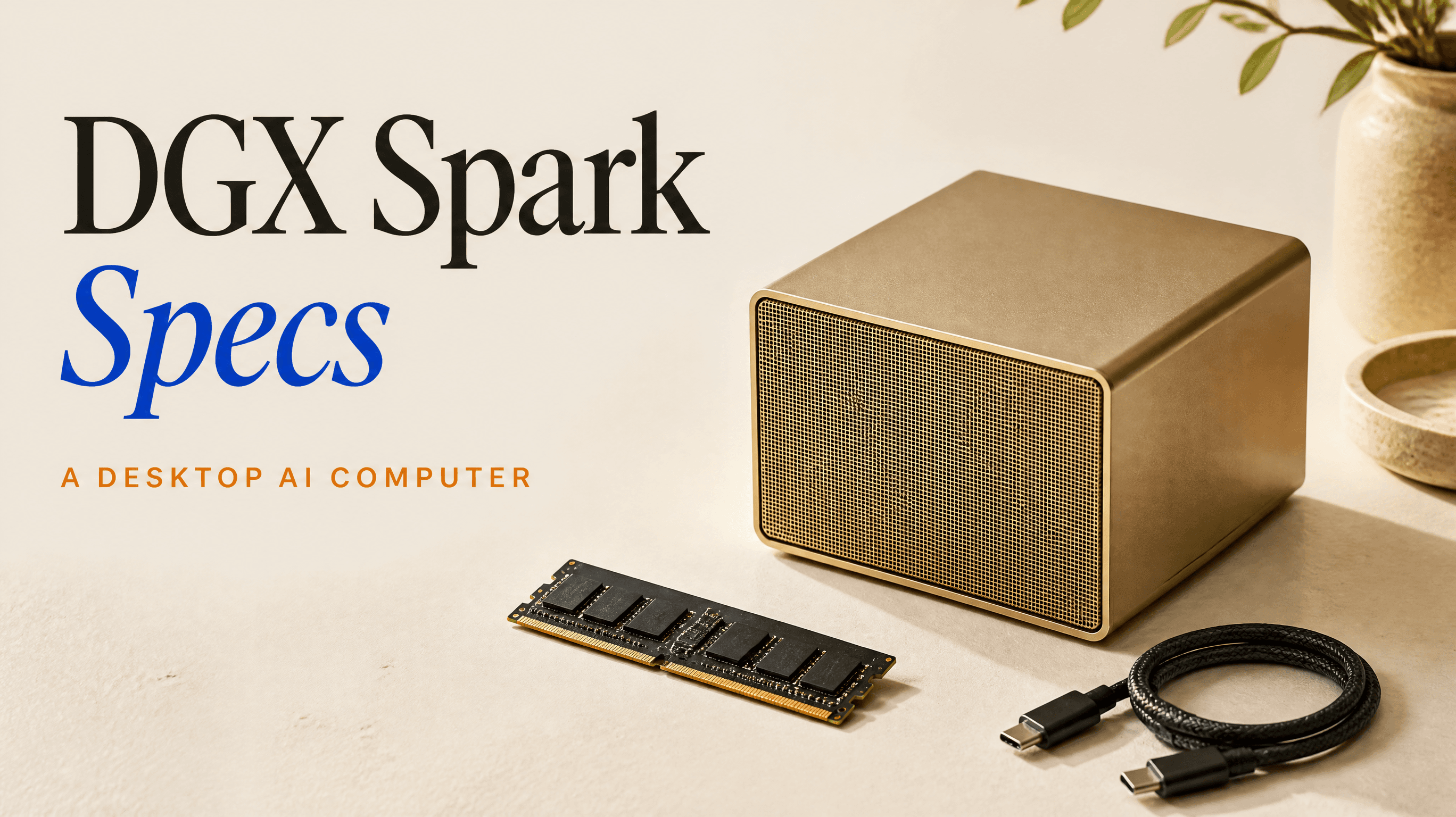
NVIDIA DGX Spark is a 150 mm square desktop computer built on the GB10 Grace Blackwell Superchip. Its headline DGX Spark specs are a 20-core Arm CPU, up to 1 petaFLOP of FP4 compute, 64 GB or 128 GB of unified LPDDR5x memory at 273 GB/s, up to 4 TB of NVMe storage and a 200 Gbps ConnectX-7 network port. It ships with NVIDIA's Ubuntu-based DGX OS.[1]
Two numbers decide what the machine is good at: 128 GB of memory sets how large a model it can hold, and 273 GB/s sets how fast that model can produce tokens. This page lists the official DGX Spark specs, then works through what they mean for running large language models locally.
DGX Spark specs at a glance
| Component | Specification |
|---|---|
| Chip | NVIDIA GB10 Grace Blackwell Superchip |
| CPU | 20-core Arm: 10 Cortex-X925 + 10 Cortex-A725 |
| GPU | Blackwell architecture, 5th-generation Tensor Cores, 4th-generation RT Cores |
| AI performance | Up to 1 PFLOP FP4 (theoretical, with sparsity) |
| Memory | 64 GB or 128 GB LPDDR5x, coherent unified memory, 256-bit interface |
| Memory bandwidth | 273 GB/s |
| Storage | Up to 4 TB NVMe M.2, self-encrypting |
| Networking | 10 GbE RJ-45, ConnectX-7 NIC at 200 Gbps, Wi-Fi 7, Bluetooth 5.4 |
| Ports | 4x USB Type-C, 1x HDMI 2.1a, up to 3x DisplayPort over USB-C |
| Power | 240 W power supply; GB10 TDP 140 W |
| Size and weight | 150 x 150 x 50.5 mm, 1.2 kg |
| Operating system | NVIDIA DGX OS |
Source: NVIDIA DGX Spark specifications, checked November 4, 2026.[1]
Two footnotes on NVIDIA's sheet change how to read the table. The 1 petaFLOP figure is "theoretical FP4 TOPS using the sparsity feature", not a sustained number for dense models. The 64 GB configuration "is available exclusively through participating OEM partners", so the 64 GB version is sold only through those partners.[1] NVIDIA's product page does not list a price; it sends buyers to the NVIDIA Marketplace and partners.
What 128 GB of unified memory can hold
NVIDIA says DGX Spark can run inference on models of up to 200 billion parameters.[1] The arithmetic behind that is simple. A weight stored in 4-bit format takes half a byte, so 200 billion parameters need about 100 GB, which leaves roughly 28 GB of the 128 GB for the operating system, the runtime and the context cache. At 8-bit precision the same budget holds about half as many parameters.
Weights alone, by model size and precision:
| Model size | 4-bit weights | 8-bit weights | Fits in 128 GB? |
|---|---|---|---|
| 30B parameters | ~15 GB | ~30 GB | Yes, at either precision, with room for long context |
| 70B parameters | ~35 GB | ~70 GB | Yes, at either precision |
| 120B parameters | ~60 GB | ~120 GB | 4-bit comfortably; 8-bit leaves almost nothing for context |
| 200B parameters | ~100 GB | ~200 GB | 4-bit only |
The figures are parameters multiplied by bytes per weight. They leave out the context cache, activations and runtime overhead, which is why a model that "fits" on paper can still run out of memory with a long prompt.
Because CPU and GPU share one memory pool, there is no separate VRAM limit to fit under. That also means the context window competes with the weights. Ollama, for example, raises its default context to 256k tokens at 48 GiB of VRAM or more and recommends at least 64,000 tokens for coding agents; a long context on a large model can push the total past what is free.[2]
The 64 GB version halves all of this. In 4-bit format it fits models up to roughly 100 billion parameters before any room for context.
Why 273 GB/s matters more than 1 petaFLOP
Generating each token requires reading the model's active weights from memory. For a dense model, that is all of them, so memory bandwidth sets a ceiling on decode speed:
maximum tokens per second ≈ memory bandwidth ÷ bytes of weights read per token
For a dense 70-billion-parameter model in 4-bit format, about 35 GB of weights are read per token, so 273 GB/s allows at most about 7.8 tokens per second. A mixture-of-experts model that activates, say, 10 billion parameters per token reads about 5 GB at 4-bit, which raises the ceiling to about 55 tokens per second. These are upper bounds from the published bandwidth, not measurements; real throughput is lower once caches, attention and software overhead are counted.
The practical reading: DGX Spark holds models that consumer GPUs cannot, and it is better suited to mixture-of-experts models with small active parameter counts than to the largest dense models.
Running local LLMs on DGX Spark
The GB10 chip is on Ollama's supported GPU list, at CUDA compute capability 12.1.[2] LM Studio ships for ARM64 Linux, which matches DGX Spark's Arm CPU.[3] NVIDIA's own stack, including NIM microservices, is supported on DGX OS.[1] Disk space is rarely the limit: a 200-billion-parameter model in 4-bit format is about 100 GB on disk, so the 4 TB maximum holds dozens of large models. For a side-by-side of the two most common local runners, see Ollama vs LM Studio.
For models larger than one unit can hold, ConnectX networking lets up to four DGX Spark systems work together on one model.[1]
FAQ
Does DGX Spark run Windows?
It ships with NVIDIA DGX OS, a Linux distribution based on Ubuntu that matches the software on NVIDIA's other DGX systems.[1] Windows PCs powered by NVIDIA RTX Spark are a separate product line.
Is the DGX Spark memory VRAM?
It is unified memory shared by the CPU and GPU, 64 GB or 128 GB of LPDDR5x. A model can use most of it, minus what the operating system and other processes need.[1]
How many DGX Spark units can be connected?
Up to four, through the built-in ConnectX-7 networking at 200 Gbps.[1]
When DGX Spark specs are not enough
The DGX Spark specs favor capacity over speed: 128 GB fits a 200-billion-parameter model at 4-bit, but 273 GB/s keeps dense-model output slow. If a project needs the largest models with long contexts and fast responses, a hosted API is the alternative. reAPI serves large models such as DeepSeek V4 and Kimi K3, with its 1M-token context, on one OpenAI-compatible key, which is useful for comparing local results against the hosted versions.
References
- NVIDIA. DGX Spark product page and specifications. Retrieved November 4, 2026 from nvidia.com/en-us/products/workstations/dgx-spark
- Ollama. Hardware support and context length. Retrieved November 4, 2026 from docs.ollama.com/gpu and docs.ollama.com/context-length
- LM Studio. System requirements. Retrieved November 4, 2026 from lmstudio.ai/docs/app/system-requirements