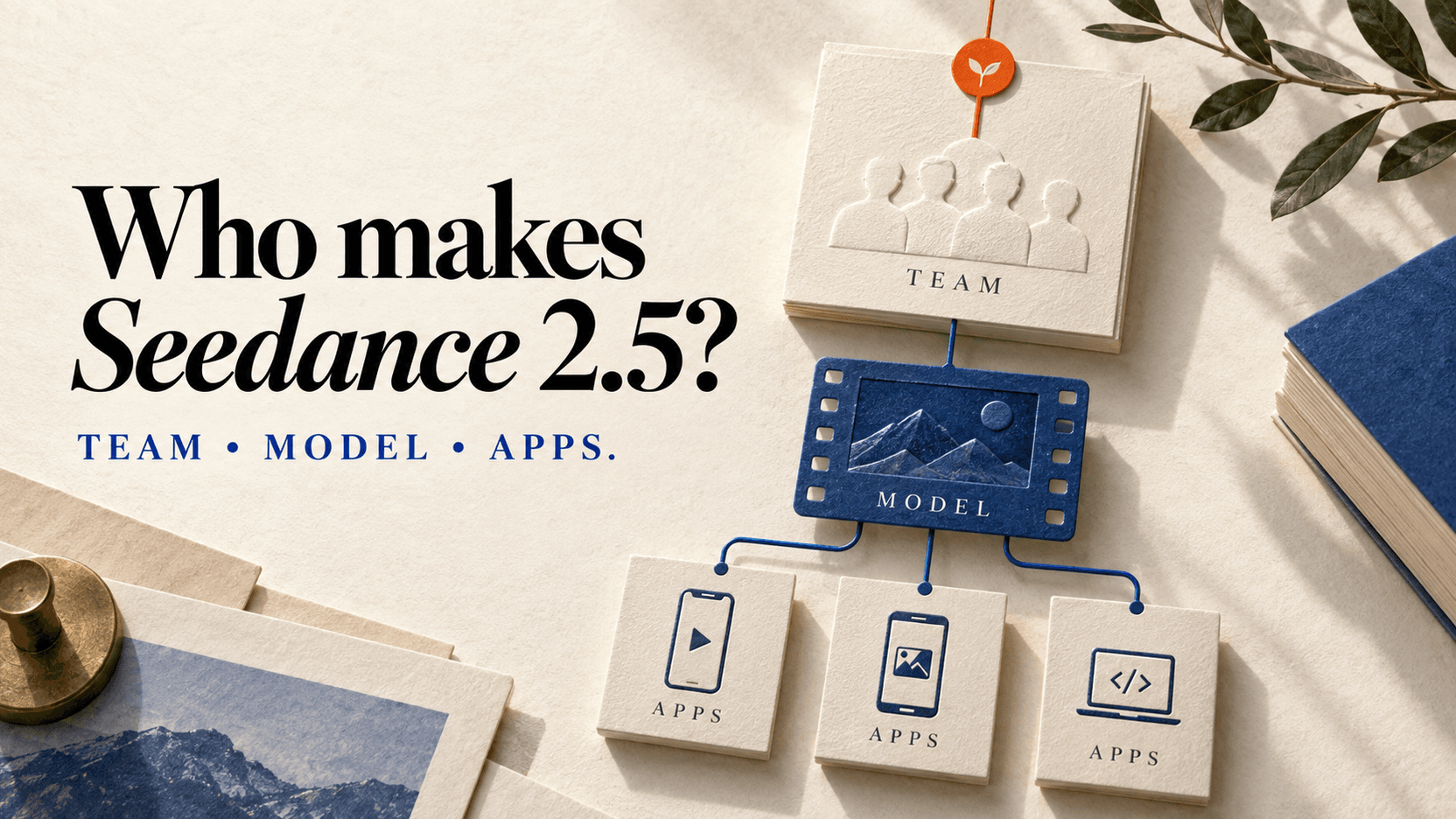
Who Makes Seedance 2.5? ByteDance and Its App Brands
Who makes Seedance 2.5? Learn how ByteDance Seed, Doubao, BytePlus, Volcengine, Dreamina, and Jimeng relate, and find the official model and release sources.
ByteDance's Seed research team develops Seedance 2.5. The team's official announcement, dated July 31, 2026, introduces Seedance 2.5 and names the applications receiving it.[1] When identifying who makes Seedance 2.5, keep that team separate from BytePlus, Volcengine, Dreamina, Jimeng, and Doubao. Those names identify cloud services, consumer products, or access destinations.
This guide maps those names using official pages checked on September 12, 2026. It is especially useful when Chinese results say 字节、豆包、火山引擎 or 即梦, while English results use ByteDance, BytePlus, and Dreamina. For a route you can use now, Seedance 2.5 on reAPI provides a separate playground and API service; the model's developer attribution remains ByteDance.
TL;DR
- ByteDance Seed is the research team behind the official Seedance 2.5 release. Its own organization profile describes research labs in China, Singapore, and the United States.[1][2]
- BytePlus describes its enterprise technology as drawing on ByteDance's research and engineering. Its name identifies a service destination, not a separate inventor of Seedance.[3]
- Volcengine's model platform, 火山方舟, publishes the Chinese-cloud model as
doubao-seedance-2-5-260628.[4] - The official Seed model page currently directs consumer users to Dreamina and API users to BytePlus. The July 31 announcement separately names Jimeng AI and Doubao Pro.[5][1]
- reAPI is an access service with its own request contract. Its public model value is
doubao-seedance-2.5-face, which should be used with reAPI's endpoint and documentation.[6]
| Name | What it identifies here | Where it matters |
|---|---|---|
| ByteDance / 字节跳动 | The company behind the Seed team.[1] | Developer attribution and company identity. |
| ByteDance Seed | The research team publishing the model and release material.[2] | Model announcements and research context. |
| Seedance 2.5 | The video creation model introduced in July 2026.[1] | Choosing the correct model version. |
| Doubao / 豆包 | Chinese product and model branding; Doubao Pro is also an app route named in the release.[1][4] | Understanding Chinese names and doubao- model IDs. |
| Volcengine / 火山引擎 | The cloud-service brand; 火山方舟 is its model platform.[4] | Domestic cloud documentation and model access. |
| BytePlus | An enterprise technology service drawing on ByteDance engineering.[3] | International cloud API access linked by Seed.[5] |
| Dreamina / Jimeng AI | Consumer application names appearing in the official access routes.[5][1] | Manual creation, account eligibility, and app billing. |
| reAPI | A separate playground and API service documenting Seedance access.[6] | reAPI's endpoint, key, parameters, and credit billing. |
Who makes Seedance 2.5, and where is the team based?
The clearest developer attribution comes from the release itself. ByteDance Seed presents Seedance 2.5 as its new video creation model, built on the preceding generation's unified multimodal audio-video architecture. The announcement describes generation, reference, and editing capabilities and explains where users can access them.[1]
“Seed” is the research-team name; “Seedance” is the video-model family. The team's official organization profile covers research in language, speech, vision, world models, and infrastructure.[2] A product using a model from that team does not become the model's developer merely by putting its own brand on the interface.
ByteDance's corporate history dates the company's founding to 2012, by a team led by Yiming Zhang and Rubo Liang.[7] That history is useful for identifying the company, but it should not be confused with the much later release date of Seedance 2.5.
For the Japanese question “どこの国,” the most precise short answer is that the developer is ByteDance Seed, within a company founded by Chinese entrepreneurs. TikTok's official historical statement confirms that founder origin, while Seed's current profile describes research locations across China, Singapore, and the United States.[8][2]
Company origin does not tell you the processing location, contracting entity, or billing rules of every product that provides the model. Those need to be checked in the service you choose. A model's country of origin is not a substitute for reading that service's own terms.
Why the same model appears under several names
The names refer to different parts of the product ecosystem. A research team builds a model; an application offers an interface; a cloud platform supplies API access; an independent service can publish its own integration contract. Keeping those roles separate resolves most ownership confusion.
These roles do not imply that the products share one account, subscription, model entitlement, or set of terms.
The API strings make this distinction concrete. Volcengine documents doubao-seedance-2-5-260628. BytePlus's task reference uses dreamina-seedance-2-5-260628. reAPI documents doubao-seedance-2.5-face.[4][9][6] These are service-specific identifiers, so copy the value from the documentation for the endpoint you are calling.
A different prefix does not establish a different research team. It also does not guarantee identical account permissions or field names. Treat the endpoint and its documented model value as a pair.
Dreamina and Jimeng are apps; CapCut is a broader product name
The international Seedance 2.5 model page's consumer button leads to Dreamina on dreamina.capcut.com. The July 31 announcement says the model is rolling out to Jimeng AI and Doubao Pro.[5][1] Those are access destinations for users, rather than competing explanations of who trained the model.
Keep Dreamina and Jimeng's names distinct when giving instructions. A reader opening the international Dreamina destination needs its current account and creation controls. A reader following the Chinese release instructions is looking for 即梦 AI or 豆包专业版. Replacing every name with a loose English translation can send that reader to the wrong product.
The shared CapCut domain also needs careful interpretation. ByteDance lists CapCut among its products, and Seed links directly to the Dreamina service.[7][5] That establishes the product relationship visible in the access route. It does not prove that every CapCut editor includes the same Seedance model selection or subscription allowance.
Douyin is another separate name. ByteDance's company history identifies Douyin as its Chinese-market short-video product.[7] Calling Seedance a “Douyin model” may express a broad association with ByteDance, but “developed by ByteDance Seed” is the clearer attribution. Douyin, Doubao, and Seedance should not be used as interchangeable product names.
For readers who just want to create a clip, this distinction is practical: identify the model developer once, then follow the chosen app's own instructions. The Seedance 2.5 access guide covers the destinations without assuming one app account unlocks another service.
Which official source answers which question?
Use the release article for what ByteDance announced and when. The July 31 post describes longer generation, expanded references, and editing, while acknowledging remaining problems in complex motion and interactions among multiple subjects.[1] It is a model announcement, not an independent benchmark or a promise that every prompt will succeed.
Use the current cloud documentation for the API you plan to call. Volcengine's model list and BytePlus's task reference identify their supported models and interfaces. For reAPI, use the Seedance 2.5 documentation for the public request contract.[4][9][6]
Use the provider's own account and billing pages for prices and eligibility. The developer's model name does not tell you what a particular subscription includes. For example, BytePlus API credentials and reAPI credentials belong to different service contracts; choosing the same model family does not make the keys interchangeable.
The technical-report question has a narrower answer. The official 2.5 model page and July 31 launch article retrieved for this review did not link a separate Seedance 2.5 technical report.[5][1] We therefore use those pages for their published claims rather than labeling the announcement a full technical report or supplying a guessed paper URL.
A separate report may exist outside the two pages checked. If you find a paper, verify its exact model version and publisher before using its architecture details or parameter counts to describe 2.5. A similarly named Seed model or an earlier Seedance report is not automatically documentation for 2.5.
Use the correct company name in Chinese and Japanese
For Chinese copy, the direct attribution is “Seedance 2.5 由字节跳动 Seed 团队开发。” Use 火山引擎 for Volcengine, 火山方舟 for its model platform, 即梦 AI for Jimeng, and 豆包专业版 when referring to the consumer destination named in the release.[1][4]
For Japanese copy, “開発元は ByteDance(字節跳動)の Seed チームです” preserves the company and team relationship. Keep BytePlus and Dreamina as product names, with a short explanation of their role. This avoids suggesting that BytePlus is a Japanese translation of ByteDance or that 即梦 is the model developer.
For “who owns it,” answer the intended question first: the model is a ByteDance Seed product. If the reader is asking who operates their particular account, takes payment, or processes a request, name the service they are using and consult its documentation. Those are separate questions from identifying the research team.
This naming discipline also makes support easier. An issue with a reAPI task ID should be described using the reAPI request contract. A problem selecting a model inside Dreamina belongs to that application's controls. The shared model family helps identify the technology; it does not identify the right support channel on its own.
FAQ
Seedance 2.5 ByteDance
Yes. Seedance 2.5 is developed by ByteDance's Seed team, which published its official release announcement on July 31, 2026.[1]
Seedance 2.5 BytePlus
BytePlus is an enterprise service destination for Seedance API access. It describes its technology as drawing on ByteDance research and engineering; it is not a separate attribution for who developed the model.[3][5]
Seedance 2.5 company
The company attribution is ByteDance, and the research-team attribution is ByteDance Seed. App and API provider names should be kept separate from that model-developer attribution.[1][2]
Seedance 2.5 owner
For the model, use ByteDance Seed as the developer attribution. For an account, bill, or API task, identify the service providing that access; reAPI, for example, has its own public contract.[1][6]
what company makes Seedance 2.5
Seedance 2.5 is from ByteDance's Seed team: 字节跳动 Seed. 火山引擎、即梦 and 豆包 describe cloud or consumer product names around access.[1][4]
who develops Seedance 2.5
The developer is ByteDance's Seed team. In Japanese: ByteDance(字節跳動)の Seed チーム.[1][2]
what country is Seedance 2.5 from
ByteDance was founded by Chinese entrepreneurs. Seed describes research labs in China, Singapore, and the United States; that origin does not establish the processing region for every service offering the model.[8][2]
Seedance 2.5 official website
Use ByteDance Seed's official model page for developer information and its own access links. Use the July 31 announcement for the dated release record.[5][1]
Keep the developer and the access service separate
Who makes Seedance 2.5 is straightforward: ByteDance Seed. The next choice is where you want to use it. Follow the access map for apps and cloud options, or use Seedance 2.5 on reAPI for a playground and documented API under one service contract.
References
- ByteDance Seed. One-take Creation, Flexible Referencing: Introducing Seedance 2.5. Published July 31, 2026; retrieved September 12, 2026 from the English announcement and Chinese announcement.
- ByteDance Seed. Official organization profile and research-team introduction. Retrieved September 12, 2026 from github.com/ByteDance-Seed.
- BytePlus. About us. Retrieved September 12, 2026 from byteplus.com/en/about-us.
- Volcengine. Model list: Doubao Seedance 2.5. Retrieved September 12, 2026 from volcengine.com/docs/82379/1330310.
- ByteDance Seed. Seedance 2.5 official model page and access destinations. Retrieved September 12, 2026 from seed.bytedance.com/en/seedance2_5.
- reAPI. Seedance 2.5 API documentation. Retrieved September 12, 2026 from reapi.ai/docs/seedance-2-5.
- ByteDance. Company history and product overview. Retrieved September 12, 2026 from bytedance.com/en.
- TikTok. The Truth About TikTok: Separating Fact from Fiction. Published April 17, 2023; retrieved September 12, 2026 from newsroom.tiktok.com/the-truth-about-tiktok. Cited only for the historical statement about ByteDance's founders.
- BytePlus. Create a video generation task. Retrieved September 12, 2026 from docs.byteplus.com/en/docs/ModelArk/1520757.
Author

Categories
More Posts
How to Use Claude Code: Anthropic's Terminal Coding Agent
How to use Claude Code: the 1M token context window, 80.8% SWE-bench score, Plan Mode, every surface it runs on, installation, and how it compares to Cursor.

Is Wan 3.0 Open Source? Weights, API Access, and Local Use
Wan 3.0 has an API, but no official open weights as of August 23, 2026. See what is available, what is not, and when Wan 2.2 is the local option.

GPT Image 2.5 Flare vs Sunburst: Which Should You Use?
Compare GPT Image 2.5 Flare vs Sunburst for speed, editing precision and API controls, with a practical test plan and clear limits on pricing comparisons.